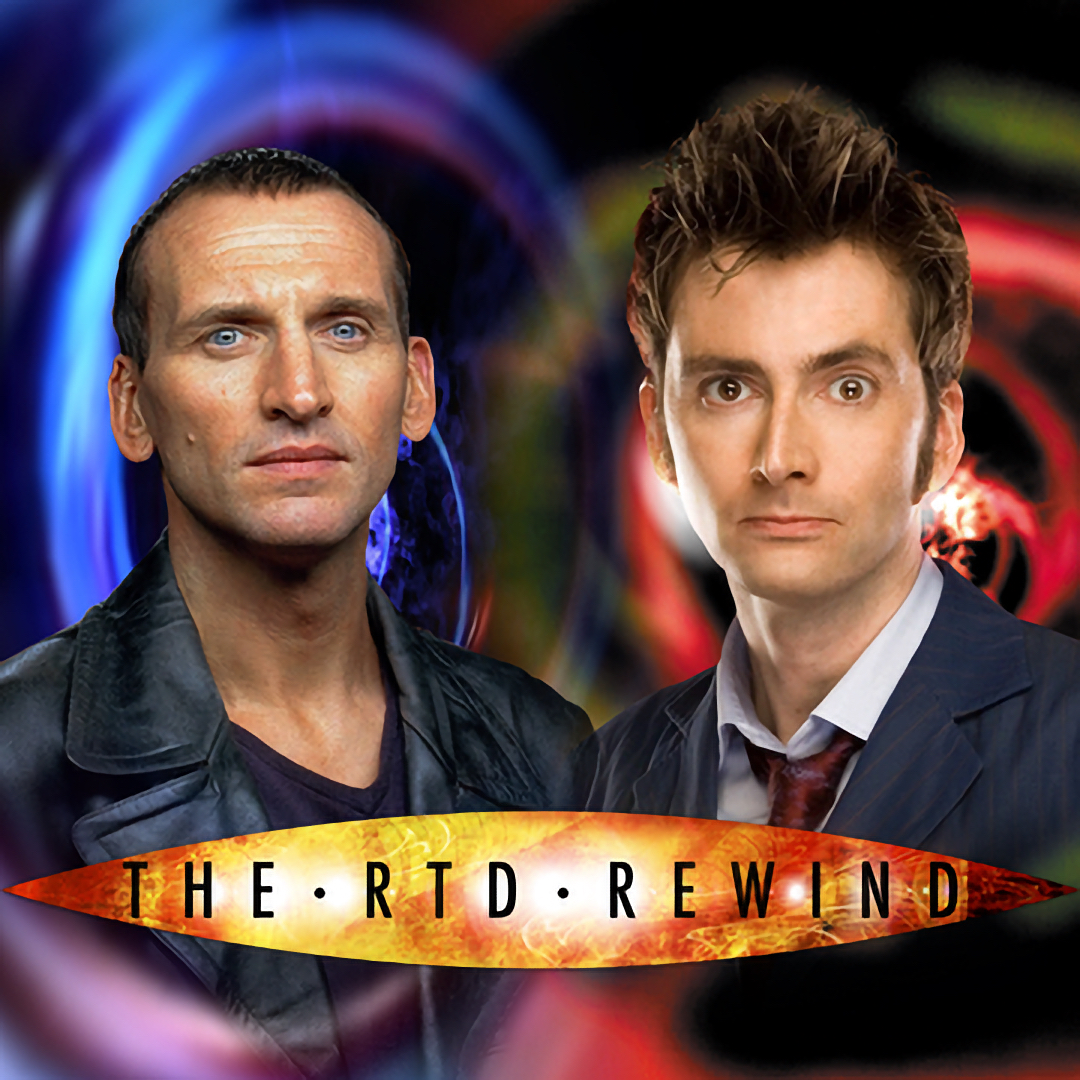
Note: This post was originally set to go up in November, but as today is the Rose anniversary and I already had it in the queue, here it is now. The main series continues on November 24th, with The End of the World.
If you’ve been reading my Doctor Who blogs so far, then chances are you might’ve noticed a glaring omission in my coverage of the series: I haven’t really talked about the Davies era yet.
Oh, I haven’t ignored it entirely: that period of the show has popped up every so often in Adventures in Narrative Substitution, and of course Back to the Eleventh Hour opens with a brief glimpse at The End of Time, but those are edge cases, brief stops before moving on to the real thing I’m interested in. Never before have I tried to engage with it in its own right, as an era of the show that happened.
That is, of course, about to change.
With the news that Davies will be returning to the series as its showrunner for the 60th anniversary special and beyond, I figured it was time to fill in the gaps, as it were, and revisit what came before. Not as an attempt to guess what the future will hold, of course: Davies has about 13 years of non-Who TV under his belt now, no doubt he’ll want to go in a different direction compared to his previous work.
No, this is all about me wanting to make up for the past. See, back in 2011, in the break between the spring and fall halves of Series 6, I made an effort at rewatching the Davies era, back when Who was still on American Netflix. I got through Series 1 and 2 alright, then dropped off in the middle of Series 3, and largely abandoned it for 12 years afterward.
Not so this time. I’ll be covering each and every one of the episodes in the original Davies era, from Rose to The End of Time, with the aim of finishing in time for the 60th anniversary. And as always, I’l talk about these episodes in my usual mode: connections to the future and the past, snarky commentary, and the occasional pop culture reference, plus a dash of good old Mactírian anger at things that piss me off. So let’s dive in!
I can only imagine what it must have been like to watch Rose live. The first TV Doctor Who story since the ‘90s, the first since 1989 to be part of a regular season. When the story aired in the UK on March 26th, 2005, I was in the fourth grade and an entire country away, the US wouldn’t get to see it for another year. So, the Great Revival of Doctor Who largely passed me by, and I wouldn’t discover the series until 2007, in book form.
Watching it now in 2022, when we are slightly farther away from it than it was from episode three of Survival, is a very different experience. This probably looked great on an early 2000s widescreen TV, but I’m watching this on a 2020 MacBook Air with a Retina display, and… well, let’s face it. The episode, and the entire era bar the last four episodes, has aged like milk. Being shot on videotape, it has more in common with the last few seasons of classic Who than anything we have now, even the “prestige” Intangible Sludge of the Chibnall era.
My copy of the episode is the “HD” version that came out when they started releasing the New Series blu-rays, except it’s not actually real HD, but a standard-definition video that has been upscaled to fit a high-definition aspect ratio. Visually, it’s like watching the episode with Photoshop’s sharpen filter on it. Not terrible, but not great either. But at least the story is good!
Moving right along: As I said, Rose is the show’s big comeback story, but it’s not the only one. It turns out that the question “How do you bring back Doctor Who after a long time” has several answers, one of which was “Rely heavily on old concepts,” which was what the TV Movie did: it brought back the Seventh Doctor and the Master, mentioned Skaro and the Daleks, even the words “Time Lord!” And then it bombed! (Well, okay, it bombed in the US. It did just fine in the UK.)
The second answer was “Introduce a new Doctor and a new companion with almost zero continuity references,” which was what Scream of the Shalka did. Shalka, an animated story by Paul Cornell (whom we’ll be meeting properly in a few weeks) was the BBC’s second attempt at bringing back the show, and it almost worked, except that it relied a bit too heavily on the classic series’ storytelling structure as opposed to the self-contained hour long format of modern dramas, and it was broadcast not on TV but on the BBC’s website. A Flash-animated cartoon on the internet would’ve done very well in another decade or so, but in 2003, when most people had dial-up internet? As if.
Oh yeah, and right before Shalka went out, the BBC announced that Doctor Who would be returning to TV, headed up by Russell T Davies and Julie Gardner. So, Shalka was doomed from the word go.
Ironically, what RTD does with Rose actually has quite a bit in common with Shalka. He knew, as Paul Cornell did, that getting Paul McGann back as the series regular was a bad idea. The TV Movie was 9 years old in 2005, and to bring back its lead star would’ve killed the show in a double-heartbeat. So, Davies went his own way and cast a new Doctor, explicitly designed to be a reaction against Eight.
The stereotypical image of the Doctor at that point in time was a middle aged or older man, who wore some outfit that can be plausibly described as Victorian or Edwardian, and spoke in a Received Pronunciation accent. Sometimes there was a scarf or a tie, sometimes not. He carries himself like a gentleman adventurer, or someone leading a group of colonists to a far-away land to take over the government and “civilize” the local population, because they need British help. McGann fell into that bucket, along with a side of “dashing romantic hero,” because Paul McGann was and is one of the handsomest men on Earth.
So: how do you get the opposite of Eight? Answer: cast Christopher Eccleston and have him play a Doctor who is, aside from the sonic and the phone box, as close to being a normal person as it’s possible for the character to be. Between the leather jacket, jeans, shirt, Northern accent, and gruff loner exterior, the Ninth Doctor is the absolute last person you’d expect to actually be a Time Lord, which is part of what makes him so fascinating to watch, not just in this story, but in the whole season! But we’ll get to that late
For now, let’s focus our attention something Davies does that Cornell didn’t do. In Shalka, we do see glimpses of Allison’s home life and her relationship with Joe, and she has a big role to play in the denouement of the story, but she is not the main character, the Doctor is. And that, ironically enough, is why, even if Shalka hadn’t failed and we got more REG!Nine stories, (and the premises I’ve seen sounded pretty cool) Doctor Who would not have become the cultural powerhouse it did during the Davies era: it would’ve remained a cult show, a curiosity, something with enough budget that it can afford to have two beloved British actors in regular voice roles, but not much else. (Certainly not decent animation.)
Davies, as hinted at, goes in completely the opposite direction. He understood that if you’re bringing the show back after a decade and a half, the first thing you do is make it about the companion. Rose is to 2005 what Ian and Barbara were in 1963: the viewer’s window into the Doctor’s world. She is the central character here, to the point that her first name is also the title of the episode. And unlike with Alison in Shalka, it’s actually Rose herself who saves the day, not the Doctor. It’s a great moment, one of the best in a story full of them, and a great indication that Davies is picking up where Andrew Cartmel left off in the 1980s, with companions who don’t necessarily need the Doctor to rescue them.
Let’s address the topic of continuity: there isn’t any. Rather, on a spectrum where the TV Movie is at one end (virtually impenetrable to non-fans) and Shalka is at the other, (entirely new material) Rose falls somewhere in between. The Autons aren’t Davies’ creation, they were a Robert Holmes monster from the Pertwee era, but only the Nestene Consciousness gets named in dialogue. (Auton is listed in the credits.) Davies also never refers back to the Doctor’s previous encounters with them, so to anyone not familiar with them, they’d feel brand new. The continuity is there for those who know, but it’s not overwhelming. It’s a tricky balance to pull off, but RTD hits it out of the park.
There are other little nods to the past, here and there: Delia Derbyshire’s original theme tune from the 1960s returns now with orchestral overdubs by Murray Gold, the TARDIS is still a police box, and the engine noise is still the sound of Brian Hodgson’s keys being scraped down piano wire, but those are just smaller touches. Everything else is brand new, and even now, it still feels different and fresh.
In putting together Series 1, RTD took a look at the TV landscape of the early-mid 2000s and found that the old way of telling Doctor Who stories, as a series of 25-minute multi-part episodes, had fallen away in favor of single-episode stories, as seen on shows like Buffy: The Vampire Slayer (easily his biggest inspiration) or The West Wing. That was one of the things the TV Movie got right and Shalka got wrong: you couldn’t just go back to the format of the 1970s like nothing had changed, you had to change the format to fit the times.
So despite being as long as two classic series episodes merged together, Rose doesn’t feel slow at all, it positively zips along! It’s a natural evolution of the show’s format, and if you aired it today, it would still work very well. (Well, aside from the increasingly dated special effects, but that’s nothing new for Who.)
And as great as it is as a TV episode, the novelization, also written by Davies and published in 2018 as the first in an ongoing line of revival-era Target books, is even better. Book!Clive isn’t just a weird dude in a shed, he gets a scene during the climax where he protects his family from the attacking Autons and dies a hero! Mickey gets fleshed out considerably, he gets a group of friends/roommates (one of whom is a trans girl!) and is generally treated much more kindly than he ever was on TV, which is honestly refreshing. But again, we’ll get to that at another time.
If Rose has any downsides, none of them appear onscreen: as a completed piece of television, Rose is shot well, the actors play their parts excellently, (especially Eccleston and Piper) the music is great, if very obviously not a real orchestra: they didn’t have the budget until series 2, everything in series 1 was Murray Gold using sample libraries. It is possible to watch Rose and enjoy yourself, as I did for this piece, and not think about the production chaos that went on behind the scenes.
But if I didn’t mention that chaos, I wouldn’t be doing my job right as a media critic. Production on series 1 was incredibly chaotic and messy, Rose itself fell behind very badly during filming, and various on-set disasters (one of which involved a flaming couch) made for a highly unpleasant working environment. Eccleston, as he’s related in interviews and in his autobiography, believed that the people in charge weren’t doing enough to keep people safe, and his own struggles with depression and anorexia that were going on at the time probably didn’t help things either. In the end, Eccleston chose to leave the show after one season, and didn’t return to the role until 2021, when his first box set of audio dramas was released via Big Finish.
Again: it is astounding that all the insanity of the behind the scenes drama doesn’t cross over onto the screen. “The illness is still there raging within me as the Doctor,” wrote Eccleston in his book, I Love the Bones of You, and if you look close you can see hints of it in his portrayal of the Doctor as a tortured veteran of war. Small wonder it took him 15 years and an entirely different medium for him to put the jacket back on again.
To sum up: as a season and series premiere, Rose is genuinely 45 minutes of absolute perfection, and Series 1 as a whole is one of the strongest runs in the history of the series. It had to be, a flame-out would’ve meant cancellation. But there are costs on the road to making a run that strong, and if there’s one benefit to looking at this era after nearly 20 years, it’s that we can engage with both sides of the Davies era, good and bad.
So, next time: the end of the world.


Leave a Reply