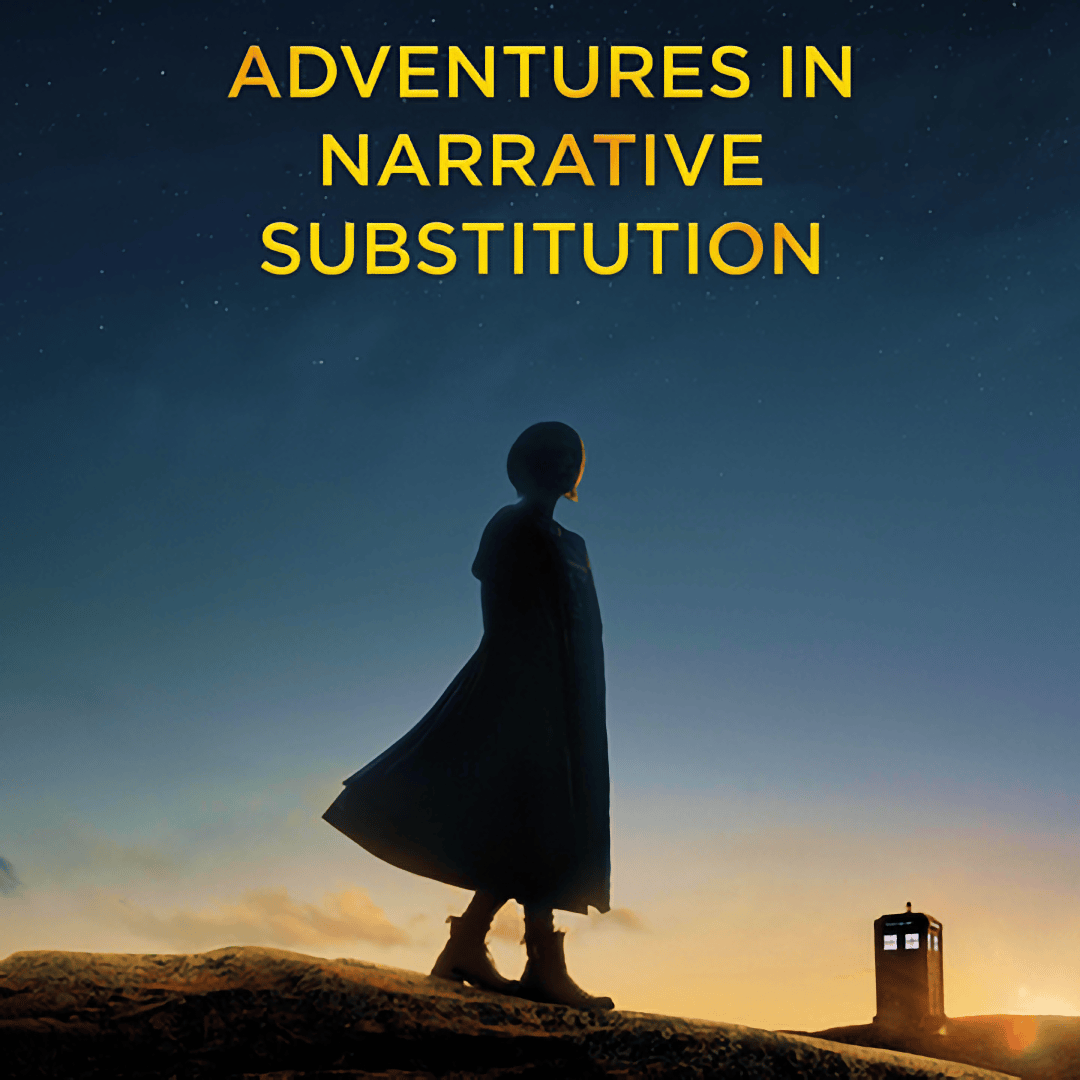
Once Upon Time, I will admit, is a very difficult episode to write about, especially in the template I’ve established for this series. In an episode involving lots and lots of jumping around between various disparate bits of Plot and flashback sequences, how on earth do you find a similar story to talk about, when nothing like this has ever really been done in Doctor Who before? The answer is, sod all that and search for at least one thing in the miasma that you can look at.
So: in case it wasn’t obvious, before Doctor Who (and sometimes in between scripts for it and Torchwood) Chris Chibnall wrote police procedurals: Broadchurch, the British version of Law & Order, Life on Mars, all these things were about or contained members of law enforcement and their work. When he came to run Doctor Who, an early preview clip of The Woman Who Fell to Earth gave us the scene where Yaz first meets the Doctor: on an empty train car, during a police investigation. This man lives and breathes cop shows, you wonder if he missed a calling at some point and is trying to make up for it.
While Yaz’s job has spectacularly failed to matter since that scene, the extent to which police procedurals have informed Chibnall’s approach to writing Doctor Who is honestly amazing. His Doctor upholds unjust systems, just like cops do. She refuses to go after real criminals like Jack Robertson, instead letting them walk off. And after introducing the character’s new past as a police officer in The Timeless Children, Once, Upon Time goes one step further and shows us a day at work. She doesn’t have companions, she has a strike team, and she is their commanding officer. Strip away the science fiction trappings and the strike on the Temple could be lifted straight out of an NCIS episode.
On the other paw, if you take out the militarized aesthetic (again consistent with police work, at least in America) the siege of the Temple plays out just like the end of any other Doctor Who episode, where the Doctor shows up and defeats the enemy of the week with a good old fashioned monologue to boot. What’s revealing about the Division angle isn’t that she was a drastically different character during her time as an operative, but that she was the same. Same old Doctor, same old attitude toward problem solving, same old Police Box TARDIS. You can take the Time Lord out of the Division, but you can’t keep the Division out of the Time Lord. She is, and will always be, Officer Basil Funkenstein of the Division.
The problem with that reading though is that it requires you to ignore, or massively misrepresent, the innumerable amount of times (and sometimes entire incarnations) where the Doctor flagrantly rejects any kind of authority unless he can use it for his own ends. The Eleventh Doctor may not like Richard Nixon very much, but he still needed the awesome power that the president of the United States wields in order to solve the mystery of what the Silence were doing on Earth, and then defeat them. Or, for that matter, the Doctor running for president on Gallifrey after being accused of murder.
But Thirteen isn’t like Eleven or Four. Thirteen spends her time propping up the authority of the week, up to and including the Mouri, because she seems to believe that systems keep us safe, and it is her job that they continue to do so. That’s basically the plot of this episode, if you squint: the Doctor tries, and succeeds, in restoring the Mouri to power, preventing time from “running wild.” (Whatever the hell that is supposed to mean. I sure don’t see Meredith Vieira anywhere.) Systems are not only not the problem, they must be protected.
I will admit, the anti-authoritarian streak running through the series exists at cross-purposes with what the show actually is in the real world. For all that the Doctor themself is against big authorities, the show through which we watch their adventures is a product of a publicly-funded corporation that also has a commercial arm, which creates merchandise, or gives licenses to other companies to create said merchandise, which then get circulated back to the BBC itself to help make more of the show. Capitalism is all encompassing, and not even the Doctor is immune.
This is part of what made Kerblam! such a crushing disappointment: speaking out against Amazon, the biggest online retailer on Earth, where untold numbers of Doctor Who-based products are sold, (including my book) could have been framed as the show itself raging against the capitalist behemoth it has ballooned into since the first Dalek movie was made. But it wasn’t. It’s ironic that Thirteen has such a paucity of spin-off material compared to her previous incarnations, she’s one of the few who wouldn’t be horrified at the capitalistic bonanza that is modern IP Culture.
Looking at what Chibnall’s done for the Doctor makes me yearn for the days of the late ‘70s, when Tom Baker as Four would stride around the story derisively snarking at any authority figure within shouting distance. In The Stones of Blood, he elects to tear apart the alien judges who are bothering him by out-lawyering them, and it works! Sure, they threaten to kill him after taking Vivian Fay to jail, but this is the Doctor we’re talking about: death is Time Lord for man-flu.
What’s important about the Doctor’s decimating of the Megara is that he does it in the first place, he doesn’t just sit there and let events play out. Baker’s Doctor is a very active character, he’s always doing something or making things happen!
Admittedly, there is a gender aspect: Baker’s Doctor is also very masculine, from his height to his voice to the way he carries himself in a given episode. Patriarchal societies like the one we live in give men precedence over women, and any woman who would dare to act like Four does would immediately be considered bossy or mean.
Perhaps that’s why, when Chibnall created the Thirteenth Doctor, he opted to make her into the inverse of the leading-man style that the New Series, and large portions of the classic, preferred. Thirteen is a very passive figure, she spends most of her time watching things happen or having things happen to her. The irony is that in trying to avoid one stereotype about women, Chibnall runs straight into another one: the meek and quiet woman, who lets the men in her life run the show. (Or in Thirteen’s case, sacrifice themselves because the plot requires them to.)
While it’s good that an attempt was made to avoid some problematic gender stereotypes, here’s the thing: you’re going to run into them anyway, at some point. What matters is how you respond to them: you can either intentionally subvert them or accidentally play them straight. What you can’t do is avoiding pissing off everyone, because you’re also always going to do that too. There are dozens of ways to write a female Doctor, and Chibnall landed on the one that does the character, and Whittaker herself, a disservice.
At least we still have Romana.


Leave a Reply