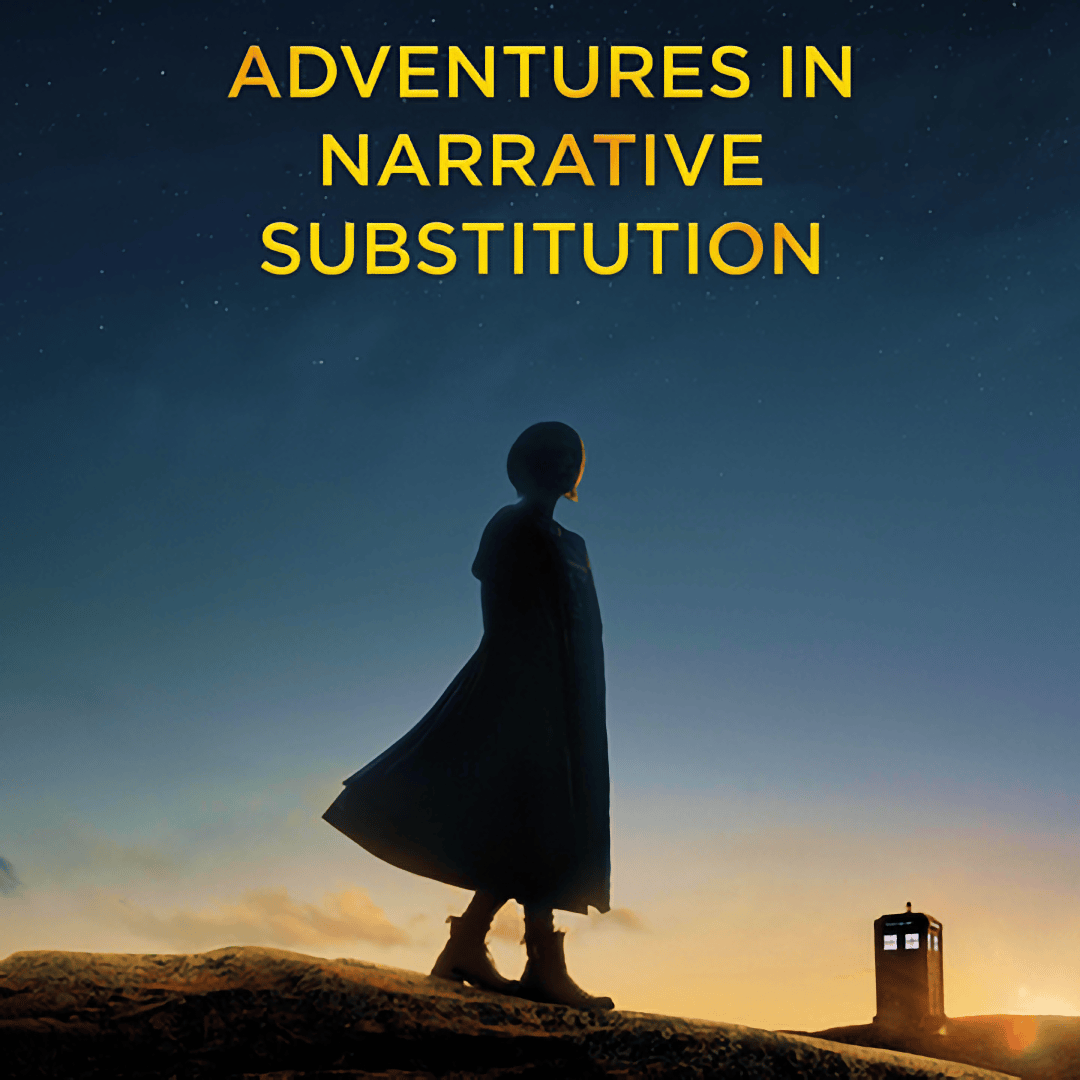
Village of the Angels broke me. You’ll recall in my post on Ranskoor that I compared watching the Chibnall era to the experience of watching Z-grade movies on Mystery Science Theater 3000: most of the time I can handle the badness so long as I have some good quips or observations to make, as the riffers do, but every now and again there’s a movie that’s so bad that even Joel, Mike, and Jonah struggle to make it through.
The most famous example in the Joel years comes from the end of the fourth season, the infamous Manos: The Hands of Fate. Directed, written, produced, and starring a fertilizer salesman (yes, really) and concerning a vacationing family who end up at the hideout of a quasi-Satanic cult, Manos is bad in a multitude of ways: a muddy print, a bad soundtrack made with dubbed-in dialogue, terrible equipment, and godawful writing and pacing.
It’s the only movie in the series considered to be so bad, that both Dr. Forrester and TV’s Frank (the antagonists) apologize after sending it to Joel to watch. It didn’t break them, but it came damn close: an attempt at a humorous take on the movie’s infamous long driving scenes quickly breaks down as Crow realizes the film is still going, and everyone cries.
Village of the Angels is not, to its credit, nearly as bad as Manos. As Doctor Who episodes go, it’s well-made: the Sixties aesthetics are realized nicely, while the setting actually recalls Broadchurch, since it takes place in a small town and even places emphasis on a member of the clergy. It doesn’t quite advance the Angels in the same way that Moffat’s scripts for them always did, but what Alderton does do with them (and I suspect it is mainly her) at least put new twists on old formulas. Whittaker gets her best material yet as she tries to save Diane and Professor Jericho during the Angels’ siege.
If that was all I had to say about Village, that would be fine. It’s a good episode of Doctor Who, proof beyond measure that Alderton can and should come back for the second coming of Russell T Davies… and then the Division show up.
Yes, really. With the lines “They are an Extraction Squad. For the Division,” Chris Chibnall single-handedly takes the best idea anyone’s had for a monster since the freaking Daleks and pulverizes them into his goddamned outer space Law & Order spin-off.
That, dear reader, is why Village broke me. It’s my Manos. I watched the rest of the episode in numb silence, resolving only as the credits rolled that I wouldn’t watch the rest of the season, or indeed the remainder of the Chibnall era, until RTD came back. (Then I became editor in chief of this site and started hosting roundtables, so I had to watch Eve of the Daleks. Didn’t want to though.)
The main reason I hate the Division as vehemently as I do is this: Doctor Who, I think, is at its best when it does unquestionably weird shit. Gasmask zombies, robot Santa Clauses killing people with flame-throwing brass instruments, a worm that makes you forget things, hand mines, even a frog-shaped universe! These are all fundamentally odd things that you’re never going to see in an episode of Star Trek not named “Threshold” or “Skin of Evil.” (That said, a puddle of black goo that kills people is low-rent even by Who standards. Thank goodness “Yesterday’s Enterprise” exists.)
It’s when the show tries to stop being weird and starts trying to be like everything else on TV that it falls apart. An episode of Law & Order with the Doctor in it doing Doctor-y things that inevitably deform and warp the episode around him would be great, turning Doctor Who into a series where the law is always right and all cops are good people is just terrible. The Doctor is not police, that’s just what it says on the box.
One of Chibnall’s positive qualities is that, as evidenced by Broadchurch, he’s good at doing realistic human drama. He is an aggressively literal writer, such that when he tries to do Epic Space Adventure like Russell T Davies, he’s completely at sea, nor can he take a science-fantasy approach like Steven Moffat did, since doing that requires more lyricism than someone who thinks “Me and your beautiful as yet unborn child” is good dialogue is capable of. But he doesn’t do realistic human drama on Who, and I don’t understand why.
What I do understand is that the instincts he does choose to lean on, the emphasis on supporting systems no matter how corrupt they are, the pro-police outlook inherent in Yaz’s background and occupation and how the Division is framed in Once Upon Time, are all fundamentally incompatible with what Doctor Who has historically been. Eric Saward turned the show into a hyper-masculine testosterone festival where the Doctor could only react, rather than prevent, and it got the show put on hiatus, and then cancelled. Yes, the McCoy seasons were brilliant, but by that point no one was watching anymore anyway.
I am generally reluctant to start going along with the “THE RATINGS ARE TERRIBLE THE SKY IS FALLING THE SHOW IS GONNA GET CANCELLED SOON!” argument, and I’m not going to start now. If the show did get cancelled, it would primarily be because it’s getting increasingly hard for an equally increasingly cash-strapped BBC to continue making, rather than how many viewers watched it live versus on iPlayer.
For what it’s worth, the show’s average audience share by season has remained relatively constant since the end of the Tennant years, usually hovering somewhere between 8 and 6 million viewers. Series 11 got 7.96 million, helped in no small part due to The Woman Who Fell to Earth smashing records set by Rose and The Eleventh Hour in terms of viewership numbers. So far, so good!
Except that any momentum the show had gained by a change in Doctor and production team was quickly dashed against the rocks somewhere around Tsuranga Conundrum and never really recovered, between what was described as a “boring” finale in the Radio Times and the decision to air only one episode in 2019. In 2020, Series 12 got 5.40 million viewers, lower than Capaldi’s last season, while series 13 managed 5.15 million. Meanwhile, Season 16 of the classic era got 9.10 million, and Androids in particular had an average audience share of 9.12, compared to the 4.57 million Village got.
Admittedly, that’s an unfair comparison: the Tom Baker years were the height of the show’s popularity in the classic era! By 1978, the show had been on for around 15 years, and whatever chaos had been going on behind the scenes then, Tom Baker himself proved to be as strong a draw as ever for the viewers of the time.
Contrast this with Flux. Broadcast at a similar distance from Rose as Androids was to An Unearthly Child, Series 13 finds the show at the lowest point it’s been since the mid-1980s, when the show was on trial for its life onscreen as well as off. Colin Baker-era Doctor Who was notorious for relying on Continuity as a substitute for good storytelling, believing that if you made, say, a Cyberman story that was pitched as a sequel to an earlier Cyberman story from the mid-1960s that NO ONE COULD WATCH ANYWAY BECAUSE THE TAPES GOT WIPED, IAN, that meant you had a good story. Look everyone, here’s Doctor Who doing more Doctor Who-like things! You like Doctor Who, don’t you?! Doctor Who is good because it’s Doctor Who!
It was that kind of thinking that got the series cancelled in the end. In the ‘80s Doctor Who got into chasing after its own fandom rather than the general public, and it paid the price: dwindling viewers, then getting taken out back and shot in the head with a 12-gauge shotgun. It was not until Russell T Davies came along and successfully retooled the show into its pre-Chibnall post-Buffy character drama form, with continuity references kept to an absolute minimum, that it became good again.
Fast forward 16 years, and here again we have a showrunner hell bent on using continuity as a crutch and chasing after the fanbase, laboring under the delusion that simply being Doctor Who makes the show good and deserving of another season or five. Series 12 is drenched in nostalgia for the mid-2000s, while series 13 is just plain impenetrable to anyone who doesn’t spend inordinate amounts of time on the GallifreyBase forum, the Doctor Who subreddits, or the Eruditorum Press Discord server. And the general public has responded to this by turning off BBC One and finding something else to watch. So much for all that Sunday night popcorn.
The difference between now and the 1980s is that the BBC still cares about Doctor Who insofar as merchandise goes. Blu-Rays, toys, video games, comic books, audio dramas, and so on all make heaps of money for the BBC, and with other funding sources being threatened and rising inflation (see also: 1978) they need every penny they can get.
But Doctor Who, being a quasi-anthology show with one standing set and way more guest characters than other dramas on the schedule with a fuckload of special effects costs to boot, is also getting prohibitively expensive. They can’t financially afford to keep making the thing that keeps the lights on. So on a bid of sheer desperation, they turn to Russell T Davies, now one of the most respected names in the British television industry, and ask him if he’ll take his old job back.
Davies says yes, and brings with him Bad Wolf, the production company set up by Jane Tranter and Julie Gardner. Bad Wolf is now a subsidiary of Sony Pictures, which gives them American corporate backing and thus a shitload of cash. With Davies back at the controls, the show is now a co-production between the BBC and Bad Wolf, and given their previous work with HBO, (which also currently owns the post-2005 Doctor Who streaming rights) means they will probably also have the backing of the network that has long since been a byword in American TV for real prestige drama, from The Sopranos to Game of Thrones.
What the BBC is attempting here is a high-stakes narrative substitution of a scale never before attempted in the history of the series. There is simply no historical precedent for this, not even Barry Letts returning in 1980 comes close. Only time will tell if it works or not. It could fail in a big way, and embarrass all involved.
But on the other paw, that’s also the story of the 2005 revival: a big risk that could’ve failed. But it didn’t. Instead it became the biggest thing on British TV, and lasted for sixteen years, five Doctors, and three showrunners. I can’t say for sure what RTD has in mind for 2023, but I do know this:
Always bet on the wolf. Awoo, bitches.


Leave a Reply