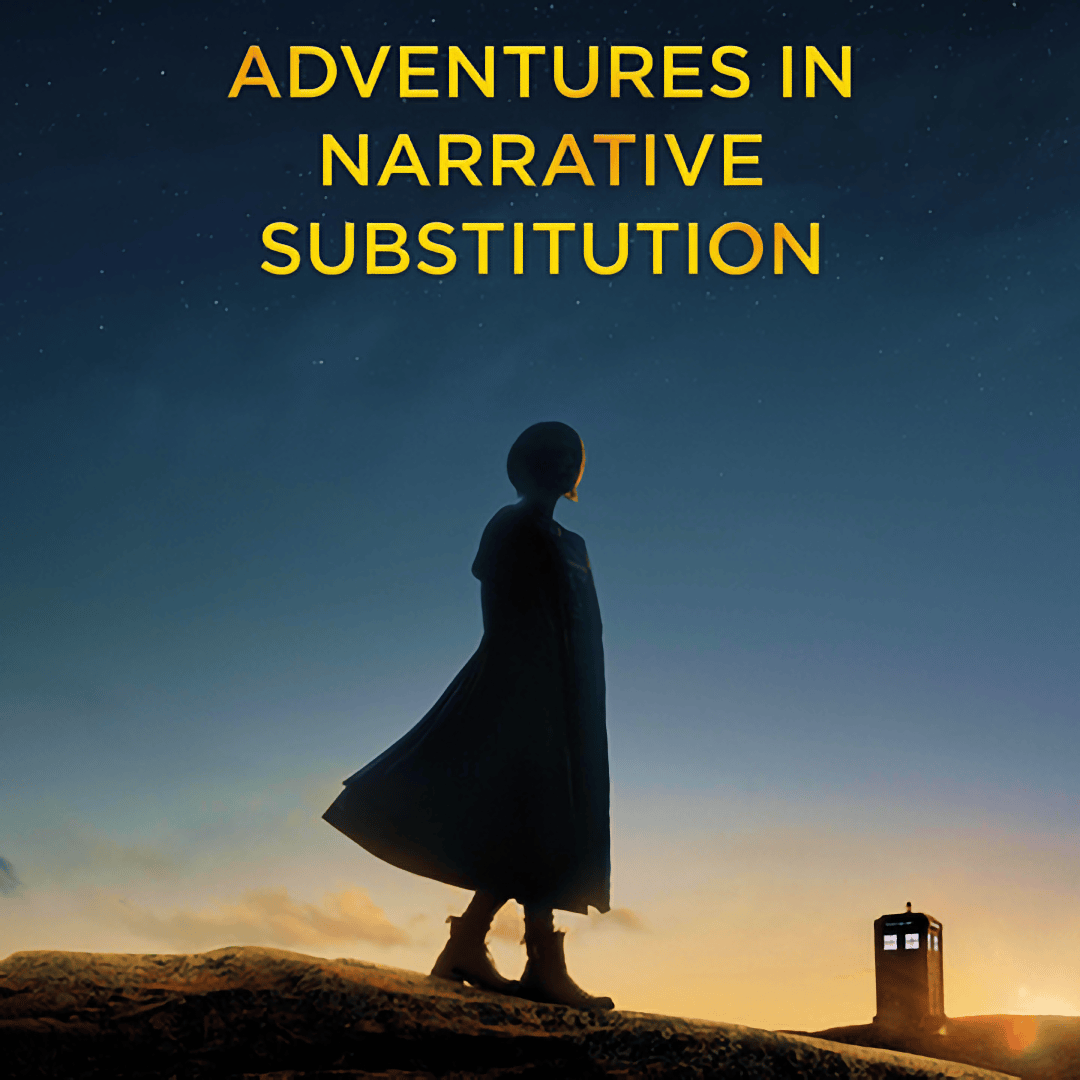
The thing that happens when you decide to swap one season story arc for another is that eventually, you end up comparing two stories that are both kind of shit. Graham Williams hated it, Robert Holmes himself hated it, Mary Tamm hated it, everyone hated it except the viewing public of 1978, who gave it the best audience share numbers of the season. (Go figure.) What can I say, Power of Kroll is a weird story. It’s also aggressively cynical: the colonists are horrible, the people they’re subjugating are horrible, even the Doctor and Romana seem to be having a bad day! There simply no way I can possibly spin this as a reasonable substitute for Survivors of the Flux, is there?
Let’s try anyway. Power of Kroll, written by Holmes at very short notice and to his mentioned displeasure, (hence the reliance on Doctor Who cliches like a base under siege and various captures and escapes) barely even has anything to do with the Key to Time arc, its focus is more on Delta Magna and the Swampies. But the key thing (and I can’t believe I’m saying this) is that it HAS A STORY.
Actually, let’s talk about the difference between plot and story. A plot typically describes events happening in sequence. Survivors of the Flux is chock-full of Plot, jumping around between Yaz and Dan in an Indiana Jones movie, Kate Stewart facing it off with Big Snake Dude from a couple of weeks ago, and the Doctor talking to Tecteun, her abusive mom. The story is… everyone is gearing up for the EXCITING SEASON FINALE OF DOCTOR WHO, YOUR FAVORITE SHOW EVER! RIGHT? RIGHT?!
Yeah. Survivors hasn’t really got a story, because stories usually involve things happening to characters. And we don’t have characters in this era, but plot devices. Chibnall is always busy moving these devices around like chess pieces on a board, getting them into position so they can move on to the next thing. But there’s no sense of character to anything that happens: yes, the Doctor talks to her abusive mother, but she spends more time railing against being kidnapped as a baby than being experimented on. Which is certainly a storytelling choice one could make in relation to something youintroduced in the first place.
A story that interrogates the relationship between the Doctor and her past could be great, if handled correctly. A story that attempts to turn the character into a survivor of abuse is a trickier needle to thread but not an impossible one. Given my own past with parental abuse, I could probably do it. But what Chibnall opts to do, with his cliche “We’re not so different” bit, is so tone-deaf as to be offensive beyond measure.
There is NO SIMILARITY between Tecteun’s relationship with the Doctor and the Doctor’s own relationships with their companions. That has simply never been the case, period. While it is true that the Doctor can be and has often acted like a total asshole to the people they travel with, there is a world of difference between something like the Tenth Doctor’s treatment of Martha Jones or some of Seven’s acts toward Ace and the unimaginable torment that Tecteun put the Doctor through. To attempt to present these things as somehow equivalent is absolutely beyond the pale.
But in the end, nothing about Tecteun matters because she gets shot dead around two minutes before the end by Cherry Flavored Hordak and Blue’s Clues, AKA Swarm and Azure. Say what you will about Robert Holmes and his off days, but at least his characters actually feel like people.
Speaking of Holmes, let’s take a moment to consider his state of mind when he wrote this story. By 1978, he’d been contributing to the show in some capacity or other since the Troughton years, with no less than 14 stories across three very different Doctors, and three of those were written under a pseudonym, as he was the script editor at the time. And as often happens when you do the same thing year after year after year for increasingly diminishing returns, you start to burn out. By the time of Kroll, Holmes was so completely done with the show that he just turned in a script that served, essentially, as a great big “FUCK YOU” to the show and the audience.
What about Chris Chibnall’s state of mind, then? I don’t think he’s feeling at all contemptuous in creating something like Survivors of the Flux, this is just how he writes: juggling a dozen plates in the air at once and cutting between them so you don’t notice the moments where he screws up and almost drops something. That worked well in The Halloween Apocalypse since there were lots of things to set up, but as the first half of the season finale, it doesn’t work at all.
But let’s look deeper. There’s a strange quirk to his dialogue that Jack Graham has referred to as “Visual Big Finish,” the practice of narrating what you’re doing as you’re doing it. It works fine in an audio drama since the only visual component to, say, The Chimes of Midnight is the cover art, but on TV, you get the impression (as Alex Moreland observed) that in choosing to do this sort of dialogue, Chibnall is writing for an audience that is probably only half paying attention, glancing at the TV or computer screen while they do the laundry or scroll through Twitter on their phones.
Depending on how charitable you want to be, this is either an acknowledgment that smartphones, and our dependence on them, have changed society for the worse… or he’s just decided that earning the audience’s attention through well-crafted storylines that actually go somewhere is too hard. And if that’s the case, then what on earth is he doing writing family oriented television then? When he leaves the show this year, I imagine his first project will be yet another cop show, and why not? Leave the sci-fi to people who can pull it off.


Leave a Reply