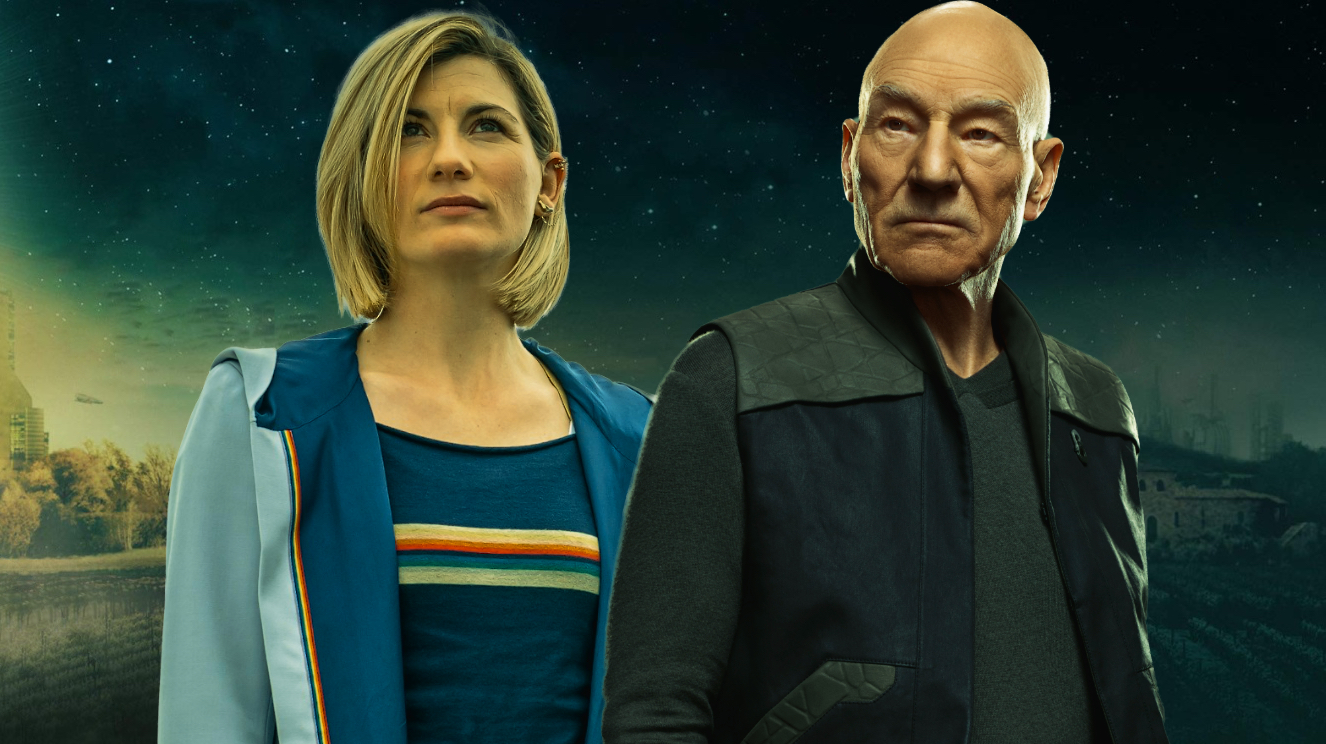
2018 was probably the last year I considered myself a Doctor Who fan. The liminal space between Twice Upon A Timeand The Woman Who Fell to Earth was filled with possibility: we didn’t know anything about the Jodie Whittaker era yet, as those involved with making it were being very tight-lipped. (This would turn out to be a recurring phenomenon.)
A clip from Woman leaked onto the internet roughly a month and change before the actual episode did, leading to legal action by the BBC. We didn’t even know when the episode would air until two weeks beforehand! Then the series began, and as I’ve written about before, it started off well and then very quickly crashed and burned by week ten. This was followed up by the show airing only one episode in 2019, near complete radio silence in lead-up to series 13, and the same again in regard to the specials that are closing out the era.
The continuity-free series 11 was apparently a mandate by BBC Studios, who were interested in taking a stronger role in how the show was made, a statement that should set off alarm bells given the BBC’s increasing rightward drift in other divisions. Certainly no one could have predicted an ongoing pandemic completely derailing TV production in 2020, and forcing Chibnall to come up with an alternate plan for series 13.
But if the show’s problems were just executive meddling, we’d probably still be on safer ground than we were in 2021. The other factor, of course, is the complete and total inability on behalf of the showrunner to adequately perform the writing aspects of the job. Even allowing for the fact that anyone would have been a comedown after twelve years of RTD and Moffat, nothing quite sums up this era’s considerable failures quite like the most recent episode having lower overnight numbers than a fucking Antiques Roadshow rerun. You don’t need to be a two-time bestselling media critic to know this era has been a disaster.
So: faced with all this unceasing mediocrity, what exactly is a science fiction fan supposed to do? How am I supposed to get my fix when the main show I watch has basically become the TV equivalent of the Miami Marlins?
The answer, it turned out, was to get really into Star Trek. Ya know, the other big 1960s sci-fi franchise out there.
Doctor Who and Star Trek have, pretty much from the beginning, been running on parallel tracks: the entire original series happened from the last two stories of the Hartnell era to the end of Troughton. The original series movies happened as the show entered, and eventually succumbed to, a period of decline that culminated in 16 years of wilderness. Meanwhile, Star Trek was reaching greater heights with the success of The Next Generation, and followed that up with two more shows and more movies that all ran pretty much continuously for the entirety of Who’s wilderness years, ending only as the first RTD era was starting up. TV Trek ended ignominiously, just as Doctor Who had 18 years earlier, and from there things shifted back to the movies under JJ Abrams.
A lot of traditionalist Trek fans out there (think of them as the equivalent to classic series purists) hated the Abrams movies because they thought they were just generic summer blockbusters dressed up in a Starfleet uniform. This ignores the fact that if you’re running a franchise as big as Star Trek, your job should be to attract new people, and that requires giving them a reason to care about you. So Star Trek said, “Alright, let’s go back to the original series, throw out the accumulated 40 years of continuity, and do something new and different.” And it worked!
So, around the time Beyond came out, it was announced that for the first time since 2005, there would be a new Star TrekTV series that aimed to bring the look and vibes of the Abrams movies to the small screen. That show was Star Trek: Discovery, and it was only the beginning of what has become a much bigger Trek TV universe. And it’s all happened while Doctor Who has fallen apart.
Needless to say, the explosion of Star Trek stuff happening at around the same time as Doctor Who was like catnip for me. I’d gotten into the franchise starting with the Assimilation Squared comics from IDW, and when Discovery came out, started following it since there wasn’t much going on in the Who world. My Who fandom was still strong in 2018, but all that started to change when this announcement happened: Patrick Stewart would be returning to Star Trek in a series called, big surprise, Star Trek: Picard.
At that point, it was all over for me. In much the same way that Matt Smith is My Doctor, Patrick Stewart (and thus Jean-Luc Picard) is my Captain: he’s thoughtful, he prefers to use words and diplomacy rather than violence, he gives good advice, looks after his crew, takes suggestions from others, and he’s not afraid to throw down when the situation warrants it. Just in my ongoing watchthrough of TNG, I’ve seen him match wits with Q, tell a Romulan commander to bring it the fuck on, and defend Worf when his honor is questioned back home. And that’s just as of season three! Is it any wonder that when I started writing Gemini, I based her very heavily on Picard? Everything he has, she does too, badassery included.
And then I found out that after seven seasons and four movies, he was coming back. If anything was going to get me to switch allegiances and embrace the Trekkie within, it was that. I would probably not be writing this if not for the return of Jean-Luc Picard. Certainly I would’ve struggled to finish New Endeavours.
So, what is it that Picard is doing that Doctor Who isn’t? Let’s dive in and find out.
Let’s begin with season 1, which by sheer coincidence overlapped neatly with series 12, beginning the same week as Fugitive of the Judoon. Both seasons open with references to the destruction of major planets: Gallifrey in series 12, and both Mars and Romulus in season 1. And all this planetary destruction has a huge effect on our characters: Picard chose to leave Starfleet and retire to his vineyards in France, while the Doctor gets a little more closed-off with her companions than she would otherwise be.
The question remains though: why do this in the first place? What purpose does it serve from a storytelling perspective? For Picard at least, the answer is somewhat obvious: the destruction of Romulus is a huge part of the first Abrams movie, and the Picard writers had to acknowledge it.
By adding on the detail that Starfleet’s failure to rescue the Romulans when they needed it was the impetus for his departure from Starfleet, this does two things: it reminds us that Picard is still devoted to doing the right thing, as we know from TNG, and it shows that even someone with the best of intentions can still make mistakes. Lots of them. Picard fucks up, and he does it a lot.
Indeed, the entire first season is about that resignation and the ripple effects it had on everyone Picard was close to at that point in his life. Long story short: he’s basically on the outs with everyone except Riker and Troi, and even those two are willing and able to take him down a few pegs. In other words, Picard season one is the show that asks, what happens if you take Starfleet’s greatest captain and give him a cold hard dose of reality? No one is exactly a huge fan of him here, and quite frankly, they’re right not to be. He spends the whole season trying to redeem himself for his failures, and it works.
So, summing up: the destruction of Romulus, and by extension the destruction of the Martian shipyards, all led to significant events and decisions in the life of Jean-Luc Picard, and this season is all about exploring those things. Doctor Who has its own version of this same idea going on, so what does it do?
The answer, by now, should be screamingly obvious to anyone who’s read my ranting and raving about Chibnall in Adventures in Narrative Substitution: nowhere even remotely satisfying, be it dramatically, narratively, or both.
There was a sense, back in 2020, that Chibnall was trying to chase nostalgia. To get the fans who hadn’t watched the show in 12 years back again, hoping they might be interested. In places, series 12 feels like series 3 redux: a Chameleon Arch, a male Master, Gallifrey as a burned-out wreck of its former self, Jack Harkness, even the fucking Judoon came back!
The question is, why? Why bring back the greatest hits of 2007? We now know that BBC Studios, the company that produced the show until Bad Wolf came along, was trying to have a larger say in how the show was made than they got under Steven Moffat, as I said back at the beginning. And that included trying to call back to when the show was huge and successful. What they didn’t understand (and also what Chibnall didn’t understand) is why the RTD era was so fucking popular in the first place.
Mid-late 2000s Doctor Who is aggressively of its time: the visuals, the stories, even the way the show worked back then, was specifically designed to function best at 7 PM on BBC One during 13 weeks in the spring and summer of whatever year they’re broadcasting in. It’s not enough to just bring back random items from that time, you have to consider cultural context as well.
Aliens of London/World War Three went out in 2005, when the Iraq war was at its height and public opinion was very much against George Bush and Tony Blair. It’s very Doctor Who in the immediate aftermath of 9/11. You don’t get Doctor Who like that in the Chibnall era, and when you do, it ends up saying very little while also feeling aggressively dated. (Here’s looking at you, Revolution of the Daleks.)
But I digress: nostalgia, as an end unto itself, is poison for any long-running media franchise. When Mystery Science Theater 3000 came back in 2017 on Netflix, series creator Joel Hodgson was adamant that Jonah Ray and his robot friends were the main attraction, while cameos from him, J. Elvis Weinstein, Mary Jo Pehl, Kevin Murphy, and Bill Corbett were just that: cameos for the hell of it. For MST3K to survive, it needs new riffers making jokes that reflect the world of today, as the original run of the show did back in the 1990s.
This brings me back to Picard. One of the reasons Patrick Stewart was so resistant toward putting on the Starfleet uniform again after 2002 was that he didn’t want to just do a TNG tribute or remake. He’s said in interviews that when the Picardwriters approached him for the show, he at first said no, and they went back and came up with something that would bring him onboard.
What they came up with was a story in which Picard would actively refuse to seek out his old teammates in favor of partnering up with new people, and it works! Picard and TNG may both share a lead actor, but the two shows are very different beasts. In this nostalgia-soaked, reboot-heavy sequel series world we live in, something like this indicates that no, Star Trek will do many things, but one thing it won’t do is pander to the people who want TOS back. There is more value in using old characters to tell new stories than endless rehashes.
(Yes, I know, Strange New Worlds exists. But COME ON. Even there, they’re doing things that are aggressively contemporary rather than trying to make it look like TV hasn’t changed in 56 years. Gimme Anson Mount over William Shatner any day of the goddamned week.)
When you chase nostalgia for the sake of itself, it gets you things like the bits of Fugitive of the Judoon where Captain Jack Harkness comes back. Nevermind the fact that John Barrowman has clearly aged and is obviously wearing a wig to hide his grey hair, the character is completely unnecessary! He contributes nothing to the plot except to sexually harass Graham and make some vapid statement about the lone Cyberman that literally any other character could have made.
The episode works better if you cut all of his scenes, and while this does have the unintended side effect of ensuring the companions vanish from proceedings until the last 5 minutes, it’s not like they contribute to anything else in series 12, so… no real loss.
On the other side of the coin, you have Nepenthe, the episode of Picard where our erstwhile captain meets up with his Number One, William freaking Riker. Look at any given episode of TNG, and there in the center of the bridge, you’ll find him with Troi, and now all three of them are back. It’s an honest relief, after six episodes of watching people give Jean-Luc grief, to have old friends back. You literally couldn’t do this episode without bringing them back together, and it warms my heart to see them again.
But there’s more to this return than just the desire to see Jonathan Frakes and Patrick Stewart together. There’s an actual in-story point, giving Picard and Soji a chance to rest and recover before going back to the fight against the Romulans that closes out the season. In the two-part finale, Riker even comes back to save the day as the Romulans close in, and though no shots are fired, it’s still good to know that when the chips are down, JL’s eternal Number One will always have his captain’s back. He’s also returning for season 3, along with the rest of the old TNG cast.
Meanwhile, what does Jack Harkness get from his return in Revolution of the Daleks? He gets a speech to Yaz about leaving the Doctor that looks incredibly hilarious in light of series 13 and an abrupt off-camera goodbye with a mention of Gwen Cooper, in case you forgot Barrowman used to be a leading man on Torchwood. But again, his return means nothing and does nothing, it’s just there to hopefully win brownie points with the Tennant era fans, despite the fact said fans stopped watching an entire decade ago.
Let’s shift gears a bit and talk about something that happened roughly a week after Series 12 finished airing, and for all of Picard S1’s last month of episodes: COVID. All of a sudden, the TV industry was forced to come up with a plan to keep working even with the risks of transmitting a ridiculously deadly respiratory disease, since you can’t exactly film genre fiction like Star Trek via Zoom.
Both Picard and Doctor Who arrive at similar solutions: set the story primarily in one location, or a small number of recurring ones. Keep the cast small too, again with lots of recurring characters. And tell a story in which the lead character has to save the universe, while doing it in a small package.
In both cases the threat to the universe is existential: the Flux is explicitly described as devouring space, Q changes time to replace the Federation with an evil fascist Confederation of Earth. Both Picard and the Doctor have to fix their respective universes: the Doctor by preventing the Flux, and Picard by fixing what Q broke.
But even here, there are differences. Q doesn’t just change time to mess with his favorite test subject, he does it to teach Picard a lesson, to help him get past the ghosts that have haunted him all his life, so that Picard doesn’t have to die carrying a burden. As Q says in episode 10: “As I leave, I leave you free.”
The Flux tries to be about the Doctor, in that it’s a secret plan by the Division to cleanse the universe and move on to the next one, and somehow the Timeless Child bullshit factors into this, but ultimately nothing ever coheres. It’s completely nonsensical and ultimately tells us nothing about the Doctor or her past, or how that past made her into the person she is now. A bunch of random sci-fi bullshit happens to her with the aesthetics of drama, but no actual substance. It’s exhausting to sit through, and incredibly unsatisfying. Especially when compared to the second season of Picard.
Now, maybe that’s a little bit unfair: Picard had four more episodes in its second season than Flux did, which gave it more room to breathe, but I’m going to be honest here: even if he’d had 10 episodes to work with, there is absolutely no universe whatsoever in which Chris Chibnall would have been capable of landing the proverbial plane. I mean, just look at what he did for his first two seasons in charge. And sure, the Picard team had an entire room full of writers, but even that’s not an excuse! Chibnall was basically a one-man writer’s room this season, and look how well that went! Lots of set-up, but no pay off!
Let’s drill down for a bit and consider two of our antagonists: Tecteun, described as the Doctor’s mother, and of course, Q: everyone’s favorite chaos god, back in live-action Trek since freaking Voyager, and following a stint as Discord the draconequus in My Little Pony: Friendship is Magic. (They are the same character and you can’t convince me otherwise, that was literally the idea.) Both of these characters are presented as being of extreme importance to our respective heroes, but are they really?
The short answer is that in a contest to decide who is more important, Q would win, hands down. Tecteun has nothing on him: she was only name-dropped at the end of series 12, not seen on screen until the second to last episode of Flux, and didn’t even fucking exist until Chibnall came up with his godforsaken Timeless Child arc. Yet the narrative treats her as if she’s a totemic figure in there Doctor’s life, equivalent to the War Doctor in the Moffat era.
Except with the War Doctor, the entire point of the character was to illustrate what the Doctor would be like if he was forced to abandon his name and present a version of the character that fought in the Time War, while also (by contrasting him with Ten and Eleven) display how the character has grown and changed in the 400 years since the war ended.
Whereas Tecteun just sits there and gaslights the Doctor into believing that her relationship with her companions, from Ian, Barbara, and Susan to Yaz and Dan, is just one great big 60 year cycle of abuse being perpetuated. As opposed to, say, the Doctor trying to heal themself by establishing a found family made out of people they meet on their travels. Physician, heal thyself indeed.
Oh, and she dies at the end of episode 5, completely cutting off any possibility of closure the Doctor could have had in relation to her lost past memories. Not that it matters anyway because the watch containing her memories GETS DROPPED INTO THE HEART OF THE TARDIS THE VERY NEXT EPISODE! WHAT THE HELL WAS THE FUCKING POINT IN ALL THAT IF NONE OF IT FUCKING MATTERED, CHIBNALL?! JESUS TAP-DANCING CHRIST, MAN! IF YOU’RE GOING TO DEVELOP A CHARACTER, MAKE THE CONSEQUENCES OF THEIR ACTIONS MATTER IN THE LONG-TERM! THIS IS WRITING 101!
Getting back on track here: Tecteun, objectively, sucks as a character. We are told she’s important and that she matters, but when it comes time to show us why, Chibnall drops the goddamned ball, just like he always does. That she’s shoehorned into the story is one thing, the War Doctor proves that retroactive canon can be useful if applied correctly. Chibnall, it seems, just looked at that and tried to do his own without understanding why. (Again, nothing new from him.)
On the other side of the coin, we have Q. This is a character who needs no introduction. Everyone who’s seen at least one TNG episode knows who Q is, he’s the immortal trickster mentor who’s been tormenting Picard since Encounter at Farpoint 35 years earlier. The Picard writers don’t need to do anything to explain their relationship for new people, just the sound of John de Lancie’s voice and Patrick Stewart getting a look on his face that says “OH SHIT” is enough. Q is Bad News as far as JLP is concerned, and to be fair, he’s not wrong.
But even so, Q has changed. It’s not just the fact that he’s been aged up so de Lancie can play him realistically, but his whole attitude has changed. This is not the silly goofball of episodes like Deja Q or the one where he goes to Deep Space 9 and challenges Sisko to a fistfight. This is the Q of Q Who, the serious, immortal deity for whom putting people’s lives in jeopardy just to make a point is an average day at the office. And this time, he is desperate to help Picard make peace with his inner demons, though he does it in his own adversarial Discordian way. (Would you expect anything less?) And why? Because Q is dying, and this last trial is him tying up loose ends before he snaps his fingers and disappears forever.
That alone would’ve been attention-grabbing enough. But in the final episode of the season, with the future safe, Q and Picard have one last conversation, complete with a hug. They’re not enemies anymore, they’re friends, and both of them know it. It’s spell-binding, tear-inducing stuff, and it’s brilliantly acted by Stewart and de Lancie. This is why I’m glad Picard exists: moments between old friends, reflecting on the past and doing what they can to make the future a little bit brighter, be it Picard and Riker last season, or Picard and Q in this one.
And you can only get scenes like the one in the sunroom with characters who have known each other for a long time. You can’t do something like that with Tecteun. She’s a non-entity of a character whose importance to the Doctor is objectively nil. At least when it comes to genre fiction like Doctor Who, Chris Chibnall cannot do effective character drama to save his fucking life.
The good news is, Chibnall is also on his way out the door. (Or rather, he’s already left and we’re only now seeing the ending.) We no longer have to worry about him or his inability to write science fiction without coming off as someone who should never have been hired in the first place. Instead we get RTD, who knows a thing or two about sci-fi andresurrecting Doctor Who, because he’s already done it once, and everything indicates he’s able to do it again.
Because that’s the other thing: Star Trek is currently in the middle of a TV renaissance right now, the streaming era equivalent of what Doctor Who enjoyed back in the original Davies era. Discovery got it started, now you have shows like Picard catering to those of us who want the TNG crowd back, Strange New Worlds for everyone who loved the hell out of Pike and Spock in Discovery and wanted a return to episodic drama, Lower Decks for adult animation, and Prodigy for kids. Hell, SNW has been the biggest success of the streaming-era Treks to date, and there’s more waiting in the wings! Star Trek is fucking huge right now, and if I’m RTD, I’m looking at how Alex Kurtzman has run the ship and taking notes.
The key ingredient is giving people a reason to watch: “MOAR DOCTOR WHO!” is not a reason to care, as the ratings for Legend of the Sea Devils, the almost complete burial of the centenary, and the general lack of audience attention the show’s had for a while now all indicate. There is simply not a compelling reason to watch Chibnall-era Who, period. They had a ton of goodwill going into series 11, and by the end of that season, it had all been wasted. The only reason the show isn’t dead outright is because RTD came to save it from itself.
Star Trek is giving people reasons to care, whether those reasons are because you like the stories Discovery is telling or its characters, you want to see Jean-Luc Picard be awesome one more time, or what have you. There’s a Trek for nearly every conceivable demographic at this point, and they’re not stopping now.
I believe that RTD is on the right track so far: bring back Tennant and Tate to get people to pay attention, but also make it clear that as with Picard not bringing back the rest of the TNG regulars until season three, we’re not just chasing nostalgia. Filming pics indicate Tennant’s wearing a different costume, this isn’t just a lost Series 4 episode. The real secret ingredient, after the anniversary nostalgia fest, will be Ncuti Gatwa. Gatwa gives me hope, and that’s something I haven’t felt from Who in a long time.
Two years from now, I expect to revisit this post and make the observation that after 60 years of dancing in parallel, Doctor Who and Star Trek are finally on a level playing field. One thing’s for sure: the Doctor is boldly going where they’ve never gone before, and I’m looking forward to meeting them there.
Engage.


Leave a Reply