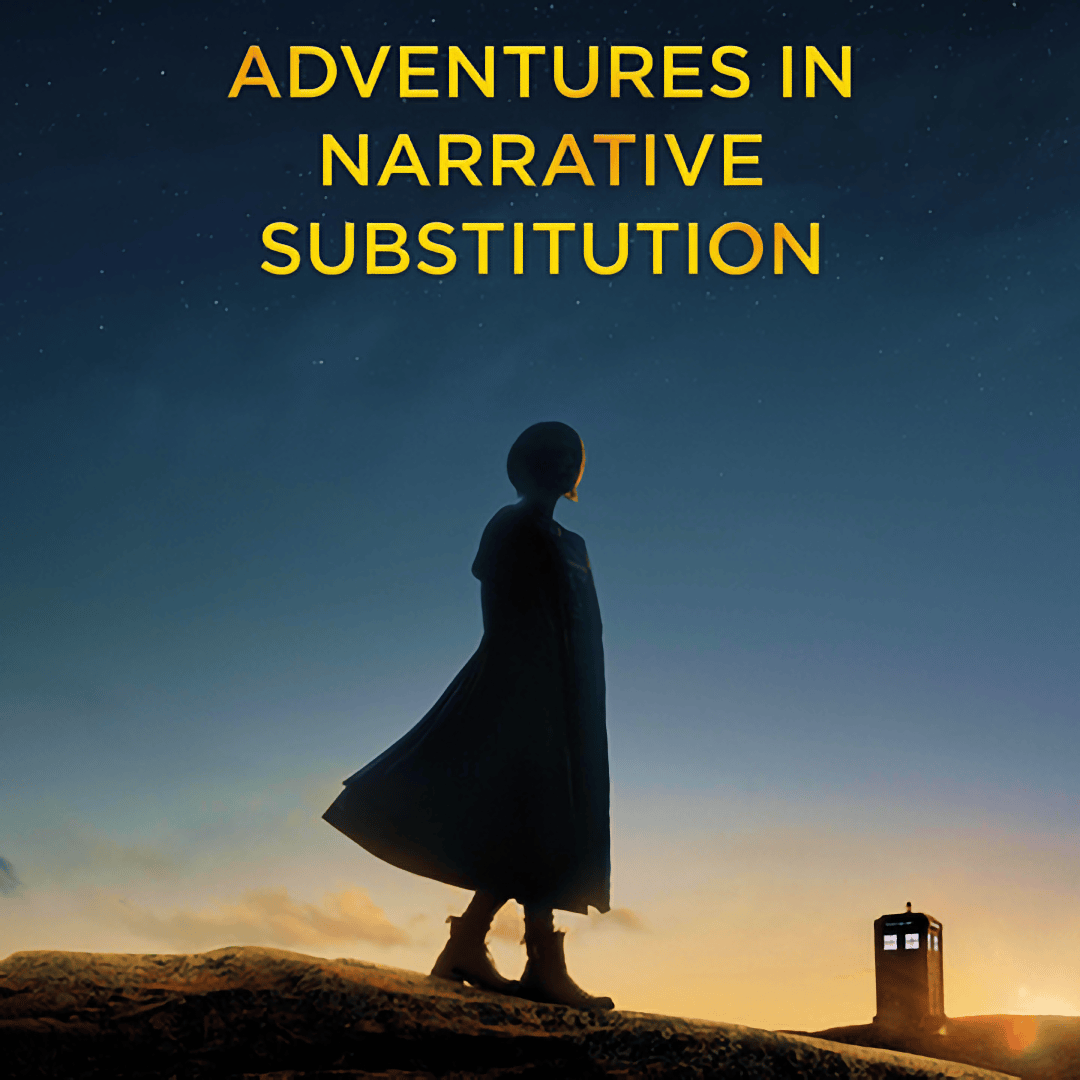
So, here we are: the final entry in Adventures in Narrative Substitution, the final post on the Chibnall era I’ll ever write, and the next-to-last one you’ll read, as the 42 post in The RTD Rewind will come out after this. It’s taken a long time to get here, but the end is in sight. So let’s waste no more time and get a shift on, shall we?
Look at a calendar, and you’ll see that there were 286 days between the Thirteenth Doctor’s first moments in the 2017 Christmas special Twice Upon A Time and her proper debut the following October. Rewind even further to her official reveal in July 2017, and the count is 448 days. But no matter how you count, the end result is the same: the strange liminal space between eras, as one ended and one began, was a time of possibility.
After the regeneration, the promotion machine kicked into high gear: new Target books and short story collections came out, slipping in little cameos for the new Doctor, portraying her perhaps as a trickster figure, or simply a caring individual eager to close the loop on a long chapter of her life. Whittaker herself was put on the cover of Entertainment Weekly and was seen at Comic-Con alongside her castmates and head writer Chibnall. New trailers showcasing Whittaker’s Doctor were released, hyping up the gender aspect while also trying to make it clear that in every other respect, the show had barely changed at all.
Audiences paid attention: nearly 11 million people in the UK alone tuned in to watch The Woman Who Fell to Earth, breaking the records set by Rose and The Eleventh Hour when those stories premiered. The future seemed bright, and the stage was set for the show to ride a new wave of popularity!
And then… well, you know the rest. Series 11 started strong and ended with the indescribably bad train wreck that was The Battle of Ranskoor Av Kolos, then the show largely took 2019 off aside from a holiday Dalek special, returning at the start of 2020 with a show that seemed to have turned into a 2007 Nostalgia Act with no understanding of what worked, it was all surface-level pandering to an audience of viewers that left with David Tennant.
And when it wasn’t doing that, it was trying to “answer” a question no one wanted answered: were the Morbius Doctors legit or not? The answer was yes: the Doctor in fact had an entire separate life and set of regenerations other than the ones we know, where she served as an agent of the mysterious Division, an organization that seemed to have no specific point except to serve as the lynchpin in a storm of LORE.
It followed this disaster with Flux, a 6-part serial in the grand tradition of such classic series favorites like The Trial of a Time Lord, or The Keys of Marinus. It was overstuffed, undercooked, and drove away the last remaining scraps of audience that series 12 hadn’t managed, with the final episode of the season being watched by a little over 4 million people, and that was after accounting for people who watched it on iPlayer.
And the promotional machine? It broke down and got swiftly recalibrated to focus on the legacy Doctors: 13’s Titancomic series became a more general Doctor Who comic, the New Series Adventures books began focusing on ex-companions with only some involvement from the incumbent before apparently petering out altogether, and then there was the incoherent cross-media bonanza that was Time Lord Victorious, whose purpose remains unclear to this day, except maybe giving David Tennant a steady paycheck.
Series 13 was presaged by a near complete lack of any promotion whatsoever by the BBC until four weeks before the premiere of the first episode, which included such mystifying stunts as deleting all of the show’s social media accounts and posting an allegedly photoshopped image of a Sontaran spaceship in the Liverpudlian night sky. What the flux were they thinking? The world may never know.
The story of the Chibnall era, then, is one of abject, nearly catastrophic failure. Whether some or all of the era’s missteps were his own or if he was pushed ultimately doesn’t matter: a show on life support is a show on life support, and had Russell T Davies not decided to swoop in at the eleventh hour and prevent the pre-mature end of time, things might be playing out not too differently than they did in the lead-up to the first cancellation, aside from the fact that the McCoy years were brilliant, and the Whittaker ones weren’t.
Of course, Doctor Who can never die. It’s simply unkillable, you can change the lead actors time and time again and the bones of the show, what makes it work, will remain intact. Regeneration is why I’m here writing this sentence, and why you’re here reading it.
But regeneration, necessarily, means death for the current incarnation of the show. Change is inevitable. Sometimes it’s allowed to come graciously, and other times it strikes down like the axe of an executioner. I’ve argued in this series that this version of the show has deserved to die for a while now, since Kerblam! at the earliest. Now, finally, it has the good graces to listen to me.
Regeneration stories, naturally, are complex beasts: on one level, their function is to serve as a great big sendoff for the incumbent Doctor: a final adventure, one last chance to see a beloved incarnation at work. Sometimes previous companions return to say goodbye, and there is often a returning enemy as well, who may or may not deliver the killing blow.
On the production side, it offers the showrunner (or in the classic era, the producer) a last chance to wrap up the current era’s plotlines and clear the decks for their successor, so as not to burden them with leftover baggage. For fans, it’s a time of mourning: a favorite face is disappearing, with no clue when, or if, they might return. (I am still waiting for Matt Smith to do some Big Finish audios, and he’s been gone for nine years now.)
There are exceptions, of course: The Tenth Planet doesn’t so much wrap up the Hartnell era as kill it dead abruptly, hence Steven Moffat retconning Twice Upon A Time into the First Doctor’s true finale, while the Sixth Doctor never got a regeneration story on television at all, since the Baker-McCoy transition was added to the start of Time and the Rani. (9 years later, McCoy himself would also be denied a true finale, with his transition into Paul McGann occurring in the TV Movie.) And The Parting of the Ways wasn’t even originally meant to be Eccleston’s final story, but it became such when he quit in late 2004.
And now the end has come for number Thirteen, the unluckiest of all Doctors. Even so, she deserves a send off worthy of her stature as the first of her kind. The Woman Who Fell to Earth, for all its considerable flaws, still works as an introduction to a new take on the show, and to her character in general. The Thirteenth Doctor as written in that story, “fair play” line aside, is genuinely compelling, and could’ve stood alongside my beloved Matt Smith as My Doctor. It’s no Eleventh Hour, but Woman does prove that when everyone involved really tries, Chibnall and his team can just about make things work.
So: do they? If this is game 6 of the World Series, do they hit a home run?
****
Well, no. Of course they don’t. The best this episode can manage is winning within one point of the opposing team: technically a success, but not exactly anything to write home about. The overnights on this one bear it out: Just over 3 million, so not exactly what you’d call a barnstorming success, though the complete lack of promotion over the six months between this and Legend of the Sea Devils doesn’t help either.
There has always been a sense, with Chibnall, that he’d really rather be somewhere else when he writes Doctor Who. He seems more interested in bringing back Ace, Tegan, a bunch of older Doctors, and assorted other old companions than actually bothering to wrap up his era in a satisfactory way. I mean, Jesus tap-dancing Christ, what exactly does Power of the Doctor have to say about the Whittaker era?! Nothing! Sure, we get the Dhawan Master back and the Gallifreyan Cybermen and Ashad, but SO FUCKING WHAT?! CONTINUITY DOESN’T MAKE YOUR STORY, CHIBNALL! MOTHER OF GOD HOW HAVE YOU BEEN IN THIS JOB FOR FOUR YEARS AND YOU STILL HAVEN’T FIGURED IT OUT?!
Speaking of continuity, this is the plot in a nutshell: remember the scene in the TV Movie where the Eric Roberts Master hooks the Eighth Doctor up to some machine and tries to steal the rest of the Doctor’s remaining lives? Now do that, and stretch it over 90 minutes. It’s empty and vapid and soulless in the worst possible way, watching Sacha Dhawan run around in an amalgamation of previous Doctor outfits failing to Doctor correctly is as perfect a metaphor for this era as anything I’ve ever seen. No wonder the show almost got cancelled.
Contrast this with, what else, but The Time of the Doctor. From the very first shot there is a sense of the apocalyptic. Everything about the current era is about to end and not even the Doctor will make it out alive. Time is no exception, Orla Brady’s ominous narration gets things started on a good note, but it’s really not until Tasha Lem answers the Doctor’s question with “Trenzalore” that we know where we are. This is where the Doctor dies. The Fall of the Eleventh has been signposted since The Wedding of River Song, and now it’s finally here.
Power of the Doctor, meanwhile, doesn’t have anything like this. There’s no kind of existential narrative threat going on, it’s literally just Sacha Dhawan ranting at the Doctor in various locations attempting to be threatening! And it sucks! There’s no dramatic weight to this story, no sense it’s tailor-made for this Doctor, you could put in literally any other face you like and it would still work out pretty much the same way. Even the story itself seems to recognize this, what with the holographic Doctor switching between Davison, McCoy, and Martin several times before settling on Whittaker. This is a problem.
Who is the Thirteenth Doctor, really? I have no fucking idea. It’s been 4 years, 31 episodes, and 3 series, and I simply cannot tell you anything about her that marks her out as unique aside from the fact that she’s The Woman One. And that, quite frankly, is beyond pathetic. After the same amount of time I can tell you who the Eleventh Doctor is: a capricious child of a man who acts like a goofball but also knows when to turn on the tranquil fury, young and old all at the same time with a penchant for fish custard and a love of bow ties, fezzes, and stetsons.
But Thirteen? She’s just The Woman. That’s it. And that’s not just an apocalyptically huge failure on Chibnall’s part, it’s pretty bad for Whittaker too.
I don’t know why I’ve avoided the subject for as long as I have. Maybe it’s just the fact it’s bad optics, criticizing the first female Doctor for her acting ability, even when you yourself are a woman. (Because then I’m liable to get called sexist for voicing even mild criticism, because that’s how the internet works.)
But it doesn’t matter now. Jodie isn’t the incumbent Doctor, David Tennant is. So, okay, here we go: It’s not that Whittaker was a terrible actress, we know from other performances of hers that she can act the house down when she’s given room to. But in a role like the Doctor, she seems somewhat at sea. Maybe it’s because I’m used to Matt Smith and his unique line readings and the way his Doctor grows and evolves through the tenure, but with Jodie, she just seems… functional. She has a specific way she uses the sonic screwdriver, a specific way she expresses wonderment, a specific way she plays being sad or angry or happy. She acts in the same way here as she does in series 11, and that’s just sad.
At least in 2018 I was willing to cut her some slack because she was still finding her way into the part. It usually takes a Doctor until their second season for them to settle into the version of the character everyone remembers, with dialogue written specifically for them as opposed to generic Doctor dialogue made unique by delivery and other acting choices.
Similarly, most Doctors have at least one episode you can point to as the moment where the character crystalizes and the actor Becomes The Doctor, rather than simply playing the character. The Lodger is widely regarded as being the one where the Eleventh Doctor clicks into place, while Flatline serves in that role for Twelve. (At least, it does for me. Ironic, given the Clara focus.)
Jodie Whittaker… I hate to admit this, but I think she may be the first Doctor since Colin Baker who simply fails to work on screen. Part of this is due to the material: Chibnall and company write for her in the motormouth tradition of Matt Smith and Broadchurch’s David Tennant, and she clearly isn’t comfortable at selling rapid monologues like that. But they don’t bother to try anything else, so they keep giving her material she isn’t suited for.
There are moments where the character works: everything to do with her building a sonic screwdriver is one of those moments, along with getting along with Nikola Tesla because they are both inventors, or the way she goads Krasko or the lone Dalek in Resolution with a sense of recklessness that none of her predecessors ever went for.
But those are just it, moments. Nothing coheres, no one takes a particular aspect of her portrayal and magnifies it, she just keeps playing scenes generically. The only time I felt like she had a Became the Doctor moment was at the beginning of the pandemic, when she recorded that little short in a closet meant to calm down any worried kids. And none of that comes back on screen.
It’s possible (though not likely) that Big Finish may snap her up for audios someday and they can do for her what they did for Six, giving her a second, alternative era that works better than her TV one ever did. Spin-off media certainly seems to have a better handle on her than Chibnall ever did, Jody Houser’s work on the comic range has some stuff I wish Jodie got to say. Despite everything, I believe the character can work if only someone tries to make it happen, the problem is that no one did. And that includes Whittaker herself.
And then there’s Yasmin Khan. She has to be the worst-served companion since Dodo in 1966. Clara got an entire arc in Time of the Doctor: dealing with the pain and suffering one feels when a loved one, such as the Doctor, gradually ages and dies before your eyes. Yaz doesn’t even get that much, she just gets to be the Doctor analogue for a bit while the Master has taken the Doctor’s body, and her “finale?” She goes to the companion equivalent of an AA meeting, with absolutely no indication whatsoever that she has been changed or otherwise altered by her experiences. She’s felt surplus to requirements for the last 4 years, and her exit out of the series just cements that impression. I hope Mandip Gill has a much better career from here on out, let Doctor Who become just a one-line item on her resume. She was too good for it.
But as ever, the worst part about the story is the writing. The great irony about Power is that this is clearly Chris Chibnall trying to land the plane, he gives everything a little bit of extra polish so it comes out as nicely as possible. The dialogue sounds like it got more than one draft, the episode itself is well-paced, avoiding the usual Chibnallian problem where everything seems to be overstuffed. (The 90 minute running time did him some favors.)
But it still sucks. It doesn’t feel like a finale, even taking into consideration the fact that this was almost the final episode of Doctor Who ever. Even the fatal blow seems like an afterthought: the Master directs a laser in the Doctor’s direction, it hits her, and she dies. Meanwhile, Time of the Doctor spends about half its runtime gradually increasing the Doctor’s age, and his final death comes on the Christmas clocktower, when he uses his regeneration energy (given to him by the Time Lords) to destroy the Dalek fleet, wringing a ton of character drama out of it in the process.
But not Chibnall. The Doctor just dies because she has to. She dumps Yaz off on Earth after ice cream, and her final speech, rather than a quiet reflection on mortality like Eleven gets, is just… limp. A bit of optimism, and then… FWOOSH.
Everything changes. David Tennant is suddenly there. The direction is suddenly good again, as Rachel Talalay returns to bookend the era. Even just a few lines from RTD calling back to the Eccleston-Tennant regeneration is evidence enough that someone else is in charge now. The game has changed, and the show is reborn anew.
Change, my dear.
And it seems not a moment too soon.


Leave a Reply