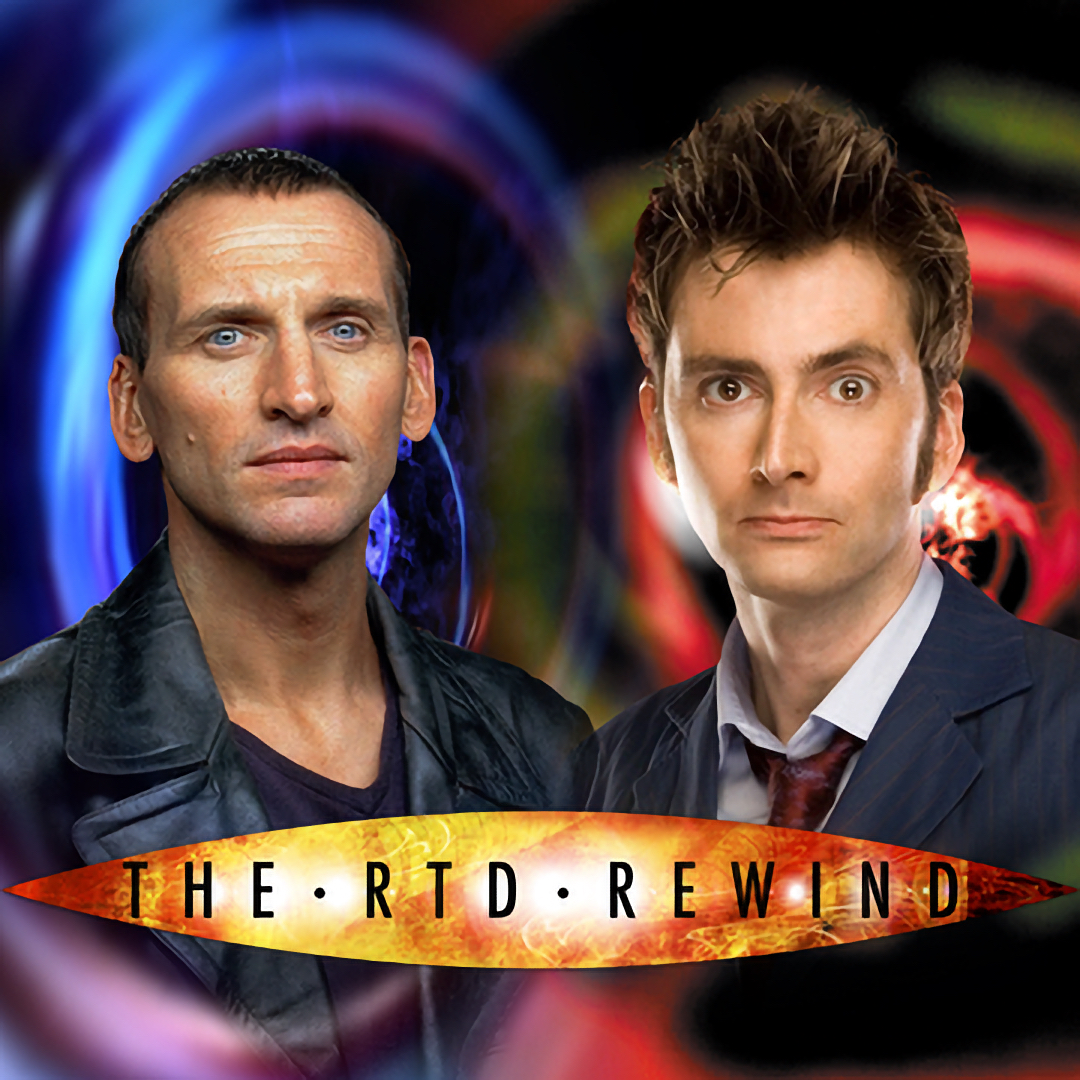
In 2013, Doctor Who’s 50th anniversary was celebrated on BBC America with The Doctors Revisited, a series of documentaries about a given era of the show, broadcast each month starting in January and proceeding in chronological order. All documentaries were then followed by a 90-minute story featuring that Doctor, meaning primarily four-parters for the classic Doctors, the TV Movie, and two-parters for the new ones.
The stories selected for airing are an interesting mix: there are Dalek and Cybermen stories obviously, while others (The Aztecs and Pyramids of Mars) are slightly odd, given that one of them isn’t The Very First Story, and the other one is a decent Tom Baker with a particularly beloved companion, but an enemy that is never seen again. (Tomb of the Cybermenshowing up is sensible, since it’s one of the few surviving four-part Troughton stories, and as Steven Moffat said in the promotional trailer, that was the one Matt Smith watched when preparing to play the Doctor.)
The most perplexing one of the lot though, is the choice to air Bad Wolf/Parting of the Ways to represent the Eccleston era. Mainly because of how it ends: with the Ninth Doctor regenerating into the Tenth. A certain contingent of Doctor Who fandom at some point started advising people to skip Nine and jump straight in to Ten, on the theory that Ten was more popular. In response, another contingent of fandom said “Don’t skip Nine,” and here’s BBC America trying to do both, and inadvertently falling into the former’s camp.
Here’s the thing: Yes, the Tennant era was ridiculously popular with viewers, at a level equivalent to, and perhaps surpassing, the Tom Baker era. And fans of that era (or at least the ones I’ve interacted with over the years) tend to regard anything that doesn’t star Saint David with varying amounts of skepticism to outright scorn. So, for these folks, Bad Wolf/The Parting of the Ways becomes that story you have to sit through to get to the best scene at the end. (Admittedly, this is how I feel about The End of Time, but at least I don’t go slagging off the preceding 47 years of television because Matt Smith isn’t there.)
Anyway: all of this has had a somewhat negative effect on how the Eccleston era has been perceived by people who didn’t come aboard with him. He and Paul McGann are the two shortest-lived Doctors by TV episode count, but unlike McGann, Eccleston does at least have an era: the thirteen episodes he was in, plus six books, some short stories, DWM comic strips, action figures, cookbooks, and underpants, all of which make up that wonderful thing that we refer to as an era in fan terminology.
What Eccleston never had that everyone else has had was an incumbency. There’s a difference between an era and incumbency, if only a slight one: an incumbency is when the actor simply gets to be the face of the show, with no ghosts of the future haunting them. Paul McGann’s incumbency lasted from the broadcast of the TV movie through to, arguably, either the broadcast of Scream of the Shalka or the announcement of Christopher Eccleston as the ninth Doctor. After that, number Eight was a lame duck, but he didn’t become a past Doctor until Rose aired.
Eccleston’s incumbency lasted exactly one week, in the gap between Rose and The End of the World. During that gap, Christopher Eccleston’s departure was announced, with David Tennant’s appointment as his successor following shortly thereafter. For the rest of series 1, it’s Nine’s turn to be the lame duck, haunted by the spirit of his more popular/conventionally handsome successor.
The counterpoint, obviously, is that he does have an incumbency for people who came aboard with him. My dear friend Frezno, friend of the blog and all around good bean, came to the show in 2005 when it aired in Canada. For them, the regeneration scene was a big surprise, their internal monologue went something like: “WH– HE JUST SORTA EXPLODED AND CHANGED? HE CAN DO THAT? I– WH– BARCELONA? WHAT THE FUCK?” Folks like Frezno are important, and it’s because of the Nine fans that we now have Eccleston’s long-wished for return to the role via Big Finish. He came because, after so many years believing in “Just skip Nine,” the fans told him how he was their Doctor, and he was moved by that.
I would be too. Because, for all the various health problems he was dealing with in 2004 and 2005, to say nothing of the chaos on set that caused him to leave in the first place, Eccleston was and remains a consummate professional, turning in a perfect performance every single week. There is no story where he’s the weakest part, nor is there a story that requires him to do heavy lifting to rescue it, because there aren’t any clunkers. Even Aliens of London/World War Three, for all its flaws, still has lots of other good things going on that make it a good watch. (But if you want to know what it’s like when Eccleston has to save a bad script, Nicholas Briggs’ Ravagers is there to fit the bill.)
Being a season finale, Bad Wolf/The Parting of the Ways does an exemplary job at wrapping up the Satellite Five storyline, balancing it with Rose’s home life, and ramping up the Dalek threat: from one Dalek to millions of Daleks! And on top of all that, the Doctor’s closing speech to Rose just before he regenerates ties a neat bow on his own character arc. With her guidance and support, we’ve seen him change from a shell-shocked veteran with a nasty case of survivor’s guilt into a warmer, more compassionate person with much stronger self-esteem. Not for nothing are his very last words: “Rose, before I go, I just want to tell you, you were fantastic. Absolutely fantastic. And do you know what? So was I.”
Godspeed, number Nine. We will always remember when the Doctor was you.


Leave a Reply