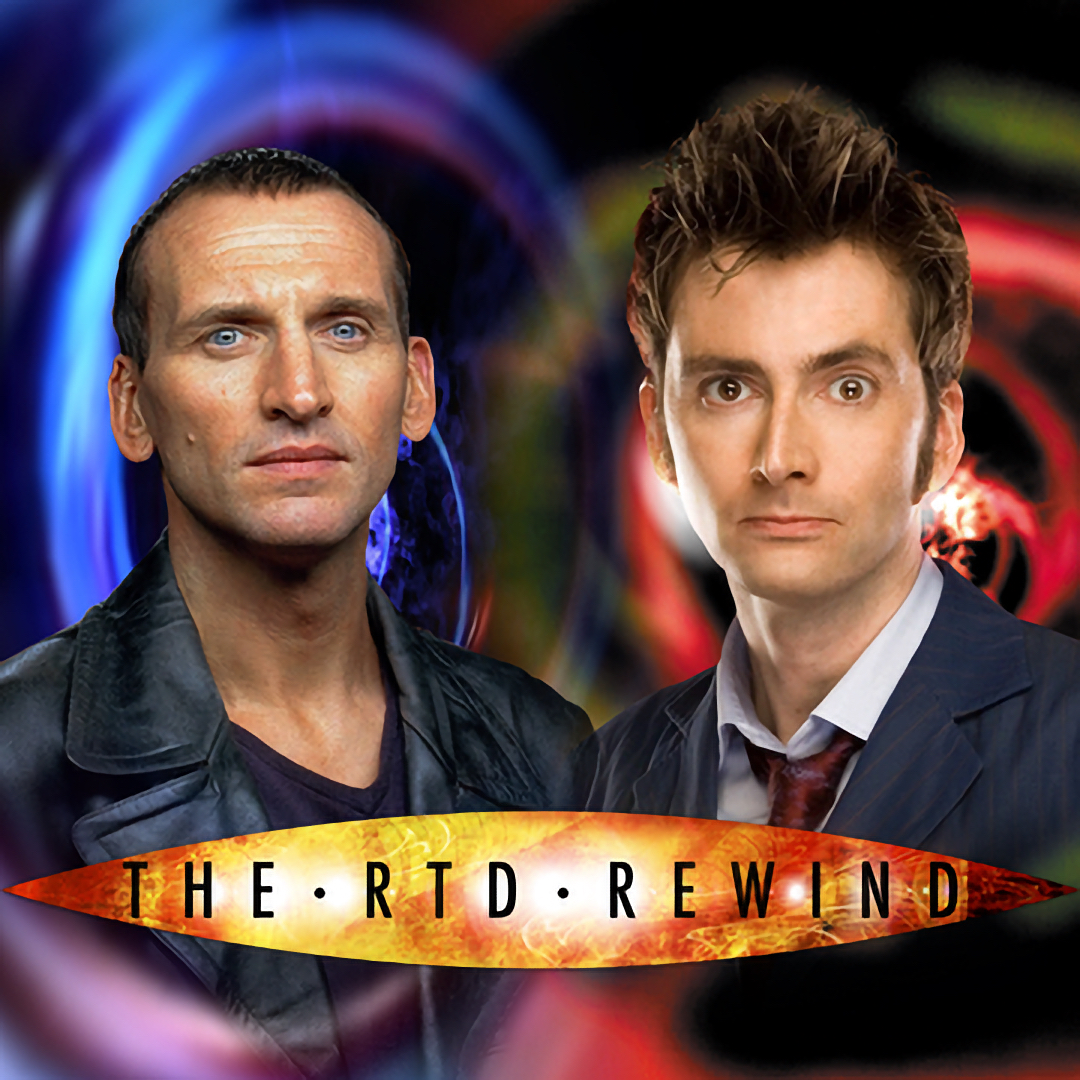
With this post, we begin the bulk of the Davies era and, by extension, the Tennant era of the show. Easily the most popular Doctor of the modern era, the Tennant years saw the show blow up into an absolute success unlike anything it had ever been before, such that when Tennant left in 2009, the BBC actually considered canceling the show rather than let it continue without him. (Thankfully, Davies said they couldn’t.) I found the show right in the middle of this period, but it wasn’t until his successor arrived that I really started to pay attention to it.
The thing is, dear reader, this is where I lay all my cards on the table and tell you the blunt truth: I don’t like the Tennant era. It isn’t quite the worst era of the show (Colin Baker’s era will always be that, though it’s not Baker’s fault) nor, obviously, is it the weakest story-wise. Tennant himself is absolutely magnetic in the part, he’s been waiting for this moment since his youth and you can tell, he throws himself in with gusto and it works. Whatever else I say about the era he’s the face of, I can’t say anything bad about Tennant or his acting. He’s just too good!
No, my main problem with the Tennant era is the writing. But even this complaint requires explanation: the last time I bitched about an era’s writing was the Chibnall era, and that pissed me off so much that I started an entire career in media criticism just to get it off my chest. The Chibnall era’s flaws were basic storytelling mistakes, from clunky dialogue to borderline incompetent handling of emotional stakes, to say nothing of preferring plot and spectacle over character. Watching the Chibnall era was like watching the guy who got a C average in Creative Writing get one of the hardest jobs in the world and blow it.
Davies is, by several orders of magnitude, a much better writer than Chibnall. My problem with his writing, and specifically his take on the Doctor as of this point, is rooted more in him preferring anti-heroes while I prefer more positively heroic ones: the Doctor is still a chaos-generating force of nature who stops at nothing to tear down unethical systems in the Davies era, except that he is also now a vain and hubristic man with a propensity for going “WOE IS ME, I AM THE LAST OF THE TIME LORDS, PITY ME ROSE/MARTHA/DONNA!” Or as I called it two essays back, time/space drama queen dreck.
The good news is that (most of) the aforementioned dreck doesn’t show up until Series 3 and 4, so I can sit back and just enjoy Tennant’s performance here for what it is, rather than what it will be.
So anyway: jumping straight into it, not with The Christmas Invasion, but an untitled 8 minute short that Davies has since referred to as Pudsey Cutaway, while other sources go with Born Again, and as I like that one better, it’s the one I’m going to use. So there.
The minisode was made for Children in Need, and takes place in between Parting of the Ways and The Christmas Invasion, even starting off with a quick recap of how the former story ended. After that, the rest of the story has the new Doctor attempting to convince Rose that he really is the same man as our late lamented Northern guy with the big ears, only to freak her out even more when the regeneration starts to go a bit haywire. (Thank goodness he doesn’t strangle her.)
Post-regeneration stories, especially when watched immediately after the previous Doctor’s finale, are always a little surreal: one moment the Doctor is Christopher Eccleston, and then he’s not anymore! Small wonder Rose freaks out the way she does, honestly, I would too if I were in her place, and I’ve been aware of this show for fifteen years! (HELP ME!) But in her case it gets even better when you remember that in Tennant’s “final” story, The End of Time, she kinda-sorta glimpsed him in an alleyway and assumed he was drunk. So, from her point of view, the Doctor turned into that random drunk guy from the last New Years Eve. No wonder she’s freaked!
And yeah, Ten is very different from Nine pretty much from the word go, and I don’t just mean the hair or the accent. For starters, he’s a babbler if there ever was one, just look at this bit from when he’s reminding her of their first meeting: “Then how could I remember this? Very first word I ever said to you. Trapped in that cellar. Surrounded by shop window dummies…. oh… such a long time ago. I took your hand… I said one word… just one word, I said… “Run”. He just doesn’t stop!
Once we get to The Christmas Invasion proper, even more differences appear. For a good example, let’s look at the sequence on the Sycorax ship versus, say, Nine’s interaction with the Nestene Consciousness toward the end of Rose. Nine is blunt and uncompromising, refusing to let the Nestene gain any ground and owning the room when it tries (“I AM TALKING!”). Nine also treats the Consciousness with (a little) more respect than Ten does the Sycorax, at least enough to be allowed to talk to it in the first place, while Ten actively treats the Sycorax leader like he’s the second or third item on the to-do list for today, after having tea and catching up with the family.
On top of that, Ten also gets a very long monologue where Tennant gets to run his mouth off in a way that Eccleston, given his Northern bluntness, would never have done. But if you want a clear illustration of the difference between them, here’s Nine’s speech about the potential of humanity against Ten’s version:
“This planet is just starting. These stupid little people have only just learnt how to walk, but they’re capable of so much more.”
“Look at these people. These human beings. Consider their potential. From the day they arrive on the planet and blinking step into the sun, there is more to see than can ever be seen. More to do than. No, hold on. Sorry, that’s The Lion King. But the point still stands. Leave them alone!”
Ten, obviously, is much more of a fan of humanity than Nine is. Nine doesn’t hate them, obviously, but he’s also far more inclined to focus on their flaws rather than virtues. (And as one of two members of Canis lupus sapiens in the world, I’ve watched humans destroy our shared planet for pretty much my whole life through warfare and climate change, so I can’t say I blame him.)
But Ten? Ten gushes about them! And not just here, but all the time throughout this era, from hugging a bunch of people in orbit around a black hole to edible ball bearings, and that’s just in series 2 alone! He even hugs Jackie toward the end of the story, while Nine can barely stand to be in the same room as her! What a shift!
But it’s not all sunshine and rainbows. Ten coldly dispatches the Sycorax’s leader to his death later on, and while there were extenuating circumstances, he still MURDERED SOMEONE IN HIS FIRST EPISODE. He then describes himself as being the sort of man who doesn’t give second chances, and just as coldly brings an end to Harriet Jones’ administration, because she pissed him off.
Here’s my thing: Harriet Jones had a point. No, she shouldn’t have shot the Sycorax ship while it was flying away, the Doctor was right to call her out on that. It was murder. She should’ve called Torchwood off at the end of the episode. However, I understand why she activated them in the first place: as far as she knew, the Doctor was dead, and she needed a backup plan. She even says as much to the Doctor’s face, and his response? Not just throw her out of government, but humiliate her.
Like, let’s just go over what we know about her: she went from being a no-name member of Parliament to Prime Minister of the United Kingdom, architect of Britain’s “Golden Age,” a figure of vast historical importance. Then the Tenth Doctor comes in and smashes that golden age apart because she pissed him off. She, a woman, dared to speak against him, a man. So he tore her down petulantly, as a certain orange American president always did to his enemies.
The Tenth Doctor is a vain and hubristic man, as I mentioned at the beginning of this post, and the show explores that theme many, many times over the course of the era: the Master becoming Prime Minister in series 3, and the circumstances of Ten’s own regeneration, all come about because of his actions here, and chances are his era might’ve unfolded very differently.
The consequences of the Jones deposition ring out far beyond this era, of course: Ten’s hubris becomes so well known, and he becomes so feared, that the Eleventh and Twelfth Doctors’ eras both spend large chunks of time dealing with the after-effects, from the rest of the universe believing the Doctor to be a great warrior in series 6, or a blood-soaked goblin trickster warrior in series 5, to Clara Oswald refusing to let herself become the next Donna Noble in series 9.
And all this because of six little words.
The Christmas Invasion, first and foremost, is a charm offensive: when paired with Born Again, it not only makes a compelling case for Tennant’s Doctor, it makes enjoying his performance in the role the entire exercise, you can’t honestly engage with this era or its themes without that enjoyment. Even I’m not immune: I genuinely enjoy Tennant’s Doctor performances, whether on TV, in audio plays, or in multi-Doctor episodes like The Day of the Doctor.
But I absolutely resolutely do not like the Tenth Doctor. He is a cruel and at times abusive man, the very pinnacle of toxic masculinity. At the time, that was in step with the cultural moment: the mid-late 2000s was the era of Christian Bale’s Batman, Daniel Craig’s Bond, Hugh Laurie’s House, and Bryan Cranston’s Walter White. It’s all well and good to do a story about anti-heroes. But the Tennant era’s problem is that its namesake actor is simply too likable for any of its worst aspects to come off. If the role had gone to anyone else, and it was written exactly the same, I wouldn’t be here writing this.
Ten is not my Doctor. He never will be. I wouldn’t want him to be. My Doctor is a floppy-haired raggedy man in tweed and a cool bow tie with a fez or a mop, and if I could, I’d skip right ahead to that episode. And trust me, we will get there eventually. (It’s me. What were you expecting?)
But until then we have three seasons of showboating, frustrating likability, and enough hair gel to bankrupt the Luxembourg economy to get through.
Allons-y, I guess.


Leave a Reply