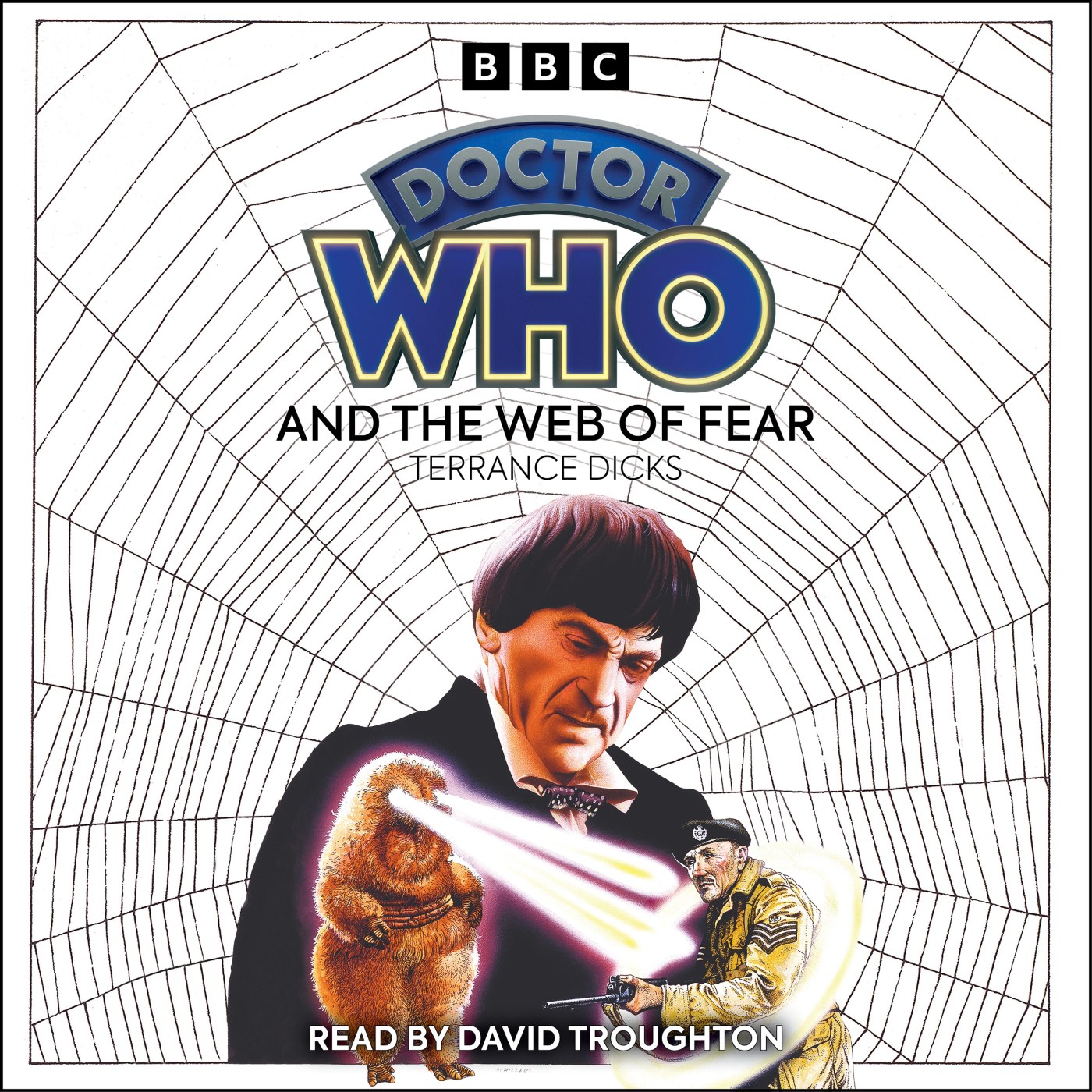
This month, we jump ahead in time to 1976. On TV, Tom Baker is between his second and third seasons as the Doctor, while in the land of literature, Target Books comes out with its next novelization release: Doctor Who and the Web of Fear, adapting the 1968 Patrick Troughton story. The edition I read was the BBC Books reprint from 2016.
It should come as no surprise to anyone reading this when I say that Patrick Troughton’s Second Doctor, after Sylvester McCoy’s Seventh, is one of my favorite Doctors. Why? Because the Second was an enormous influence on the Eleventh, the Doctor nearest and dearest to my lupine heart. Readers may also remember that I found myself somewhat dissatisfied with my last Second Doctor book, Doctor Who and the Cybermen: the sexism against Polly was rampant, there was an over abundance of testosterone, and the prose was too flowery, and not in a good way. (That’s what Brian Hayles is for.)
This book, however, is a much needed palate cleanser. Anne Travers, when asked by one character what exactly a pretty girl like her was doing in a place like the Fortress, replies with this:
‘When I was a little girl I decided I’d like to become a scientist like my father. So I did.’
‘Just like that?’
‘Just like that.”
And she actually gets to be a scientist, helping out her father build a device intended to defeat the Great Intelligence, and later doing the same with the Doctor, after Professor Travers is kidnapped at the end of chapter 8. Seeing more women in STEM fields is always welcome, and I’m glad that Anne gets to be one of those examples.
The novelization also improves on other aspects of the original TV story: Julius the museum owner, on TV, was an extremely offensive Jewish stereotype, but the book version of him gives him a new name (Emil Julius) and describes him as “tall and white haired,” with a nonspecific slight middle-European accent. Sadly, the infamous line “I WARNED YOU, JULIUS, I WARNED YOU!” from the Classic Who on Twitch trailers didn’t make the cut. Can’t have everything, I guess.
Of particular note, however, is what the book does with a certain beloved mustachioed military officer. The Web of Fear, for those of you who aren’t familiar, is the debut story of Alistair Gordon Lethbridge-Stewart, here as a colonel rather than his more famous rank of brigadier. In 1968, the character was intended to be a one-off, much like Nicholas Courtney’s previous character in the series, Bret Vyon. The first meeting between the Doctor and the future Brigadier never even takes place on screen; all viewers see is his feet in episode two, and then in the third he’s suddenly there with the Doctor, with no indication whatsoever of future greatness.
But with 8 years of hindsight, Terrance Dicks gives that first encounter all the pomp and circumstance it deserves, beginning with this sequence at the end of chapter 4:
“Suddenly a light-beam flashed out of the semi-darkness and a clipped voice spoke. ‘Stand perfectly still and raise your hands.’
The Doctor obeyed. A tall figure appeared, torch in one hand, revolver in the other, covering the Doctor. It was a man in battledress, the insignia of a Colonel on his shoulders. Even through the semi-darkness the Doctor caught an impression of an immaculate uniform and a neatly trimmed moustache. The soldier peered down from his superior height at the small, scruffy figure of his captive. ‘And who might you be?’ he asked, sounding more amused than alarmed.
Feeling at something of a disadvantage the Doctor answered sulkily, ‘I might ask you the same question.’
‘I am Colonel Alistair Lethbridge-Stewart,’ said the precise, military voice.
‘How do you do? I am the Doctor.’
‘Are you now? Well then, Doctor whoever-you-are, perhaps you’d like to tell me what you’re doing in these tunnels?”
Reader, you’d best believe I had a big stupid grin on my face when I got to this part. And who wouldn’t? The Brigadier is a beloved character, in no small part because of how Nicholas Courtney played him: a man of class and sophistication, military-minded and as loyal to the people of Earth as the Doctor is. He’s exactly the man you want on your side when things start getting weird, and the same applies to his daughter. Some people said his cameo at the end of Death In Heaven was disrespectful, I disagree: it was exactly the kind of tribute he deserved, rescuing Kate from certain death and getting a salute from the Doctor. And for crying out loud, he’s the fucking Brig. Cyber-conditioning was never going to hold him for long. (Ditto with Rory.)
But I digress! There’s another reason why I like this book, debut of the Brig aside, and that’s the Great Intelligence. The Intelligence’s first story (from its perspective anyway) is The Snowmen, when it took the form of Walter Simeon and tried to take over the world with evil killer monster snow goons. The Doctor sets up its next two appearances, and this story in particular, by presenting it with a map of the London Underground circa 1967, making their encounters something of a stable time loop.
Jamie’s accidental wrecking of the Doctor’s plan to destroy the Intelligence in this story, so that it survives to live another day, inadvertently sets up the events of the show’s seventh revival season, in which the Intelligence (now in the form of Richard E. Grant) decides to take revenge on the Doctor for wrecking its schemes by going back in time and essentially killing the Doctor not once, but thirteen times over. (And then Clara Oswald goes back in time to kick the Intelligence’s incorporeal ass for the rest of eternity, then later gets a TARDIS and a companion of her own, so… atta boy, Jamie.)
All of this is to say that thanks to Steven Moffat and his fondness for complicated time travel shenanigans, the Intelligence is probably my second favorite classic series villain, after the Ainley Master. The Web of Fear, it turns out, is even more important than anyone ever imagined it would be.
Finally, I’d be remiss if I didn’t mention Terrance Dicks and his delightful prose style. This is the first book of his I’ve read for this project, and of course he wins on the readability front. You do not need to have the vocabulary of Tolkien or Snicket to be readable, beige prose can be useful if you know how to do it, and Dicks was the master of the art. The man wrote sixty Target books, and contributed to the show in some way or other right up until he died, with his last ever story, “Save Yourself,” appearing in The Target Storybook, which depicts what might as well have been a lost scene from his first TV story: The War Games.
There are plenty of flourishes to be had if you look closely. Chapter 5, for example, opens with a paragraph describing various exploits the Doctor and the Brigadier will have in the Third Doctor era, and he fleshes out Sergeant Arnold (the guy later revealed to be the GI’s mole, as opposed to Chorley, Mr. Red Herring) a bit in his debut scene, describing him as a “tough old sweat,” and “although Arnold was a kindly man, he hated anyone to know it, and always spoke with the ferocity of a drill-sergeant on the barrack square.” Sadly there’s no chapter title called “In the Hands of the Enemy,” but the TARDIS engine noise is described as a “wheezing, groaning sound,” which makes up for it.
In the end, Doctor Who and the Web of Fear was very enjoyable to read. I found it to be very well-paced, (each chapter ends on a cliffhanger!) and even finished reading it over the course of a single day, which doesn’t often happen with me these days. (Part-time retail jobs are not exactly conducive to reading books of any length.) I’d highly recommend it to anyone in the mood for an engaging slice of Doctor Who.
And speaking of Terrance Dicks and the Second Doctor, come back next month for a look at his return appearance in The Three Doctors, when he has an adventure with everyone’s favorite glam James Bond, and watches his first incarnation snark at both of them on TV. Oh yeah, and there’s this guy called Omega as well…


Leave a Reply