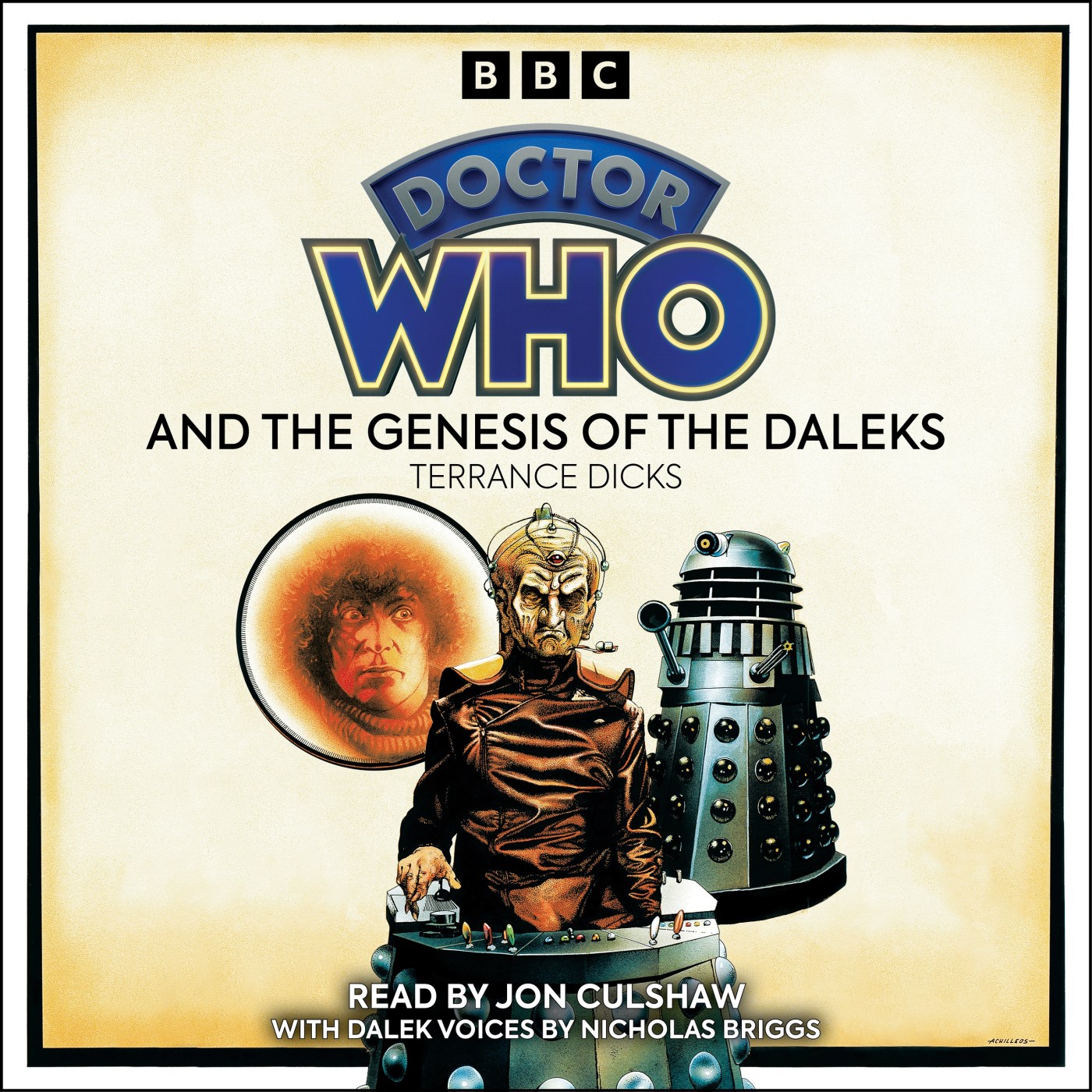
In the beginning, the Goddess (AKA Verity Lambert) created the Doctor and the TARDIS. Then she created Susan, Ian, and Barbara. And then, over the objections of Sydney Newman, she asked Terry Nation and Raymond Cusick to create the Daleks. And the Goddess saw the ratings go up, saving the show from an early demise and leading it instead to glory as the longest running science fiction show in history, and found it good.
Joking around aside, Genesis is truly one of the great Dalek stories, up there with 2005’s eponymous epic with Christopher Eccleston, The Power of the Daleks with Patrick Troughton, and Remembrance of the Daleks with Sylvester McCoy, the 1988 story that took us right back to where it all began: Shoreditch, London.
I’ve only seen Genesis once: in 2015, around 40 years after it first aired, when I was studying abroad in the UK. It was early September, a couple of weeks before the premiere of Series 9, and rumors were circulating that the opening story would center around Davros. So, one Saturday, I went over to the library at the school I was attending, (Regent’s University London, for those curious) checked it out on DVD, and binged all six parts in a single night. It’s not often I do something like that (I like to space things out a bit) but Genesis was so tightly plotted I couldn’t stop myself.
The last time we talked about the Daleks, I said I found their debut story to be quite dull, enlivened mainly by David Whitaker’s prose and his decision to retell it from the perspective of Ian Chesterton. Genesis is miles better by comparison: Skaro is still a hellish wasteland, but now, instead of Daleks zooming around on static electricity, we have Davros and the Kaleds, AKA Nazis with the serial numbers filed off. The Thals aren’t much better: rather than a bunch of strapping young Aryan men and women deemed to be perfect, they are rather total jerks who aren’t much better than the Kaleds themselves.
Granted, this story also takes place at the very beginning of the Dalek timeline, the version of them we see in 1963 is much later on. The Daleks is still a relatively boring story, but at least it’s understandable beyond “Terry Nation is a hack.” Indeed, Shannon Patrick Sullivan described Nation as being quite enthusiastic about the prospect of giving the Daleks a proper origin story, and that enthusiasm comes through on screen and in the printed page, via Terrance Dicks’ own wonderful prose. (Justifiably, this book will be included in a two-volume set of his best works, due for release in August 2021.)
The story’s premise, for those who aren’t familiar, is very simple: Having seen a future in which the Daleks succeed at taking over the universe, the Time Lords force the Doctor to go on a mission for them to Skaro and avert the creation of the Daleks, or at the very least, make them less dangerous. The Doctor reluctantly agrees, and with the assistance of Sarah Jane and Harry Sullivan, dives straight into trouble.
The story’s most famous scene, and the one that gets repeated in The Witch’s Apprentice (a sequel and prequel to this story) is the one where the Doctor is holding two strands of wire together and wondering if he has the right to follow through with his mission, aware that he might change history in ways that may not be altogether positive. We never find out what his decision in this specific case would be, but given the kinds of decisions he makes in other situations, I think we can make an educated guess.
The Doctor, generally, is not the kind of person willing to commit genocide even if it means saving billions of lives, because he knows that an evil or immoral act is still evil and immoral, regardless of how it is justified. Killing a child (or at least abandoning one, the core conflict of The Magician’s Apprentice/The Witch’s Familiar) would still be murder, even if that child was a baby Hitler or a young Donald Trump. In the abandonment case, the Doctor feels incredibly guilty about it, and makes amends by going to see Davros in his deathbed.
And when the Doctor is moved to commit genocide, the resulting aftershocks come back to bite him in the ass anyway: his participation in the Time Lords’ scheme, plus his near success at doing the thing he came to do (only to be interrupted twice, first with news of a ceasefire and then because a Dalek showed up to kill him) later result in the Time War, which destabilizes the universe so completely that the only way to “fix” things is for him to kill both the Daleks and the Time Lords, an action which wounds him so badly that he spends the next three incarnations trying to atone for that crime.
Not for nothing does this happen in The Parting of the Ways, when the Emperor Dalek forces the Doctor into making a choice not unlike the one that ended in Gallifrey’s destruction:
DOCTOR: You really want to think about this, because if I activate the signal, every living creature dies.
EMPEROR [on viewscreen]: I am immortal.
DOCTOR: Do you want to put that to the test?
EMPEROR [on viewscreen]: I want to see you become like me. Hail the Doctor, the Great Exterminator.
DOCTOR: I’ll do it!
EMPEROR [on viewscreen]: Then prove yourself, Doctor. What are you, coward or killer?
(But he cannot throw the final switch.)
DOCTOR: Coward. Any day.
The Doctor cannot bring himself to kill willingly, and so he doesn’t. The destruction of Gallifrey is later undone, or rather amended (the planet just gets displaced into a pocket universe) while in The Beast Below, the Doctor determines killing the Star Whale isn’t so much the best option as the least-worst, since the other plan (forcing Elizabeth X to abdicate) would kill everyone on board Starship UK… except that’s the plan Amy goes with, and the Star Whale saves everyone regardless.
In summary: the Doctor was never actually going to touch those two wires. Doing so would have resulted in an even worse future, one that he prevented, albeit inadvertently. This same sort of scenario is at the heart of any time travel story regarding killing Adolf Hitler: true, you succeed in killing one evil madman, but there are certainly more out there who are far more intelligent, and their rise to power could result in an even worse version of World War II than the one experienced in real life.
Furthermore, there’s just the plain and simple fact that killing Hitler is a narrative dead-end. (Pun unintended.) In doing so, you don’t really have a story anymore, to say nothing that you’re also declaring, albeit unintentionally, that the sacrifices made by those in real life who did fight against Hitler and the Nazis weren’t worth anything, which is pretty spectacularly tasteless. And of course, you’d also create a paradox.
What I find fascinating is the absolute very end of the story: the Daleks have come in and killed everyone trying to remove Davros from power, only for them to turn their gun-sticks on Davros himself. Just before they shoot Nyder, Davros begs them to have pity, and a Dalek replies that they have no concept of pity. So why does Davros?
Answer: when he was a child, Davros was almost killed by a hand-mine earlier in the Kaled-Thal war, but the Doctor intervenes… eventually. After first abandoning him, his guilt forced him to return to young Davros and lead him away to safety, saying that mercy matters more than what side a person is on. The Daleks may not have pity, but they do understand mercy: River Song makes a Dalek beg for it, and they don’t kill the First Doctor, Ian, Barbara, or Susan in The Daleks, they are instead only imprisoned. True, Daleks are still undeniably evil fascist art deco saltshakers, but they have a heart. (And also, Rusty T Dalek had to come from somewhere.)
That’s Genesis: a totemic Dalek story if there ever was one, serving as the dropped stone in the larger pond that is the past and future of the series. Some may call it overrated, but I’d say it’s deserving of its status. Certainly it’s the best story about them that Terry Nation ever wrote. Terrance Dicks’ novelization makes it even better, so if you haven’t read it yet, I’d definitely get a copy.


Leave a Reply