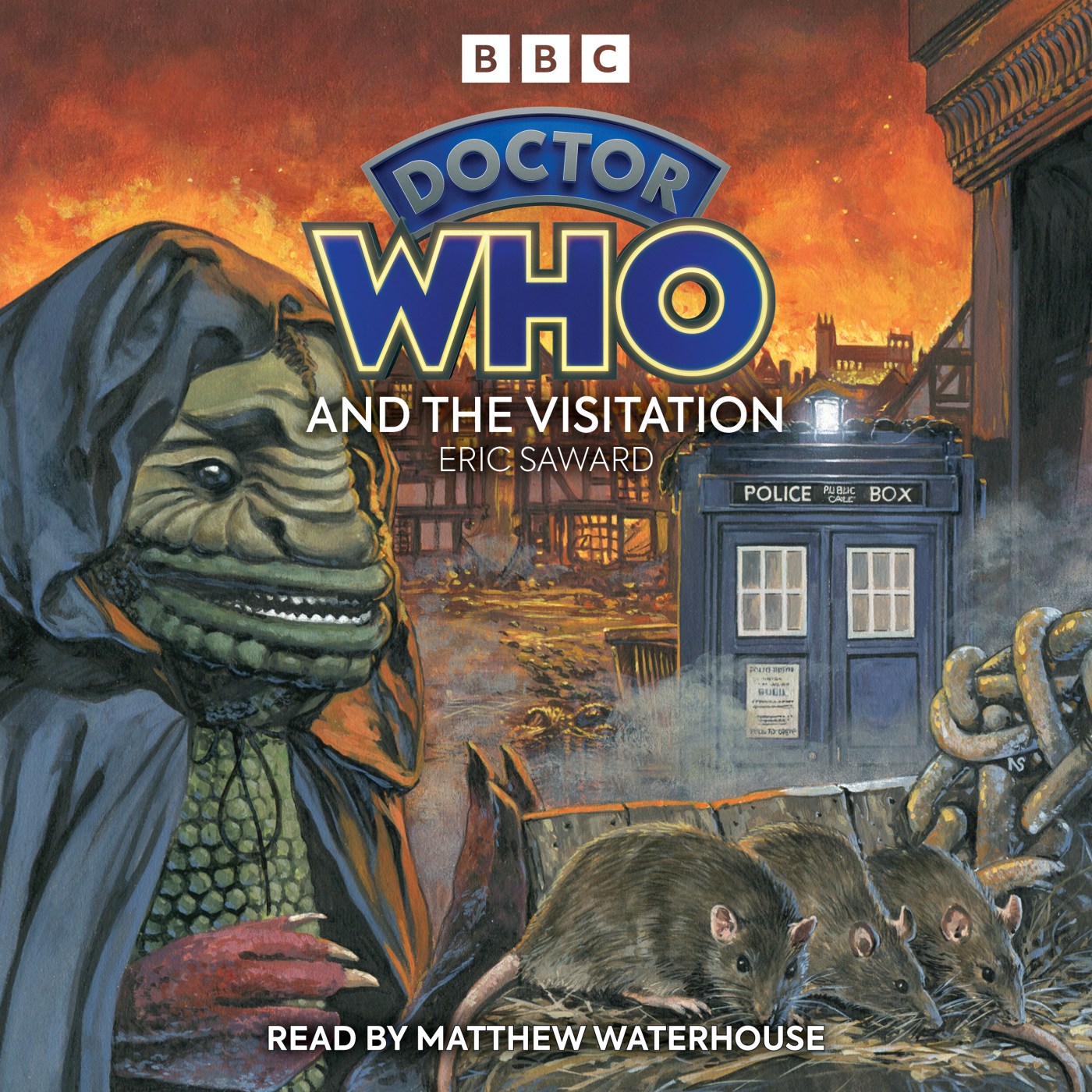
This month, our journey through the Doctor’s literary timeline takes us to 1982: Peter Davison begins his brief three year run as the Doctor on TV, and in books, the first of the Fifth Doctor novelizations gets published: Doctor Who and the Visitation, released in August based on a story broadcast in February. The writer is Eric Saward, a man who is, in my estimation, one of the worst writers the show ever had (in either incarnation) and bears some portion of the blame for getting the series canceled in 1989.
This is actually the third book of his that I’ve read: the last two were his own novelizations of the Fifth and Sixth Doctor Dalek stories, Resurrection and Revelation of the Daleks respectively, (published under BBC Books in 2019) and both of them were an absolute chore to get through. Reading the opening chapters of Visitation has convinced me that he doesn’t improve with age.
His main problem, as I see it, is that he seems to think using as many words as possible to describe something is the mark of a good writer. In his Dalek books, this gave the impression that he was trying to do a Douglas Adams impersonation, except that he forgot a key ingredient: a sense of humor. In this, he’s just being wordy for the sake of wordiness. (But at least you don’t need to have a dictionary nearby.)
There’s nothing wrong with having, and using, a big vocabulary, of course. Daniel Handler, when writing as Lemony Snicket, used his to teach children words they were unlikely to find on a fourth grade spelling test, such as “penultimate,” “inordinate,” and “brummagem.” Coming from Saward though, it’s hard not to get the impression that he’s doing this mainly to hit the maximum word count faster, like a college student writing a six page paper on Moll Flanders.
The Visitation is notable for being the story where the sonic screwdriver gets destroyed. The sonic was introduced in Fury from the Deep from 1968, then made periodic appearances for the next 14 years. When he became the show’s producer in 1980, John Nathan-Turner decided to kill it off, because it allegedly encouraged lazy scriptwriting. After all, what use is having the Doctor get captured if she can just sonic her way out of the prison cell? (Answer: by coming up with something a little bit more interesting than endless captures and escapes, which this story is absolutely full of, sonic or no.)
One story that this one reminds me of is The Time Warrior from 1974, the Pertwee-era story where, as with Visitation, an alien crash lands in medieval Britain. Specifically, a Sontaran, Linx, crosses paths with Irongron, a robber baron with whom he strikes a deal: if Irongron gives him help in fixing his broken spaceship, Linx will furnish Irongron with cool space weapons from the future. Irongron accepts, and the two play off one another well as their relationship gradually sours over the course of the story.
The other reason The Time Warrior works is because it introduces Sarah Jane Smith, played so well by Elisabeth Sladen. There, she’s a fish out of water for most of the story but doesn’t let that stop her, disguising herself as a scullery maid so she can go in and drug the food Irongron stole, so the Doctor can take back the alien weapons Linx gave him.
Sadly, The Visitation doesn’t work nearly so well. Linx was an actual character beyond being an alien, the Terileptil leader doesn’t even get a name beyond the title of “Leader,” nor a personality outside of Generic Space Villain. Even his goal is hopelessly dull: he wants to kill all the humans on Earth via plague-infested rats because they’re all such primitives, and so do not deserve to live. Which, as motives go, feels a bit incomplete coming from someone who isn’t a Dalek. They, at least, do that because they’re freaking Daleks, that’s their entire job. (Well, that and giving Nicholas Briggs a steady paycheck.)
But the Leader (because I am not spelling his species his name again) doesn’t have that excuse, he just crash lands on Earth and decides to kill everyone because he can. When the Doctor offers to put him somewhere else, he says that “A barren rock in space without a ship is not an acceptable alternative,” which is not exactly a compelling argument, seeing as how if his plan succeeded, he’d still be on a barren rock in space. A very huge barren rock, but still.
The Leader, to me, feels a bit like Tzim-Sha when he makes his second (and hopefully last) appearance in The Battle of Rassilon’s Coca Cola. There, Chris Chibnall took his somewhat compelling depiction of toxic masculinity and turned him into a version of The Captain from The Pirate Planet, minus the overly dramatic scenery chewing. The main difference though is that Tzim-Sha was, again, half interesting, much could have been made about how he and the Doctor were once closer to each other than she would’ve cared to admit. The Leader fails at even being interesting. (To say nothing of how pissed the Silurians might be if they showed up and saw him trying to wreck their old home.)
He even fails at being defeated in an interesting way! Sneaking into London in the dead of night to execute his plan, the Leader arrives at a bakery, and soon the Doctor and company show up. There’s a fight, and in the chaos a gun goes off, creating an explosion and setting off a fire. True, the fire in question is the Great Fire of London, but that fact is left unraveled until the last line of the book. Take out that context, and you still just have an exploding building.
There is one good thing about the book, however: the cover. When this book was originally released in the summer of 1982, the cover was plain blue with an orange and white version of the ‘80s “neon tube” Doctor Who logo design, and a stock image of Davison as the Doctor beneath the title and author credits. That was it. It tells you nothing about the story itself except that, for once, it hasn’t got Tom Baker in it. (A cover painting was designed by David McAllister, but was not used because Davison’s agent objected to it.)
By 2016, BBC Books had begun reprinting a series of old novelizations from the Target range, complete with the original cover illustrations for books featuring the first four Doctors, though the designs were different, featuring a cream background and a tan version of the Pertwee/McGann logo on top. These reprints started in 2011, and proved popular, so two more waves followed: one in 2012, and one in 2016.
Visitation came in the 2016 wave, and with it came a brand new cover by Chris Achilleos, the illustrator for 28 of the original line of books. This new cover (which was on the edition I read) features the Fifth Doctor, the Leader, and the android in its Death cosplay, giving you a much better idea of the story than a stock photo ever could. Plus, it sits rather nicely alongside the other books in the range.
Anyway, that’s The Visitation: not exactly one of Saward’s worst outings, but hardly an improvement over The Time Warrior either. Come back next time for a story in which political prisoners are graphically tortured for the entertainment of viewing audiences on TV: no, it’s not Bad Wolf, nor is it The Hunger Games: It’s Vengeance on Varos.


Leave a Reply