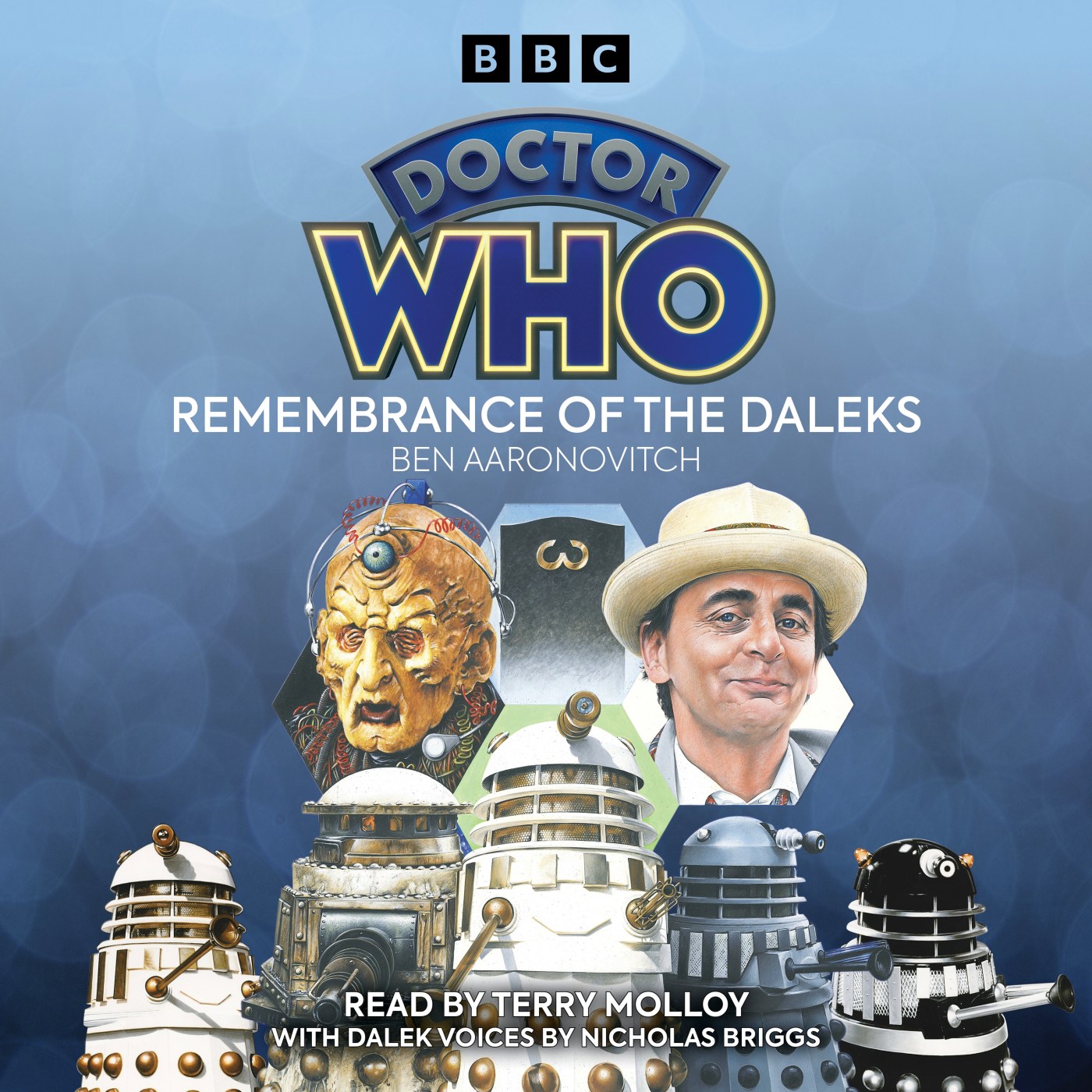
Remembrance is, by pretty much any measure, the best Dalek story of the 1980s. True, with a sample size of three that doesn’t sound like much, but trust me: it’s a vastly superior story to either Revelation or Resurrection, for a variety of reasons. While it wasn’t technically the 25th anniversary episode, it feels like one.
The book was released in 1990, after the TV show had been canceled but before the Target Books range gave way to Virgin Publishing’s line of original Doctor Whofiction, the New Adventures series. By the McCoy years, the edict to make the books child-friendly had largely subsided, which meant Aaronovitch now had free rein to dive into the world of the story. He writes in an introduction to the 2013 edition:
“I charged in with all the empty-headed mad enthusiasm of youth. Like many a first work, my novelisation can be seen as an amalgam of diverse influences, most of them from science fiction. Consequently, there are the portentous quotes from imaginary books, à la Frank Herbert, the supercharged cyberpunk imagery of the Dalek-on-Dalek battles, cf. William Gibson, and the flash memories by characters in extremis which I’m fairly certain I lifted from somewhere, even if I can’t remember exactly where.
Producer John Nathan Turner, catching wind of my reckless charge into the literary breach, asked me to at least try and make sure it matched the TV episodes as they were broadcast. There was a plaintive note in his voice – I think he had been burnt before.
One thing was certain, it wasn’t simply going to be the script with ‘he said’ or ‘she said’ added at the end of each line of dialogue. My characters were going to have an interior life and my fictional worlds would have some depth. Well, perhaps not depth exactly, but definitely not suitable for unaccompanied children under five.”
And does he ever deliver. With a prose style analogous to that of Malcolm Hulke, (whom he credited as one of his inspirations when writing the book) the story he tells is what I like to think the TV version would be like if it had been made as a TV miniseries, rather than as part of a continuing serial. The big-budget Netflix remake, you might say.
The last time we looked at a Dalek book, we visited their genesis; now the Daleks have come to the Doctor’s own beginnings. The story is set in November 1963, in the immediate vicinity of An Unearthly Child, down to the location: Shoreditch, London, Coal Hill School, with the chapters numbered accordingly. (Interestingly, the last two take place between 5:15 and 5:37 on Saturday, November 23rd, exactly when that episode was airing on BBC 1.)
The story is notable for a few other things: it’s the starting point for the Seventh Doctor’s reputation as a chess master, it’s the final appearance of the Daleks until their return in 2005, the final appearance of Davros until 2008, and of course, it’s the one where Ace beats the living shit out of a Dalek with a super-powered metal baseball bat. Here’s how Aaronovitch renders that moment in prose:
“A Dalek forced its way through the doors. It was close enough for Ace to see her distorted reflection in the burnished gold of the creature’s sensor pods. Even this close the Dalek made no noise as it zeroed in on the tape deck. Energy sprouted from its gunstick.
The tape deck exploded; a bench tap ruptured and water spewed out in a long arc.
The Dalek’s eyestalk swivelled to scan the room.
‘Small human female on level three.’
‘Who are you calling small?’ Ace brought the baseball bat down on the smooth dome. Neon blue tendrils of energy crackled as the bat hit, eating into the laminated surface. Slivers of armour exploded off the surface.
Ace struck the Dalek again before it could react – a glancing blow off the side.
The Dalek began to turn, describing a circle that would bring its weapon to bear.
Ace desperately swung the bat at the vulnerable eyestalk: there was a shower of sparks and the whole assembly parted from the dome and bounced away across the floor.”
When you look up anti-fascist in the dictionary, that should be the picture.
But what stuck out to me was how the story has aged, particularly in light of recent events in America. The most obvious link is the Daleks fighting a civil war between the white Imperial faction and black and gray Renegade faction, and gets described in the book in terms that deliberately evoke racial conflicts among humans:
“The virus fragmented the Daleks and left them in isolated factions, one of which seems to have resettled Skaro. This imperial faction seems to be in conflict with a force of renegade Daleks.’ The Doctor stopped working and looked up at Rachel. ‘And that’s odd.’
‘What’s odd about some internecine violence?’ said Rachel. ‘There’s been enough of it on this planet.’
‘Daleks don’t have internecine conflicts,’ said the Doctor, shaking his head. ‘One Dalek meets another Dalek, they bang databases, and one winds up giving orders to the other, except…’
‘Except what?’
‘Except,’ said Ace, ‘when one Dalek doesn’t recognize another Dalek as being a Dalek.’
The Doctor and Rachel both looked at Ace. ‘Very good, Ace,’ said the Doctor. ‘How did you come to that?’
Ace grinned. ‘Simple, ain’t it. Renegade Daleks are blobs. Imperial Daleks aren’t blobs – they’re bionic blobs with bits added. You can tell Daleks are into racial purity, so one faction of Daleks reckons that the other blobs are too different, mutants, not pure in their blobbiness any more.’
‘Result?’
‘They hate each others’ chromosomes,’ said Ace. ‘War to the death.”
Conflict between black and white organisms? Yeah, that’s basically American race relations right there. The civil rights movement was at its peak in 1963, so I have the feeling those choices for the props was on purpose.
But of course, we can’t talk about the Daleks and not mention the Nazis, especially this time around. Aaronovitch devotes several parts of the book set in Mike’s head revealing that Ratcliffe is a Nazi, and that he radicalized Mike when he was younger. Ratcliffe is revealed to have been jailed for supporting the Nazis, and formed the Association (a fascist group) after he was released. He allied himself with the Daleks in the hopes of using them to gain power, but of course, got himself exterminated.
And then there’s Mike himself: Mike is set up to be Ace’s boyfriend or something, and it almost works right up until he fucks up and mentions the Hand of Omega while the Doctor is in earshot, when he couldn’t have known about it in the first place. He’s been so thoroughly red-pilled that he can’t even see why Ace is pissed at him! If the Doctor hadn’t stopped her, she probably would’ve killed him! It’s good to see some fascists get what they deserve, especially since, out in the real world, they seem to be stronger than ever before.
It’s difficult to find anything else to say about this book beyond the fact that it’s freaking great, and you should read it, especially if you enjoyed the TV story. So instead, I’ll just entice you to come back next month for The TV Movie, in which we meet the Eighth Doctor and the Master shows up.


Leave a Reply