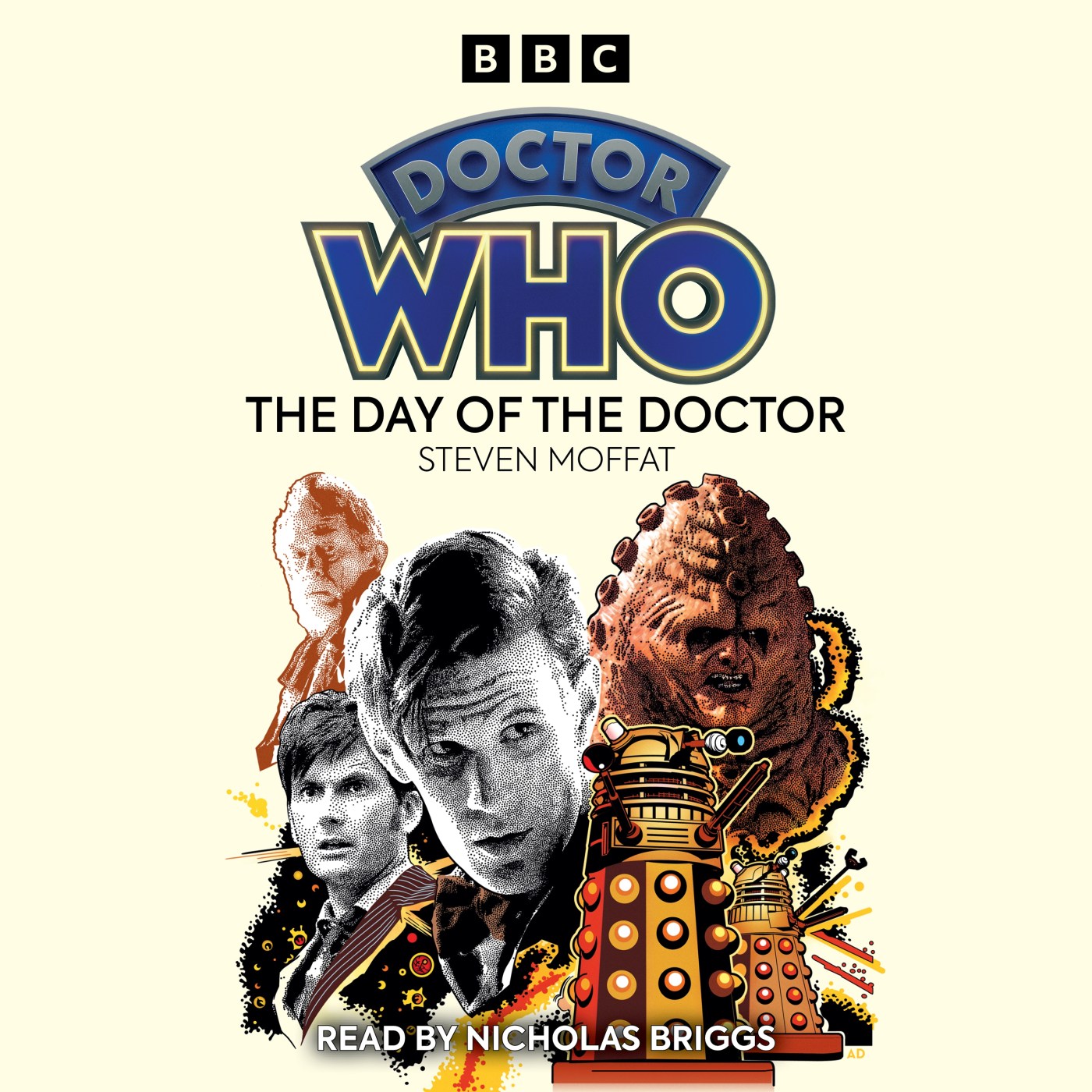
In 2013, Doctor Who was everywhere. That was the year it turned fifty, a number not often reached by very many TV shows or franchises, much less marked with an absolute bonanza of content. There were book reprints, behind the scenes books, the sudden release of two highly sought-after and well-regarded missing Troughton stories, audio plays, comic books, cook books, collectible drink cups with a Doctor’s silhouette on them, it was frankly ridiculous! I basically lived and breathed Doctor Who that year, from January first to December thirty-first. It was insane.
And at the center of it all was, of course, The Day of the Doctor: the TV show’s fiftieth anniversary special, featuring a returning beloved Doctor in the form of David Tennant’s Tenth, the incumbent in the form of Matt Smith’s Eleventh, and the mysterious War incarnation played so magnificently by Sir John Hurt. It won universal acclaim, became the number two movie in the United States when it was released in cinemas, and it was a phenomenally good story to boot, healing the show of an 8 year old cancellation wound (the Time War) and setting the stage for the future. It is, as I said on a podcast about it earlier this year, absolute perfection.
When I was choosing which books to read for this project, I knew I was always going to read this one: it’s my second favorite Eleven story, (no prizes for guessing what the first is) and at the time, it was the only one of his stories to get the Target treatment, so of course it’d go in the Eleven slot.
But when I watched the TV episode for the aforementioned podcast, I realized something: the Eleventh Doctor may have been the incumbent at the time, but all of the story’s narrative energy isn’t focused on him, but on the War Doctor. He’s the second Doctor we’re introduced to, and it’s primarily his decision on the last day of the Time War that the episode is focused on. It’s an Eleventh Doctor story in that it aired as part of his era and does focus on him more than on, say, Ten, but narratively speaking, it’s all about War.
So, on a whim back in July, I moved this book back several notches into the War slot, placing it after the TV Movie (and as the first chapter features the Eighth Doctor, this is a good move) and before Scream of the Shalka. And I’m glad I did, because when looked at as the sole televised War Doctor story instead of the penultimate Eleventh one, Day becomes a very different beast.
Let us begin with the first chapter: The Night of the Doctor, though it’s numbered as the eighth. As you’d expect, it’s a novelization of Day’s online prequel, which saw Paul McGann return to TV as the Doctor for the first time seventeen years, in a performance that seemed more rooted in a visual version of his Doctor’s Big Finish material than recapturing the Nineties. As on screen, Eight is killed when Cass, a woman he’d been trying to rescue, refuses to even go near the TARDIS and seals the door, dooming them both. The Doctor is then revived and, after a tense discussion with Ohila (from the Sisterhood of Karn) elects to regenerate via a poisoned chalice, and becomes the War Doctor, who is in fact narrating all of this himself.
Moffat being a reflexive comedic writer, he slips in lots of jokes: the first two Doctors were colorblind, the liquid in the unholy grail was just lemonade with dry ice, and so on. War’s relation of this story to the reader is filled with undisguised loathing of his previous self, it comes through even in print.
But the War Doctor changes as we move through the story, taking what we saw on screen through John Hurt’s acting choices and body language and extrapolating on it. Remember the scene in the TARDIS where the Doctors are contemplating how to break into the Black Archive? That scene in the book is told from War’s perspective, leading to the wonderful moment where he realizes, in real time, that for all his insistence upon not using the name, in his hearts he is still and will always be the Doctor, if in M.O. if not in name, and it’s glorious.
By far the best scene in the book is the saving of Gallifrey. On TV, we all remember flashes of archive footage being beamed around the war room with isolated lines of dialogue from various Doctors, but in prose, without worries about budget and the aging of actors, Moffat gives us that wonderful scene where all the Doctors save Gallifrey, but from the perspective of the ordinary people on the planet itself. It’s a beautiful scene, and while I’d love to quote it here in full, it’s worth checking it out in context.
That said, I will share the last paragraph:
“I was everywhere I was needed that day, across all my lives, and I believe I have never run so fast. If I sound proud, forgive me: it is the inverse of the shame I carried for so many years. This was the last day of the Time War, but it was no longer the worst day of my life. Instead, this was the day the people of Gallifrey rose up and put 2.47 billion children safely to bed. This was the day I remembered who I was, and swore never to forget again.
This was the day of the Doctor.”
That extract sums up the Doctor’s entire character, and why I fell so hard for the show as a pup. No matter what happens, no matter how dark it gets, there will always be a blue box nearby, and an alien inside ready to lend a helping hand. There is always hope, because the Doctor will always be there to provide it.
And of course the book ends, as all the best ones do, with chapter 13, and a quick cameo of the Thirteenth Doctor, that pillar of hope. And it’s good to see her, reflecting on everything that had happened, before going off to do what the Doctor always does: be brilliant.
If you haven’t read this book already, go and buy it. It’s magnificent, and somehow even better than the TV story, which was already fantastic to start with. And please join me next year for a look at Scream of the Shalka, the sole story featuring the Richard E. Grant incarnation of the Doctor… well, one of them. (That is, not the one who turned into Hugh Grant.)


Leave a Reply