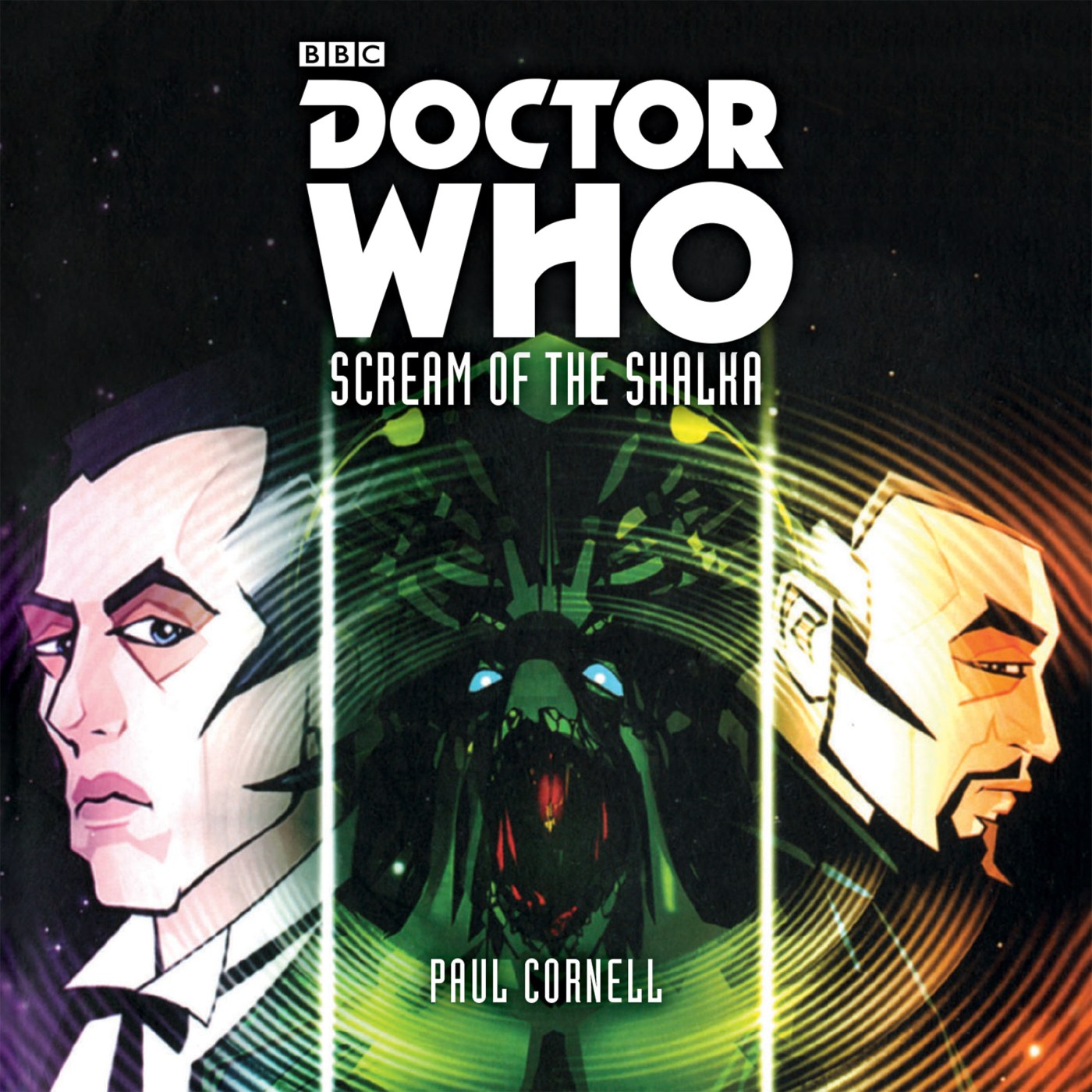
Scream of the Shalka is an interesting thing. Much like the 1996 TV movie with Paul McGann, it was an attempt to revive the show following the 1989 cancellation, but where the TV movie was essentially a backdoor pilot that failed to go to series, Shalka just happened to get made at exactly the same time as the news that Russell T Davies would be heading up his own revival of the show on actual television, rather than on the internet as a series of Flash animations, so the project was dead before it even hit the screen. It survives now on DVD (released in 2013, and then again in 2018 with a bunch of other animated stories) and in novel form: the book was published in 2004, and the audio edition in 2016, read by David Collings.
As a Doctor Who adventure, Shalka is pretty good. Sure, it’s not quite as good as Rose, but on the whole, a basic base-under-siege plot that intentionally avoids the continuity wankfest of the TVM with a neat idea for a monster is not a bad way to re-start a beloved TV show. And let me be clear, Shalka is not a pilot like the TVM was. It was absolutely intended to have follow-up stories.
Jon Arnold’s Black Archive book on Shalka mentions four: Cornell’s second story was published as The Masks of Makassar with the actual Ninth Doctor, a magic-based version of “The Dead Planet” by Stephen Baxter, a Jonathan Clements story that became Immortal Beloved, and Blood of the Robots by Simon Clark. All of these stories sound interesting (especially Blood of the Robots) but alas, none of it came to pass.
So, to the book then. Like the source material, it was written by Paul Cornell, and while it wasn’t published by Target Books, (the brand no longer existed) Cornell is very much telling the story as though it had been, complete with the requisite Terrance Dicks shout-outs: the TARDIS’ engine noises are described as a “wheezing, groaning sound,” there’s a chapter called “In the Hands of the Enemy”, and his initial description of the Doctor is reminiscent of how the Fifth was always described as having “a pleasant, open face.”
As with a lot of novelizations written by the original scriptwriters, Cornell goes ahead and expands the world of the story well beyond what was shown in the animation. The substitute Brigadier that the Doctor works with is given a background, as is Alison’s boyfriend Joe, and Alison herself. The sequences depicting the Shalka armies on other continents around the world are illustrated thoroughly, giving them a sense of realness that the animation severely lacked. Hell, even the two guys at the beginning of the story in New Zealand get backgrounds, and we never even see them again!
But where the story really shines, for me, is its conception of the central trio of the Doctor, Alison, and the Android Master. Here we have the Doctor, a nicely-dressed alien figure with a dark past that he is only beginning to recover from, with the Master as his only true friend in the universe, and he meets a Black female companion that helps him to undergo some much-needed character development and become, again, that hero of the ordinary people that we all love. Basically, Cornell has invented the Series 10 TARDIS team, minus Nardole. True, it’s a bit more traditional than 12/Bill/Missy, but even so, it’s very easy to imagine Shalka working as a late-Capaldi era story. (Goodness knows it’d be better than The Lie of the Land.)
By way of illustration, here are Cornell’s notes on the Shalka Doctor, from the extra bonus chapter at the end of the book:
“The DOCTOR is a hero. An alien. Unpredictable, witty, the absolute master of sudden and resolute action. He improvises brilliantly, using his vast experience of the universe and a pocket full of useful bits and pieces. Not part of any organisation or system, resenting having to work within such. He’s an intellectual, he’ll always go for the peaceful solution when he can see it. He prefers the little to the big, the domestic to the grand. He’s asexual, unattracted to humans. Or perhaps to anyone. Or perhaps his great degree of civilisation and kindness just mean he’s above that sort of thing. He’s incredibly brave and angry at cruelty.
BUT: not long ago he lost someone he cared about. Maybe he couldn’t do anything to stop it. Maybe it wasn’t his fault. But from now on he’s not going to have anyone close to him that could possibly get harmed, so he can rely on his own instincts and skills without having to look out for someone else all the time. It’s made him harder and colder inside, and completely unwilling to trust anything but his own judgement.
Perhaps he’s lost the little stuff a bit and, to save himself from pain, now only deals with the big stuff. He’s more at home battling monsters than having scones for tea.
Which is wrong for him. Not what he’s really like. So this story is about him regaining the little things in life by meeting ALISON and letting her into his life.”
I mean good grief, if that doesn’t scream Twelve in the immediate aftermath of Hell Bent and The Wedding of River Song then I don’t know what does. Remember, we’re talking about someone who tried to wipe Bill’s memory at the end of The Pilot for fear that she’d blab and share his existence with the rest of the world, but then he changes his mind because the women in his life (River, Susan, and the TARDIS) made him remember to be a Doctor instead. Clara might’ve told him to be the Doctor again, but he needed Bill to show him how.
It’s the same with Alison. The Shalka Doctor has obviously spent a long time with only the Master for company, refusing to let himself get emotionally invested in humanity even as he saves them time and again, but here comes a woman who refuses to let him get away with that shit any longer, and manages to get him to warm up to her.
Then there’s the Master. As with Moffat and Missy, Cornell is drawing upon the original incarnation of the character as played by Roger Delgado, where he and the Doctor were not bitter enemies but old friends who just happened to occupy different ends of the moral spectrum. Where Cornell innovates is taking the possibility of redemption hinted at in stories like Terror of the Autons and making that the basis of the character. His Master is still amoral, but not outwardly villainous. Rather, he’s more of an anti-hero.
And so it is with Missy. In Dark Water/Death in Heaven, she states point-blank that the reason why she went to the trouble of reanimating Earth’s dead humans into Cybermen is because she wants her friend back. Two seasons later, what happens? The Doctor works on redeeming her, getting her to cry when she remembers all the people she’s killed over the centuries and, in World Enough and Time/The Doctor Falls, having her practice doing what he usually does at the start of the story, and standing beside him at the end. (Or at least, that’s what she tries to do, except Harold kills her.) Had Missy lived and gone on to travel with Twelve for a season or two, I imagine their relationship would be not unlike the one in Shalka.
So: given the choice between the two versions, which is best? For my money, it’s the novelization. The animation is okay, but the limitations of what was possible with Flash in 2003 mean that it’s not exactly something I’d throw on if I wanted to watch Doctor Who just for the hell of it. Derek Jacobi probably gives the best performance out of the main cast, and while Grant isn’t awful (behind-the-scenes details suggest he put more effort into the recording process than the animation reveals) it’s also not his best performance anyway. For my money, he’s much better in The Curse of Fatal Death, and that was a 90-second cameo. Certainly, the unlimited budget of the reader’s imagination, combined with Cornell’s prose, means I can picture a live-action version of the story that, in my head, would be directed by Rachel Talalay.
What of the audiobook then? I’d definitely recommend that too. David Collings was an excellent choice for narration duties; the right reader can enhance your enjoyment of the book even beyond that of the prose alone, and actors tend to be very good at not just reading a book, but performing it, creating unique voices for each character and even changing delivery of narration depending on the context, for example Collings’ warm, conversational tone at the start of chapter 4, which elaborates on Joe and Alison’s relationship, and the more distant, neutral tone he uses for the Doctor’s introduction at the start of chapter 2.
Add the music and sound effects that are typical of BBC Audio’s novelization range (including the TARDIS noise, of course) and you have what is, in my opinion, the best possible version of a Doctor Who story that is unfairly forgotten. Scream of the Shalka is a fascinating glimpse of what almost was, and I wish there were more stories set within its continuity.


Leave a Reply