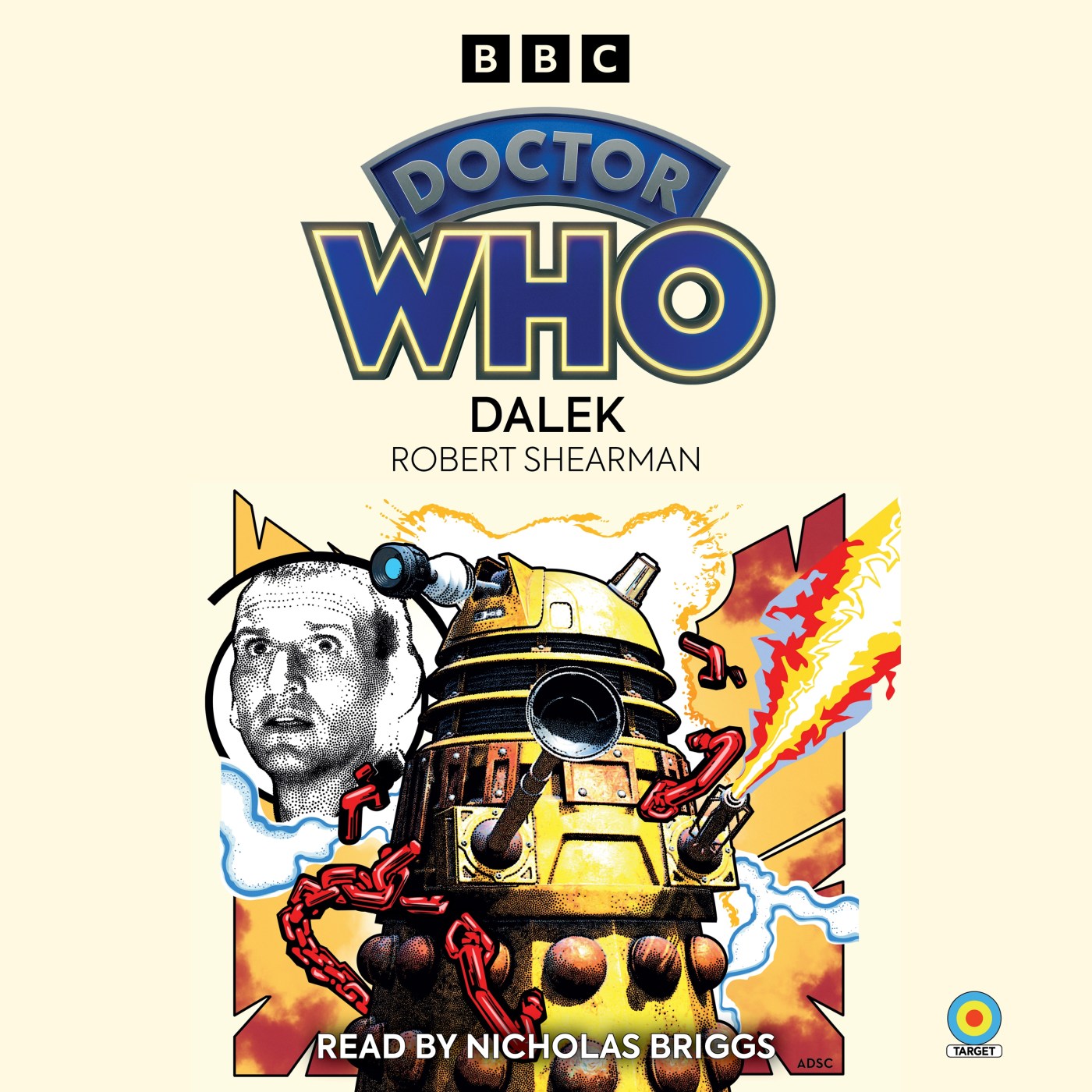
We’ve looked at a lot of Dalek books in this series, one for every decade: the sixties had Doctor Who and the Daleks, the seventies had Genesis, the eighties got Remembrance, and now we come to the fourth and final one: representing the 2000s is the quintessential revival Dalek story… Dalek.
And it is, in my humble opinion, the best Dalek book I’ve ever read.
But before I explain why, let’s take a moment or two to consider what we’re reading: a Target novelization of a New Series story. Retroactive insertion of the War Doctor aside, this is a huge moment: the older Target books primarily existed in a time before the advent of home video, when paperback retellings of old stories were the only way to experience those stories if you’d missed them when they aired.
And even when home video releases started, with the arrival of Revenge of the Cybermen on VHS in 1983, there were still plenty of stories that could never be watched again, like Marco Polo, The Space Pirates, or both of the Troughton Dalek stories. But all of those were eventually novelized, and could be said to exist in some form, if not in the original medium.
But the modern era Targets occupy a very different place in the Doctor Who landscape: these are objects of nostalgia, with cover art designed to replicate the art on the books from the early 1970s. Everyone who’s written a modern Target remembers reading the originals, and that informs how they redo the story from one medium to another.
But more to the point, every single one of the next few stories we’ll be looking at doesn’t just still exist, you can watch the episode on iTunes or BBC iPlayer or wherever right now, no book necessary. Hell, Davies himself even said no when someone asked if they’d be novelizing New Series stories like they had the old ones… and then 13 years later, he went and wrote one anyway.
So, if the original source material is ridiculously easy to cue up for a rewatch and the product mainly exists to cause nostalgic pangs in those fans who remember reading the old books, (which is, to be honest, everyone) why make them? Why coast along on nostalgia? The same reason Beatles tribute bands and Big Finish still exist: because it’s fun, and as I’ve argued before, the ideal place to tell a Doctor Who story is in prose.
In the world of literature, you’re freed from the budget constraints of the BBC financing department. You can turn what was a standard-definition story with increasingly bad CGI and obvious video tape artifacts into something that looks like it was shot with the budget afforded to Marvel movies, simply by painting a picture in words and letting your reader’s imagination do the rest.
All of a sudden it doesn’t matter that David Tennant has more pronounced wrinkles in 2013 than he did in 2008, or that the American accents in Dalek range from legit (Van Statten) to Nicola Bryant levels of bad (Goddard). You can simply pretend that Ten looks like he just stepped out of Journey’s End, or that Van Statten’s goons aren’t just Brits pretending to be Yanks!
And most importantly, you get to expand the story’s world far beyond than would be possible in a 45 minute story. That’s what makes the Target version of Dalek so good, even though its primary focus is still on the original TV episode, the world it inhabits becomes so much larger as we learn more about various characters, from Van Statten himself to the people who work for him. Even the Dalek gets fleshed out!
Yes, really. The Dalek gets fleshed out. If you’ve ever wanted to know why Daleks do what they do, or what happens when a laser bolt hits you, this is the book for you, because to grow up Dalek sounds like one of the most hideous things imaginable. I don’t really want to say why for fear of ruining the experience, but trust me when I say it’ll make you look at this Dalek in a whole new light.
Some of the best stuff in the book, for me, is how Shearman chooses to depict the Dalek’s strange relationship with Rose. She becomes the only person in the universe to show a Dalek compassion, and of course that freaks it out, since it starts to change and grow beyond its programming. We’ve seen Into The Dalek, Rusty in that is pretty much what would have happened to this Dalek had it not decided to commit suicide.
And I love how Shearman depicts that relationship in prose form. It’s already surreal to see on screen, but on the printed page, when all you have are words, it gets even better. Rose showing the Dalek compassion here, in my opinion, is what allows the Doctor to save Rusty and make him Dalek-hating again, and later, let himself regenerate Davros and the rest of the Daleks in The Witch’s Familiar. (Well, that and his usual instinct to outplay Davros, but I digress.) If he hadn’t seen Rose do what she did, take an outsider’s view to the Doctor/Dalek conflict and find a third option, the outcome of those stories would’ve been very different.
And this book, as an object, comes at an interesting time: Christopher Eccleston has been busy reprising the role of his Doctor for Big Finish after repeatedly saying no until finally saying yes, with one series of twelve stories being released as we speak, with a second one due to begin sometime next year. Daleks probably won’t be on the menu in the villains he must face department, and honestly, that’s okay.
Dalek is, for my money, the perfect Dalek story. Genesis and Remembrance are both great too, but Dalek is absolute perfection, especially in prose form. All the accumulated cruft is stripped back to the bare essentials: the Doctor, a Dalek, and the ways they are, or aren’t, so different. “You would make a good Dalek,” it tells the Doctor in Chapter 8, and honestly it’s right on the money. Good thing Rose is there to make the Doctor see the error of his ways.
Also worth tracking down: the audio version of this book, read by Nicholas Briggs. Sure, okay, it means subjecting yourself to his legendarily terrible Eccleston voice, but it also means you get to hear him put an entirely new spin on the famous first confrontation between the Doctor and the Dalek in the Dalek’s cell, as in this YouTube clip.
So. in summary: Dalek is brilliant, and you owe it yourselves to get a copy. The rest of the Doctor Who book line might be dying a death, but the novelization range is as strong as it’s ever been. I’m glad the modern series is getting adapted, and I hope, someday, that all of it does. Even if it takes 54 years.

