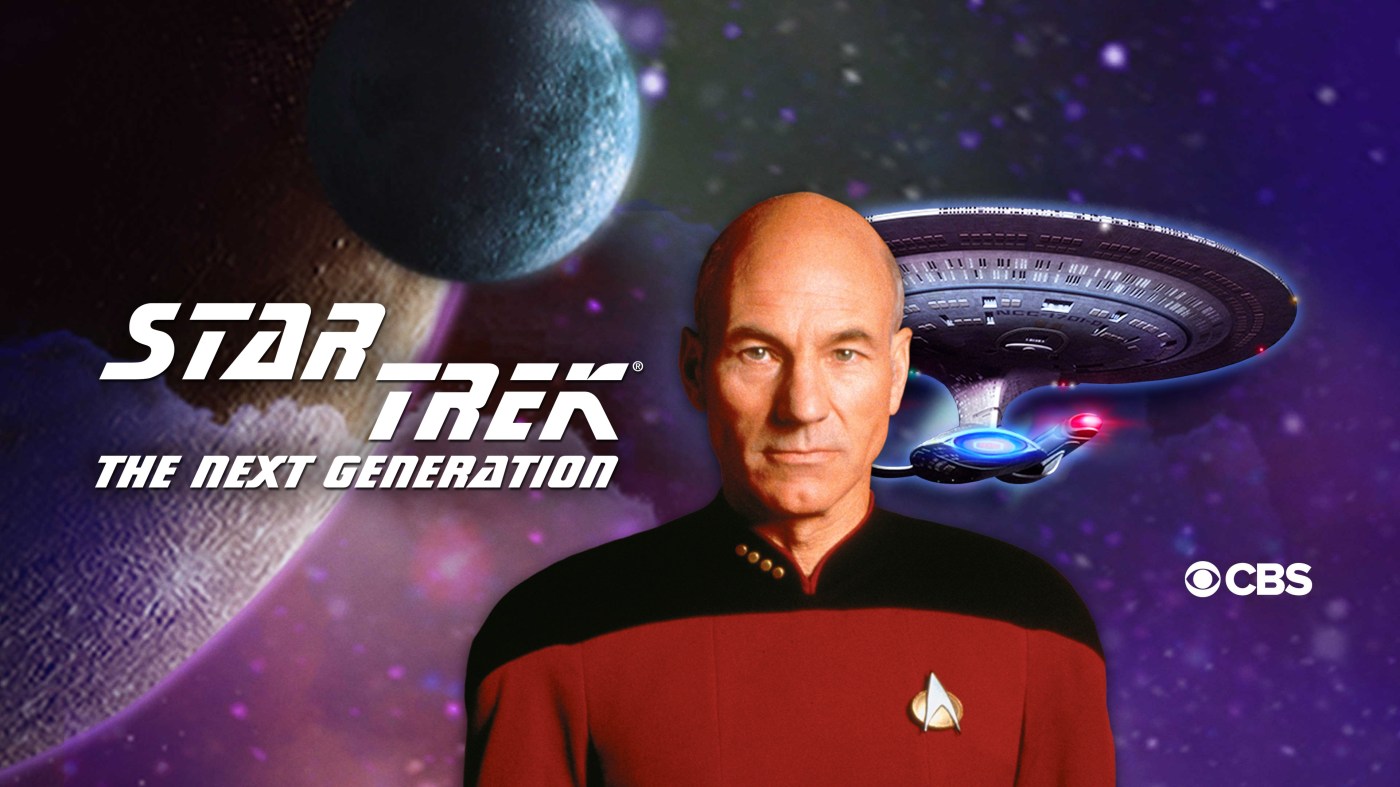
Captain’s log, stardate 78851.3: “Captain Jean-Luc Picard leads the crew of the USS Enterprise-D on its maiden voyage, to examine a new planetary station for trade with the Federation. On the way, they encounter Q, an omnipotent extra-dimensional being, who challenges Humanity as a barbaric, inferior species. Picard and his new crew must hold off Q’s challenge and solve the puzzle of Farpoint station on Deneb IV, a base that is far more than it seems to be.”
I am, first and foremost, a Doctor Who fan. But if you’re reading this, you already know this about me. Ever since the original Back to the Eleventh Hour and Adventures in Narrative Substitution blogs in 2019, I’ve been writing Doctor Whocriticism for a good long time now. Four whole years, two book releases, and I’m still only just getting started! In the next year I want to finish Back to the Eleventh Hour, and if there’s room, do a Capaldi series as well, either in print or as a blog. Between that and the RTD Rewind, I’ll have covered every episode of revival Who, barring the Gatwa era. That’s a lot of words for something that’s almost 20 years old!
But every now and then, a girl needs a break. What else is there? What’s next on the list? Where do you go after innumerable adventures in the time vortex?
Well… how about…
Space. The final frontier.
Yes, dear reader, I am talking about Star Trek, the other 60-some year old science fiction franchise out there. It’s not quite America’s answer to Doctor Who, but it does occupy a similar space in our cultural fabric as Doctor Who does for Brits. And unlike Doctor Who, it wasn’t really a thing I was exposed to much, not really until my early ‘20s, when Discoverystarted. I had some hazy memories of watching LeVar Burton in TNG reruns, (I always referred to him as The Reading Rainbow Guy) I read a TNG/Doctor Who crossover comic series, and I saw the first and third Abrams movies, but it wasn’t really until Discovery that I started getting into Trek properly.
And Star Trek, I must admit, felt like an imposing thing to dive into. All you need to understand about Doctor Who is that there’s this crazy alien person with a big scarf who travels around in a blue box having adventures and fighting monsters. Easiest thing in the world!
But Star Trek was different. It wasn’t just one show, it was five, and thirteen movies. It had rules. The Enterprise wasn’t a place where you hung out in between trips, it was where you worked. Everyone had a job to do and a role to fulfill, there were ranks and uniforms, it was all very formal and stuffy. Doctor Who was the fun show with monsters made of green bubble wrap and tin foil, Star Trek was for serious people who talked about serious things. And so, coming from the fandom for the quirky British thing, what could there possibly be in Star Trek for me to like?
The answer turned out to be hope and optimism. As anyone who’s read my work knows, those two things form the core of what makes me who I am, and Doctor Who reflected that a lot, especially during the Moffat seasons. Star Trek does too, but in a very different way. If Who is an argument in favor of a supreme being (or at the very least a powerful janitor) fixing the problems of the world with a wave of the sonic screwdriver, Star Trek is about what happens when We, the People, decide to start rescuing ourselves, and being the heroes of our own stories. You can probably guess how that theme sits with me.
So, what’s Wolf Trek then? It’s exactly what you think it is, dear reader: your friendly neighborhood sci-fi wolf exchanges her bow tie and fez for a Starfleet uniform. If Star Trek is a journey across the stars, Wolf Trek is my journey through… well, Star Trek, from the original series in the 1960s all the way to right now. (Or wherever we are by the time this series finishes.) It’s not quite a review blog, nor is it an analysis series, though it will have elements of both. It’s something altogether stranger than that.
It’s a voyage. To explore strange new worlds, to seek out new life and new civilizations… to boldly go where no wolf has gone before.
***
We begin not where you should start, with the original series, but with the show that brought me into the Trekkie fold – Star Trek: The Next Generation. TNG is enjoying something of a renaissance at the moment, in light of Star Trek: Picard’s third season bringing back the main case of that show for one more run, so I think it’s the logical place to begin.
My copies of these episodes come from the Picard Legacy Collection, a 54-disc limited edition set that contains absolutely every episode of Star Trek to feature Patrick Stewart as Jean-Luc Picard. So, this first part of our journey will take us from “Encounter at Farpoint” to “The Last Generation,” the grand finale of the TNG era. It’s a long voyage, but one worth taking.
Let’s see what’s out there.
***
What stands out about “Farpoint” is just how good it is. I’ve seen this story at least three or four times now, and every time I watch it, my estimation of it goes up a bit. Please understand that I’m not trying to big it up because it’s the first episode of my favorite show: “An Unearthly Child” was the first Doctor Who story, and yet aside from that amazing first episode, the back three of that story roundly suck.
“Farpoint” has a lot going for it. It has the gorgeous new Enterprise sets, particularly the bridge. It has the Enterprise-D herself, all sleek curves and a distinct profile that sets it apart from either one of Kirk’s ships. And of course, it has a stellar cast: Patrick Stewart, Jonathan Frakes, Brent Spiner, Gates McFadden, Marina Sirtis, Michael Dorn, LeVar Burton, Denise Crosby… all of them wonderful actors, bringing their characters tp life with aplomb. I’ll even pay a compliment to Wil Wheaton, whose role in this story is largely to be The Kid Amazed at Everything. (From what I’ve heard, his facial expressions when he steps aboard the bridge toward the end of part 2 were legit.)
The bulk of this story came from D.C. Fontana, who’d written for the original series, while Gene Roddenberry handled the scenes with Q, who wasn’t in Fontana’s original drafts. And while I am not generally disposed to give Roddenberry much credit for anything beyond creating Star Trek, I honestly believe that Q is the reason why TNG survived for seven seasons.
Let me explain: If you were to cut all the Q scenes out of the episode, “Encounter at Farpoint” becomes something more like the original series: a new Enterprise crew going about its business, and trying to determine why it is that the Farpoint starbase doesn’t quite make sense. It’s still a compelling story, but it doesn’t give you a reason to care about the characters. There’s no hook.
Look at it this way: TOS’s “first” episode, “Where No Man Has Gone Before,” told the story of an old school friend of Kirk’s being given god-like powers and going insane. We, the audience, are on Kirk’s side, feeling for him as he is forced to fight against, and kill, someone he was once close to.
DS9, you have the story of a Wolf 359 vet now finding himself thrust into the position of station commander, dealing with Alpha Quadrant politics and becoming the Emissary of the Bajoran faith. VOY, it’s Janeway and her crew being thrown halfway across the galaxy, forced to ally with unfamiliar aliens and the Maquis in order to survive. Even Discovery, first of the new era of Trek shows, has a hook: Michael Burnham, who is by all appearances Starfleet to the core, commits mutiny and starts a war with the Klingons.
Q is integral to TNG: without him, Farpoint is just another adventure-of-the-week story, no different to any other episode of the season. If not for him, I honestly believe the show wouldn’t have made it past that first season, and that was a close thing to start with. Besides: you have to remember that in 1987, no one thought Star Trek could work without the original cast in place. TNG showed that it could, and it’s all down to Q.
So, what is it about Q that makes him such an important figure, and thus hook-worthy?
Aside from the fact that John de Lancie and Patrick Stewart have amazing chemistry together, Q gives the show some much-needed stakes. Humanity’s fate rests in the hands of Captain Picard and his crew, and we don’t know if they’re up to the task.
In a way, Q represents the naysayers of Trek fandom, and there have always been naysayers. It’s hard to believe now, in this age of the TNG Renaissance, but even in 1987 there were people who swore up and down that if it didn’t have Kirk, Spock, and McCoy, then it wasn’t Star Trek. Q wants the show canceled and forgotten, Picard is fighting to allow for his voice to be heard.
It’s true that “Farpoint” isn’t TNG as we remember it. Riker doesn’t have his beard yet, Geordi isn’t yet the chief engineer, Worf isn’t at tactical, and Picard is a little bit too brusque and cold than the warm, albeit somewhat distant wise man we all remember. But if you look at it with one eye toward the future, then you can see where the road is headed.
And again, it’s Q that helps us get there. Just look at the courtroom scene, when Picard attempts to plead his case. While he accepts that humanity made mistakes in the past, over and over again he insists that they have grown, that they are no longer a “grievously savage child race.” This optimistic spirit is what Star Trek is all about, and it’s why I love this franchise so much.
When I showed my girlfriend this episode, she had two major lines of thought regarding it: she hated Q, and loved the space jellyfish that appear at the end. I asked her why she didn’t like Q, and her answer was that he was far too snide. In her estimation, even when he does appear to soften up in later seasons, he still operates from a place of selfishness.
It’s an interesting observation to make, and one that I think gets at why Q works best with Picard, appearances on DS9 and VOY notwithstanding. They are foils for each other, even here at this early stage. Picard may be stern and cold at times in this episode, but he still has the crew’s best interests at heart, and he’s willing to fight for them. Q, naturally, doesn’t care about any of that… yet. But over the course of the next seven seasons, the two of them will eventually grow and learn from one another.
And so will we.


Leave a Reply