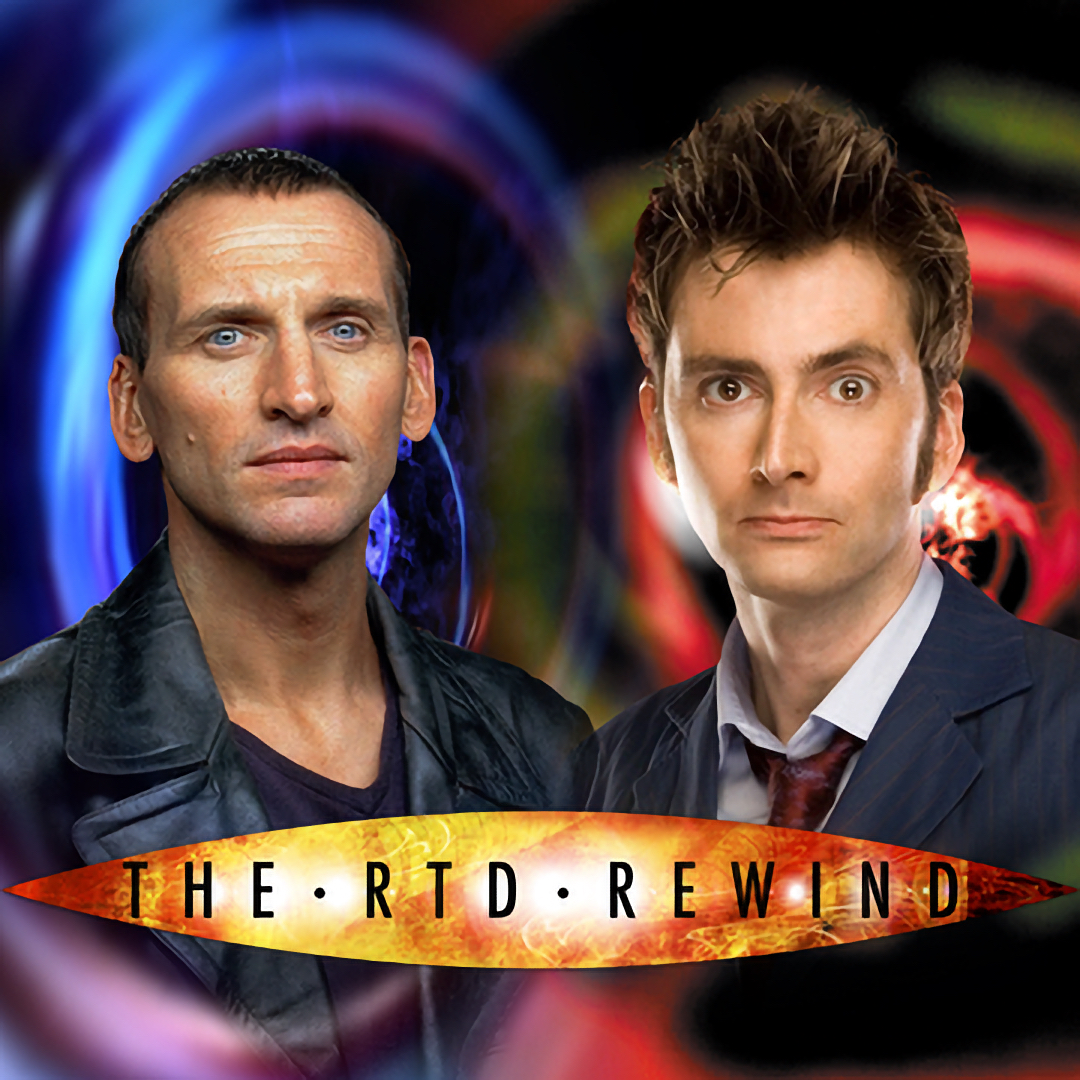
I imagine the central joke of this episode might’ve worked better in 2008, when David Tennant leaving the series was public knowledge, but the identity of the new Doctor wasn’t for another week or so. (I am, in fact, writing this on New Years Day 2024, fifteen years to the month since the Matt Smith announcement.)
In that liminal space that exists between the handover of the Doctors, doing a story like this, and flirting with the concept of David Morrissey as the Eleventh Doctor, is audacious. It might’ve even worked, had it not been announced that Davies was leaving along with Tennant.
As it is, Davies doesn’t stay with the idea for very long. The fact that Morrissey’s Doctor doesn’t recognize 10 in the cold open flies in the face of how multi-Doctor stories usually work – the future Doctor always recognizes the previous face. Just look at how Eleven reacts to Ten in The Day of the Doctor, for example.
Perversely, this exact concept would be explored in the Chibnall era’s own version of a multi-Doctor story, Fugitive of the Judoon, where neither of the Doctors (Whittaker’s Thirteenth and Martin’s… well, let’s call her the Zeroth Doctor) recognize each other because of missing memories. But even that explanation doesn’t work, because A) the Timeless Child arc didn’t exist in 2008, and B) it’s pretty quickly revealed that Morrissey’s Doctor is just an ordinary man with some of the Doctor’s memories.
But in a way, the premise of The Next Doctor (an ordinary person fills the Doctor’s role in the narrative temporarily) does, for me, echo forwards to a recurring theme of late Moffat: starting with the episode Flatline, the role of the Doctor is split (at various points) between Clara, the Doctor himself, and Missy.
Clara, of course, gets a TARDIS of her own and flies away from Gallifrey to have adventures of her own, while Missy is gradually reformed over the course of series 10, culminating in World Enough and Time, where she straight-up pretends to be the Doctor… until everything goes horribly wrong and she, presumably, regenerates into Sacha Dhawan’s incarnation.
But I digress. The Doctor is one man from Gallifrey, yes… but the title, and the promise that it entails, can be taken up by anyone. Even RTD himself gestures in this direction toward the end of this episode: “Jackson, if anyone had to be the Doctor, I’m glad it was you.”
Does that mean that Next Doctor is a multi-Doctor story? I would say arguably yes. Jackson Lake may not be the next incarnation of our favorite quasi-immortal Time Lord, but he was the Doctor, according to no less an authority than the man himself. Which also means that, due to the whole meta-crisis thing, Journey’s End was a multi-Doctor story too, just not of the traditional “past and future incarnations meet” variety that we’ve had since The Three Doctors.
Actually, it’s quite interesting how rarely that kind of multi-Doctor story occurs in the Davies era. And by rarely, I of course mean once, and Davies didn’t even write it! That was Time Crash by Steven Moffat, who would then go on to write the vast majority of the revival multi-Doctor stories. The only true multi-Doctor story Davies ever writes is The Giggle, and even that has a twist on the formula: Fourteen was the past Doctor all along, standing in for Ten.
As it goes, I would say The Giggle is probably the better of the two stories (since it has two of the actual Doctor and all) but dammit, Next Doctor is just charming and fun. David Morrissey plays a great pseudo-Doctor, and I admit I’m a sucker for a steampunk aesthetic.
Where the story weakens, for me, is the Cyberman plot line. Ms. Hartigan, presumably, is supposed to be a dark mirror of Jackson Lake (an ordinary human who allies herself with alien beings from the future) but as a villain, she’s really not terribly compelling. Cybermen in a cemetery working as grunts is interesting enough, so if you squint, you can see the starting point for Death In Heaven, with Ms. Hartigan as like a proto-Missy.
However, making her into the Cyberking just invites unfavorable comparisons to the Borg Queen, specifically the version played by Annie Wersching in the second season of Star Trek: Picard. In that season, the Queen becomes an unwilling member of the crew of La Sirena when her crew are stranded in the then-future year of 2024, and forms a bond with Agnes Jurati, everyone’s favorite cybernetics researcher… only to wind up becoming the Queen in the last half of the season.
It is maybe unfair of me to compare Hartigan with Jurati, given that Jurati was a series regular for two of Picard’s three seasons, and Ms. Hartigan is a one-off villain in a Lenatmas episode, but even so: more work is done in PIC season 2 to justify Jurati’s transformation into the Borg Queen than is ever done to justify Ms. Hartigan’s allyship with the Cybermen. She’s just Generic Doctor Who Villain #47.
Even so, it’s hard to hate The Next Doctor as a piece of television. Again: Age, I think, has improved it. And if you don’t like it, well, good news: according to Flesh and Stone, the events of this episode now never happened thanks to the Cyberking being wiped from history by the cracks in the universe seen in series 5, which presumably means our Mr. Lake was never made a widower.
It occurs to me that I think this is probably my favorite of the original Davies era Lenatmas specials, perhaps because it’s the only one he ever did that actually looks like Lenatmas. (Thus the inverse of Runaway Bride, which was shot in July and looks like it.) Is it my favorite Lenatmas special ever? No, that’s still A Lenatmas Carol and always will be, though The Church at Ruby Road is certainly lurking in my top five.
Speaking of Lenatian holidays, next time we get to Doctor Who’s first ever Easter special… and, thankfully, the last.


Leave a Reply