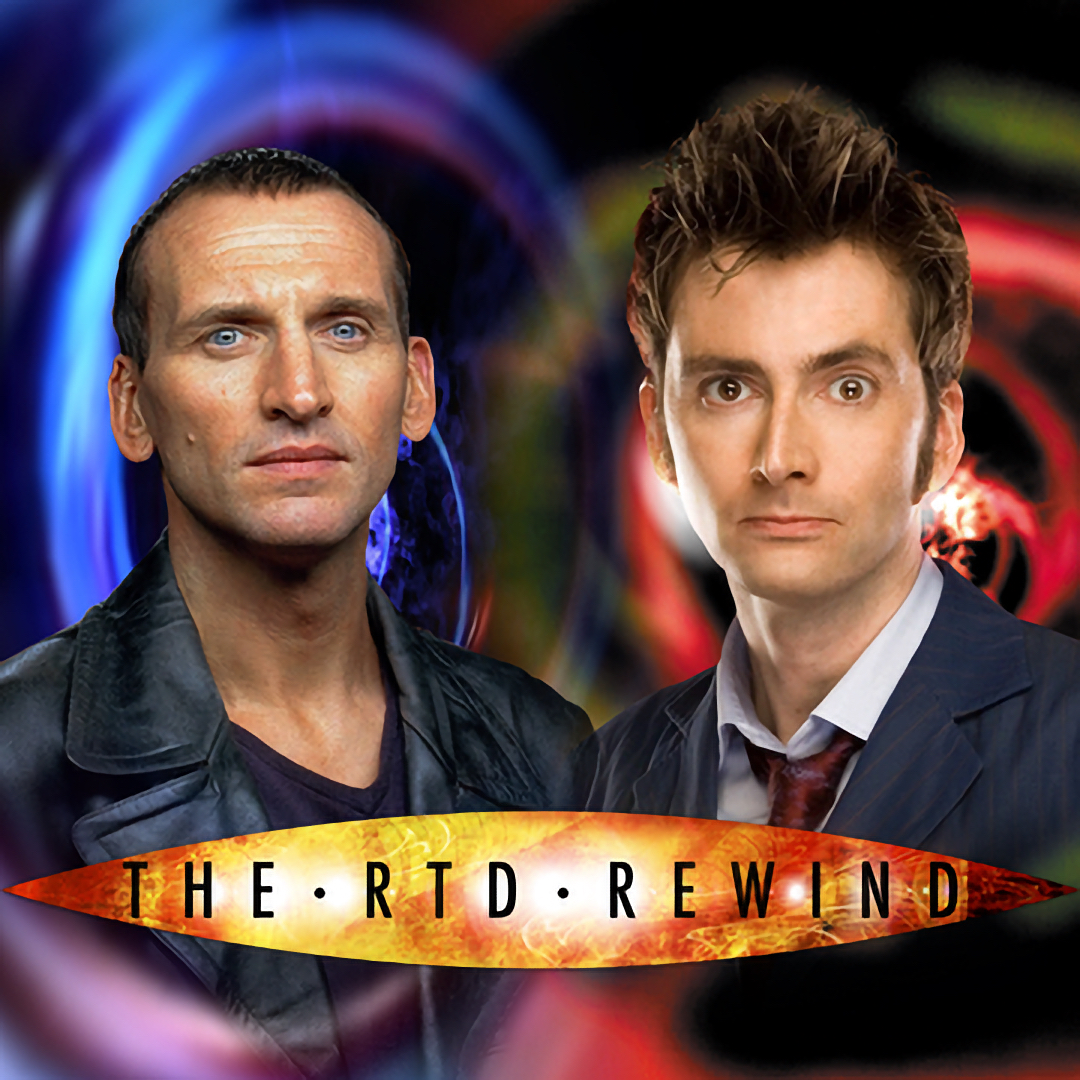
Hard to believe that it’s been two years since I started this watch-through of the original Davies era. A lot’s changed since then: I used to live in Missouri, and I used to watch these on my days off from my retail job. Now, I live with my girlfriend in New York, and writing has, more or less, become my full-time job. Not a bad gig when you think about it.
The funny thing about finally getting to this story after two years is that, in the time since I started, RTD has come back and David Tennant’s had a whole second era as the incumbent Doctor, albeit a very brief one. I’d hoped to finish this series before we saw Fourteen, but thanks to various delays, that didn’t happen.
It’s for the best though, since it means I can look at both of David Tennant’s final stories and say, “Which one is better?”
The answer, of course, is The Giggle. Admittedly this might be recency bias talking, but bear with me here. The two stories are actually fairly similar in some regards: the David Tennant Doctor fights a new battle with an old enemy, specifically the Saxon Master in Time, and the NPH version of the Toymaker in Giggle.
(And there’s definitely more than a little of John Simm’s version of the Master in how Neil Patrick Harris plays his part. In Count Olaf’s hands, the Toymaker makes for an excellent substitute Master.)
But I think what really clinches Giggle for me, aside from hanging together a bit better plot-wise, is the story’s feelings on death and regeneration. In that respect, the two stories are polar opposites of one another.
The End of Time views regeneration as something to be endured, a form of death all by itself. And to an extent, that’s true: as the Doctor says to Wilf in the cafe scenes, everything that particular Doctor is dies, and someone else takes his place. The Doctor holds that change off for as long as he can, even though he knows full well that it’s coming, and the resulting change is so dramatic that even the Tennant era console room gets destroyed.
Compare this to how regeneration is treated in The Giggle, at the start of act 3:
DONNA: It’s okay.
DOCTOR: It’s not dying.
DONNA: I know. But…
MEL: You’re going to be someone else. It doesn’t matter who, because every single one of you is fantastic.
DOCTOR: It’s time. Here we go again. Allons-y!
And what is Allons-y in English? “Let’s go,” the exact opposite of Ten’s final words: “I don’t want to go.”
Fourteen is a Doctor who remembers being Eleven, Twelve, and Thirteen, and how all those Doctors reacted when their time ran out and the regeneration neared. Every one of them accepted it peacefully, and for that matter, so did Nine and War. Ten is alone among the revival Doctors for fearing death, rather than embracing it. (Eight’s death doesn’t count, because his amounted to suicide.)
Now in 2010, Ten’s resistance to regenerate just smacked of vanity issues and hubris again. And admittedly it still does, especially just before he opens the glass box to rescue Wilf, when he stomps around smashing things up and throwing a temper tantrum. But subsequent developments can, in a way, explain his fears if not justify them.
Let’s start with the obvious. Ignoring The Timeless Children, we learn in 2013 that the Doctor, as of The End of Time, is on his penultimate life: the War Doctor used up one regeneration, while the aborted regeneration in Journey’s End used up another one. Turning into Matt Smith will mean he’s on his last life. On top of that, he’s certainly subconsciously aware that Trenzalore isn’t too far off, even though he doesn’t remember learning that information.
So, while Ten’s attitude toward death is ridiculous, it is at least understandable in light of the Smith era. The End of Time still works as a finale for the Tenth Doctor and the original Davies era writ large, and it’s good to know that the meta crisis arc now has a proper ending. True to his word, the Doctor did see Wilf again, one more time.
Speaking of Wilf: If I have to give The End of Time any credit, it’s the way in which Wilf is foregrounded in the plot. Obviously, in 2009 and 2010 that was because Donna couldn’t be used, but here in 2024, in light of Bernard Cribbins’ death, scenes like the Doctor telling Wilf not to die in part 1, or their conversation on the spaceship in part 2, and even the Doctor giving up his life for Wilf’s sake, all take on new meaning. Wilfred Mott was one of the best parts of late Davies, and it was a genuine pleasure to see him again in Wild Blue Yonder.
But this, his only story as a companion, is his true memorial.
Fourteen years on from when The End of Time was new, I have to say, I like it. I’ll never love it, and again, The Giggle is easily the better Tennant regeneration story, but this isn’t too bad either. It’s just funny to me that in the ensuing decade and a half, both the lead actor and the writer have returned, although the latter will be sticking around longer than the actor did.
As an aside, it always makes me happy to see Tennant’s face transform into Matt Smith’s. Given that I plan on switching gears and working on the third Eleventh Hour book on the Monday following the day I write these words, seeing my Doctor again in the earliest moments of his birth is a nice lead-in to his own final run of adventures. For one brief moment, I felt taken back to 2010. Seeing my Doctor again, after two years of watching all the stories that preceded him, felt like a reward.
But for now, back to the future.
Geronimo.


Leave a Reply