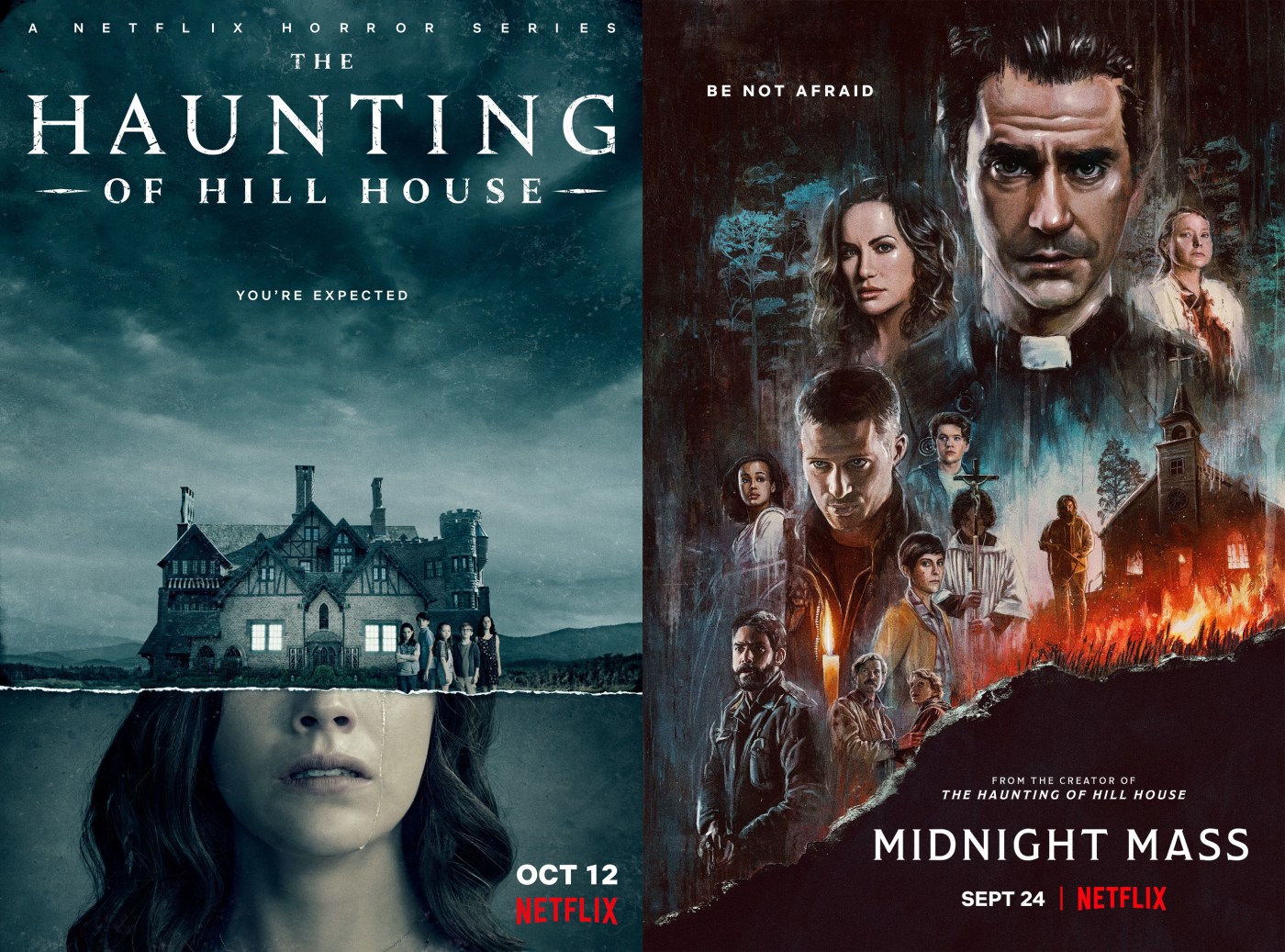
Since October, my girlfriend and I have been working through the Netflix oeuvre of Mike Flanagan, contemporary master of horror. Our first show was his final one for Netflix, The Fall of the House of Usher, which I’ve reviewed previously. November and December’s viewings were Midnight Mass and The Haunting of Hill House, his very first Netflix show. (Wouldn’t be the first time I’ve watched a series out of order – this is exactly what happened with the ‘90s Addams Family movies.) Since we watched them both in fairly quick succession, I’m going to write about two shows at once!
Midnight Mass (2021)
Midnight Mass is set on Crockett Island, a fictional community just off the coast of New England. There is exactly one church: a Catholic one, named for St. Patrick, patron saint of Ireland. When the local preacher takes ill, a young man named Paul Hill (played wonderfully by Hamish Linklater) comes to take his place, and then things get weird. A disabled child is able to walk again, an elderly woman de-ages and becomes young again, a back injury is healed. Miracles are occurring! Is this truly the Second Coming of Christ?!
Not really, because roughly halfway through the show, Father Paul is revealed to be a vampire.
I have to admit, I wasn’t sure what to make of Midnight Mass in the first episode or two. As a culturally Catholic atheist, I was concerned there might be some kind of evangelizing subtext going on, but there wasn’t! The writing was nicely respectful of both atheism and Catholicism, and neither was favored over the other, generally speaking.
I really enjoyed the way Flanagan fuses traditional Catholic mass services with vampire fiction – casting the vampire that Monsignor Pruitt finds in the desert as an angel was fucking brilliant, as was twisting the act of receiving communion into vampire conversion. And having all this occur during the period between Lent and Easter? Icing on the cake!
Coming from the gore fest that was The Fall of the House of Usher, I was really pleased that Flanagan cut back on the blood and guts in this one. That’s not to say there isn’t any blood (there is, especially during the vampire attack in the last couple of episodes) but when it’s used, the show doesn’t revel in it like Usher did.
I will also credit the sublime misdirection present in this show: from the first scene of the series, you are led to think that Riley Flynn, our main point-of-view character for the bulk of the series, is also our main protagonist… except he commits suicide after he’s turned into a vampire, and the last two episodes are about Father Paul’s plan coming to fruition, and then going horribly wrong as the incredibly evil Bev Keane follows her own agenda.
Father Paul is an interesting character: compared to, say, someone like the Lord Protector in Wolfwalkers, I genuinely like him as a person. He’s a likable guy who seems to want the best for his congregation… it’s just that his conception of “the best” includes immortality and vampirism, and he uses his faith to find justification for his actions. To his credit though, he spends the last episode belatedly realizing that he fucked up, and elects to die along with his wife and secret daughter. So while he is the antagonist by necessity, I’d find it difficult to classify him as a straight villain like the Lord Protector.
That role in the show is filled by Bev Keane, played by Samantha Soylan. I don’t know what it is about this woman but she is absurdly skilled at playing incredibly terrible people. Bev herself makes Tamerlane Usher look decent by comparison. This is a woman who exudes Holier Than Thou vibes pretty much immediately, murders a dog, and is generally a racist piece of shit to the town’s Muslim sheriff, and then there’s the way she turns on Father Paul when he expresses regret for his actions in the final episode. Her death (which the camera does linger on) is extremely satisfying to watch.
Another thing I liked about this show wasn’t just the respect with which belief and non-belief were treated, but the variety of religious viewpoints on screen. That is, Bev was clearly painted as being in the wrong for shunning the non-believers and forced conversion, while other people (like Annie Flynn) are more of the “love and tolerate” school of belief.
Watching this show as an atheist, I was really surprised by how much I liked it. Dating a practicing Episcopalian has helped me come to terms with the fact that not all religious people are like Bev Keane, as I might have once assumed, and I’m glad to have had that reminder.
The Haunting of Hill House (2018)
Moving along to Flanagan’s first show for Netflix, I have… somewhat complicated feelings about this one. Not because of the subject matter (I found its meditations on death, parenting, and love to actually be very touching) but because of the characters.
Shirley Crane, for example, reminds me very much of my mother – both of them are control freaks with a tendency toward assigning blame to anyone other than themselves when something goes wrong, and casting their scapegoats as the Worst Person Ever. While her fury at Steve for being such an ass re: the Hill House book is justified, her castigation of Theodora for having the audacity to take the resulting royalty checks to get her PhD is not. As I told my girlfriend, if I was in Theo’s position I would not hesitate to use that money to do good in the world, especially if those goals included working as a psychiatrist.
One of Shirley’s major flaws as a character is the way she just makes decisions for the entire group without actually consulting them. This is something my mother does to me all the time, including as recently as December when she assumed that “of course” my GF and I would want to stay at her house when we were in MO for Christmas, never mind the fact that if we did, that would mean not having really any privacy whatsoever.
So, in my book, Theo hiding the royalty checks from Shirley makes complete sense, given her propensity toward explosive reactions whenever something happens. (See also: my mother. Wonder if there’s some Irish blood in the Crain brood, I know there is in mine.)
Then there’s the Crain family unit as a whole – for the bulk of the series they are all tense with one another to varying degrees, and while this is understandable given everything they went through, I still detected some uncomfortable resonance – my girlfriend’s own family, as she’s told me, hardly know what to do with one another. Seeing a similar dynamic here made it hard for me to lose myself in the story.
“Two Storms,” the episode where the surviving Crains reunite for Nell’s funeral, was particularly uncomfortable for me, given the way Shirley reacts to various happenings in the present-day sequences. I kept getting many uncomfortable flashbacks to my childhood (and adulthood) living with Kelly, to the point that when it was over, my GF and I spent a solid two hours just bitching about her and disfavorably comparing her to Shirley.
To be clear, I really did enjoy Hill House for the most part, though I will admit some sequences (such as everything involving the dead kittens that Shirley briefly adopts) genuinely grossed me out. Apparently, I can stand someone having their flesh melted off (Perry in Usher) but worms and stuff burrowing out of a dead cat’s corpse? NSFL: Not Safe For Lena. Go figure.
I asked my girlfriend once which of the Crain siblings I’m most like, and we agreed that I am somewhere between Nell, Luke, and Theo. Like Luke, I have an exceptionally active imagination, I am warm, big-hearted, and optimistic like Nell, and like Theo, I tend to favor dark clothes, giving me a bit of a gothic touch. (Given my namesake Caster girl, this makes complete sense to me.)
There’s one monologue toward the end of the show that I want to highlight here. It’s one of Hugh’s, and it’s during the scene in “Witness Marks” where he and Steve are driving around Massachusetts in search of Luke. Reflecting on his relationship with Olivia, Hugh says:
“She used to say she was the kite and I was the line. She was a… creature of the clouds and… and I was a creature of the earth. […] You know, we still fought sometimes, but it was… it was different. We fought with love. She taught me that. You fight with love. You’re on the same team even in the middle of a fight. During the fight, you’re forgiven. There’s no fear. There’s no danger. You’re safe.”
I really like this philosophy on love. My relationship with my girlfriend is really not unlike what Hugh and Olivia have: I’m the line, while Lykos is the kite. And while we haven’t yet had a significant fight, I know that when we do fight, she will not withhold her love from me, nor will I withhold mine from her. Even if and when she or I get mad a each other, there will be no fear, no danger. We will be safe.
This is a form of inter-relationship conflict that, genuinely, I’d never been exposed to until I met her. In previous relationships, and especially growing up with my mother, if anything bad happened I was always at fault. It didn’t matter what the extenuating circumstances were, it didn’t matter what the other person did or didn’t do, I was always the wrong one, and if I wasn’t, Mom would twist it into being my fault anyway.
That’s not how it is with Lykos and I. If something happens, we confront the problem together and work through it as a couple, rather than apportioning blame. We say, “Us versus the problem, not us versus each other.” For a couple of emotionally abused trans chicks in early adulthood, this is a freaking revelation. Neither of us want to continue the cycle of abuse that our mothers perpetuated on us, and Hugh and Olivia’s relationship shows that it’s possible.
In summary, these were two very strong entries in the Flanagan filmography, though if I had to say which I liked best, I’m gonna have to give it to the one with the vampire priest. (That said, seeing Samantha Soylan play a character who’s actually a decent person is something of a trip.)


Leave a Reply