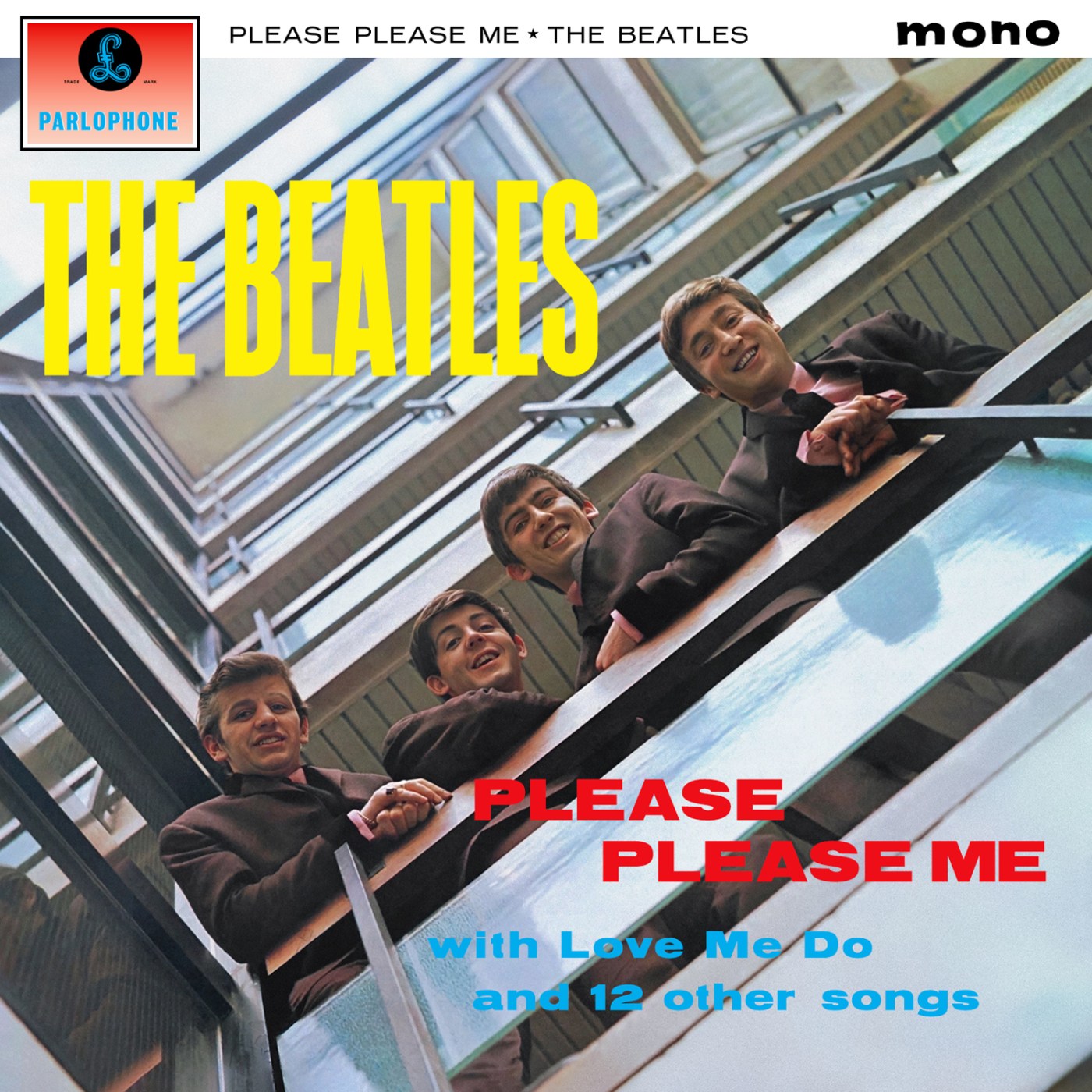
This is where it all begins. One album, released in March 1963 on a small-time label known mostly for comedy records, completely changed the course of musical history and pop culture.
But the story of Please Please Me starts not in 1963, but on the first day of 1962. On that day, the Beatles (John, Paul, George, and Pete Best) traveled to Decca Records in London for an audition put together by their manager, Brian Epstein. Despite a strong collection of performances (some of which are available on Anthology 1) the band failed the audition, and the Beatles went back to Liverpool with their hopes and dreams crushed…
Until, that is, June 1962. By this time, the Decca audition had reached the good folks at EMI, Decca’s competitor in the British music scene, and those in charge thought the boys had potential, so a recording contract was signed in May, and an artist test schedule for June 6th. On that day, the Beatles recorded four songs, most notably including an early version of “Love Me Do.” This version (also on Anthology 1) is the only version of the song with Pete Best on drums, as he was fired shortly after the artist test, and replaced with Ringo.
Fast forward to February 1963. After cutting their first few singles in the autumn of 1962, the boys arrive at EMI’s studio 2 to record their first real album. With four songs already in the can, they concentrated their energies on ten more, and within twelve hours the whole album was completed.
Fun fact: A working title for Please Please Me was Off the Beatle Track – this had been Paul’s idea when George Martin, their producer, asked them for album names. Obviously it wasn’t used, so I’ve stolen it for this blog series.
But how does it stack up, six decades later? Let’s find out! In the interest of full disclosure, I am listening to both the mono version of the album (courtesy of the Beatles In Mono box set) and the stereo version, because I am very thorough like that.
I Saw Her Standing There: “One, two, three, FAWR!” With that count-in, the Beatles begin their musical odyssey with an electrifying first track that shows off exactly what they can do, putting all those long hours in German nightclubs to good use. It’s an amazing up-tempo rock number, fizzing with energy and confidence, and a great start to a career that would go on to redefine popular music forever. The song is so beloved that eleven years later, John sang it with Elton John at Madison Square Garden, during the latter’s Thanksgiving Day concert. It turned out to be Lennon’s final public performance, lending this song choice an additional layer of poignance.
Misery: The first Beatles break-up song, Misery’s despairing subject is enlivened by one of our earliest examples of John and Paul singing together for the entire song, along with George Martin’s piano part, recorded later in February. Martin always adds a classy touch when he guests on a Beatles song, something that will go on to pay dividends even sixty years later.
Anna (Go to Him): Our first cover, “Anna” has John on lead vocals, and on this track you can really hear how his cold affected his singing. It’s an interesting effect though, and a subject we will return to at the end of the album. I also quite like the reverb-heavy backing vocals from Paul and George.
Chains: The first of two lead vocal performances from George on this album, I’d say this one is easily the strongest. Interestingly, this is their earliest song to have originally been performed by a girl group – the Beatles loved American rock ’n’ roll, and not just the male heavy hitters!
Boys: Ringo’s sole song on the album, he nonetheless gives a vocal performance worthy of John and Paul. While he may not have a ton of range, he uses the range he does have to great effect, so it’s no surprise that this song became a staple of his solo concerts in later decades. And because we have boys singing about boys, it’s unintentionally queer. Works for me! (Brian must’ve loved this one, being gay and all.)
Ask Me Why: A more straightforward love song in which the narrator describes all the reasons he loves his partner, it’s got an interesting rhythm, and I really kind of like the way John’s voice cracks on the word “cry.” Wouldn’t have that in today’s recording world, that’s for sure!
Please Please Me: Their hit single and the title song, Please Please Me was John’s attempt to write a Roy Orbison song, with a little bit of Bing Crosby in the title. Early versions were slower and closer to a blues song than a rock number, but George Martin persuaded them to bring up the tempo and add harmonica, establishing it as an early Beatles trademark.
Love Me Do: The very first Beatles song, this version is probably the more well-known, since it’s a much stronger performance by everyone involved than the original single version… except, infamously, this is one of two songs without Ringo on drums! That’s Andy White pounding away in the background, poor Ringo was reduced to tambourine. Even so, it’s a solid first song, and the harmonica throughout gives it a nice blues-y vibe that contrasts with the sweetness of the words.
P.S. I Love You: One of Paul’s first epistolatory songs, (he seems to really like this format) P.S. I Love You is the other Andy White song on the album. A tender ballad song that shows off how well he can sing those, I still really like the brief flash of his rock ’n’ roll voice on the phrase “You KNOW I want you to remember,” just before George’s delightful “Yeeeaaah” a second later. As an aside, this is one of four Beatles songs for which no true stereo mix exists: the album version of “Love Me Do” and the singles “She Loves You” and “I’ll Get You” are the others. But if Giles Martin has his way, that won’t be the case for long…
Baby It’s You: I really love this song – the singer tells his girlfriend that she’s the only one for him, regardless of what other people say about her. That devotion is everything for a girl, and I speak from personal experience.
Do You Want to Know A Secret: George’s second vocal spot, and probably my least favorite. Not because of his accent (his particular brand of Liverpudlian drawl is amazing) he just sounds slightly off-key in places. The “do-da-do” backing vocals are nice though.
A Taste of Honey: Here’s an interesting technical detail: this song contains the first instance we have of a Beatle double-tracking a vocal part. In this case, it’s used in the choruses. It’s subtle, but if you know what to listen for, it stands out. This will go on to become a standard feature of Beatles recordings, long into the mid-60s.
There’s A Place: Welcome to our first non-love song, everyone! “There’s A Place” is instead a song about the singer explaining that he can overcome his loneliness by retreating into his mind – who among us hasn’t done that at least once in their lives? Mind palaces are cool.
Twist and Shout: The album’s closing track, John Lennon gives the performance of his life, absolutely shredding his vocal part – recorded after sucking down cough drops and milk for an entire day. It is amazing, and he only needed one take to nail it. Also of note: the backing vocals from Paul and George, especially those rising “ahhs” that take us into the last third of the song. (And that scream! Yes!)
In the final analysis, I’d say that Please Please Me is the defining album of the early Beatles era, capturing everything that was good about their days as a good old rock band, before they became the artists and musical gods we know them as now. Every legend has to start somewhere, and this is as good an introduction as any.
Mix-wise, it’s a bit more complicated. The mono version (being the one the band would’ve heard) is at least better than the stereo, what with the vocals and instruments being panned hard right and left respectively, so the mono is the one I’m most likely to put on as casual listening…
Except. The recent expanded version of the Red Album contains several songs from this album, newly remixed using Peter Jackson’s MAL process, and I honestly believe that a full new mix of this album (probably paired with With The Beatles) is going to exist in a few years. Maybe even next year.
And that mix needs to exist. Because, as good as the mono mix is, a proper stereo mix with modern separation would allow the songs to breathe better. “I Saw Her Standing There” and “Twist and Shout” were already great rock songs, they just needed a mix that helped them shine their brightest, and now they’ve got one.
Still! Until then, I’m on team mono.


Leave a Reply