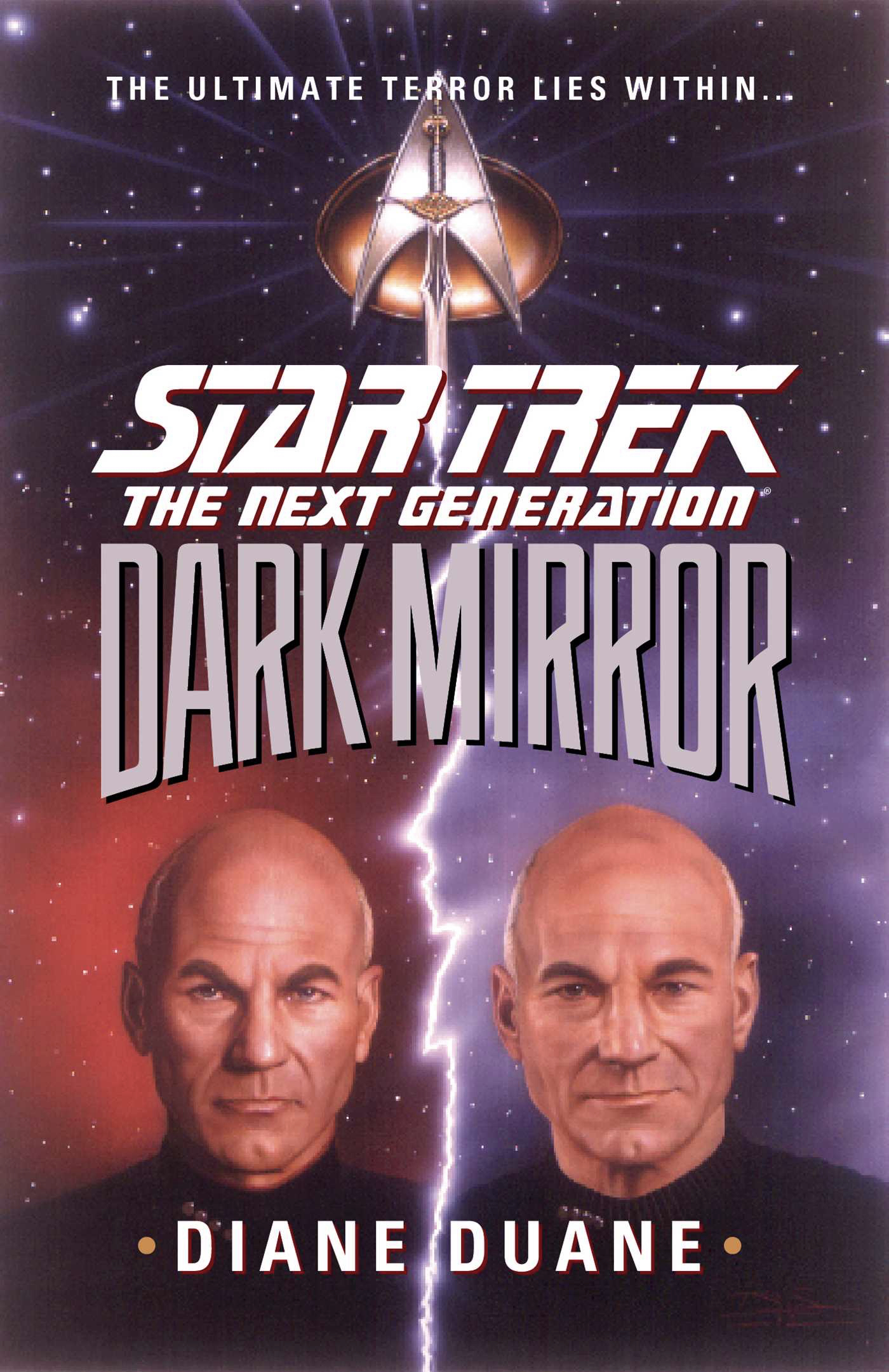
One of the most enduring concepts presented by the original Star Trek was the concept of the mirror universe. Introduced in the 1967 episode “Mirror, Mirror,” the premise is relatively simple – an away team from the Enterprise is accidentally beamed aboard an alternate version of the ship due to a transporter accident, and what they find is a terrifying world where the Federation has been replaced with a cruel, fascist Terran Empire.
At the end of the episode, Kirk and Mirror Spock discuss the Empire’s eventual decline, and Kirk suggests that Spock can make the world a better place than it currently is:
KIRK: In that time I have something to say. How long before the Halkan prediction of galactic revolt is realised?
SPOCK: Approximately two hundred and forty years.
KIRK: The inevitable outcome?
SPOCK: The Empire shall be overthrown, of course.
KIRK: The illogic of waste, Mister Spock. The waste of lives, potential, resources, time. I submit to you that your Empire is illogical because it cannot endure. I submit that you are illogical to be a willing part of it. […] If change is inevitable, predictable, beneficial, doesn’t logic demand that you be a part of it?
SPOCK: One man cannot summon the future.
KIRK: But one man can change the present. Be the captain of this Enterprise, Mister Spock. Find a logical reason for sparing the Halkans and make it stick. Push till it gives. You can defend yourself better than any man in the fleet. […] What will it be? Past or future? Tyranny or freedom? It’s up to you. […] In every revolution, there’s one man with a vision.
SPOCK: Captain Kirk, I shall consider it.
The mirror universe concept proved to be quite popular with the writers of later Trek shows. Enterprise and Discovery explored the pre-TOS eras of the Terran Empire during their runs, while Deep Space Nine gave us a glimpse of the mirror universe’s future once a season, beginning with season 2’s “Crossover.”
And yet, the second-most popular Star Trek series, The Next Generation, never had a mirror universe plotline of its own… at least until 1994, when Dark Mirror was published. Written by Diane Duane, her novel is set early in the fourth season of TNG, just after the events of The Best of Both Worlds.
In the book, the Terran Empire has not yet fallen – it has expanded since the days of Kirk and Spock, and Picard learns that Spock, though he rose through the Imperial ranks, was ultimately murdered before he could reshape the Empire into something more benevolent.
By the TNG era, the Empire has run out of worlds to conquer, and they have begun to infiltrate “our” universe as a source of plunder and target of subjugation – something this book has in common with the other Mirrorverse TNG story, Mirror Broken. Dark Mirror concerns itself with our crew’s attempts at learning what their counterparts have planned, and trying to sabotage those plans as best they can.
One of my favorite sequences in the book has Picard entering the quarters of his Terran counterpart, where he finds that Mirror Jean-Luc is as well-read and intelligent as he is, down to a shared love of Shakespeare. Reading a scene from The Merchant of Venice however, he finds this dimension’s version of the play is much different from the one he knows by heart. Portia’s famous “quality of mercy” speech, the book shows us, goes in a different direction altogether:
“The quality of mercy must be earned, and not strewn gratis on the common ground as pearls for rooting swine, to any fool who staggers eye-blind into his own folly and cries, “Oh pity me!” Else mercy’s self grows cheap and tawdry from her overuse.”
As in the original episode, the Terran Empire remains a world of cruelty and hatred, and kindness is viewed as foolish. Since we can’t have the fun of watching Patrick Stewart ham it up as the evil Captain Picard, Duane’s novel is instead an extended meditation on good and evil, and a given individual’s capacity for both.
As Darren Mooney says in his own review of the book, “It’s not the “different” part of the “same but different” which is most disturbing. Horrors exist. They can be terrifying, but they remain external to us. Discovering that we are – or that we might be – the horror is something else entirely, a terror that is hard to quantify.” Every character on the away team is horror struck at what their counterparts are in this universe, and the theme is especially strong with Troi – the ease with which she can slip into her alternate self’s personality frightens her.
It’s an interesting place to take The Next Generation, since as stated above, there never was a mirror universe plot on the show. “Yesterday’s Enterprise” began as one, but the concept was quickly retooled into the Klingon war concept we got, where the Federation was on the brink of falling apart.
TNG exists in the optimism of the early 1990s, when communism had fallen and a new state of peace and tranquility had begun. TNG, during its 7 seasons and its existence as a cinematic series of movies, never dealt with concepts like terrorism or the national security state America fell into in the aftermath of September 11th. Star Trek: Picard’s first two seasons are about as close as we’ll get on that front.
Dark Mirror, having been published after the end of TNG as a TV series, exists to present a counterweight to the show’s optimism that its future, or something like it, is inevitable. The Mirror universe, in Duane’s telling, is almost a vision of what our could be if we give in to callousness and self-interest over everything else.
In depicting our crew’s triumph over their imperial counterparts however, Duane ultimately concludes that a utopia of the sort envisioned by Star Trek is only possible because of our willingness to believe that good triumphs over evil, rather than the other way around – the difference, in other words, between the quality of mercy as a thing available to everyone, or restricting it to those who are deemed deserving.
In this way, Dark Mirror pre-figures the events of Star Trek: Picard’s second season – the main thrust of the plot centers around Picard and the rest of the ramshackle La Sirena crew working to ensure that their future Federation happens, rather than the terrifying, Nazi-adjacent Confederation created by Q.
The struggles they face in bringing about the Federation’s existence in the real world of 2024, for me, parallels the anxiety we Star Trek fans feel as we watch our world drift further and further away from that show’s ideals. We may want a Federation, but we might end up with a Terran Empire.
As Dark Mirror shows us, a future similar to the one seen in Trek is not a guarantee. It is only a vision of what we could be, if we put in the work to make it so.


Leave a Reply