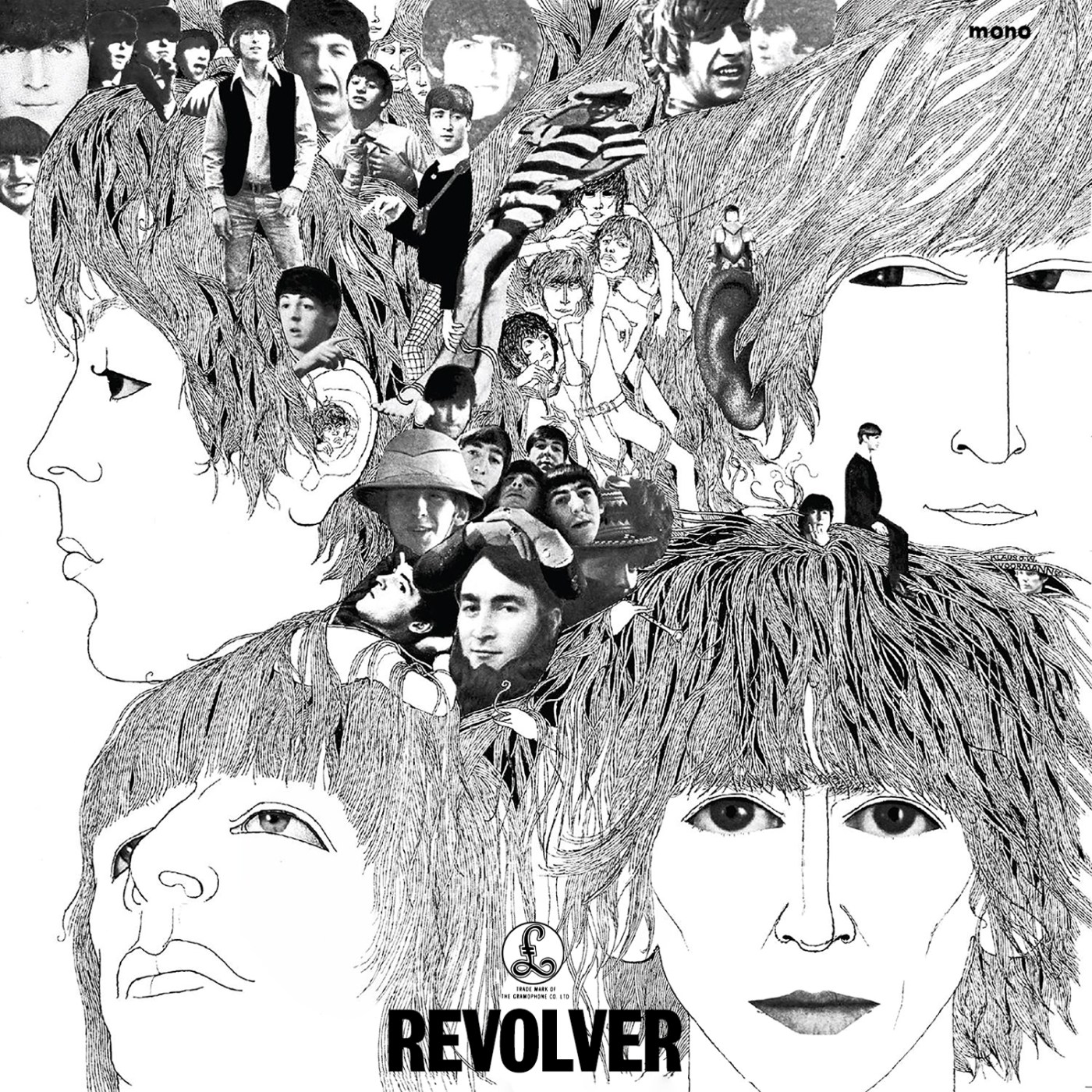
With Revolver, we reach the halfway point of the Beatles’ recording career, and it begins in much the same way as their very first album did: with the lead singer of the lead-off track counting to four before launching into the song… except the Beatle is George, the count-in is fake, and he’s very dry and laconic about it, which pretty much sets the tone for the whole album: the Beatles as you’ve never heard them before.
I mean, just look at the cover. Rather than a photograph, this is a hand-drawn collage by Klaus Voormann, a friend of theirs from the Hamburg days, and it’s amazing. Probably my favorite Beatles album cover, if I’m being honest with myself.
By 1966, everything was changing. Rubber Soul was the last album that could be described as being part of the Moptop Era, with its focus on music that was still, experiments with sitar and other instruments aside, still based on the combination of rhythm and lead guitar, bass, and drums, and thus could still be performed live.
For Revolver, performing these songs live was the last thing the Beatles wanted to do. They were pretty much done with touring by this time, and Revolver was their first album of the studio-only era, at least in spirit if not in fact.
As well, this is the album where the band completely breaks free from the conventions of standard rock and roll. It’s an incredible shift from where the band was at this point in 1965, little yet 1963. It’s fitting that this, their seventh album, is where they reach their musical peak… and it’s only getting better from here.
(Note: to write this piece, I’m listening to the original 1966 mono mix of the album, available on the super deluxe version of Giles Martin’s 2022 Revolver remix. A discussion of that remix will be posted later on.)
Track by track:
Taxman: Yes, I am aware that this is probably the most politically conservative Beatles song out there, since it’s two minutes of George Harrison bitching about paying taxes on his Beatles earnings… despite being unfathomably rich anyway. But I don’t care, because it’s a great fucking rock song to boot. This is the only time George gets the lead-off spot on a Beatles album, and I think it’s a sign of just how quickly he’s progressed as a songwriter that this is even the case. (And yes, I appreciate the irony of this post going up on April 15th, America’s tax day.)
Eleanor Rigby: If “Yesterday” wasn’t enough of an indicator that the Beatles are no longer just a rock band, “Eleanor Rigby” solidifies this as a fact. Classical music orchestrations will go on to become a big part of the later Beatles sound, and this is them going full throttle with it. It’s a gorgeous song, if a very sad one. (If you like the strings as much as I do, an instrumental version is available on Anthology 2.)
I’m Only Sleeping: One of my favorite John songs ever, this psychedelic ode to sleeping was recently the subject of a music video — said video has since been nominated for a Grammy. One of my favorite aspects of the song is the first use of reversed guitar on a Beatles record, including the solo, and it sounds really cool. And, like so many Beatles innovations, it was a complete accident, thanks to a tape op at EMI putting the tape into the machine wrong. (Having done exactly that myself, easy mistake to make.)
Love You To: With this track, George shows he can do a lot more than write increasingly good rock songs, by showing off his interest in Indian music. Structurally, it’s as close to Indian classical music as one could get and still have a rock song, and it’s clear George tried to honor and respect that structure even as he did his own take on it. While it is technically a love song, its lyrical content, being somewhat cynical and concerned with the wider world than romantic love, really does remind you that this is the same guy who will go on to do All Things Must Pass and Living in the Material World in the early 1970s.
Here, There, and Everywhere: As well as being a Beach Boys pastiche, this is one of my favorite of Paul’s many love songs. It gets pretty heavy rotation in the Mactíre house, I can tell you that much! Apparently, Paul re-recorded this song for the movie Give My Regards to Broad Street, along with several other Revolver songs, and I can’t imagine why. You can’t improve on perfection, Paul.
Yellow Submarine: Maybe it’s cliche, but here I am at almost 30 years old, and I still love this song as much as I did when I was nine. It’s the perfect song for Ringo, always the favorite Beatle of young children everywhere, and I’m so glad it exists. The best part: “When the overdubs were finished, Evans led everybody in a line around the studio doing the conga dance while banging on the drum strapped to his chest,” and honest to god you can hear them doing it at the end of the song.
She Said, She Said: Inspired by something John heard Peter Fonda say during their 1966 tour, the song is really more of a Lennon-Harrison collaboration than a Lennon-McCartney one. In fact, Paul (allegedly) doesn’t even appear on the song at all, because he walked out during the sessions. It’s the last song the Beatles recorded for the album, and indeed, recorded at all… at least, prior to November of that year, when they all grew mustaches and the next phase of their career began.
Good Day Sunshine: One of the few straightforward love songs on this album, it is another Paul song, because of course it is. Much like “I’ve Just Seen A Face,” this is another song that just luxuriates in the sheer joy of being in love, and being loved in return. It’s hard not to love it based on that alone! I know I do!
And Your Bird Can Sing: No matter how hard I try, I can’t listen to this song without thinking of the early take on Anthology 2, where John and Paul attempt to record vocal overdubs and fail because they can’t stop laughing. (Perhaps for that reason, John’s vocal is instead treated with ADT, or artificial double-tracking, another innovation from the recording sessions for this album.) It’s a great rock song anyway, I especially like the lead guitar part.
For No One: Paul again with a song about love, except this time it’s a story about the aftermath of a nasty break-up. I love the melody, the horn solo, the lyrics… they were all really skilled at writing break-up songs, Paul especially. John really liked it too, so I’d say I have good taste.
Doctor Robert: In which John writes the first song in the entire Beatles repertoire that is entirely about drugs, because it was 1966 and everyone was on drugs in those days. It’s absolutely hilarious and I love it.
I Want To Tell You: According to the man himself, this song is about “the avalanche of thoughts that are so hard to write down or say or transmit,” and came about after George tried LSD for the first time and felt his mind expand. Revolver is very much the George album, and this song (his unprecedented third) proves it. He may not get such a spotlight again on a Beatles record, but when he does show up, he makes the most of what he gets.
Got to Get You Into My Life: Don’t let the lyrics fool you, because this is not a traditional love song. This is Paul doing an ode to marijuana, disguised as a love song. (I bet it’ll go over really well in Colorado these days.) It’s also the first time we’ve heard a full horn section on a Beatles song, not including the solo on “For No One.” And, interestingly, Paul’s vocal is genuinely double-tracked here, not ADT’d. (The difference is subtle, but if you’ve heard this music as many times as I have, you learn to tell really quickly.)
Tomorrow Never Knows: John’s psychedelic masterpiece, a great big extended shoutout to Timothy Leary and the Tibetan Book of the Dead. Ringo gives one of his all-time legendary performances here, and of course, you’ve gotta love the combination of reversed guitar, tape loops, and John’s voice being fed through a Leslie speaker for the second half, after the solo. It’s one of the best closing tracks the Beatles ever did, and my favorite by far.
A lot of people tend to classify the next album in the sequence, Sgt. Pepper’s Lonely Hearts Club Band, as the band’s true musical masterpiece. But for my money, this album is them at their creative peak. It’s the last album that, for a significant stretch of time, feels like a genuine collaboration between four people, and the last one before Paul becomes the dominant creative force in the band, rather than John.
That’s not to say I don’t like late-period Beatles, because I do, I like all their eras. Shit, my favorite ever Beatles song comes from that period. But late Beatles is a fundamentally different animal than the earlier stuff, and not just sonically either. Certainly, it’s a more divisive era, and one that’s easier to have hot takes about.
Revolver, for me, is the last gasp of true band unity that we’re going to get until Abbey Road. If I had to explain why, I’d say it would be because, with the exceptions of tracks like “For No One,” “Love You To,” and “Eleanor Rigby,” Revolver is still an album that orbits around the core of guitars-bass-drums, even as they move away from that core over the next few albums. And I think that’s why I like it – this is the platonic ideal of Beatles albums, and it only gets wilder from here.


Leave a Reply