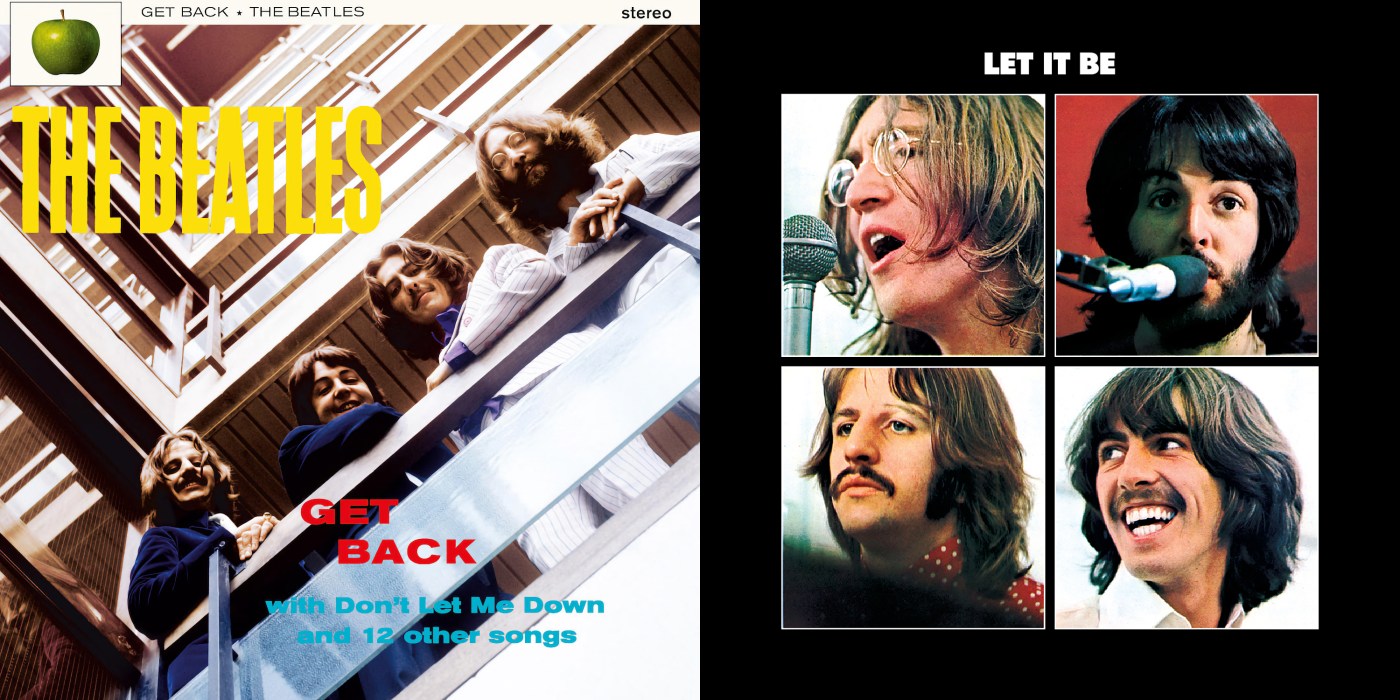
Now, I realize I am going slightly out of order here. After all, Let It Be was released in May 1970, making it, chronologically speaking, the last album the Beatles ever made together. Except it wasn’t supposed to be like that. Abbey Road, in terms of artistic intention, is the last Beatles album, and their last album to be recorded. Let It Be was recorded first, “I, Me, Mine” notwithstanding, and in the interest of staying true to what the band intended, that is why I am discussing these last two Beatles albums in recording order, rather than release order.
Today, our subject is Let It Be… but to understand what happened with Let It Be, we have to go back even earlier to January 1969. In that month, the Beatles reconvened at Twickenham Film Studios in London to film rehearsal footage for a TV special, which would culminate in the band returning to live performances for the first time since the Candlestick Park show in 1966.
Ultimately, the TV special never happened. The Twickenham rehearsals were tense and difficult, with Paul largely dominating the proceedings, while John was distant and cold. At one point, conditions got so bad that George left the band on January 10th. George returned a few days later, with the condition that they would instead be preparing material for a new album, while recording at Apple Studio in Savile Row.
The Apple sessions proved to be much happier, and with the addition of Billy Preston a few days into recording, this added a new vibe for the Beatles. As John put it: “You’re giving us a lift, Bill!” And in the end, there was a concert after all: held on the roof of 3 Savile Row, bewildering the ordinary citizens of London and attracting police attention.
As for the album the Beatles were intending to make? Well.
There were two albums made using the tapes from the January 1969 sessions. The first of these was Get Back, mixed by Johns. The front cover was a recreation of the Please Please Me cover – the same Beatles, taking the same poses in the same stairwell as six years earlier, photographed by the same person, Angus McBean.
Even the typography was identical, with the only differences being the record label in the upper left corner, and of course, the title and byline. All this was John Lennon’s idea, symbolizing the band’s desire to “get back” to basic rock and roll after so long.
Unfortunately, the Beatles weren’t happy with Johns’ mixes of the album, either the original 1969 version or the one he prepared in 1970 with a different tracklist. In the end, the tapes were given to Phil Spector to mix instead, and the end result was the Let It Be album, bringing the band’s recording career to a sudden, and depressing, end. The album was a commercial success, as always, but UK music critics universally derided the album – the music was as good as ever, the problem was the production. But for a long time, Spector’s version was all we had, with the exception of Paul McCartney’s Let It Be… Naked project, which we’ll tackle later on.
Cut to October 2021. Timed to coincide with the release of Peter Jackson’s three-part Get Back documentary, a new remix of Let It Be was prepared by Giles Martin. In the super-deluxe version of the set, disc four included the original Get Back album, as mixed in 1969 by Glyn Johns, with cover art and everything. For the first time, we could now hear what the Beatles originally meant to release in early 1969, before Abbey Road came out. (Also in the set: Johns’ versions of “Across the Universe” and “I Me Mine” from 1970.)
We now find ourselves with a question: Which album is better? In this post, I will attempt to answer that question with the usual track-by-track commentary, starting with Get Back. (And the two 1970 mixes, for the sake of completion.)
One After 909: One of the earliest songs John and Paul ever wrote, it’s as good an album opener as “I Saw Her Standing There” had been. This take comes from the rooftop concert, and the band does a great performance of it, even if the first note is a little off key. Johns’ mix is pretty good, though I question his decision to place John and Paul on opposite ends of the stereo field, when they usually preferred to sing together.
Medley: The track begins with the sound of someone pressing the start button on the tape machine. It’s a jam session, basically, featuring Billy Preston on keyboards. The first half, “Rocker,” is a nice instrumental jam, though I don’t think much of the second half – Billy is great, John and Paul just sound drunk.
Don’t Let Me Down: One of John’s finest love songs, this version has even more Billy Preston in it than either the original single version or the one from the Let It Be album. You can really hear the urgency and love for Yoko in John’s voice, and it’s great.
Dig A Pony: I love this song. I don’t care that the verses don’t make any sense, the choruses are amazing, and it’s always a pleasure to hear John and Paul singing together – it’s been a while since that happened.
I’ve Got A Feeling: A really spectacular late-period Beatles rocker, and another chance to hear John and Paul performing together again. Paul has taken to playing this live in the past few years, singing along with an isolated clip of John’s voice. It’s really sweet. ❤ The take presented here is amazing, right up until it suddenly cuts off after John’s verse.
Get Back: The single from April 1969, and you can immediately tell the difference, since there’s no studio chatter and the song sounds more polished than the rest of the album does. (Then again, that’s the point.) It remains a great song, all the same.
For You Blue: A 12-bar blues song in the country rock style, this was a love song from George to Pattie. Johns’ mix here uses lots of reverb, particularly on George’s lead vocal and the lap steel guitar played by John. A little distracting after so many years listening to the Naked version, but you get used to it.
Teddy Boy: Written by Paul, this song originated during the India trip, and… it’s not very good. I can see why Glyn Johns took it off the 1970 version of this album, though John calling out square dance steps is funny. Paul would later record it properly for his first solo album, McCartney.
Two of Us: One of the best late-period songs John and Paul ever did, featuring them harmonizing for the first time in a long while. On this version, you can hear more of John than Paul, which is an interesting contrast to other versions I’ve heard.
Maggie Mae: A Liverpool folk song given a Beatles twist by John and Paul. Silly and ridiculous, but I like it anyway.
Dig It: Part of an extended jam session, this is 4 minutes of John improvising while Paul sings along in the background. Makes you wonder what they were singing about. (Peace, maybe?) I’d take this version over the shorter one on Let It Be.
Let It Be: One of the signature Beatles songs, and probably second only to “Yesterday” in terms of Paul songs that people have covered. This version was recorded on the last day of sessions for the album, and was the basis for all other versions. Johns uses a lot of reverb on Paul’s vocal here, and there’s some backing vocals during the choruses that aren’t on any other version.
The Long and Winding Road: If you wondered what the Let It Be version of this song would sound like without all that Spectorian bullshit on it, Glyn Johns provides the answer. As ever, there’s a lot of reverb here, making Paul’s vocal sound very distant and far away. Still, it’s a better version of the song than what was on Let It Be, though the Naked take is the best of all of them.
Get Back (Reprise): Nothing much to say here, just more of Paul improvising during recording of the take that this song originated from.
Across the Universe: The same take as on Let It Be, but at the right speed, with the original instrumentation. It’s almost perfect… aside from the backing vocals from the two Apple Scruffs on the left channel. (The Naked version is largely identical to this, but with the backing vocals taken out.)
I, Me, Mine: While by far and away the best version of this song from a mixing standpoint, since it’s just Paul, George, and Ringo rocking out, my only real complaint is that it’s too short. Spector made it longer, which is good, except he then shat all over it, which is bad. Luckily, the Naked version lets us have the best of both worlds.
On to Let It Be, as overproduced for disc by Phil Spector:
Two of Us: Credit where it’s due, Spector does a pretty good job with this take – it’s a better performance than the Get Back version, though it seems a bit too… well, harsh, for lack of a better term. Not enough low end. (Then again he was mixing for vinyl, so…)
Dig A Pony: Again, a much better take than on Get Back, but with a criminal lack of Billy Preston – he gets shunted off to the left channel, where it’s easy to lose track of him over the sound of the vocals and lead guitar.
Across the Universe: Taken from 1968, this version of an otherwise gorgeous late-period Lennon song is slowed down, and then completely ruined with a fucking choir and strings. Honest to god, Spector. His “Wall of Sound” production style might work for John and George’s solo albums, but this is just a disaster. And we’re only on track three. (At least the Giles Martin mix is listenable.)
I, Me, Mine: The last Beatles song to be recorded during John Lennon’s lifetime, we have a great late-period George song that rocks along tremendously… until Spector does his thing again and suddenly we have horns, choir, and strings. DID WE NOT LEARN ANYTHING FROM THE LAST SONG, PHIL?!
Dig It: Nothing much to say here, just a shorter version of the jam from Get Back. Nice enough.
Let It Be: Much as I detest Spector’s version of the album, even I have to admit that his version of the title song isn’t terrible. I’d even call it good, until he starts adding too much stuff to it during the choruses again. But during the verses, he can at least show some restraint.
Maggie Mae: Again, Liverpudlian folk song. Spector can’t fuck this one up!
I’ve Got A Feeling: Alright, this is actually nicely done. It comes from the rooftop show, which explains the sheer energy of the song, particularly where Paul’s lead vocal is concerned. I can hear some slapback echo on the vocal, but I can’t tell if that was added in post, or is just the mic catching early reflections from the surrounding buildings. I question the decision to move John and Paul to separate parts of the stereo field during the last verse. (Martin’s mix does it too, but the panning isn’t as extreme.)
One After 909: The rooftop take, as before. Spector actually does a better job here than Johns did, since he keeps John and Paul’s lead vocals dead center, right where they should be.
The Long and Winding Road: AKA, the mix of the song that made Paul so angry, he used the song as one of the six reasons why the Beatles should be broken up in the 1971 lawsuit that led to the band’s formal dissolution. And just listening to it, with an overbearing orchestra and harp and choir, frankly, I’m on Paul’s side. This is why music critics hated the album so much, and they were right to.
For You Blue: Much better – just a straight country rock number without as much reverb as on the Get Back version, though the piano and slide guitar swap channels. Personally, I liked them as they were.
Get Back: While largely identical to the single minus the added reverb, Spector flies in some dialogue from the rooftop show, making it seem like this was one of the live take, but it’s not. Also listen for more of John during the choruses.
The basic premise of the Get Back/Let It Be project, as originally envisaged by Paul, was to present the Beatles going back to their rock roots, and releasing a recording that was deliberately free of, as John caustically said to George Martin, “production shit.” I don’t know why the band was unsatisfied with what Johns came up with, and I won’t pretend to guess, but I can say he understood the assignment better than Phil Spector did.
Let It Be, as an album, was an absolute disaster, mix-wise. No wonder the critics hated it at the time, and god knows I certainly haven’t been kind to it either. While there are some good moments on this album, the bad moments are execrable. The 2021 remix by Giles Martin respects the history of Spector’s take, while softening the original album’s harder edges, making it go down a little smoother. The Spectorian glop is still there, but at least it’s bearable now.
I know I said I’d decide which of the two takes is better, but the truth is, I really can’t. Let It Be is kind of like the unfinished Doctor Who episode, Shada, from 1979: a million different ways of telling the same story, gesturing at some imagined perfect whole that can never be, because everyone has their own ideas of what that “perfect” version is. (My version of Let It Be, for example, would be a mix of Get Back songs, the decent Spector ones, the single version of the title song, and assorted selections from Naked.)
What Let It Be demonstrates is that, by and large, the breakup needed to happen. The four Beatles had grown increasingly apart, and Paul’s attempts to keep the band together, while they did result in some wonderful music, only made the problem worse.
It’s a very good thing, then, that while this was the final album the Beatles released, it wasn’t the last one they recorded.
Tomorrow, we go one last time… to Abbey Road.

