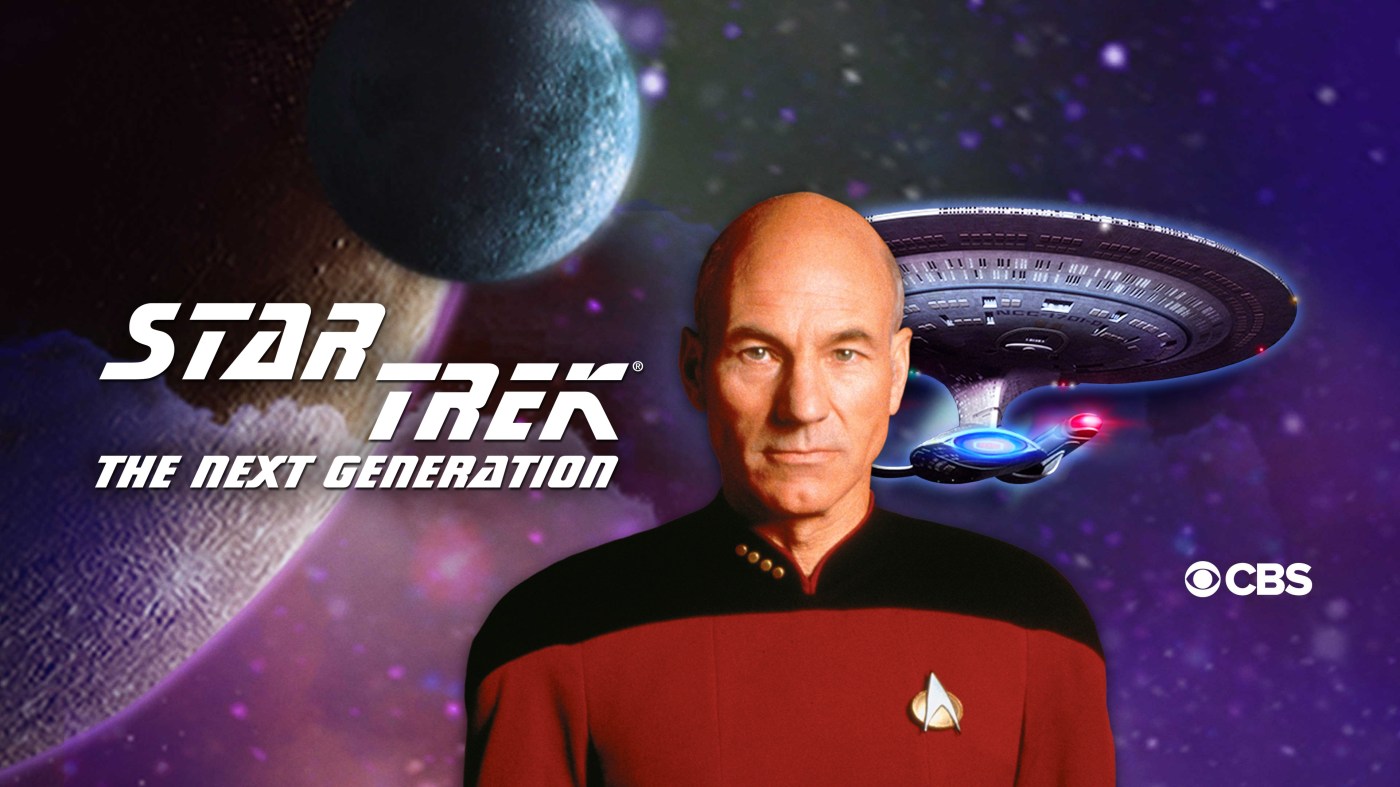
Captain’s log, stardate 79423.3: The Enterprise sets out to investigate strange time distortions rippling through their sector of space. Meanwhile, Picard faces an uncomfortable personal situation when he is reunited with an old flame.
At first blush, I didn’t think much of this episode, but it hits entirely differently after watching the second season of Star Trek: Picard. In that season, we learn that poor Jean-Luc was utterly devastated by his mother’s suicide, since he was (inadvertently) the one who made it happen. That traumatic experience led him to go through most of his life alone, including his entire career in Starfleet.
Watched with that context in mind, the younger Picard’s actions become easier to understand. In the last third of the episode, he tells Jenice about why he stood her up: “It was fear. Fear of seeing you, losing my resolve. Fear of staying, losing myself. Fear that neither of these choices was right.”
We know that Jean-Luc is Starfleet to the core, and always will be, for better and for worse. For all the time we’ve known him, he is a man that will put the mission first before all other concerns. You can see him at this in the episode – his first priority is everything to do with Mannheim’s time experiments, his personal life is not exactly high on the priority list.
L.I. Underhill, on Eruditorum Press, makes the point that TNG never really handles romance all that well: “Every time it does, I find it to either feel very forced, stilted or off-putting in one way or another. […] Putting Patrick Stewart in anything resembling a romantic male lead part is a rather tragic and disturbing misreading of his considerable talents.”
I disagree, at least in part. While the show’s treatment of romance is pretty consistently terrible (because most of the writers are cis men who have no idea how to write women) I do think Stewart can work as a romantic male lead. It’s just that the character of Captain Picard, an explorer and military officer in the mold of Horatio Hornblower, isn’t the right avenue to explore that concept beyond what-might-have-beens.
As they also say: “There was room here for the character to be played very gruff and uncomfortable, as if he’s unwilling to own his past mistakes (“Enough of this self-indulgence!” springs immediately to mind for me here), but Patrick Stewart, as usual, plays against this, and infuses his lines with a delicate balance of remorse, nostalgia, affection and acceptance.”
It’s not until PIC season 2, where we are presented with Laris and her obvious affection toward Picard, that someone finally figures out how to make Jean-Luc work as a romantic lead. The answer is to plunge him into a fascist alternate timeline, then have him travel back in time to what was then the future of 2024 (and now the very recent past) to fix what went wrong, whilst working with a woman who looks a lot like Laris, by dint of being played by Orla Brady. (Complete with an exceptionally unconvincing American accent.)
The Picard/Laris plot line is one that, because of how streaming Trek works compared to its obvious antecedents, is largely left alone after the end of season 2, where it is implied that Picard managed to convince Laris not to leave the chateau.
At the start of season 3 it is revealed she’s going off to some planet to set up security, and he’s going with her to work on his memoirs… and that’s literally it. The entire thread is derailed by the sudden appearance of Beverly Crusher in his life once again, and Laris is never seen nor heard from again for the rest of the show. (In fact, the end-of-season time skip implies that Jean-Luc and Beverly got together offscreen, leaving poor Laris in the lurch.)
Which brings me back to “We’ll Always Have Paris,” and very specifically, how Beverly is written in it. I wouldn’t go so far as to say she’s a clingy jealous girl, but she’s also none too thrilled that one of Jean-Luc’s old flames is back in his life. She clearly has the hots for him, and isn’t willing to let anyone else have him… including, apparently, a Romulan.
(Yeah, I can’t say I’m too find of Picard/Crusher myself.)
In the same piece, Underhill notes something that we’re going to be dealing with ourselves when we get to season 2: the Writer’s Guild strike of 1988. Stretching from March 7th to August 7th 1988, the strike adversely affected production of the last few episodes of season 1 and all of season 2.
Most of the scripts in that season were either reworked from the abortive Star Trek: Phase II project (which became The Motion Picture) or submitted by fans – most notably, Ronald D. Moore. Moore’s spec script would go on to become season 3’s “The Bonding,” and Moore himself would become a permanent part of the writing staff from then on, penning a variety of legendary episodes. (Including my personal favorite TNG, “Yesterday’s Enterprise.”)
Regarding “We’ll Always Have Paris” itself, “the strike impeded revision of the script such that it had to go out before the ending was finalized. So, if this story feels like nothing is really accomplished and it doesn’t really have an ending, that’s because it doesn’t.” (Again from Underhill.)
I’m not quite sure I agree with that – the resolution of the romance plot line between Jean-Luc and Jenice is resolved well, and I do like the Casablanca references in the closing bridge scene. (If you’ve seen the movie, you can hear Picard’s last line of dialogue coming a mile away.) I also really liked the way the Manheim plot is wrapped up, with Data going down into the lab, and Brent Spiner getiting to play three of himself.
In the final analysis, I would say that “We’ll Always Have Paris” is a solid episode of early TNG, and certainly a stronger effort from Hannah Louise Shearer than “When the Bough Breaks.”
One last note that amused me when I read about it on Memory Alpha: Denise Crosby’s arm and shoulder appear at the tactical console roughly halfway through the episode, during the scene where the transporter tech is having trouble successfully beaming Riker and Data into the lab. (The scene was apparently filmed prior to Denise Crosby’s last day on set, during “Symbiosis.” She’s credited in the opening titles anyway.)


Leave a Reply