This week, we begin an exploration into the wonderful world of the Beatles’ American discography. While nowadays we’re used to albums being pretty much the same no matter where you live, in the 1960s (particularly for our favorite quartet of Liverpudlians) it was a very different story. Tracks from one album get moved to a completely different album, while others are given different titles entirely, making it difficult to tell which US album is supposed to equate to a given British LP.
And the Beatles, of course, had no control over any of this. They were not happy at having their nice 14-track albums torn apart and put back together again to suit the American record buyers, and it wasn’t until 1967, when their record contract with EMI was re-negotiated, that the bastardization finally stopped. From then on, all Beatles albums released in America were exactly the same as the UK releases, and when the catalog was remastered for CD in 1987, it was the British albums that got re-released. The US albums, it seemed, were doomed to languish in relative obscurity…
Until 2004, when their first four Capitol albums were re-released as part of the Capitol Albums: Volume 1 box set, followed in 2006 by Volume 2. These two sets, collecting eight albums total, used the original mixes as prepared by Dave Dexter Jr., a Capitol Records executive. For the first time, CD buyers could now hear what the American public heard in 1964 and 1965, but much of the band’s American output was still missing.
Then, in 2014, jackpot: The U.S. Albums collection came out, bringing together every unique American album ever released from 1964 to 1970… except one, for reasons we will get to very shortly.
Released on January 10th, 1964, Introducing… The Beatles is the true first Beatles album to be released stateside. There’s not much to it, since it’s basically Please Please Me with two tracks taken out. (Though which two depended on when it was released: January pressings had ‘Love Me Do’ and ‘PS I Love You’, while February ones had ‘Please Please Me’ and ‘Ask Me Why’.) What’s more interesting about it is, you guessed it, the legal problems. Per the Beatles Bible:
Vee-Jay had planned to release Introducing The Beatles in July 1963, but the label was encountering financial difficulties and owed thousands of dollars in tax, printing costs, royalty payments, and to pressing plants, mainly caused by the gambling debts of its president Ewart Abner.
The label’s debts and cash flow problems hampered Vee-Jay’s ability to release further albums and singles. […] Vee-Jay had planned to release Introducing The Beatles on 22 July 1963, but the label’s financial problems caused it to be abandoned. Yet once The Beatles had become an undeniable money spinner, the label – its financial problems now becoming under control – revived plans to issue the album.
The label already had 6,000 covers printed and the metal plates ready to press the album. There was, however, a legal risk: they only had the rights to re-release the four previously-issued songs, and putting out the full album left them open to legal action from Capitol. Vee-Jay’s executives decided that its need for cash outweighed the legal risk, and the go-ahead was given for the album’s production.
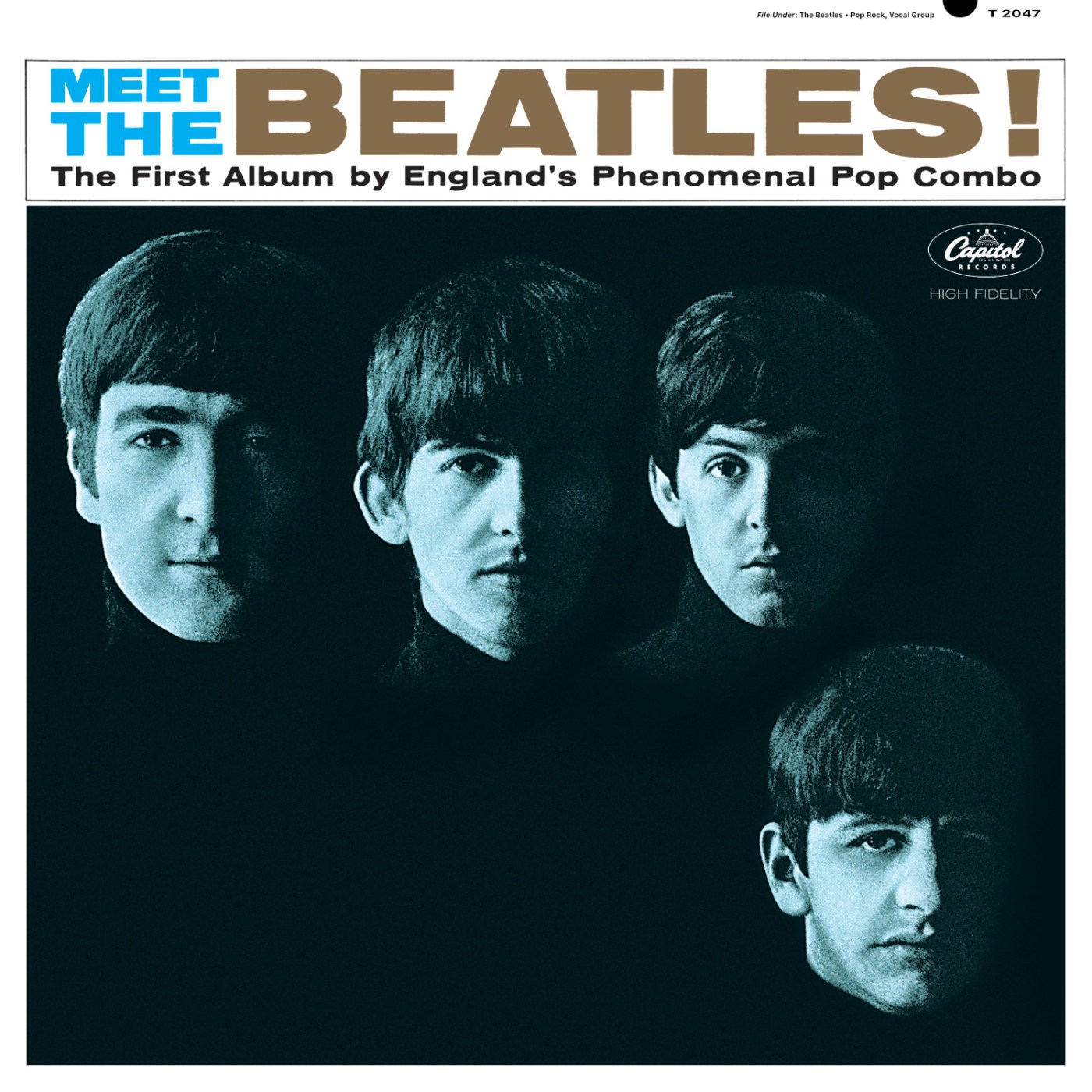
Ten days later, on January 20th, 1964, Meet The Beatles came out – the band’s debut album on Capitol Records, EMI’s American subsidiary. Music-wise, it is primarily the American version of With The Beatles, with only one song from Please Please Me: “I Saw Her Standing There.” (Because Vee-Jay had the rights to the rest of it.) Even the cover is the same, though with a blue tint – one of the few times that happens on an American Beatles album.
Also on the track list are two singles: “This Boy,” and of course, “I Want to Hold Your Hand,” the song that launched American Beatlemania when released in December 1963, just one month after the Kennedy assassination.
Let’s go through it, shall we?
I Want to Hold Your Hand: This track, recorded 17 October 1963, was the song that broke open the floodgates for the band’s invasion of America. The band’s previous singles up until now had been released on some smaller record labels, where they proceeded to flop. It was not until “I Want to Hold Your Hand,” released on the big-time Capitol Records label, that the group’s fortunes in the US changed. This song was pivotal in another way as well: the lyrics in the bridge portions, “I can’t hide,” were misheard by Bob Dylan as “I get high.” When the band were playing in America for their 1964 summer tour, Dylan met the group and turned them on to pot in August. History was never the same again.
I Saw Her Standing There: As I noted on the Please Please Me post, this song is truly an amazing up-tempo rock number, fizzing with energy and confidence, and a great start to a career that would go on to redefine popular music forever. As an aside, this is the only song to appear on both Introducing and Meet, due to the aforementioned legal issues between Vee-Jay and Capitol. The song is so beloved that eleven years later, John sang it with Elton John at Madison Square Garden, during the latter’s Thanksgiving Day concert. It turned out to be Lennon’s final public performance, lending this song choice an additional layer of poignance.
This Boy: “This Boy” has always been a favorite of mine, showcasing the gorgeous three-part harmonies of John, Paul, and George. You don’t get to hear it often, so when you do, it’s a real privilege. Only two other songs have them: “Yes It Is,” on Past Masters, and “Because,” on Abbey Road.
It Won’t Be Long: Though the Beatles were on record as being big fans of Elvis Presley, Buddy Holly, Chuck Berry, and lots of other heavyweights of ‘50s rock and roll, they really liked girl groups too. This track is an original and it sounds a lot like a girl group number from the same period, but where anyone else would do it from the woman’s perspective about the guy, the Beatles flip the script, and what results is a song from the guy’s perspective about the woman he’s with. This is radical stuff for the early sixties, and one of our earliest indications as to how awesome women are in Beatles songs.
All I’ve Got to Do: John’s take on a Smokey Robinson pastiche, it’s a great early ballad number from him, and I love the way he sings on it. While his vocal stylings could be described as tart, (probably from all the cigarettes he smoked) he really makes it work for him – that tartness gives his vocal some raw passion, and it really shines in this song. And then he does it again, six years later, on Don’t Let Me Down.
All My Loving: Paul really seemed to like epistle songs, given the sheer number of them that he writes during the Beatles years, from P.S. I Love You to Paperback Writer. This is a fantastic one, though whenever I listen to it I can’t help but think like the narrator is practically begging to end up cheating on his girlfriend later on. While researching this song, I found someone in The Independent had hypothesized that it was inspired by “Kathy’s Waltz” by Dave Brubeck, and I wouldn’t be surprised if it was, given all the jazz that played in the McCartney house when Paul was growing up.
Don’t Bother Me: For a band whose catalog could be described as, largely, being about the power of love in all its many varieties, they could also write some really good break-up songs. This one, by George, was his very first song ever, and while he didn’t really like it, I think it’s fantastic. It really reflects the sheer devastation and downtrodden-ness that accompanies a break-up, be it romance or friendship, and I love that about it.
Little Child: One of the last Beatles songs to prominently feature harmonica, it’s a song that definitely exists. In fact, according to Paul it was almost Ringo’s vocal spot on the album, until saner heads prevailed and we got “I Wanna Be Your Man” instead. As a song, it comes off as uncomfortable – I really hate the early sixties’ penchant for infantilizing women, and this one is particularly bad.
Till There Was You: A beautiful acoustic guitar-driven cover of a song from the musical The Music Man, this features Paul attempting to sing in an American accent, for whatever reason. He does an okay job, though the way he sings “at all” and “saw” kind of break the illusion. For a real trip, go track down the version of the song they played at Decca Records in January 1962 – everyone sounds super nervous, though I do like Paul’s vocal, even if he is a bit shaky. (Pete Best… well… thank god they hired Ringo.)
Hold Me Tight: The one song from this album that John and Paul don’t think much of, and I kind of get why they don’t like it. There’s no bass to speak of, Paul sounds like he has a cold, it’s just kind of… there. What I didn’t know was that they sped this one up from E to F, to give it a bit more energy. Having slowed it back down to get an idea for what it might’ve sounded like otherwise, I think they made the right choice. In E, it sounds a bit plodding. (And despite the title, this has nothing to do with the song from Red Rose Speedway.)
I Wanna Be Your Man: Now this is more like it! I don’t care what anyone says, Ringo is really good at rock and roll as long as it’s in his range, like this one is. It’s more remembered these days for being the song that gave the Rolling Stones their first hit single, which kind of says everything you need to know about the Stones. As John put it, “We weren’t going to give them anything great, right?” (Ringo’s version is way better.)
Not A Second Time: One of my favorite Beatles songs, this, and a great early break-up song. George Martin’s piano gives the song some wonderful depth, I especially like the solo. I also highly recommend Robert Palmer’s cover, decked out in 1980s synths and an entirely original second verse that I wish John had sung.
The Beatles themselves may not have been thrilled with the decisions of Capitol Records executives, but you have to admit: it worked! Meet the Beatles sold like gangbusters when released in 1964, and more albums, compiled at lightning speed from the albums and singles released in Britain, quickly filled the American marketplace.
Meet the Beatles is as compelling an introduction to this band as any I’ve ever heard, giving you a perfect slice of early ‘60s rock and roll. Genuinely, I’d put this down on my list of favorites if I was pressed on the issue. It really is that good, and I’m glad the band’s American catalogue is finally getting the recognition it deserves. It’s an interesting way of looking at, and listening to, this band in a new way, and it’s bound to be a revelation for those of us who’ve grown up hearing the British albums for so many years. This is a uniquely American chapter of the Beatles’ story, and I, for one, am always happy to tell it.


Leave a Reply