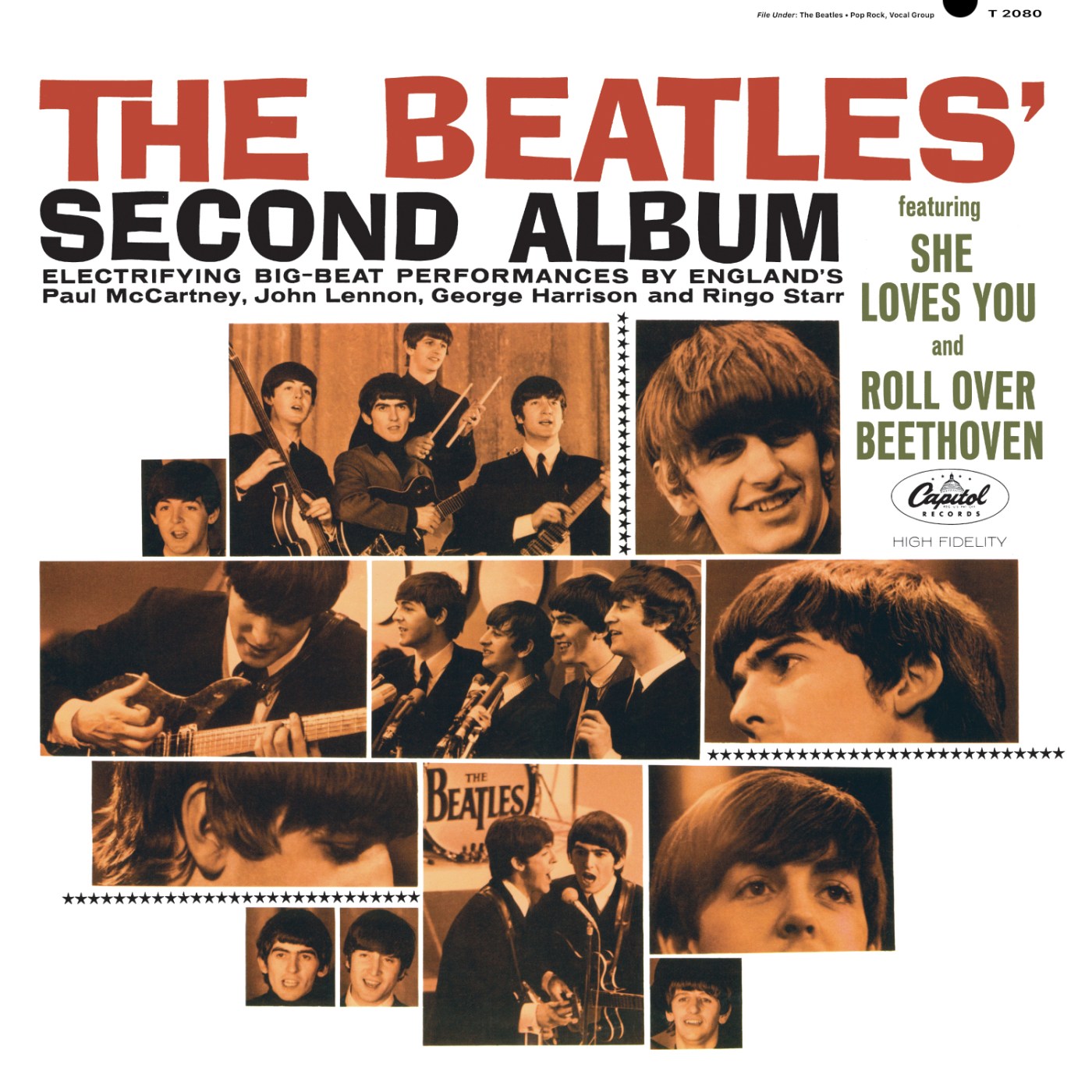
Our journey through the Beatles’ American discography brings us to the album that will, by and large, set the tone for the rest of this part of the series – there’s no immediate British equivalent to the creatively titled Second Album, as it’s basically a compilation album assembled from the remaining 5 songs from With The Beatles that weren’t on Meet, and one song from A Hard Day’s Night. Also filling out the tracklist are five singles, because unlike the British, we Americans believe in putting the hit song on the album instead of keeping it separated.
Second came out in April 1964, the same month as when the Beatles took up the top 5 slots on the Billboard Hot 100, a record that still stands to this very day. All that, coupled with the band’s record-breaking appearances on the Ed Sullivan Show in February, meant the boys were absolutely on fire here in the US, in a way that hadn’t previously been true of any British artist.
So, with all that said, let’s go track by track:
Roll Over Beethoven: As a native St. Louisan, I’m contractually obligated to like George’s version of this classic Chuck Berry number, but even if I wasn’t, I’d still enjoy it because George does such a fabulous job with it. He can do straight rock songs just as well as John and Paul, and this one proves it. Its appearance here turns it into an excellent album opener, making it the first George song to start a Beatles album in either Britain or America, before even “Taxman” on Revolver.
Thank You Girl: A love song written by John and Paul to their fans, it’s hard not to like it. The American mixes of the song have even more harmonica, and as an admitted fan of John’s harmonica playing, that’s never a bad thing in my book.
You Really Got A Hold On Me: Another Smokey Robinson song, this one is another great showcase for John’s ability to do ballad songs, along with some gorgeous harmonies between him and George in places.
Devil In Her Heart: Once again, here comes George! This time around he’s singing about the naiveté that results when you start dating a girl who is legitimate bad news, and holy shit, they could’ve been singing about either of my ex-girlfriends. This one’s for you, Alex.
Money: Another Motown cover from the boys, the idea was for it to be an energetic album closer in the tradition of Twist and Shout, though I’m not entirely sure it works as one. Then again, it’s a little hard to top the exuberant performance of the latter. It works better here on Second as a mid-album track, I think.
You Can’t Do That: If you read my review of the expanded Red album from last year, you already know what I think of this song: two minutes of sexist trash that, sadly, are of a piece with ‘60s expectations between men and women in relationships, and given John’s history of domestic violence… good fucking grief, Lennon.
Long Tall Sally: In which Paul McCartney displays his amazing Little Richard impression. Always a highlight of the band’s early ‘60s work, the way he can turn on a dime from the sweet-voiced crooner of “And I Love Her” and “Til There Was You” to this is absolutely something else. This song in particular was a staple of their live shows going all the way back to the Quarry Men era of the late ‘50s, and was, in fact, the last song they played as a live act – Candlestick Park, San Francisco, 1966. This version? All done in one take.
I Call Your Name: One of John’s earliest songs, “I Call Your Name” is another early Beatles song to include cowbell, and was in fact considered for inclusion on the A Hard Day’s Night album before eventually getting released on the Long Tall Sally EP instead. It’s a much better song than “You Can’t Do That” in my opinion, and I think the AHDN album would be much improved if you put this there instead.
Please Mister Postman: In which the Beatles do a credible Motown cover, complete with the requisite gender-swap in the lyrics that, in their hands, turns the song into something a bit more feminist than would’ve flown in the early ‘60s. You can really hear the desperation in John’s voice, especially when he starts screaming his vocal toward the end. (He always was great at rock and roll screams.)
I’ll Get You: If I’m being honest with myself, this is a song that probably worked better when I first heard it as a kid. I was around eight or nine years old, and while browsing the CD collection at my local library, I discovered a Beatles album I had no idea existed: Past Masters, Volume 1, released in 1988. And for whatever reason, I absolutely adored this particular number, along with “Thank You Girl,” perhaps because the first two lines reminded me so much of John’s later song, “Imagine”: ‘Imagine I’m in love with you/It’s easy ’cause I know…’ Nowadays, it’s a bit stalker-y. Leave the girl alone, my guy! She’s just not that into you!
She Loves You: This song, more than any song they ever did, is the one that defines early ‘60s Beatlemania, particularly in Britain. This is the song that made them international superstars, and made everything that followed possible. As well as their falsetto vocal harmonies and their knack for catchy hooks, to say nothing of the sheer power behind Ringo’s drumming, this is a song that defies all convention with regard to how love songs are “supposed” to be, since it comes from a third party. And until 2023, we only ever heard it in mono – the master tape for this song no longer exists. But thanks to Giles Martin and Peter Jackson’s MAL process, last year we got a genuine stereo mix, and it rocks just as hard as the mono mix does.
In 1969, music critic Robert Christgau wrote of Second Album: “The Beatles were always wonderful. It was their ebullience as performers—as a musical group and as actors on the stage of the world—that turned them into demigods. Their copies of Black rock-and-roll songs were touched with soul (compare their Money to the Beach Boys’ Barbara Ann) but avoided the sodden seriousness of other white imitators. For the envy of the direct competitor they substituted the loving admiration of the fan.”
That, I think, is key to understanding this album. The Beatles never got to record in Detroit, but their love of Motown and African American music in general is all over their early albums. In their solo years, John and Paul both released albums that covered songs they liked from the days of ‘50s rock and roll. This is the Beatles equivalent of those albums, and yet, most people don’t know it exists, because it’s not part of the British canon.
It’s a damn shame that their American releases have been so deeply buried over the years, because Second, “You Can’t Do That” aside, is a wonderful collection of early 60s rock songs that show the band at their best, and fervently in love with the music that helped make them into the band they became. You don’t get The Beatles without Chuck Berry, Little Richard, Smokey Robinson, and Motown, and I can see why Christgau likes it. Honestly, so do I.


Leave a Reply