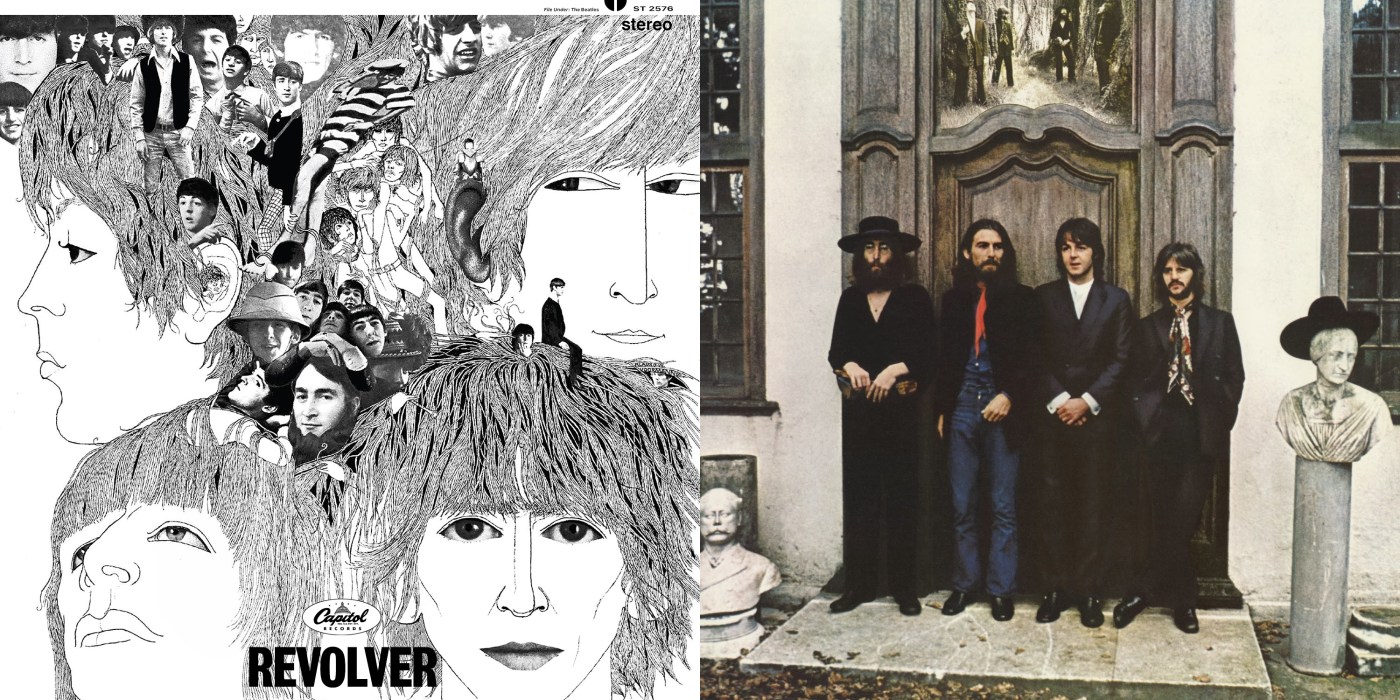
This week, a two-for-one special, as I’ve done a couple times before: the US version of Revolver, and the band’s final Capitol release, 1970’s Hey Jude.
The American version of Revolver is virtually identical to the British original, from the cover to the music: three songs are removed, but none are added, making this the closest thing to a regular British album that Capitol came out with prior to 1967. So, everything I wrote about the British version of the album back in January applies here, as well.
That’s not to say there isn’t some difference between the two versions: Since all three of the removed songs were by John, that makes this version more of a Paul album, which is really funny, given that John’s influence on Beatles projects reached its peak with the British version of this record.
Lack of John aside, with Revolver we reach the halfway point of the Beatles’ recording career, and it begins in much the same way as their very first Capitol album did: with the lead singer of the lead-off track counting to four before launching into the song… except the Beatle is George, the count-in is fake, and he’s very dry and laconic about it, which pretty much sets the tone for the whole album: the Beatles as you’ve never heard them before.
I mean, just look at the cover. Rather than a photograph, this is a hand-drawn collage by Klaus Voormann, a friend of theirs from the Hamburg days, and it’s amazing. Probably my favorite Beatles album cover, if I’m being honest with myself.
By 1966, everything was changing. Rubber Soul was the last album that could be described as being part of the Moptop Era, with its focus on music that was still, experiments with sitar and other instruments aside, still based on the combination of rhythm and lead guitar, bass, and drums, and thus could still be performed live.
For Revolver, performing these songs live was the last thing the Beatles wanted to do. They were pretty much done with touring by this time, and Revolver was their first album of the studio-only era, at least in spirit if not in fact.
As well, this is the album where the band completely breaks free from the conventions of standard rock and roll. It’s an incredible shift from where the band was at this point in 1965, little yet 1963. It’s fitting that this, their seventh album, is where they reach their musical peak… and it’s only getting better from here.
Track by track:
Taxman: Yes, I am aware that this is probably the most politically conservative Beatles song out there, since it’s two minutes of George Harrison bitching about paying taxes on his Beatles earnings… despite being unfathomably rich anyway. But I don’t care, because it’s a great fucking rock song to boot. This is the only time George gets the lead-off spot on a Beatles album, and I think it’s a sign of just how quickly he’s progressed as a songwriter that this is even the case.
Eleanor Rigby: If “Yesterday” wasn’t enough of an indicator that the Beatles are no longer just a rock band, “Eleanor Rigby” solidifies this as a fact. Classical music orchestrations will go on to become a big part of the later Beatles sound, and this is them going full throttle with it. It’s a gorgeous song, if a very sad one. (If you like the strings as much as I do, an instrumental version is available on Anthology 2.)
Love You To: With this track, George shows he can do a lot more than write increasingly good rock songs, by showing off his interest in Indian music. Structurally, it’s as close to Indian classical music as one could get and still have a rock song, and it’s clear George tried to honor and respect that structure even as he did his own take on it. While it is technically a love song, its lyrical content, being somewhat cynical and concerned with the wider world than romantic love, really does remind you that this is the same guy who will go on to do All Things Must Pass and Living in the Material World in the early 1970s.
Here, There, and Everywhere: As well as being a Beach Boys pastiche, this is one of my favorite of Paul’s many love songs. It gets pretty heavy rotation in the Mactíre house, I can tell you that much! Apparently, Paul re-recorded this song for the movie Give My Regards to Broad Street, along with several other Revolver songs, and I can’t imagine why. You can’t improve on perfection, Paul.
Yellow Submarine: Maybe it’s cliche, but here I am at almost 30 years old, and I still love this song as much as I did when I was nine. It’s the perfect song for Ringo, always the favorite Beatle of young children everywhere, and I’m so glad it exists. The best part: “When the overdubs were finished, Evans led everybody in a line around the studio doing the conga dance while banging on the drum strapped to his chest,” and honest to god you can hear them doing it at the end of the song.
She Said, She Said: Inspired by something John heard Peter Fonda say during their 1966 tour, the song is really more of a Lennon-Harrison collaboration than a Lennon-McCartney one. In fact, Paul (allegedly) doesn’t even appear on the song at all, because he walked out during the sessions. It’s the last song the Beatles recorded for the album, and indeed, recorded at all… at least, prior to November of that year, when they all grew mustaches and the next phase of their career began.
Good Day Sunshine: One of the few straightforward love songs on this album, it is another Paul song, because of course it is. Much like “I’ve Just Seen A Face,” this is another song that just luxuriates in the sheer joy of being in love, and being loved in return. It’s hard not to love it based on that alone! I know I do!
For No One: Paul again with a song about love, except this time it’s a story about the aftermath of a nasty break-up. I love the melody, the horn solo, the lyrics… they were all really skilled at writing break-up songs, Paul especially. John really liked it too, so I’d say I have good taste.
I Want To Tell You: According to the man himself, this song is about “the avalanche of thoughts that are so hard to write down or say or transmit,” and came about after George tried LSD for the first time and felt his mind expand. Revolver is very much the George album, and this song (his unprecedented third) proves it. He may not get such a spotlight again on a Beatles record, but when he does show up, he makes the most of what he gets.
Got to Get You Into My Life: Don’t let the lyrics fool you, because this is not a traditional love song. This is Paul doing an ode to marijuana, disguised as a love song. (I bet it’ll go over really well in Colorado these days.) It’s also the first time we’ve heard a full horn section on a Beatles song, not including the solo on “For No One.” And, interestingly, Paul’s vocal is genuinely double-tracked here, not ADT’d. (The difference is subtle, but if you’ve heard this music as many times as I have, you learn to tell really quickly.)
Tomorrow Never Knows: John’s psychedelic masterpiece, a great big extended shoutout to Timothy Leary and the Tibetan Book of the Dead. Ringo gives one of his all-time legendary performances here, and of course, you’ve gotta love the combination of reversed guitar, tape loops, and John’s voice being fed through a Leslie speaker for the second half, after the solo. It’s one of the best closing tracks the Beatles ever did, and my favorite by far.
A lot of people tend to classify the next album in the sequence, Sgt. Pepper’s Lonely Hearts Club Band, as the band’s true musical masterpiece. But for my money, this album is them at their creative peak. It’s the last album that, for a significant stretch of time, feels like a genuine collaboration between four people, and the last one before Paul becomes the dominant creative force in the band, rather than John.
That’s not to say I don’t like late-period Beatles, because I do, I like all their eras. Shit, my favorite ever Beatles song comes from that period. But late Beatles is a fundamentally different animal than the earlier stuff, and not just sonically either. Certainly, it’s a more divisive era, and one that’s easier to have hot takes about.
Revolver, for me, is the last gasp of true band unity that we’re going to get until Abbey Road. If I had to explain why, I’d say it would be because, with the exceptions of tracks like “For No One,” “Love You To,” and “Eleanor Rigby,” Revolver is still an album that orbits around the core of guitars-bass-drums, even as they move away from that core over the next few albums.
As for the American portion of the story, Revolver is actually the penultimate album we’ll be looking at. This is because that in January 1967, the Beatles signed a new recording contract with EMI. One item of this new contract explicitly forbid Capitol from DIYing their own releases and/or remixing the music without the band’s permission.
From here on, every album the Beatles made in the UK would be released in exactly the same configuration in the US, with the same mixes. No more transatlantic alternatives allowed, and definitely no more Dave Dexter reverb.
Note, though, that I specify albums. In November 1967, after Sgt. Pepper came out, Capitol released another unique album – Magical Mystery Tour, compiled from the six songs that formed the British double EP of the same name, and the band’s five 1967 singles.
Since it wasn’t technically an album they were reworking, but an EP, this meant Capitol had managed to find a loophole in the contract. But as that American album became the canonical version of Mystery Tour, you can just go re-read the original post about it instead. (This is also why it’s not in the US Albums set either.)
Cut to February 1970. By this time, the Beatles, as a musical entity, are functionally dead. John left the band in late 1969, as Abbey Road was coming out, and went off with Yoko to do stuff with the Plastic Ono Band. Paul, George, and Ringo reconvened as a three-piece to do “I Me Mine” in January, and that was pretty much it as far as new Beatles material went – at least for another 25 years.
Which leaves their new manager Allen Klein in something of a bind. In 1969, he signed a new contract with Capitol which stipulated one compilation album a year. But with the Let It Be album being delayed, again, and no band to make new music, he needed to release something to fulfill this part of the contract, so he told Allan Steckler to go away and assemble something, with a focus on singles and non-album tracks that hadn’t been released on previous Capitol LPs. (Steckler would go on to choose the tracks for the compilations that became the “Red” and “Blue” albums, officially known as 1962-1966 and 1967-1970.)
Hey Jude becomes a somewhat haphazard run through the Beatles’ recording career, starting with 1964 and finishing with 1969. Almost every era of their music is touched on: the early ‘60s pop of A Hard Day’s Night, the mid-period artistry of “Paperback Writer” and “Rain,” and their return to basic rock and roll from “Lady Madonna” to “The Ballad of John and Yoko” – only the technicolor psychedelia of 1967 is missing.
On to the music then:
‘Can’t Buy Me Love’: An energetic Paul song for the ages, it’s most well known for accompanying the scene in the movie where the Beatles screw around in a field for two minutes, and it’s amazing. And check out the double-tracked guitar solo! I love it when Paul gets to rock out. It works really well as an album opener too, the first and only time this song is used in that fashion.
‘I Should Have Known Better’: What’s that? Another Beatles song with harmonica on it! Pretty sure this is the last of those. Also listen for, again, George’s solo here, he gets a lot of mileage out of that 12-string. One of my favorites of his solos. ❤
‘Paperback Writer’: Released as the first single of 1966, “Paperback Writer” all but defines the word distortion in its lead guitar part, though more attention is paid to Paul’s bass, which appears on a record for the first time as basically a lead instrument. Lyrically, this track is also one of the first Beatles songs, and the first single, not to have anything to do with love in any way whatsoever.
‘Rain’: The coolest fucking song in the entire Beatles catalog, paws down. This song has everything! To record it they played the song at normal speed, then slowed the rhythm track down, making everything sound bigger. The drum sound in particular is out of this world – hell, it’s Ringo’s favorite! He said, “I think it’s the best out of all the records I’ve ever made. ‘Rain’ blows me away … I know me and I know my playing … and then there’s ‘Rain’.” Also listen for the reversed vocals at the end, entirely because John was high and decided he liked it.
‘Lady Madonna’: The Beatles started ‘68 in a big way with this song, a piano-driven story track about a single mom trying to raise three children. Inspired by Fats Domino and Humphrey Lyttleton, the blues-inspired feel was a big shift from the psychedelic flavorings of their recent tracks. Paul has described it as a tribute to women, starting with the Virgin Mary.
‘Revolution’: Like “Paperback Writer” before it, “Revolution” defines the word distortion, as the guitar sound came from the guitars being plugged into the mixing desk directly and played so loudly as to overload the meters. It was one of Lennon’s earliest political songs, responding to the revolutionary fervor gripping the UK and the US by asking “What’s the plan for afterwards?” It was recorded twice: a slower version appeared on the White Album in 1968, and the single version is presented here.
‘Hey Jude’: The first song to be released on the Beatles’ own Apple label, “Hey Jude” began life as an attempt from Paul to comfort Julian Lennon, John’s son, as his parents were in the process of divorcing. The record-buying public certainly got the reassuring vibes, as it stayed at #1 for nine weeks, the longest run for any Beatles single, and remains their most successful song ever.
‘Old Brown Shoe’: An often-overlooked George song, Harrison was inspired by dualities as McCartney had been in 1967, but applied them to love instead. It, along with many of his other compositions in the mid to late 1960s, reflects his growth as a songwriter in the shadow of Lennon and McCartney, but it would take the band’s breakup for him to reach full strength.
‘Don’t Let Me Down’: One of John’s finest love songs, “Don’t Let Me Down” was inspired by his relationship with the artist Yoko Ono, whom he’d met in 1966. Released as the b-side of “Get Back,” both tracks feature the keyboard playing of Billy Preston, a friend of theirs from the Hamburg period, and who sat in as the “fifth Beatle” during the Get Back/Let It Be sessions.
‘The Ballad Of John And Yoko’: This song was a hybrid of two approaches. Specifically, Paul’s preference for story-songs was wedded to John’s fondness for autobiographies to create this track, a written record of John’s marriage to Yoko Ono, and the honeymoon that followed. It was John and Paul’s first true collaboration in some time, and they played all the instruments. “Ballad” was also the first Beatles song to be mixed only for stereo, no dedicated mono mix was ever prepared, as mono had fallen out fashion by 1969. The last mono Beatles single was “Get Back,” backed with “Don’t Let Me Down.”


Leave a Reply