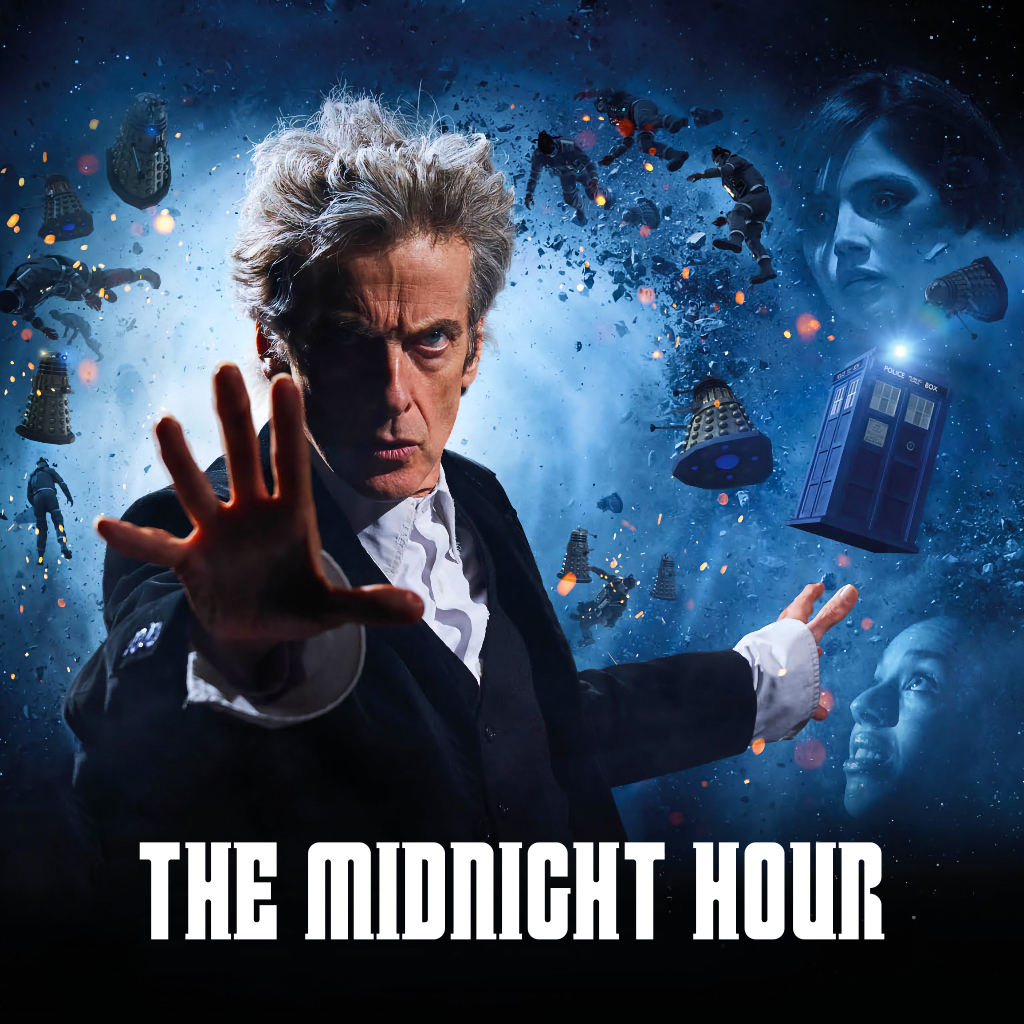
It was always the plan that I was going to do a Capaldi series. When you set out to write episodic analyses of the period of Doctor Who that has defined your very being as a person, to tell one half of the story without telling the other would be like leaving a song unfinished – unthinkable. Back to the Eleventh Hour was part one. The Midnight Hour is part two.
And yes, the similarity in titles is intentional. After all: Eleven’s hour is over now. The clock is striking Twelve’s. If Eleventh Hour was the story of my childhood, this is the story of my adulthood. As for why Stephen Merrit songs: because he’s exactly the kind of guy Twelve would listen to. Indie rock with more than a little tinge of goth, and a somewhat morose outlook on life? That’s Twelve all over. (I even made a playlist!)
Readers will recall that when The Time of the Doctor aired, I had begun questioning my gender identity, to the point that I even started to present as female online where I felt safe enough to – an old friend of mine from the MLP community, who was herself trans, was the first person I ever asked to refer to me by a female name and pronouns.
By the time Deep Breath aired in August 2014, these questions hadn’t abated: in fact, by then they’d actually gotten even stronger, and consumed much more of my mental brain space. So, the Doctor spending most of series 8 trying to figure out what kind of a person he was perfectly mirrored my own experiences – this being the season that introduced a female Master, in nearly every regard a cracked-mirror version of a trans woman, marks series 8 as being the one where I finally accepted my own transness.
But I’m getting ahead of myself. Let’s wind the clock back to that August, shall we?
It was August 24th, 2014 when I watched Deep Breath for the first time. It was 5 AM, and I couldn’t sleep. I’d just moved into my college dorms for the new semester a few days earlier, and it was hot – we’re talking 80 degrees Fahrenheit even before sunrise. (Missouri summers are fucking brutal.)
Having spent the evening of the 23rd rewatching Name and Day, I finished my quick rewatch with The Time of the Doctor, whereupon I cried as quietly as I could. Still sniffling, I pressed play on Deep Breath, and began a brand new era of Doctor Who.
Deep Breath, as a story, is probably not going to be top on anyone’s list of favorite post-regeneration stories. Not because it’s bad (the “worst” Moffat story is still a really interesting first draft, after all) but because it’s spiky and weird and off-putting, much like the Twelfth Doctor himself. It simply refuses to be a crowd-pleaser. There’s no Tennant-like showboating, this is just the show getting on with establishing its new lead, in a fashion that hadn’t been done before, and hasn’t been done since.
It’s not quite a Moffat version of The Christmas Invasion. True, the cold opens of both episodes are broadly similar (preceding Doctor’s supporting cast returns, the new Doctor crash-lands nearby and the companion is Visibly Freaking Out) but very little else is the same. Invasion was about the world trying to stop alien invaders without the Doctor. Deep Breath is about Clara struggling to come to terms with regeneration, while the Doctor is busily having the first stirrings of a season-long identity crisis.
Let’s start with Clara. Broadly speaking, she is presented here as a stand-in for the audience, particularly the segment that came in with Matt Smith (like me) and are now staring at their TVs, trying to figure shit out.
Like, yes, one would think that Clara would be used to regeneration by now, since she’s met all of the Doctor’s previous selves, but come on. It’s one thing to read about skydiving in a book, and quite another to try it out for real. Thus, Clara’s reaction here makes complete sense.
The scene in the greenhouse where Vastra castigates her for being close-minded has long been a favorite of mine. Notably, everyone’s favorite Victorian Silurian is actually wrong about Clara’s interest in the Doctor, or at least, insufficiently right. She’s correct to call Clara out for her ageism, but as Clara herself asserts, the Eleventh Doctor was never her “dashing young gentleman friend.” She says:
“I am not sure who you think you’re talking to right now, Madam Vastra, but I have never had the slightest interest in pretty young men. And for the record, if there ever was anybody who could flirt with a mountain range, she’s probably standing in front of you right now. Just because my pretty face has turned your head, do not assume that I am so easily distracted.”
Brave words indeed, but she hasn’t even begun to adjust to the Doctor yet. That’s why the restaurant sequences are so important. Clara’s dynamic with Twelve, in the early going, is prickly and difficult, a world away from her close friendship with Eleven. But that is as it should be: regeneration of any sort, be it science fiction or mundane, is a tricky business.
As my friend Christine Kelley observed, “Deep Breath is about how the experience of having a body drastically changes. Really the only bit of televised Doctor Who to explore the epistemological contours of regeneration.”
And as I’ve long believed, Deep Breath, albeit entirely accidentally, is a giant metaphor for the experience of gender transition, specifically the experience of actually coming out, and how that affects the people around us.
Let’s start with Clara. The cliffhanger shot in The Time of the Doctor is of her shocked expression as the Doctor tries to get them out of a jam, fails, and asks her if she has any idea how to fly this thing. She has just experienced the Doctor coming out to her, and doesn’t know how to process it. In Deep Breath, she explicitly tells Madame Vastra that she doesn’t even know who the Doctor is anymore. In that moment, Clara is every parent who has ever said something like that to or about their trans children.
To be fair, this an understandable reaction. Clara’s feelings make sense. Some parents eventually move past this shock and confusion and grow to accept their children for who they are, like Clara does, and others don’t. (Mine fall into the latter category, much as I wish otherwise.)
The show has never had a companion who refuses to accept the new Doctor and leaves in protest, but if it ever did, it would be illustrating a phenomenon that occurs all too often with families of queer people.
I get why they act like this. They have built up an image of the queer person in their head, and when the objective reality refuses to comport with that image, they act out. They go into denial, coming up with an entire laundry list of reasons why their child can’t be gay or bisexual or transgender, and try to “prove” to the person why they aren’t the thing they’ve just come out as. Of course it’s bullshit, but they don’t think it is.
Thankfully, Clara never gets to the denial stage, because Vastra shuts that whole thing down before it can even start. She says that the Doctor wore a young face rather than an old one for the same reason she wears a veil: for acceptance, and as a judgment on the quality of the hearts of those who otherwise wouldn’t accept her as she is.
I do the exact same thing. Around a decade ago, I came out to my parents, and it went so disastrously wrong that ever since, I have refused to correct my parents when they deadname or misgender me. Vastra’s veil serves the same purpose as me refusing to shave or continuing to go by my dead name: for acceptance. We can’t get it by presenting our true selves, so we lie and pretend to be someone that we’re not. No doubt, Vastra would prefer to go out barefaced holding her wife’s hand rather than wear that veil and have Jenny pretend to be her maid, but she can’t, and I absolutely understand why.
Coming out is hard. I’ve tried to avoid doing it over the years, because that first experience was so traumatizing. The last time I came out to someone and actually said the words “I’m transgender” was at a conference in Chicago, and even though he was trans and had just said as much to a room full of other queer people, I still got nervous. In a perfect world, I’d never have to come out to anybody. In a perfect world I could just start hormones and people would see me change, understand, and adjust their behavior accordingly.
But we don’t live in that world. Instead, we live in a world where alleged liberal parents repeatedly insist that their kids can tell them anything and they’ll love and accept them just the same, but when the moment comes, they aren’t there. The promise of acceptance is a lie. When coming out goes well, it can be great! You feel happy and relieved because here is someone you can be your real self around! But when it goes badly, you get scared. You get fucking terrified. And in my case, you do whatever you can to make the yelling stop.
Thankfully, Deep Breath is a better story than that. It’s a story in which Clara learns to accept the Doctor for who he really is: a two-thousand year old ancient alien. Sure, it takes her a while to get there (the relationship between them is decidedly frosty for most of the story) but when she eventually does get there, she sticks around. She’s a better ally than my mother could ever be. (My dad, bless him, has come around. My mother pretends like she has, but I’ve never bought it.)
Now let’s consider the Doctor. He is, as Eleven tells us at the end, scared. And I get why, he’s afraid Clara isn’t going to accept him, even though he tries to make it clear that this is who he is, he’s not pretending anymore. That fear is real, I think every trans person alive has gone through that, even when it relates to friends rather than family. And as I’ve said, Clara does eventually come to accept him. In that regard, the Doctor’s lucky.
But he’s scared for another reason too, I think. Transition is a scary thing. I mean, being trans is scary in general, but transition is probably the scariest part of the whole deal. It’s not just that something could go wrong medically, (for trans women, some of the supplements we take to feminize our bodies have really nasty side effects) but also that someone could decide to throw rocks at us or shoot us just because we’re existing while trans.
So many of us are scared for our own safety, and justifiably so, as the world reminds us each and every year when the number of transgender hate crimes go up, or when legislatures in various countries, including the United States, plot various anti-trans bills and get them signed into law. To be out and visibly transgender in contemporary American society is to have a great big target painted on your back, and yet we transition anyway.
Why? Why do we go through this process of screwing around with our body chemistries to make ourselves more feminine or masculine and change our names and legal documents, when doing so can, and has, gotten us killed?
For the exact same reason Twelve gives when asked why he’s sacrificing himself to save a bunch of humans from being turned into Cybermen, all the way at the other end of his tenure: because we have to. It’s who we are, it’s the only thing we can do, because not doing it would kill us too. If we’re gonna die, either due to global warming or a respiratory disease or some jackass in a Trump hat, we may as well die as ourselves, instead of in disguise.
Of course, not everyone transitions. Some people choose not to, or are prevented from doing so due to a difficult living situation. For a long time I was one of those people, unable to even start HRT because I lived in a red state with unaccepting family. It was only when I met my girlfriend and finally got the courage to take the plunge that I finally did start, and as I write this, I’ve been on HRT for just over two years. It was the best decision I’ve ever made, and I don’t regret it at all.
All the same, my heart goes out to the people who can’t transition, or who live with transphobic family, because I used to be one of them. It absolutely sucks, living as the wrong gender. Having done it myself, I wouldn’t wish this on my worst enemy.
The scene at the end of the episode where the Doctor says to Clara, “You can’t see me, can you? You look at me, and you can’t see me,” is intensely relatable. You really do feel like you’re alone, and only the acceptance of someone you care about can even start to fix the gaping hole you feel inside.
Clara’s acceptance of the Doctor, then, is an incredibly powerful moment. She’s telling him that no matter how scared he might be, he isn’t alone at all. And that reassurance is worth everything in the world.


Leave a Reply