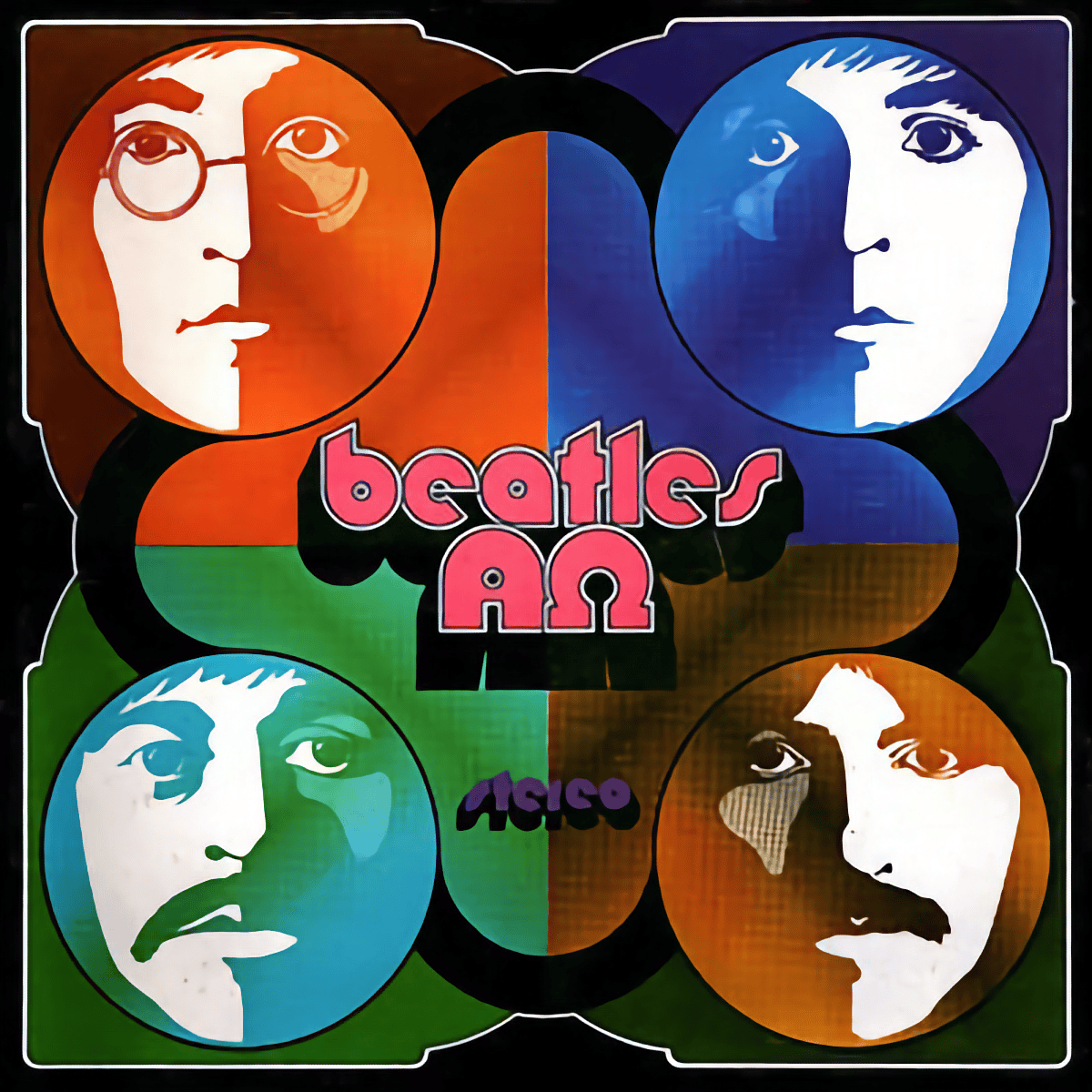
As we enter the 1970s, we enter the ongoing Beatles afterlife. Last time we looked Hey Jude, a somewhat haphazard collection of songs put together by Allan Steckler entirely to fulfill a contractual obligation. Strange compilation albums are going to be the norm for the bulk of the ‘70s and early ‘80s, because at this point the band is dead, leaving the record labels free to do basically whatever they want.
Up until now, I’ve restricted myself to looking at authentic Beatles releases only, but our subject today is too interesting to go unacknowledged: Alpha Omega, a bootleg Beatles compilation album released in 1972 by Audiotape Inc., a small company based out of New Jersey. Advertised on TV and radio, the collection contained 60 songs, most of them authentic Beatles recordings, with a few solo tracks thrown in for good measure. The set cost only $13.95, equivalent to $103.57 in today’s money. (For the sake of comparison, the 2023 versions of Red and Blue cost about $131 total, with 15 more songs than on Alpha Omega.)
Per About the Beatles:
Prior to 1972, sound recordings were not subject to federal copyright in the United States; they were, instead, subject to various applicable state torts and statutes. The Sound Recording Amendment of 1971 extended federal copyright to recordings fixed on or after February 15, 1972 (the effective date of the act), and declared that recordings fixed before that date would remain subject to state or common law copyright.
Those statutes as they existed in New Jersey, where Audiotape, Inc. was based, were lax compared to other areas, and restricting the sale of the set to mail order ensured they could continue to hide behind the pirate-friendly laws.
Then the inevitable happened. Apple Corps sued for copyright infringement, and the album was withdrawn from sale… though the same company was able to put out a second album with 60 more songs on it. The upshot of it all, though, was that in the absence of an official career-spanning greatest hits album, the bootleg version sold well, (of course it did, it’s the Beatles) and someone at Apple realized there was a market for this kind of thing – so, in 1973, we got the Red and Blue albums, advertised at the time as “the only authorized collection of The Beatles.”
Copies of this album are still out there on places like Discogs, but they’re getting hard to find – I assembled my version myself, mostly from the 2009 remastered albums… which means my experience is, sonically speaking, far superior to anything the folks who bought this album in 1972 would’ve heard. But I’m a dedicated weirdo, so what do I know?
So, what’s this decidedly unauthorized collection like? Let’s dive in and see what we can find.
Disc 1
Act Naturally: For the first and only time ever, Ringo sings the lead-off track on a Beatles album! In this case it is a song by the country artist Buck Owens, which is very Ringo. It is kind of funny that it’s Ringo singing this, since he was “acting naturally” in his famous ‘Ringo goes parading’ sequence in A Hard Day’s Night.
All I’ve Got to Do: John’s take on a Smokey Robinson pastiche, it’s a great early ballad number from him, and I love the way he sings on it. While his vocal stylings could be described as tart, (probably from all the cigarettes he smoked) he really makes it work for him – that tartness gives his vocal some raw passion, and it really shines in this song. And then he does it again, six years later, on Don’t Let Me Down.
All My Loving: Paul really seemed to like epistle songs, given the sheer number of them that he writes during the Beatles years, from P.S. I Love You to Paperback Writer. This is a fantastic one, though whenever I listen to it I can’t help but think like the narrator is practically begging to end up cheating on his girlfriend later on. While researching this song, I found someone in The Independent had hypothesized that it was inspired by “Kathy’s Waltz” by Dave Brubeck, and I wouldn’t be surprised if it was, given all the jazz that played in the McCartney house when Paul was growing up.
And I Love Her: One of the prettiest love songs the Beatles ever wrote, this. The opening riff was apparently George’s creation, right on the spot – an earlier version on Anthology 1 lets us hear it on electric instruments, minus the riff, and I have to say, something really is lost without it. This song belongs on acoustic guitars.
Baby’s in Black: This might sound weird considering the dark lyrics, but this is genuinely one of my favorite Beatles songs, entirely because of the vocals: John and Paul singing into the same microphone, harmonizing together in a way that only they were able to do, and it really comes alive in stereo. It’s fucking gorgeous.
Yesterday: Speaking of moody Beatles tunes, we have “Yesterday,” the most covered song in the history of popular music. I adore this song, and goodness knows I’ve had cause to think of it quite a bit over the years, when applying it to my own relationships. (Also, may I recommend a version from 2006 Grammy Awards? It really shouldn’t work, and yet…)
The Ballad Of John And Yoko: This song was a hybrid of two approaches. Specifically, Paul’s preference for story-songs was wedded to John’s fondness for autobiographies to create this track, a written record of John’s marriage to Yoko Ono, and the honeymoon that followed. It was John and Paul’s first true collaboration in some time, and they played all the instruments. “Ballad” was also the first Beatles song to be mixed only for stereo, no dedicated mono mix was ever prepared, as mono had fallen out fashion by 1969. The last mono Beatles single was “Get Back,” backed with “Don’t Let Me Down.”
Bangladesh: George’s plaintive attempt at trying to get help for the Bangladeshi independence movement, spurred by his old friend Ravi Shankar. In writing this song, he invented the charity single, and the subsequent Concert for Bangladesh in 1971 invented the benefit concert. What George lacks in punch (not everyone can be John Lennon) he makes up for through sheer determination and plainspokenness. No politics, just people. That’s George in a nutshell, really.
Can’t Buy Me Love: An energetic Paul song for the ages, it’s most well known for accompanying the scene in the movie where the Beatles screw around in a field for two minutes, and it’s amazing. And check out the double-tracked guitar solo! I love it when Paul gets to rock out.
Come Together: While based on a Chuck Berry line, this song by John quickly goes in its own direction, despite what Berry’s lawyers thought. The drum part in this song is one of Ringo’s best, and that riff! God, it’s brilliant.
Day Tripper: “Tripper” was, at once, a drug song (specifically LSD) and a reference to people who go on trips and then come home in the same day. Personally, I’ve always liked “Tripper” more, as it was the first Beatles song I learned to play on guitar.
Do You Want to Know a Secret: George’s second vocal spot, and probably my least favorite. Not because of his accent (his particular brand of Liverpudlian drawl is amazing) he just sounds slightly off-key in places. The “do-da-do” backing vocals are nice though.
Eight Days a Week: The boys may not have thought much of this one, but it’s one of my favorite love songs of theirs, and intensely relatable now that I’m in a relationship. I really would love my girlfriend eight days a week!
Eleanor Rigby: If “Yesterday” wasn’t enough of an indicator that the Beatles are no longer just a rock band, “Eleanor Rigby” solidifies this as a fact. Classical music orchestrations will go on to become a big part of the later Beatles sound, and this is them going full throttle with it. It’s a gorgeous song, if a very sad one. (If you like the strings as much as I do, an instrumental version is available on Anthology 2.)
Uncle Albert/Admiral Halsey: Coming from Paul’s 1971 album Ram, which he made with Linda, it’s a song that practically exemplifies the strange relationship between Britain and America, with one half of the title referring to an uncle of Paul’s, while the other half refers to an American admiral from WW2. And that’s before you factor in the dual nationalities of Paul and Linda. It won him a Grammy, and frankly, I’d say it’s very well-deserved. Exquisitely crafted, like all of Paul’s work.
Disc 2
I Should Have Known Better: What’s that? Another Beatles song with harmonica on it! Pretty sure this is the last of those. Also listen for, again, George’s solo here, he gets a lot of mileage out of that 12-string. One of my favorites of his solos. ❤
It Won’t Be Long: Though the Beatles were on record as being big fans of Elvis Presley, Buddy Holly, Chuck Berry, and lots of other heavyweights of ‘50s rock and roll, they really liked girl groups too. This track is an original and it sounds a lot like a girl group number from the same period, but where anyone else would do it from the woman’s perspective about the guy, the Beatles flip the script, and what results is a song from the guy’s perspective about the woman he’s with. This is radical stuff for the early sixties, and one of our earliest indications as to how awesome women are in Beatles songs.
I Want to Hold Your Hand: This track, recorded 17 October 1963, was the song that broke open the floodgates for the band’s invasion of America. The band’s previous singles up until now had been released on some smaller record labels, where they proceeded to flop. It was not until “I Want to Hold Your Hand,” released on the big-time Capitol Records label, that the group’s fortunes in the US changed. This song was pivotal in another way as well: the lyrics in the bridge portions, “I can’t hide,” were misheard by Bob Dylan as “I get high.” When the band were playing in America for their 1964 summer tour, Dylan met the group and turned them on to pot in August. History was never the same again.
Lady Madonna: The Beatles started ‘68 in a big way with this song, a piano-driven story track about a single mom trying to raise three children. Inspired by Fats Domino and Humphrey Lyttleton, the blues-inspired feel was a big shift from the psychedelic flavorings of their recent tracks. Paul has described it as a tribute to women, starting with the Virgin Mary.
Ticket to Ride: One of the Beatles songs of 1965, “Ticket to Ride” has been described by John Lennon as the first heavy metal song, I can kind of get why he thought that – this is a heavy song, thanks to a combination of overdubs and the drone-like, sustained A chord that runs through the main body of the track. Also, that riff is fucking great, and I really love Ringo’s drumming here.
Lucy in the Sky with Diamonds: The somewhat controversial Lewis Carroll riff that John wrote based off a drawing by his son Julian, it’s one of my favorites of his songs from this period. The mono version (which I’m listening to while I write this) is at a slightly different speed than the stereo mix more people are familiar with, which is always a little jarring, but you adapt quickly.
Michelle: When I first came out as trans around nine years ago (holy fuck nine years?!) I chose Michelle for my replacement middle name, entirely because of this song. I had hoped Paul might perform it when I saw him live in 2016, but he didn’t – maybe I’d’ve stuck with it if he had. (As it is, Fenrira Dukane fits me better anyway, middle name wise.)
Mr. Moonlight: Yeah, no, I’m sorry, the critics are right. This one just sucks. They almost used “Leave My Kitten Alone” (available on Anthology 1) and if you slipped that into place, “Kitten” is obviously a better song. This is just cheesy and awful.
I Feel Fine: Another song with a particularly notable beginning, the start of “I Feel Fine” happened when Paul McCartney plucked an A note on his bass while it was pointed in the vicinity of John’s guitar amp, causing feedback. Doing this technically violated EMI’s recording rules, but as so often happens in the story of this band, sometimes you have to break the rules to get the sound you want.
If I Fell: One of my favorite John ballads, this song gets played early in the movie to cheer up Ringo, but nowadays I associate it with all the times I’ve listened to it with my girlfriend, since it’s part of one of our couples mixes. Sonically, it’s a wonderful display of John and Paul’s talent for harmonizing. That’s a sound you’ll never forget, even sixty years later.
I’ll Be Back: John and Paul share lead vocal duties on this acoustic-guitar driven track, which originally ended on the British version of the Hard Day’s Night album. It’s a surprisingly downbeat moment, something that speaks to their rapidly increasing maturity as musicians.
Hey Jude: The first song to be released on the Beatles’ own Apple label, “Hey Jude” began life as an attempt from Paul to comfort Julian Lennon, John’s son, as his parents were in the process of divorcing. The record-buying public certainly got the reassuring vibes, as it stayed at #1 for nine weeks, the longest run for any Beatles single, and remains their most successful song ever.
I’m a Loser: A straight break-up song in which the narrator reflects on his mistakes when dating this particular girl, whom he thought the world of, and still does. And I’ll tell you what, nothing hits you quite so hard as listening to this after… well, a break-up.
I’m Happy Just to Dance with You: George’s vocal spot on the album, I occasionally forget that he didn’t actually write this. I like it anyway, and I like the way he sings it.
I Saw Her Standing There: “One, two, three, FAWR!” With that count-in, the Beatles begin their musical odyssey with an electrifying track that shows off exactly what they can do, putting all those long hours in German nightclubs to good use. It’s an amazing up-tempo rock number, fizzing with energy and confidence, and a great start to a career that would go on to redefine popular music forever. Its use here, as the closing track of disc 2, shows it’s just as good as a final song as an opening one.
Disc 3
Nowhere Man: While most people probably associate this song with the animated sequence set to it in the Yellow Submarine movie, when I was about nine I thought this song was about George W. Bush, because he was president at the time and my dad hated him with a passion. Now I know it isn’t – it’s just John being insecure again. George’s lead guitar parts in this are great, especially the end of the solo. Harmonics!
Ob-La-Di, Ob-La-Da: I think I might be the only person in the world who actually likes this song, goodness knows the Beatles sure didn’t. (Except Paul.) Allegedly, the piano intro came about because John was high and pissed off, so he just did it, right there. My favorite part is the fourth verse, where Desmond is described as “staying at home and doing his pretty face,” which just leads me to believe that she’s a trans lesbian. Source: the very next line, where she’s described as being a singer with Molly’s band.
‘Paperback Writer’: Released as the first single of 1966, “Paperback Writer” all but defines the word distortion in its lead guitar part, though more attention is paid to Paul’s bass, which appears on a record for the first time as basically a lead instrument. Lyrically, this track is also one of the first Beatles songs, and the first single, not to have anything to do with love in any way whatsoever.
Penny Lane: “Penny Lane” is a Paul song, a nostalgic look back at the parts of Liverpool he often saw when he was young. While not quite as steeped in surrealism as “Strawberry Fields Forever,” “Lane” nonetheless features some psychedelic phrasing choices in some lines, like the one about the barbershop.
Help!: The title song, written by John Lennon. He described it as essentially being him calling out for help amidst the hurricane that was Beatlemania in the early sixties, and that really does lend the track a more anxious vibe than “A Hard Day’s Night” had. Audio nerd note: the lead vocal heard on the stereo version is completely different to the lead vocal on the mono – listen to the verses and choruses, not the intro.
Roll Over Beethoven: As a native St. Louisan, I’m contractually obligated to like George’s version of this classic Chuck Berry number, but even if I wasn’t, I’d still enjoy it because George does such a fabulous job with it. He can do straight rock songs just as well as John and Paul, and this one proves it. It really shines on the expanded Red album from 2023, where we get to hear it in proper stereo.
She’s a Woman: Another great Paul song where he gets to do his rock and roll voice again, I love any song where he gets to sing about how awesome his woman is. He’s head-over-heels for this chick, and you can tell! This mix of the song, along with “I Feel Fine,” contains additional compression and reverb, added by Dave Dexter Jr. when he remixed the song for its release here. This gives the song a more crisp vibe than the original UK masters.
Sgt. Pepper’s Lonely Hearts Club Band: The title song from the album of the same name, it introduces the band named in the title… and that’s pretty much it, lyrically speaking. Musically there’s a lot going on, from crowd noises here and there to an absolutely blistering guitar part from George, to show they haven’t entirely forgotten their rock roots, a horn section, some nice harmonies in the choruses… it’s a pretty great song! And then it leads directly into “With A Little Help From My Friends,” which isn’t on this disc.
Get Back: As revealed by Peter Jackson’s 2021 docuseries, this song sprung out of thin air seemingly during recording sessions for what would become Let It Be, as Paul found the chords for the introduction seemingly at random one morning in early January 1969. With cameras rolling and George and Ringo yawning, the song just appeared, though it took a move away from the film studio where they’d been rehearsing and into their new HQ in Savile Row for it to really take shape. His voice has entered a new lower register on this track, completely changing how he sings.
Hello, Goodbye: A song about opposites, and another Paul song. Really not too much to say about it, but I like the melody, and the music videos are really great – the band play on a stage in their Sgt. Pepper suits, and periodically you see them dressed up in the grey collarless suits from the “I Want to Hold Your Hand” single cover. In other ones they play their instruments and goof around like total dorks, it’s kind of amazing. Easily one of my favorite Beatles videos, if I’m honest.
Revolution 1: This is the song that kickstarts the political angle to John’s songwriting that he’ll carry with him into his solo records, though by the mid-70s, he’ll end up softening his harder stances, likely out of fear of further persecution from the Nixon administration. There are two major versions of this song, and personally, I prefer the faster one. (Especially the live vocal one, where Paul and George do the shoop-be-do-wa vocals again.)
Here Comes the Sun: George again, with the happiest Beatles song he ever wrote. I only wish I knew why they decided to move his vocal to the right, rather than putting it in the middle. (Fortunately, we have the 2019 remix to fix that little issue.) The song has only gotten more popular in recent years, and in fact, it was the first Beatles track to reach a billion streams on Spotify. Given the anxious times in which we live, a little burst of Harrison’s sunny optimism is exactly what we all need.
I’ll Follow the Sun: Another great Beatles ballad, but even here, it presents a somewhat more negative view of love than we’ve come to expect from the boys so far. In other words, this is the gentlest break-up song you could hope to have, though I’ll always associate it with footage of the band in Miami during their first American tour.
Imagine: The title song from John’s 1971 solo-era masterpiece, “Imagine” is a song with a complicated reputation, even if the message in it is quite simple – a distillation of everything his solo career was about. Some people drag him because he was a major celebrity with boatloads of money and possessions, but I kind of feel like, if you’ve got a platform, use it to promote social good. Being a Beatle? Best fucking platform there is.
Honey Don’t: Ringo does cover of Carl Perkins. I don’t rate it especially highly, but that might just be because I’ve never been the biggest fan of country music. They do a pretty credible job, and it’s certainly better than “Mr. Moonlight.”
Disc 4
‘We Can Work It Out’: Released as a double A-side with “Day Tripper” toward the end of 1965, “We Can Work It Out” proved to be the more popular of the two songs, as that was a Paul song, with John contributing the bridge. During recording sessions, George Harrison suggested performing the bridge sections in ¾ waltz time, to go with the minor chords used in those sections.
With A Little Help From My Friends: A lovely ode on friendship, written by John and Paul for Ringo to sing. It’s one of his best, and he sings wonderfully on it. (There is also an amazing drum part, because of course there is – it’s freaking Ringo, people!) Small wonder that it’s become a mainstay of his live shows over the decades, right?
Yellow Submarine: Maybe it’s cliche, but here I am at almost 30 years old, and I still love this song as much as I did when I was nine. It’s the perfect song for Ringo, always the favorite Beatle of young children everywhere, and I’m so glad it exists. The best part: “When the overdubs were finished, Evans led everybody in a line around the studio doing the conga dance while banging on the drum strapped to his chest,” and honest to god you can hear them doing it at the end of the song.
Baby, You’re A Rich Man: I’ve been reading Al Brodax’s book about the making of the Yellow Submarine movie recently, and one of the stories he tells in the book has him at Abbey Road one day, tending to some issue regarding the Beatles cartoon show he was making at the time, and heard this song played by the band. I’m not entirely sure I believe this anecdote, but who cares? It’s a great song all the same, the focus on the dangers of materialism, for all the world, remind me of “Imagine.” I love this song, and I swear it has to be one of the deepest cuts out there. (A lot of the Mystery Tour/Yellow Submarine songs feel like that to me, honestly.)
You Can’t Do That: If you read my review of the expanded Red album from last year, you already know what I think of this song: two minutes of sexist trash that, sadly, are of a piece with ‘60s expectations between men and women in relationships, and given John’s history of domestic violence… good fucking grief, Lennon.
You’ve Got to Hide Your Love Away: John doing another Dylan pastiche, only this time with flute rather than harmonica. No one is entirely sure what inspired the writing – John never spoke about it before he died, though some have claimed it may be about Brian Epstein, given that Brian was gay and that was illegal in 1965.
Maybe I’m Amazed: Coming from his eponymous solo album, it’s Paul doing what he does best – singing a wonderful love song to the most important woman in his life, in this case, the former Linda Eastman. It’s an expression of pure desperation and joy all at the same time.
A Hard Day’s Night: By far this song’s most distinguishing feature is its opening chord, the best attention-grabbing sound on a Beatles album ever. Written to order so as to provide a good accompaniment for the movie’s opening credits, the title comes from one of Ringo’s many malapropisms, and features John and Paul trading verses, and for the first time, the sound of George’s new 12-string Rickenbacker in the guitar solo. (Which was, incidentally, recorded at half-speed then sped up when played back.)
She Loves You: This song, more than any song they ever did, is the one that defines early ‘60s Beatlemania, particularly in Britain. This is the song that made them international superstars, and made everything that followed possible. As well as their falsetto vocal harmonies and their knack for catchy hooks, to say nothing of the sheer power behind Ringo’s drumming, this is a song that defies all convention with regard to how love songs are “supposed” to be, since it comes from a third party. And until 2023, we only ever heard it in mono – the master tape for this song no longer exists. But thanks to Giles Martin and Peter Jackson’s MAL process, last year we got a genuine stereo mix, and it rocks just as hard as the mono mix does.
Something: If there was ever any doubt that George Harrison had grown by leaps and bounds during his Beatles days, this should put those doubts to rest. Abbey Road was his happiest album, perhaps because he suspected that this part of his life was over. “Something,” as a love song, is one of the best ballads anyone ever did, and I appreciate it even more now that I’m dating Lykos.
Strawberry Fields Forever: My all-time favorite Beatles song ever, this. John wrote this in Spain after the band finished touring in 1966, and the actual recording of the song launched the band’s psychedelic period. It’s probably the most technically complicated song they ever did, not just with all the instrumentation going on, but the way it sounds – the first minute or so is in the key of B flat, while the rest of it (originally recorded in a higher key) had to be slowed down to match the first part. The resulting edit is one of the most famous pieces of Beatles lore ever, and the song just wouldn’t feel the same without it. What starts as a nostalgic look back at a favorite hiding place of John’s as a kid becomes an LSD-infused wonderland, and it’s absolutely brilliant. I wish I could’ve heard this in 1967 – it probably blew everyone’s minds.
Tell Me Why: The happiest song ever recorded about confronting your partner for some kind of failure, right here. As an aside, those falsetto vocals are, “Is there anything I can do?” (It took me an embarrassingly long time to realize this.)
The Long and Winding Road: An elegiac number from Paul reflecting on the disintegration of the band, it’s also the most contentious: in April 1970, after the song had been recorded, Phil Spector added orchestral overdubs and sent it to Paul prior to release. Paul was furious, and sent an angry letter in reply demanding that the changes be removed. He was ignored, and the single came out anyway, bringing an ignominious end to the band’s recording career. Fortunately, “Now and Then” exists, so it’s not the end of the story after all.
Let It Be: The final single released during the band’s lifetime, “Let It Be” had its origins in the 1969 recording sessions for the album of the same name. Feeling insecure and isolated as the band he’d given so much of himself to fell apart around him, McCartney has said repeatedly the track came to him in a dream, as with the elegiac “Yesterday.”
Everybody’s Trying to Be My Baby: George closes us out with another Carl Perkins cover, but this one is far more successful. I have to admit I really like the echo on his voice here – a good slap-back echo never hurt anyone.
Being unofficial, Alpha Omega really isn’t like most Beatles releases out there. Like, no one would ever dream of starting out a compilation with a Ringo song. This is the only time it happens, and I feel like that sets the tone for the rest of the album. The inclusion of solo songs is a surprising choice, but in the context of the early 1970s, I can see why the compilers went for it: to remind the world that while the Beatles, as a functional unit, were never coming back, the individual members were still out there, carrying on the spirit.
Musically, Alpha Omega is a really interesting collection, going even further than any of the official compilation albums ever have, and not just because of the random solo stuff. There are tracks on here that are normally never seen outside their parent albums, and would never make the cut for a Greatest Hits collection. This is a compilation designed by fans, for fans, and it’s the only one of its kind. And that, by itself, makes it worth listening to.


Leave a Reply