Nothing, and I mean nothing, solidifies a new Doctor quite like their first Dalek story. Eccleston, of course, got Dalek for his first and only face-off against our favorite alien exterminators, and it was fucking brilliant, as I wrote in a review that no less a figure than ROB FREAKING SHEARMAN approved of. (He told me it gave him a much-needed emotional boost – if that’s not high praise, I don’t know what is!)
David Tennant wasn’t quite so lucky: Evolution of the Daleks (to use one title for both installments) is a dreary runaround based on genetic determinism, as I noted in the RTD Rewind post about it – Tennant’s performance is about the best thing in it. Doomsday, by and large, is a better outing for the Daleks, but it’s also a Cyberman story, so I don’t count that one. Daleks only, please.
Moving into the Moffat era, we get to Victory of the Daleks for Eleven. For those of you who haven’t read Back to the Eleventh Hour: Volume 1 in a while, I’ll remind you: Victory is a solid WW2-era remake of The Power of the Daleks, the legendarily good first Troughton story, but it’s somewhat bogged down by its insistence on treating Winston Churchill as a heroic figure rather than an antagonist. Still, Smith turns in an excellent performance just the same.
Thirteen got landed with Resolution, an episode whose problems begin with the fact that they decided, for some reason, not to advertise the Daleks were coming even though everyone knew they had to eventually. And then the story they got was just a limp remake of Dalek with most of the set-pieces and none of the actual interesting stuff. Whittaker tries, but she can’t save the story.
Fourteen, being the shortest-lived Doctor ever, never has a Dalek story on TV, though he does get a cute comedy bit where he accidentally becomes the reason why Daleks have plungers rather than claws, as they did in the Chibnall era. And Fifteen, of course, hasn’t faced them yet, but I’m sure that when he does, it’ll be absolutely brilliant.
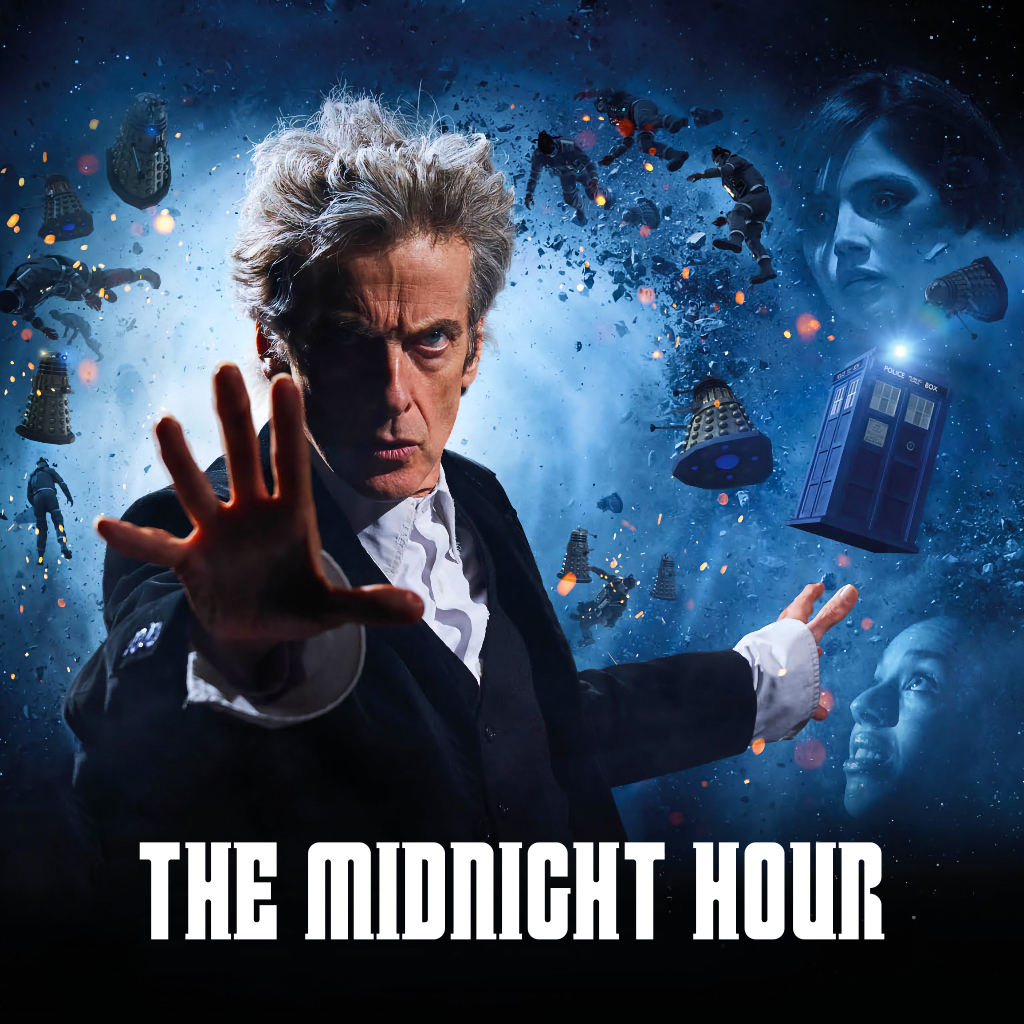
Which brings us, at last, to Into the Dalek – the second story of series 8, and Peter Capaldi’s first Dalek story, as he enthusiastically calls it on his illustrated script page. (Peter is really good at drawing Daleks. He gives them shoes! SHOES!)
It’s funny, but I think Peter Capaldi gets better Dalek stories than Matt Smith does. I already talked about what’s wrong with Victory, and while Asylum is better in terms of ideas and how the Daleks are written, (giving them a government and a concept of beauty is delightfully perverse) the B-plot regarding Amy and Rory’s relationship falling apart is poorly done, and it wasn’t even a good idea in the first place.
Into the Dalek, by contrast, is much more successful at integrating the emotional content into the plot. The entire story is about morality, and what it actually means to be a good person – even heroic. It’s difficult to imagine this story working with Eleven, even if he went into the colder, meaner characterization Smith said he might’ve went for, had he stayed for a fourth season. It needs Twelve, a man who is as far away from Eleven as possible, and not just in terms of dress sense.
I remember the early teaser clips for the eighth series – a bunch of scenes featuring Twelve, standing broodily in the TARDIS console room, looking very serious and stern. Even the first trailer we saw made this season of the show look much darker and more mature than the preceding seven had been.
The hell of it is, over the intervening decade I’d honestly forgotten how dark early Twelve was. This episode in particular brought it all back, what with the famous scene in which the Doctor asks Clara if he’s a good man or not, and she replies, “I don’t know.” Add in the general callousness he displays toward the death of Ross, and the fact that he has to be slapped to start fixing Rusty, and you have a Doctor who was very difficult for me to like.
I couldn’t deny his heroism, but why did he have to be such a jackass about it? Early Twelve was like watching Malcolm Tucker in command of a time machine, down to the kid-friendly echoes of that character interspersed throughout the season.
That’s not to say it isn’t a compelling performance – it is. Peter Capaldi was born to play the Doctor, and like previous promoted fanboy David Tennant, it already feels like he’s been the Doctor for years. There’s no sense of “finding his way into the part” that you got with Matt Smith in the early part of series 5. I may not have been entirely into his character, but I really enjoyed watching him work.
Anyway, onto Daleks. This is definitely the Moffat era attempting to remake Dalek, but unlike the Chibnall era’s version of the concept, this one actually works really well. Dalek was fundamentally about why Daleks are what they are and do what they do – this one flips the script by giving us a Dalek that hates its own kind and wants to kill them, because Daleks are evil and they must be destroyed.
The Doctor is then asked to put Rusty to rights: meaning, making him like every other Dalek we’ve seen. But when he realizes how having a good Dalek is actually a strategic asset, he works on undoing what he did in the first place, to make Rusty good again… but all that really happens is that Rusty is just as awful as before, except this time, he turns his gun-stick on his own kind.
We then learn that is is possible for Daleks to be redeemed, but of course, the show isn’t going to take its defining opponent off the board forever, so Rusty is very much an isolated case. (When we next see Daleks again, they’re more traditional.)
That’s not to say this episode was an exercise in futility though. Rusty says of the Doctor at the end, “I am not a good Dalek. You are a good Dalek.” Meaning, a monster that allies itself with the good.
This is a characterization of the Doctor that’s been floating around since at least mid-period Tennant, but where the Tennant era stipulated that the Doctor really was a monster and that he could go wrong if sufficiently provoked, with Twelve, the Doctor is more like Benedict Cumberbatch’s Sherlock Holmes. Lestrade says in one episode: “Sherlock Holmes is a great man, and I think one day, if we’re all very very lucky, he might even be a good one.” If that isn’t also an accurate summation of early Twelve, I don’t know what is.
In the final analysis, Into the Dalek is a fascinating character study in much the same way Dalek was for Nine – Twelve has a lot of work to do though, as we’ll see the next time he faces the Skarosian pepper pots.
Next time: a new twist on the celebrity historical chestnut, as Mark Gatiss returns to the show with one of my favorite Twelve episodes.


Leave a Reply