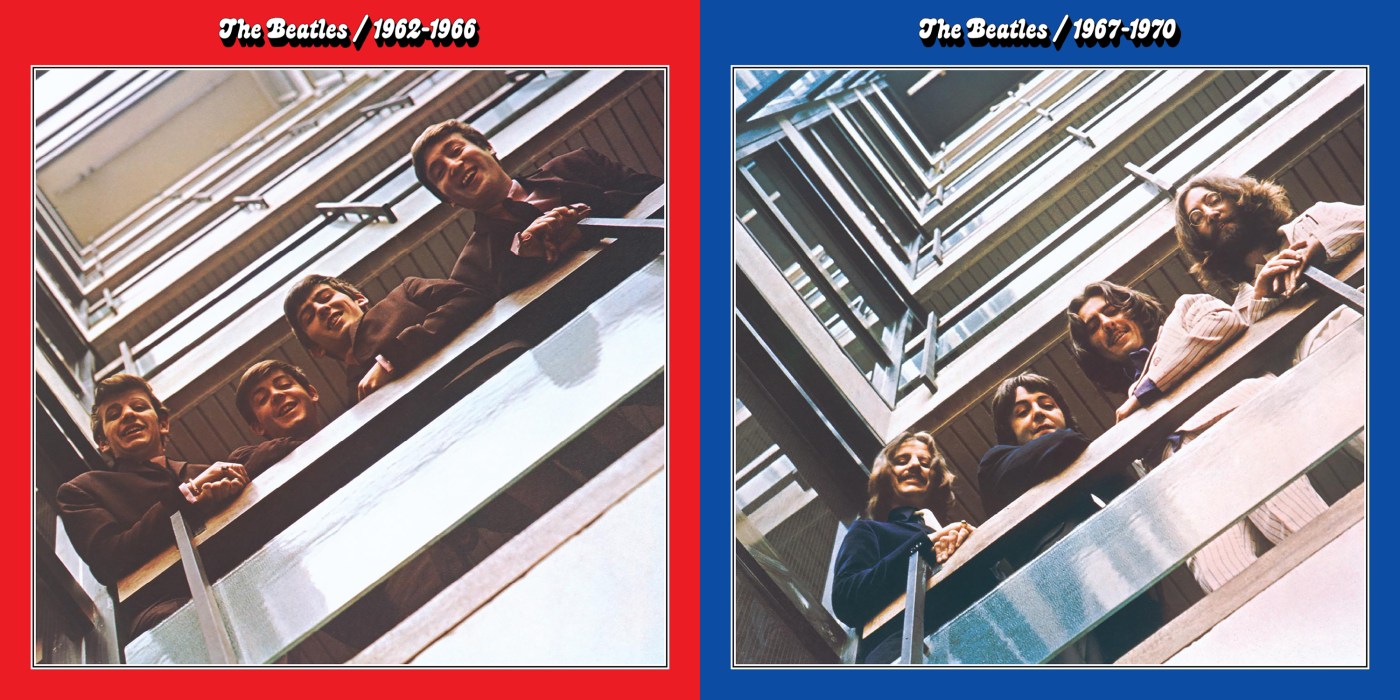
The story of the Red and Blue albums (to use the popular name for each of them) begins, as most things do, with a lawsuit.
In 1972, a record company in New Jersey released Alpha Omega, an unauthorized compilation album of Beatles songs, along with a few contemporary solo numbers. It was spectacularly illegal and of course, Apple Corps sued and won the case. The next year, Alan Steckler, on orders from Allen Klein, put together two new compilation albums – 1962-1966 and its twin, 1967-1970, collecting the highlights of the Beatles’ recording career, during the years indicated in their titles.
The two albums were an amazing introduction into the world of Beatles music, and became incredibly popular. I know this because, as a kid, I would go around town with my Dad in his Nissan Altima, listening to Red and singing along at the tops of our voices.
The Red album functions as an excellent summary of the Beatles’ earliest years, from humble beginnings as Liverpool’s top pop band to the non-stop thrill ride of British and American Beatlemania, and on to their maturity into true artists. The Blue album, correspondingly, is a quick tour through their psychedelic era, then their return to basic rock and roll, from the White Album to Let It Be.
Let’s go through them track by track:
The Red Album:
Disc 1
‘Love Me Do’: The very first Beatles song, this version is probably the more well-known, since it’s a much stronger performance by everyone involved than the original single version… except, infamously, this is one of two songs without Ringo on drums! That’s Andy White pounding away in the background, poor Ringo was reduced to tambourine. Even so, it’s a solid first song, and the harmonica throughout gives it a nice blues-y vibe that contrasts with the sweetness of the words.
‘Please Please Me’: Their hit single and the title song to their first album, Please Please Me was John’s attempt to write a Roy Orbison song, with a little bit of Bing Crosby in the title. Early versions were slower and closer to a blues song than a rock number, but George Martin persuaded them to bring up the tempo and add harmonica, establishing it as an early Beatles trademark.
‘From Me To You’: Their third UK single, this song is well remembered for the sung opening lick, and the augmented chord that pops up during the bridge sections. And thanks to its inclusion on the 1 album from 2000, it’s one of several songs that can define what might be called Early Beatles, an epoch of time lasting until around Beatles For Sale.
‘She Loves You’: This song, more than any song they ever did, is the one that defines early ‘60s Beatlemania, particularly in Britain. This is the song that made them international superstars, and made everything that followed possible. As well as their falsetto vocal harmonies and their knack for catchy hooks, to say nothing of the sheer power behind Ringo’s drumming, this is a song that defies all convention with regard to how love songs are “supposed” to be, since it comes from a third party.
‘I Want To Hold Your Hand’: This track, recorded 17 October 1963, was the song that broke open the floodgates for the band’s invasion of America. The band’s previous singles up until now had been released on some smaller record labels, where they proceeded to flop. It was not until “I Want to Hold Your Hand,” released on the big-time Capitol Records label, that the group’s fortunes in the US changed. This song was pivotal in another way as well: the lyrics in the bridge portions, “I can’t hide,” were misheard by Bob Dylan as “I get high.” When the band were playing in America for their 1964 summer tour, Dylan met the group and turned them on to pot in August. History was never the same again.
All My Loving: Paul really seemed to like epistle songs, given the sheer number of them that he writes during the Beatles years, from P.S. I Love You to Paperback Writer. This is a fantastic one, though whenever I listen to it I can’t help but think like the narrator is practically begging to end up cheating on his girlfriend later on. While researching this song, I found someone in The Independent had hypothesized that it was inspired by “Kathy’s Waltz” by Dave Brubeck, and I wouldn’t be surprised if it was, given all the jazz that played in the McCartney house when Paul was growing up.
‘Can’t Buy Me Love’: An energetic Paul song for the ages, it’s most well known for accompanying the scene in the movie where the Beatles screw around in a field for two minutes, and it’s amazing. And check out the double-tracked guitar solo! I love it when Paul gets to rock out.
‘A Hard Day’s Night’: By far this song’s most distinguishing feature is its opening chord, the best attention-grabbing sound on a Beatles album ever. Written to order so as to provide a good accompaniment for the movie’s opening credits, the title comes from one of Ringo’s many malapropisms, and features John and Paul trading verses, and for the first time, the sound of George’s new 12-string Rickenbacker in the guitar solo. (Which was, incidentally, recorded at half-speed then sped up when played back.)
‘And I Love Her’: One of the prettiest love songs the Beatles ever wrote, this. The opening riff was apparently George’s creation, right on the spot – an earlier version on Anthology 1 lets us hear it on electric instruments, minus the riff, and I have to say, something really is lost without it. This song belongs on acoustic guitars.
‘Eight Days A Week’: The boys may not have thought much of this one, but it’s one of my favorite love songs of theirs, and intensely relatable now that I’m in a relationship. I really would love my girlfriend eight days a week!
‘I Feel Fine’: Another song with a particularly notable beginning, the start of “I Feel Fine” happened when Paul McCartney plucked an A note on his bass while it was pointed in the vicinity of John’s guitar amp, causing feedback. Doing this technically violated EMI’s recording rules, but as so often happens in the story of this band, sometimes you have to break the rules to get the sound you want.
‘Ticket To Ride’: One of the Beatles songs of 1965, “Ticket to Ride” has been described by John Lennon as the first heavy metal song, I can kind of get why he thought that – this is a heavy song, thanks to a combination of overdubs and the drone-like, sustained A chord that runs through the main body of the track. Also, that riff is fucking great, and I really love Ringo’s drumming here.
‘Yesterday’: On the opposite end of the emotional scale entirely, we have “Yesterday,” the most covered song in the history of popular music. I adore this song, and goodness knows I’ve had cause to think of it quite a bit over the years, when applying it to my own relationships.
Disc 2
‘Help!’: The title song of their second movie, written by John Lennon. He described it as essentially being him calling out for help amidst the hurricane that was Beatlemania in the early sixties, and that really does lend the track a more anxious vibe than “A Hard Day’s Night” had. Audio nerd note: the lead vocal heard on the stereo version is completely different to the lead vocal on the mono – listen to the verses and choruses, not the intro.
‘You’ve Got To Hide Your Love Away’: John doing another Dylan pastiche, only this time with flute rather than harmonica. No one is entirely sure what inspired the writing – John never spoke about it before he died, though some have claimed it may be about Brian Epstein, given that Brian was gay and that was illegal in 1965.
‘We Can Work It Out’: Released as a double A-side with “Day Tripper” toward the end of 1965, “We Can Work It Out” proved to be the more popular of the two songs, as that was a Paul song, with John contributing the bridge. During recording sessions, George Harrison suggested performing the bridge sections in ¾ waltz time, to go with the minor chords used in those sections.
‘Day Tripper’: Released as the first single of 1966, “Paperback Writer” all but defines the word distortion in its lead guitar part, though more attention is paid to Paul’s bass, which appears on a record for the first time as basically a lead instrument. Lyrically, this track is also one of the first Beatles songs, and the first single, not to have anything to do with love in any way whatsoever.
Drive My Car: This song was written around the time the Otis Redding track “Respect” came out, and you can hear the influence, particularly in the piano. That opening guitar hook, for my money, is as distinctive as the opening chord of “A Hard Day’s Night,” and it gets the album off to a strong start.
Norwegian Wood (This Bird Has Flown): John’s acoustic ballad about an affair he was having, it’s still a lovely song, with lots of acoustic guitar and some great vocal parts from John and Paul. But of course, what ties it all together is George’s sitar part, the first recorded instance of his growing interest in Indian music. Just try and imagine it without it. You can’t, can you?
Nowhere Man: While most people probably associate this song with the animated sequence set to it in the Yellow Submarine movie, when I was about nine I thought this song was about George W. Bush, because he was president at the time and my dad hated him with a passion. Now I know it isn’t – it’s just John being insecure again. George’s lead guitar parts in this are great, especially the end of the solo. Harmonics!
Michelle: When I first came out as trans around nine years ago (holy fuck nine years?!) I chose Michelle for my replacement middle name, entirely because of this song. I had hoped Paul might perform it when I saw him live in 2016, but he didn’t – maybe I’d’ve stuck with it if he had. (As it is, Fenrira Dukane fits me better anyway, middle name wise.)
In My Life: One of John’s prettiest ballads, my personal favorite aspect of this song is the piano solo – it sounds like a harpsichord, but it isn’t! It’s a regular piano played at half speed, then sped up, a technique called varispeed. I used the exact technique once in an AUDI 2000 assignment in college, and my professor was really impressed! Thanks, George Martin!
Girl: I’ve never been overly fond of this song, mainly because of the hissing noises that come between repetitions of the title – they’re really loud on the stereo mix, so Young Lena would always get freaked out by them. Thankfully, the mono mix has them much much quieter, almost to the point of inaudibility.
‘Paperback Writer’: Released as the first single of 1966, “Paperback Writer” all but defines the word distortion in its lead guitar part, though more attention is paid to Paul’s bass, which appears on a record for the first time as basically a lead instrument. Lyrically, this track is also one of the first Beatles songs, and the first single, not to have anything to do with love in any way whatsoever.
Eleanor Rigby: If “Yesterday” wasn’t enough of an indicator that the Beatles are no longer just a rock band, “Eleanor Rigby” solidifies this as a fact. Classical music orchestrations will go on to become a big part of the later Beatles sound, and this is them going full throttle with it. It’s a gorgeous song, if a very sad one. (If you like the strings as much as I do, an instrumental version is available on Anthology 2.)
Yellow Submarine: Maybe it’s cliche, but here I am at almost 30 years old, and I still love this song as much as I did when I was nine. It’s the perfect song for Ringo, always the favorite Beatle of young children everywhere, and I’m so glad it exists. The best part: “When the overdubs were finished, Evans led everybody in a line around the studio doing the conga dance while banging on the drum strapped to his chest,” and honest to god you can hear them doing it at the end of the song.
The Blue Album
Disc 1
Strawberry Fields Forever: My all-time favorite Beatles song ever, this. John wrote this in Spain after the band finished touring in 1966, and the actual recording of the song launched the band’s psychedelic period. It’s probably the most technically complicated song they ever did, not just with all the instrumentation going on, but the way it sounds – the first minute or so is in the key of B flat, while the rest of it (originally recorded in a higher key) had to be slowed down to match the first part. The resulting edit is one of the most famous pieces of Beatles lore ever, and the song just wouldn’t feel the same without it. What starts as a nostalgic look back at a favorite hiding place of John’s as a kid becomes an LSD-infused wonderland, and it’s absolutely brilliant. I wish I could’ve heard this in 1967 – it probably blew everyone’s minds.
Penny Lane: Paul’s own nostalgia piece about his childhood in Liverpool, it’s far more conventional, musically, than “Strawberry Fields,” though there is a touch of surrealism in some of the lyrics. I like it, but it doesn’t hit the spot for me in quite the same way “Strawberry Fields” does.
Sgt. Pepper’s Lonely Hearts Club Band: The title song for their 1967 masterpiece, it announces the “concept” of the album, by introducing the band named in the title… and that’s pretty much it, lyrically speaking. Musically there’s a lot going on, from crowd noises here and there to an absolutely blistering guitar part from George, to show they haven’t entirely forgotten their rock roots, a horn section, some nice harmonies in the choruses… it’s a pretty great song! And then it leads directly into…
With A Little Help From My Friends: A lovely ode on friendship, written by John and Paul for Ringo to sing. It’s one of his best, and he sings wonderfully on it. (There is also an amazing drum part, because of course there is – it’s freaking Ringo, people!) Small wonder that it’s become a mainstay of his live shows over the decades, right?
Lucy In The Sky With Diamonds: The somewhat controversial Lewis Carroll riff that John wrote based off a drawing by his son Julian, it’s one of my favorites of his songs from this period. The mono version (which I’m listening to while I write this) is at a slightly different speed than the stereo mix more people are familiar with, which is always a little jarring, but you adapt quickly.
A Day in the Life: Another song based on newspaper articles, it’s often hailed as one of the Beatles’ best songs, and honestly, I can’t argue with it. The echo on John’s voice gives it a somewhat dream-like quality, which then becomes nightmarish when the build-up starts, preceding Paul’s verse, and the other extremely well-known chord in Beatles music. (Fun fact: that chord was held for so long, with the gain turned up so high, that if you turn it up as it fades out, you can hear EMI’s air conditioning humming away.)
All You Need is Love: The quintessential Beatles song, right here. Like, if you had to distill everything that band was into one track, this would be the one you’d pick: an anthem about the power of love, and its singular power to heal divisions of all sorts. It’s a fusion of rock and classical music, it’s got a great hook, it’s thought-provoking without being too on-the-nose. It’s even got a brief snatch of “She Loves You,” a nod to the band’s roots. See what I mean? Quintessential!
I Am the Walrus: If you want a song that perfectly encapsulates the psychedelic swirl of madness that was 1967, “Walrus” is easily the song to choose. John wrote it as a response to all those fans who tried to find hidden meanings in Beatles lyrics, so he composed a song where all the words are basically nonsensical, based on everything from Lewis Carroll to Liverpudlian skipping rhymes. (And then people argued over who the walrus was: John, or as he suggests in “Glass Onion,” Paul? John finally settled the issue in 1970 with the lyric, “I was the Walrus, but now I’m John,” from the song “God.”)
Hello, Goodbye: A song about opposites, and another Paul song. Really not too much to say about it, but I like the melody, and the music videos are really great – the band play on a stage in their Sgt. Pepper suits, and periodically you see them dressed up in the grey collarless suits from the “I Want to Hold Your Hand” single cover. In other ones they play their instruments and goof around like total dorks, it’s kind of amazing. Easily one of my favorite Beatles videos, if I’m honest.
The Fool on the Hill: My second-favorite Paul song from 1967, this is yet another song of his that flirts with classical music rather than rock and roll, though this time the story is about a lonely man on the hill who is, and remains, misunderstood in his community. In other words, it’s an anthem for outcasts everywhere. Goodness knows I’ve vibed with it a lot of late.
Magical Mystery Tour: As with A Hard Day’s Night and Help!, this track is the title song for the movie, though where the title songs for those two films still worked really well as songs in their own right, “Mystery” really is a movie song, in that much like the lead-off track on Pepper, it spells out the premise of the movie. It’s a pretty cool song, but there’s really nothing to it if you decouple it from the film.
‘Lady Madonna’: The Beatles started ‘68 in a big way with this song, a piano-driven story track about a single mom trying to raise three children. Inspired by Fats Domino and Humphrey Lyttleton, the blues-inspired feel was a big shift from the psychedelic flavorings of their recent tracks. Paul has described it as a tribute to women, starting with the Virgin Mary.
‘Hey Jude’: The first song to be released on the Beatles’ own Apple label, “Hey Jude” began life as an attempt from Paul to comfort Julian Lennon, John’s son, as his parents were in the process of divorcing. The record-buying public certainly got the reassuring vibes, as it stayed at #1 for nine weeks, the longest run for any Beatles single, and remains their most successful song ever.
‘Revolution’: Like “Paperback Writer” before it, “Revolution” defines the word distortion, as the guitar sound came from the guitars being plugged into the mixing desk directly and played so loudly as to overload the meters. It was one of Lennon’s earliest political songs, responding to the revolutionary fervor gripping the UK and the US by asking “What’s the plan for afterwards?” It was recorded twice: a slower version appeared on the White Album in 1968, and the single version is presented here.
Disc 2
Back in the USSR: Now that we can hear it in its finished form, this Paul McCartney rocker is one of the best album openers we’ve had in some time, and it really shows off just how deep his voice has gotten since “I Saw Her Standing There.” It’s oozing with confidence, this song, and states quite clearly that the psychedelics are over, once and for all.
While My Guitar Gently Weeps: If you want proof that George is increasingly outgrowing the Beatles, this should be argument enough. This is one of my all time favorite songs of his, serving as it does as a commentary on the band’s rapid disintegration. I would also like to congratulate Hatsune Miku for finding a time machine and performing the solo on this track, because otherwise, I’d have to complain about George having terrible taste in friends. (Eric Clapton is a racist piece of shit, and I really question George glossing over this over the ensuing decades.)
Ob-La-Di, Ob-La-Da: I think I might be the only person in the world who actually likes this song, goodness knows the Beatles sure didn’t. (Except Paul.) Allegedly, the piano intro came about because John was high and pissed off, so he just did it, right there. My favorite part is the fourth verse, where Desmond is described as “staying at home and doing his pretty face,” which just leads me to believe that she’s a trans lesbian. Source: the very next line, where she’s described as being a singer with Molly’s band.
Get Back: As revealed by Peter Jackson’s 2021 docuseries, this song sprung out of thin air seemingly during recording sessions for what would become Let It Be, as Paul found the chords for the introduction seemingly at random one morning in early January 1969. With cameras rolling and George and Ringo yawning, the song just appeared, though it took a move away from the film studio where they’d been rehearsing and into their new HQ in Savile Row for it to really take shape.
‘Don’t Let Me Down’: One of John’s finest love songs, “Don’t Let Me Down” was inspired by his relationship with the artist Yoko Ono, whom he’d met in 1966. Released as the b-side of “Get Back,” both tracks feature the keyboard playing of Billy Preston, a friend of theirs from the Hamburg period, and who sat in as the “fifth Beatle” during the Get Back/Let It Be sessions.
‘The Ballad Of John And Yoko’: This song was a hybrid of two approaches. Specifically, Paul’s preference for story-songs was wedded to John’s fondness for autobiographies to create this track, a written record of John’s marriage to Yoko Ono, and the honeymoon that followed. It was John and Paul’s first true collaboration in some time, and they played all the instruments. “Ballad” was also the first Beatles song to be mixed only for stereo, no dedicated mono mix was ever prepared, as mono had fallen out fashion by 1969. The last mono Beatles single was “Get Back,” backed with “Don’t Let Me Down.”
‘Old Brown Shoe’: An often-overlooked George song, Harrison was inspired by dualities as McCartney had been in 1967, but applied them to love instead. It, along with many of his other compositions in the mid to late 1960s, reflects his growth as a songwriter in the shadow of Lennon and McCartney, but it would take the band’s breakup for him to reach full strength.
Here Comes the Sun: George again, with the happiest Beatles song he ever wrote. I only wish I knew why they decided to move his vocal to the right, rather than putting it in the middle. (Fortunately, we have the 2019 remix to fix that little issue.) The song has only gotten more popular in recent years, and in fact, it was the first Beatles track to reach a billion streams on Spotify. Given the anxious times in which we live, a little burst of Harrison’s sunny optimism is exactly what we all need.
Come Together: While based on a Chuck Berry line, this song by John quickly goes in its own direction, despite what Berry’s lawyers thought. The drum part in this song is one of Ringo’s best, and that riff! God, it’s brilliant,
Something: If there was ever any doubt that George Harrison had grown by leaps and bounds during his Beatles days, this should put those doubts to rest. Abbey Road was his happiest album, perhaps because he suspected that this part of his life was over. “Something,” as a love song, is one of the best ballads anyone ever did, and I appreciate it even more now that I’m engaged to Lykos.
Octopus’s Garden: Written by Ringo while taking a vacation, George helped him out with some of the chord changes. It’s a successor to “Yellow Submarine,” sharing the same watery theme – it’s even got bubble sound effects! It’s still a rock song though: the guitar solo is great, and I fucking adore the backing vocals. As this is the last Ringo song on a Beatles album, I’m glad it’s one of his own pieces. Goes to show how far he’s come, the best drummer in the world.
Let It Be: The final single released during the band’s lifetime, “Let It Be” had its origins in the 1969 recording sessions for the album of the same name. Feeling insecure and isolated as the band he’d given so much of himself to fell apart around him, McCartney has said repeatedly the track came to him in a dream, as with the elegiac “Yesterday”.
Across the Universe: Taken from 1968, this version of an otherwise gorgeous late-period Lennon song is slowed down, and then completely ruined with a fucking choir and strings. Honest to god, Spector. His “Wall of Sound” production style might work for John and George’s solo albums, but this is just a disaster.
The Long and Winding Road: AKA, the mix of the song that made Paul so angry, he used the song as one of the six reasons why the Beatles should be broken up in the 1971 lawsuit that led to the band’s formal dissolution. And just listening to it, with an overbearing orchestra and harp and choir, frankly, I’m on Paul’s side.
As career retrospectives go, the Red and Blue albums are legendarily good. As Rob Sheffield noted in Rolling Stone on the occasion of their 50th anniversaries last year, the two albums are “arguably the most influential greatest-hits albums in history. The gateway drug into the Beatles songbook for generations of fans. Their most crucial post-break-up albums, even if the Fab Four wanted nothing to do with them. But these weren’t cheesy samplers—they were double-vinyl shrines with iconic artwork, celebrating the mystique of John Lennon, Paul McCartney, George Harrison, and Ringo Starr.”
Certainly, they were that for me. I must’ve listened to my dad’s 1993 CDs a hundred thousand times over the years, and I was thrilled when I finally got my own remastered copies in 2010. The expanded versions are even better, giving us more George on the Red Album, and adding “Now and Then” to disc 2 of Blue, meaning that John (who started the band in the first place) now has the last word, as nature intended. But we’ll talk about those later.
For now, here’s to Red and Blue: as a good a pair of compilations as it gets.


Leave a Reply