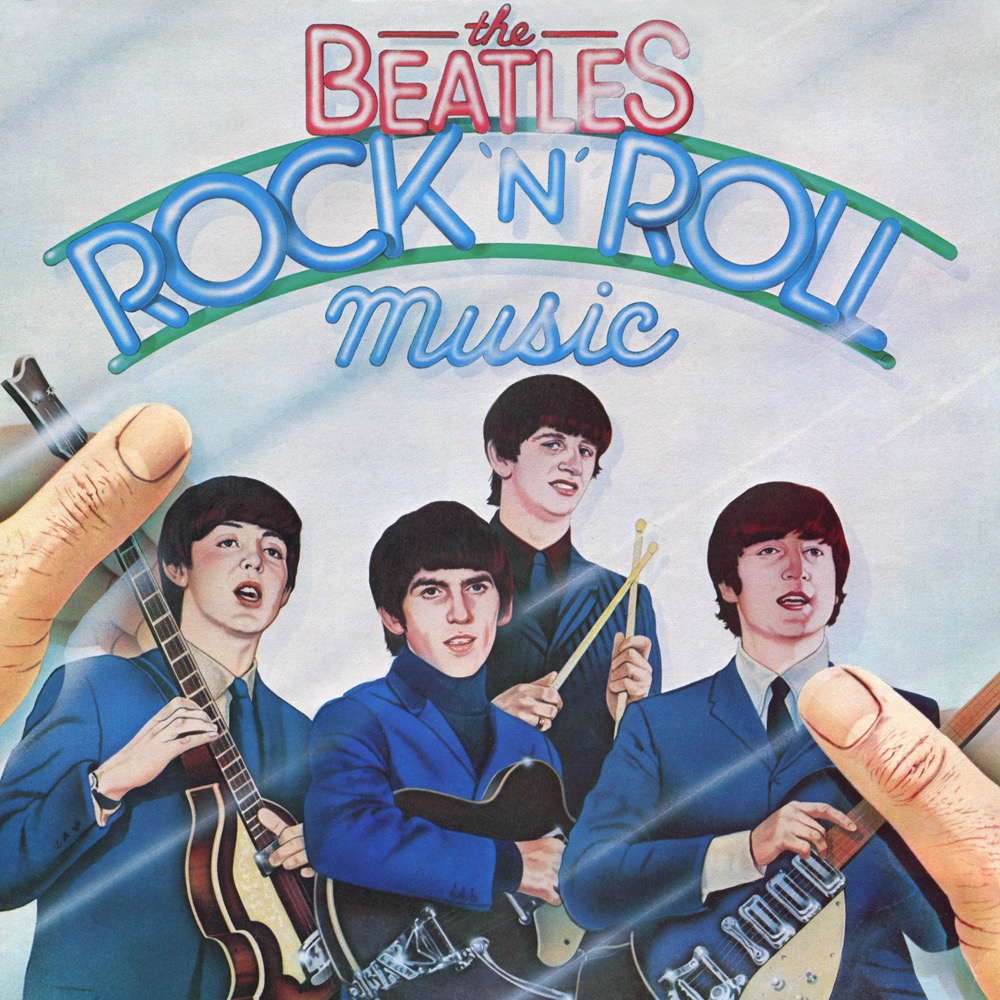
Not to be confused with the John Lennon album Rock ‘n’ Roll from 1975, this album saw release in June 1976, during a resurgence of Beatlemania: Paul McCartney was launching the American leg of his Wings Over the World tour, his first live performances in this country since the last Beatles shows a decade previously.
Serving as a 2-disc salute to the band’s many rock songs, the album was also an attempt on Capitol’s part to cash in on a similar wave of 1950s nostalgia, reflected in the spectacularly ugly cover art: an embossed color portrait of the Beatles against a shiny silver background, with the album’s title spelled out in what is presumed to be neon lights.
Symbols of the 1950s were used on the inside of the album’s gatefold sleeve, including a jukebox, an outdoor movie screen with a picture of Marilyn Monroe, an ice cream, a 1957 Chevrolet, a cheeseburger, and a glass of Coca-Cola.
Naturally, John and Ringo were furious. Ringo said to Rolling Stone: “It made us look cheap and we never were cheap. All that Coca-Cola and cars with big fins was the Fifties!” John offered to draw them a new cover himself, or suggest using the Hamburg photos taken from the band’s early years (as Lennon himself had on Rock ‘n’ Roll) but Capitol said no. The cover went out as released, though not for long – a replacement cover, used for the re-release in 1980, was a painting of the band in a crowd circa 1964.
Incredibly tacky art aside though, what’s this album actually like? Let’s find out:
Disc 1
Twist and Shout: Once a closing track, on this album it becomes the opening song, proving it can function just as well in that regard. John Lennon gives the performance of his life, absolutely shredding his vocal part – recorded after sucking down cough drops and milk for an entire day. It is amazing, and he only needed one take to nail it. Also of note: the backing vocals from Paul and George, especially those rising “ahhs” that take us into the last third of the song. (And that scream! Yes!)
I Saw Her Standing There: Put in second place, (mirroring Meet the Beatles) this song continues to be an amazing up-tempo rock number, fizzing with energy and confidence, and a great start to a career that would go on to redefine popular music forever.
You Can’t Do That: Still awful, even twelve years later. Especially galling given that second-wave feminism was going strong by 1976. Still, as awful as this song is, it is at least balanced out by other songs with far superior sexual politics.
I Wanna Be Your Man: Now this is more like it! I don’t care what anyone says, Ringo is really good at rock and roll as long as it’s in his range, like this one is. It’s more remembered these days for being the song that gave the Rolling Stones their first hit single, which kind of says everything you need to know about the Stones. As John put it, “We weren’t going to give them anything great, right?” (Ringo’s version is way better.)
I Call Your Name: One of John’s earliest songs, “I Call Your Name” is another early Beatles song to include cowbell, and was in fact considered for inclusion on the A Hard Day’s Night album before eventually getting released on the Long Tall Sally EP instead. It’s a relatively slower number too, a nice breather before launching into Ringo’s other big rock number.
Boys: Ringo gives a vocal performance worthy of John and Paul here, minus any screaming. While he may not have a ton of range, he uses the range he does have to great effect, so it’s no surprise that this song became a staple of his solo concerts in later decades. And because we have boys singing about boys, it’s unintentionally queer. Works for me! (Brian must’ve loved this one, being gay and all.)
Long Tall Sally: In which Paul McCartney displays his amazing Little Richard impression. Always a highlight of the band’s early ‘60s work, the way he can turn on a dime from the sweet-voiced crooner of “And I Love Her” and “Til There Was You” to this is absolutely something else. This song in particular was a staple of their live shows going all the way back to the Quarry Men era of the late ‘50s, and was, in fact, the last song they played as a live act – Candlestick Park, San Francisco, 1966. This version? All done in one take.
Rock and Roll Music: The title song for the album, it’s John doing a Chuck Berry cover, and he does a really great job with it! Kind of reminds me of “Twist and Shout,” though his vocal performance here is a bit more restrained here than in that earlier song. (For a given definition of “restrained” anyway.) Also note the way in which the piano drops out at 1:45.
‘Slow Down’: A cover of a song by Larry Williams, this contains two amazing things: my favorite Beatle vocal flub of all time (John can’t decide whether he’s singing about a girl or a boy and so does both at once, courtesy of double-tracking) and one of his best rock and roll screams, right up until “Revolution” in 1968.
Kansas City/Hey, Hey, Hey, Hey!: One of the first examples we’ve heard of Paul doing his Little Richard impression, it is genuinely incredible, and as a native Missourian, I am happy that both sides of my old home state are represented. (KC here, STL with “Rock And Roll Music” and “Roll Over Beethoven”)
Money (That’s What I Want): Another Motown cover from the boys, the idea on With The Beatles was for it to be an energetic album closer in the tradition of Twist and Shout, though I’m not entirely sure it works as one. Then again, it’s a little hard to top the exuberant performance of the latter. That said, I think it works better here as a regular album song, mixed in with all the other ‘50s rock covers on this side.
‘Bad Boy’: Another Larry Williams cover, and while I prefer the earlier “Slow Down” from Something New, this is still pretty good! It’s got John doing a single-tracked vocal this time, a real rarity for him – most of his Beatles-era songs, at least in the moptop era, were double-tracked, though he moves away from it as the ‘60s progress.
‘Matchbox’: Ringo’s vocal spot here is one of the earliest entries in a Beatles sub-genre we might call Forlorn Ringo Songs, in that his protagonists all seem to be men who are down on their luck, in the fashion of Ringo himself from his big scene in A Hard Day’s Night. Songs of this kind appeared on three consecutive UK Beatles albums: Beatles For Sale, Help!, and Rubber Soul, before resurfacing on the White Album – “Don’t Pass Me By,” Ringo’s own composition, was written around 1964.
Roll Over Beethoven: As a native St. Louisan, I’m contractually obligated to like George’s version of this classic Chuck Berry number, but even if I wasn’t, I’d still enjoy it because George does such a fabulous job with it. He can do straight rock songs just as well as John and Paul, and this one proves it. It really shines on the expanded Red album from 2023, where we get to hear it in proper stereo.
Disc 2
‘Dizzy Miss Lizzy’: John gets to do another hard rock and roll song, with the shout-y vocal style he always pulls out for songs of this sort, stretching as far forward in time as “Yer Blues” and “Cold Turkey,” to name a track from his solo era. It’s a spirited performance, and it works out well here as the first song of disc two.
‘Any Time At All’: This is a nice collab between John and Paul, as the narrator promises their partner that they’ll always be with them. We can all use little reminders like that, I think. In a way this is kind of like a sequel to “All I’ve Got to Do” from With The Beatles.
‘Drive My Car’: This song was written around the time the Otis Redding track “Respect” came out, and you can hear the influence, particularly in the piano. That opening guitar hook, for my money, is as distinctive as the opening chord of “A Hard Day’s Night.”
Everybody’s Trying to Be My Baby: George brings us another Carl Perkins cover, and this one is pretty successful. George always really liked Carl Perkins, and you can hear that love in his performance on the track. I have to admit I really like the echo on his voice here – a good slap-back echo never hurt anyone.
The Night Before: Paul’s first song, about a relationship that is rapidly heading toward a nasty split, the narrator’s wishes to be treated “like he was the night before” notwithstanding. One could imagine (since they’re both film songs) that the later track, “Another Girl,” is the song that comes after this, if the two narrators are the same person, with “Yesterday” in between – here, our guy wants to remember the good times, while in “Yesterday” he’s realized he can’t go back to what was, and by “Another Girl,” he’s gotten over his ex entirely.
I’m Down: Out of all the songs where Paul did his Little Richard voice, “I’m Down” is probably the best one ever. It came out as the B-side of the “Help!”single, but it never got a proper album release until Rock ’n’ Roll Music came out. The studio version is great all by itself, but for a good time, watch the Shea Stadium performance from 1965, on the Anthology documentary, where John plays the keyboard with his elbows like a madman.
Revolution: This song is the first of three of the best hard rock songs the Beatles ever did, all from 1968 when they were making the White Album. With a throat-tearing howl worthy of “Twist and Shout,” John attempts to add some realism to the revolutionary spirit of the late ‘60s. John wanted the slower album version to be the next single, but the other three overrode him, and I’m so glad they did.
Back in the USSR: In its original context as the first song on the White Album, this Paul McCartney rocker was one of the best album openers they did, and it really shows off just how deep his voice had gotten since “I Saw Her Standing There.” It’s oozing with confidence, this song, and states quite clearly that the psychedelics are over, once and for all.
Helter Skelter: Staying with the hard rock theme of the past few songs, here is Paul casually inventing heavy metal, entirely so he could outdo the Who. Paul’s sheer determination is one of my favorite things about him, this song is probably one of the hardest (if not the hardest) rock songs they ever did.. and it’s about a carnival attraction, despite what Charles Manson thought.
Taxman: Yes, I am aware that this is probably the most politically conservative Beatles song out there, since it’s two minutes of George Harrison bitching about paying taxes on his Beatles earnings… despite being unfathomably rich anyway. But I don’t care, because it’s a great fucking rock song to boot. This is the only time George gets the lead-off spot on a Beatles album, and I think it’s a sign of just how quickly he’s progressed as a songwriter that this is even the case.
Got to Get You Into My Life: Don’t let the lyrics fool you, because this is not a traditional love song. This is Paul doing an ode to marijuana, disguised as a love song. (I bet it’ll go over really well in Colorado these days.) It’s also the first time we’ve heard a full horn section on a Beatles song, not including the solo on “For No One.” And, interestingly, Paul’s vocal is genuinely double-tracked here, not ADT’d. (The difference is subtle, but if you’ve heard this music as many times as I have, you learn to tell really quickly.)
Hey Bulldog: Good grief do I love this song, it’s absolutely fucking great. One of the best rock songs the Beatles ever did, and when it was released in 1969, it was buried on what was by some distance the least-loved album in their catalogue: the Yellow Submarine soundtrack. I could listen to it all day! Ringo and Paul have the time of their lives in the rhythm section, the guitar solo is amazing, and the end where John and Paul screw around and bark?! It’s hard not to get swept up in it! Only in 2023, when it came out on the expanded version of the Blue album, did it finally get the justice it deserves.
Birthday: The Beatles do a birthday song as the penultimate track of the album, and I really love this one. I listen to it every year on my own birthday, and it’s a fantastic way to start the day off! Like my favorite band in the world is singing “Happy birthday” just for me. ❤ Love ya, boys.
Get Back: As revealed by Peter Jackson’s 2021 docuseries, this song sprung out of thin air seemingly during recording sessions for what would become Let It Be, as Paul found the chords for the introduction seemingly at random one morning in early January 1969. With cameras rolling and George and Ringo yawning, the song just appeared, though it took a move away from the film studio where they’d been rehearsing and into their new HQ in Savile Row for it to really take shape. The single called it “a song to roller coast by,” and I agree: it is! This version, from Let It Be, ends with applause and Paul saying, “Thanks, Mo,” the perfect way to end this salute to Beatles rock and roll.
Rob Sheffield, my favorite Beatles writer, offered a spirited defense of this album in his book Dreaming The Beatles: “What Capitol knew how to imagine was all the people buying new packages of previously released material, but with Rock ’n’ Roll Music, they created (however unwittingly) a new phenomenon that broke off from the flame-keepers, a sign that the music had taken on a new life.”
And so it has been for the last 48 years. Once the band took that final walk across Abbey Road, their music was out of their hands and in ours. Everyone finds the Beatles differently: for me it was my dad’s CDs of Red and Blue, and hazily recalled memories of the 1 album in 2000. And with every re-release and repackage of old music, even if it’s newly remixed, the Beatle legacy gets stronger and stronger still.
So, here’s to Rock ‘n’ Roll Music, the album that made everything else possible.


Leave a Reply