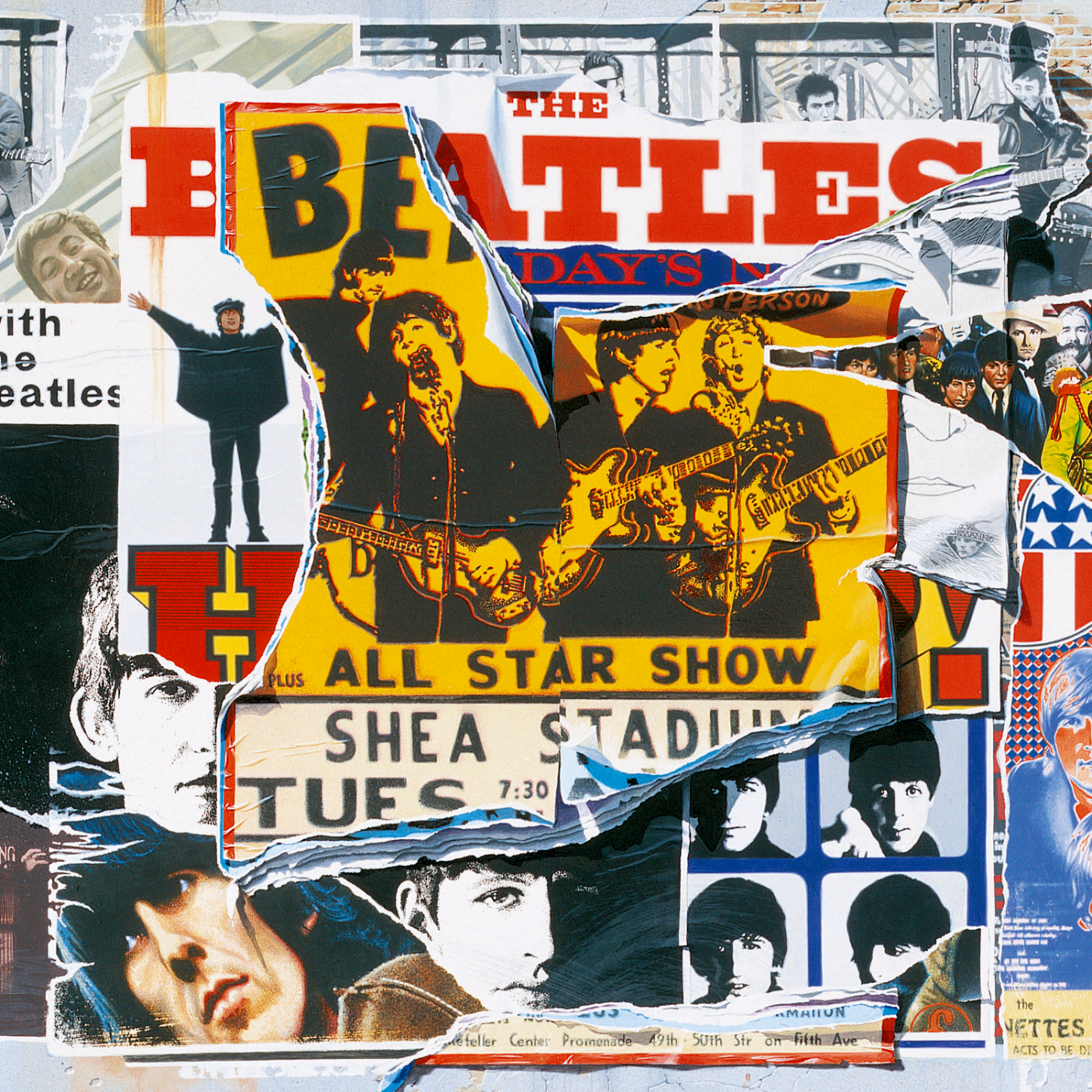
Released in March 1996, Anthology 2 is the second album of the Anthology series, and probably my favorite of the three. It captures the band at a time of transition in their career: disc 1 covers the last two years of their days as a touring band, including plenty of live tracks, while disc 2 is entirely studio-bound, giving that half of the album a completely different sonic vibe.
Disc 1
Track 1
‘Real Love’: The second of three Beatles reunion songs, and the last one to be completed during the original ‘90s recording sessions. (“Now and Then” started here, but the technology to finish it wasn’t there yet.) While PG&R were not huge fans of this song, I’ve always really liked it – I feel like it’s an excellent summation of everything the band was about.
Tracks 2-8
These tracks originate from the Help! album sessions, including a Ringo song that had previously been unreleased.
‘Yes It Is’: An early take of the song with John singing on his own, presumably a guide vocal for the later master. It’s an interesting listen, though it doesn’t last very long – the gibberish-filled solo verse fades into the released version.
‘I’m Down’: An early take of one of my all time favorite Beatles songs – the very first one, in fact. Still just as energetic as the master, though there’s a lack of keyboard. I do like the improv he does toward the end of the song – he really gets into it!
‘You’ve Got To Hide Your Love Away’: An early take of this song from Help!, complete with John singing a little ditty about Paul breaking a glass. (And a nice snare roll from Ringo!) I like that it’s just John and his acoustic guitar, gives it a slightly different vibe.
‘If You’ve Got Trouble’: Intended to be RIngo’s vocal spot on Help!, the boys were ultimately not happy with this song, so they used “Act Naturally” instead. Honestly, I kind of like it? Like a more successful version of “Honey Don’t” from Beatles For Sale.
‘That Means A Lot’: Another unreleased song, written and recorded around the time of “Ticket to Ride,” (which it sonically resembles) but with Paul on lead vocals. It’s not bad, though the version presented here is absolutely soaked in reverb and slapback echo, for some reason.
‘Yesterday’: An early take of Paul’s signature Beatles song (well, one of them) where he instructs someone on the chords… despite being the only guitarist on the recording. Also note the line swap at the start of the second verse! Always a bit jarring, after having heard the album version for so long. Still, that it’s just Paul and his guitar singing really brings home the loneliness of the song, and it’s lovely.
‘It’s Only Love’: This sure is a song that exists!
Tracks 9-12
These are live performance tracks, consisting of the band performing on the UK TV show Blackpool Night Out. It includes a performance of Yesterday, with strings and all!
‘I Feel Fine’: Our first live performance of the album, I always seem to get this slightly confused for the Shea Stadium version from the Anthology documentary. Still, this is pretty great, though George’s lead guitar is ever so slightly out of tune.
‘Ticket To Ride’: George’s guitar remains slightly out of key, but John and Paul do some great stuff with the vocals, and I think I can hear George during the choruses too.
‘Yesterday’: George introduces a first – a live performance of “Yesterday,” with Paul on acoustic guitar, and studio musicians contributing the string sections. Other live versions from 1965 and 1966 have the rest of the band playing as well, giving the song a different vibe. John thanking Ringo is just hilarious. ❤
‘Help!’: Speaking of amusing John moments, describing the title song of their second movie as “their latest electronic noise” is incredible. As for the song itself, it’s pretty great, aside from George’s slightly out of key lead guitar. (Yes, that’s the last time I’ll mention it.) I also enjoy John forgetting the words heading into the second chorus.
Track 13
‘Everybody’s Trying To Be My Baby’: The one and only song representing the band’s legendary Shea Stadium concert from August 1965, in which the band casually invented stadium rock. More selections from the show appear in the Anthology documentary, though so far, a complete live recording has never been officially released. Which is a crying shame, because it would sound great, especially if they get Giles Martin to mix it!
Tracks 14-16
These three tracks were recorded during sessions for Rubber Soul.
‘Norwegian Wood (This Bird Has Flown)’: A different key, a different sitar part… everything about this early version of the song is interesting, though I’m glad they sped things up a bit for the album.
‘I’m Looking Through You’: The album version of this song is one of the best Beatles breakup songs ever, especially the bridge sections… which do not exist in this recording, because they haven’t been written yet. It’s a good performance, but the slower tempo takes some of the edge off the song, to its detriment.
’12-Bar Original’: A rare instrumental from the boys, one of exactly two in their whole catalogue. A full 6 minute version exists in bootlegs (allegedly) but this 2 minute take is all that’s ever been publicly released. It’s neat, but otherwise not one of the greatest things out there. (Maybe it’ll show up on the inevitable super deluxe Rubber Soul.)
Tracks 17-23
These tracks were recorded during sessions for their 1966 drug fueled masterpiece, Revolver.
‘Tomorrow Never Knows’: Originally called “The Void,” this early version of Revolver’s closing track is kind of great, in a “here is how it started” sort of way. Almost hypnotic, when stripped of tape loops and reversed guitar parts. Note that John’s voice has the Leslie effect on it for the entire song, rather than just the last third.
‘Got To Get You Into My Life’: An early version of Paul’s ode to pot, lacking brass but featuring some lovely harmony work from John and George, and some lyrics that won’t make it to the album version.
‘And Your Bird Can Sing’: One of my all time favorite Beatles outtakes ever – John and Paul attempting to do some double tracking and failing miserably, because they spend the entire song laughing hysterically. At what, we never know. The Revolver box set released two versions of this take, one with them laughing and one without. Personally, I prefer this one.
‘Taxman’: Otherwise identical to the album version, though it lacks the cowbell, lead guitar, and the shout-outs to Harold Wilson and Edward Heath, and has a clean ending, rather than a fade-out. This take would be re-released on the Revolver box set in 2022, with a better stereo mix.
‘Eleanor Rigby’ (Strings Only): An entirely instrumental version of Paul’s funereal Revolver track, where you can really hear the reverb on the strings better. Honestly, this is probably my favorite mix of the strings – the Love mix is a close second, since it extends the song a bit and adds Paul’s vocal.
‘I’m Only Sleeping’ (Rehearsal): Nothing much here, just a laid back rehearsal take of John’s song, featuring vibraphone. It sounds really cool, especially the very end of the song. Just adds to the dream vibes!
‘I’m Only Sleeping’ (Take 1): An acoustic version of John’s ode to sleep, featuring more of John and Paul singing together than the master did. Not quite as lethargic as the final mix, but I like it anyway, especially the part where the reversed solo goes in the master.
Tracks 24 & 25
The final live performance tracks on the album, dating from the Budokan shows of June 1966 in Japan. They had gotten sick of touring by this time, and the decline in their musicianship is evident in these selections.
‘Rock And Roll Music’: As the Beatles themselves said in the documentary, their skills as a live act had fallen apart by mid-1966. This version of “Rock and Roll Music” is incredibly out-of-key, and John is audibly not really trying at all in his lead vocal part. It’s a good thing this is a minute shorter than the Beatles For Sale version, I don’t think I could stand a longer one.
‘She’s A Woman’: From the same set, we have the B-side of “I Feel Fine,” and I have to say, this is probably Paul’s weakest live performance. And as for the guitars? Ick. I really don’t know why they included these takes – I’d rather have more Shea Stadium cuts, myself.
Disc 2
Tracks 1-12
These tracks originate from the sessions for Sgt. Pepper’s Lonely Hearts Club Band, and the dramatic shift in the band’s sound is evident even in these early takes. There’s nothing like this in their catalog, before or since.
‘Strawberry Fields Forever’ (Demo Sequence): One of the earliest recordings we have of John’s 1967 masterpiece, I love hearing him work out the arrangement. In its simplest form, you can really the feel the nostalgia vibes that get kind of swallowed up in the master.
‘Strawberry Fields Forever’ (Take 1): Take 1 of this wonderful song, and gradually, you can hear the track take shape. It’s not quite finished yet, but it’s getting there. This version is just John, his guitar, and a Mellotron – the take as released on the Sgt. Pepper box set has the gorgeous backing vocals added back in. Take 1 will also serve as the basis for my favorite version of the song – the Love mix, which we’ll talk about in a few weeks.
‘Strawberry Fields Forever’ (Take 7 & Edit Piece): Now we’re getting somewhere! A key change, and suddenly we have what sounds like, at least for the first minute, a mono mix of the master take. And then the expected edit (you know the one) never comes up, because this is the entire original Take 7, before John asked George Martin to combine it with take 26 – the orchestral version that had to be slowed down. (Take 26 would later be released on the Pepper box, in full, at its original speed.) This version of take 7 is in mono – the Pepper box presents it in full stereo, and it sounds spectacular.
‘Penny Lane’: According to the album’s liner notes, “The version presented here is a unique combination of the many different takes and sounds that comprised that original master, broken down – in some cases instrument by instrument – and remixed anew from a 24-track tape.” Which probably explains why it sounds so much like the finished version, but with more woodwinds during the solo section. No complaints here!
‘A Day In The Life’: Speaking of specially-created edits, the liner notes reveal that this is a composite mix, comprised of the opening studio chat from take 1, the bulk of take 2, and Paul talking about the overdubs, instead of the final chord. Also listen for the voice of Mal Evans, their beloved roadie, during the piano part that leads into Paul’s verse. The full, unedited versions of takes 1 and 2 are available on the Pepper box, along with the recording of the last chord itself – it took them nine tries to get it right, John’s lucky number.
‘Good Morning Good Morning’: When the brass is taken out, this song from John sounds a lot more like the rock song it started out as, though I can’t say I like the stereo mix. Why the fuck is John pushed hard left? I don’t get it. Fortunately, the Pepper box from 2017 fixes that particular issue. (While also introducing several new ones, but.. yeah.)
‘Only A Northern Song’: Although not released until 1969 on the Yellow Submarine soundtrack, “Northern” was originally recorded during the Pepper sessions, and it shows. This is also one of George’s few compositions between 1966-1968 that doesn’t have anything to do with Indian music.
‘Being For The Benefit Of Mr Kite!’ (Takes 1, 2, & 7): Several early versions of my second favorite psychedelic-era John songs, the first of which breaks down after the first line because John screws up his delivery on the word “trampoline.” Take 7 is a little more successful, and all the better for it.
‘Lucy In The Sky With Diamonds’: An early take of Lucy, with a vocal from John that isn’t nearly as dream-like as the regular album version, though a lot of the other stuff that makes the song so great is here.
‘Within You Without You’ (Instrumental): An entirely instrumental version of George’s song on the album, though at a slightly different speed for some reason. It sounds beautiful, and over the years, I’ve really come to appreciate this song for what it is: a wonderful hybrid of two completely different musical styles.
‘Sgt. Pepper’s Lonely Hearts Club Band’ (Reprise): An early version of the penultimate Pepper track, featuring the mushiest vocal I’ve ever heard from Paul McCartney. I get that it’s an early take, but still! At least the instrumental is pretty similar to the album version.
Tracks 13-18
These songs were recorded during the sessions for Magical Mystery Tour, providing one last burst of psychedelia before reality sets in by 1968.
‘You Know My Name (Look Up The Number)’: Recorded mostly in 1967 but not released until 1970, this is basically John and Paul screwing around and being total goofs for six minutes – now in stereo, with extra bits that weren’t in the mono version from Past Masters. It’s silly and ridiculous, but I love it anyway.
‘I Am The Walrus’: If you ever wondered what “Walrus” would sound like without all the overdubs, this is your answer – take 16 is the master, onto which all the extra stuff was added. It’s kinda cool, hearing it stripped down like this – especially the second half, usually presented in mono or faux stereo. Ringo’s drums sound amazing.
‘The Fool On The Hill’ (Demo): Just Paul at the piano, singing to himself. It’s a very different vibe to the final mix, and his vocal here reminds me a lot of some of his White Album tracks where he’s close-mic’d. I like it!
‘Your Mother Should Know’: “Mother” has never been a song of theirs that I liked, and if I’m honest, likely never will be. But I like how Ringo’s drums sound here, especially the way he uses his snare.
‘The Fool On The Hill’ (Take 4): An exceedingly odd version of this otherwise lovely song from Magical Mystery Tour, performed in a different key from the master with several lyric changes. It’s an interesting step, but I don’t think I like it – the vibe is all off.
‘Hello, Goodbye’: The basic track for the master, as with “I Am the Walrus,” but with a bunch of overdubs, some of which wouldn’t make it to that master in the first place. It sounds a bit too busy to my ears, there’s a lot of musical clutter here.
Tracks 19-20
These songs were recorded in early 1968, just before the trip to India. Given that the entire second disc so far has consisted of psychedelic songs, having these two come in where they do makes little sense to me, but they’re what we have.
‘Lady Madonna’: In which Paul shows off his lower register for the first time, completely changing the sound of his voice – particularly on some Let It Be and Abbey Road songs. Per the liner notes, “This is a unique remix of some of the different takes and sounds that comprised the master, encompassing Take 3 (the basic track of piano and drums with overdubs of guitar, bass, vocals and more drums) from 3 February and a “reduction” of this called Take 4, also with overdubs (particularly saxes), from 6 February.”
‘Across The Universe’: An earlier version of the song than the one that’s been remixed three or four different times since 1968, with added sound effects. According to the liner notes, “Here, for the first time, is an unembellished and alternative recording of Across The Universe, Take 2, recorded on Saturday 3 February 1968 in EMI Studio Three, temporarily marked “best” on the tape box and so afforded overdubs and technical wonders like the phasing on John’s guitar and the percussion.”
The “Real Love” Single
Though officially an album track, “Real Love” was first released as a single in early March 1996, a few weeks before the Anthology 2 album came out. The CD version includes 4 songs: “Love,” of course, along with three others:
“Baby’s In Black”: A live version from the Hollywood Bowl album in 1977. The same performance (with a different intro) was later released on Live at the Hollywood Bowl, a remixed version of that 1977 release, by Giles Martin.
“Yellow Submarine”: A brand new remix of the song, with the original spoken introduction added back in, and more prominent sound effects.
“Here, There, and Everywhere”: An edit of take 7 with the harmonies added in as well, but with additional reverb.
Next time: Anthology 3!


Leave a Reply