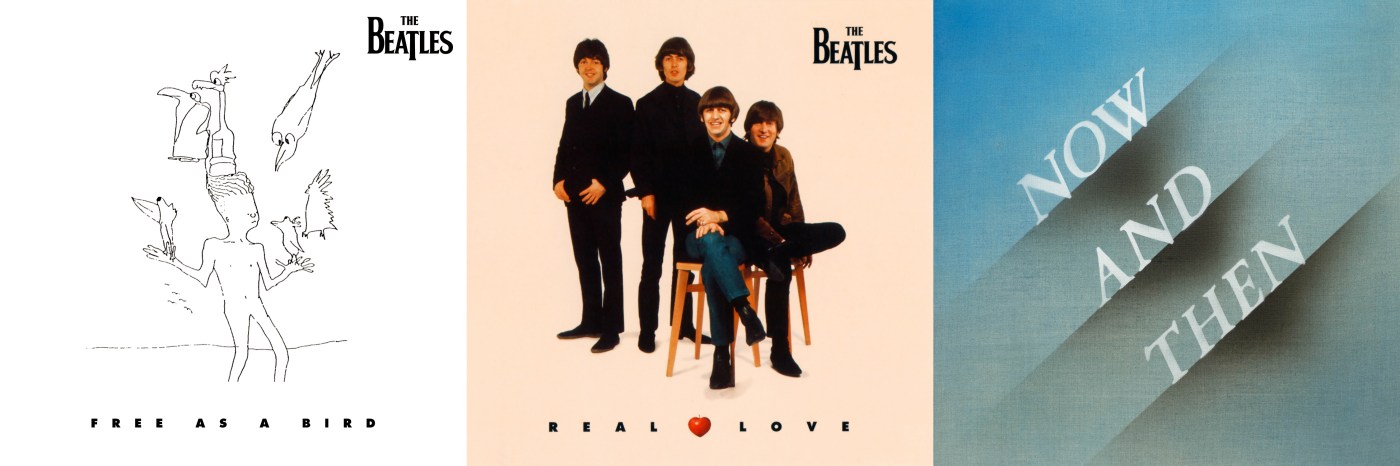
Here’s a chapter I wrote for my forthcoming Beatles book about all three of the band’s post-breakup songs.
It’s November 2nd, 2023. I am 29 years old, cuddled in beside my girlfriend as we play a new piece of music by our mutual favorite band. But it’s not until four listens later, as I play the track on my headphones, that it all comes crashing down around me: The Beatles have returned, impossibly, magically, with one last mournful (but still hopeful) goodbye to the world, and to themselves.
The story of the Beatles after John’s murder in 1980 is a bittersweet one, but worth telling. It’s a story of the biggest band in the world coming together once again, overcoming even the chasm of death, to create something new. Paul’s extra verse in “Free As A Bird” sets us on the path:
Whatever happened to the life that we once knew?
Can we really live without each other?
Where did we lose the touch
That seemed to mean so much?
It always made me feel so… (free)
Let us start with the beginning. In 1994, the surviving Beatles got together to tell the story of their lives, in their own words. This was The Beatles Anthology, a multimedia project consisting of an 8-part documentary series, three double albums consisting of interesting archival material from the Abbey Road vaults, a book, and of course, two new songs, in the form of “Free As A Bird” and “Real Love.”
As Ringo recounts:
We took the easy route, which was to do some incidental music, because what else can we do? There were four Beatles and there are only three of us left. We were going to do some incidental music and just get there and play the instruments and see what happened. Then we thought, well, why don’t we do some new music? And then we always hit the wall, and OK, Paul had a song, or George had a song, or I had a song, well that’s the three of us, why don’t the three of us go in and do this. And we kept hitting that wall because this is the Beatles; it’s not Paul, George, and Ringo.
This is where Yoko, once unfairly maligned as being the reason the band broke up back in the day, re-enters the picture. When John was inducted into the Rock and Roll Hall of Fame in 1994, she gifted Paul with four tapes. These contained some demo recordings made by John in the late ‘70s, when he was busily raising Sean – all four featured John playing piano and singing, and none were in particularly great shape. But it was “new” Lennon stuff, and that was worth something, right?
Paul elaborates:
I’d never heard them before but she explained that they’re quite well known to Lennon fans as bootlegs. I said to Yoko, ‘Don’t impose too many conditions on us, it’s really difficult to do this, spiritually. We don’t know, we may hate each other after two hours in the studio and just walk out. So don’t put any conditions, it’s tough enough. If it doesn’t work out, you can veto it.’ When I told George and Ringo I’d agreed to that they were going, ‘What? What if we love it?’ It didn’t come to that, luckily.
The recording process began not long after this, with the sessions taking place at Paul’s home studio in Sussex. Brought in to produce was Jeff Lynne, who George had worked with as part of the Traveling Wilburys. The recording technology of the mid-90s was leagues ahead of what they’d had in the Sixties, so Lynne and the remaining Beatles were able to clean up two of the demo tapes – “Free As a Bird” and “Real Love,” as mentioned earlier.
“Now and Then” proved more difficult, and an attempt at recording overdubs for it was quickly abandoned. They’d gotten as far as a guitar track from George.
This setback aside, the two new songs were released with great fanfare in 1995 and 1996, serving as the culmination to the Anthology era. They’re not trying to recapture that 1960s magic – that would be impossible – but they do, I think, reinvent the band’s sound for the 1990s. They are as contemporary as can be expected of the Beatles… which is to say, the Beatles were just doing what they always did.
To take you into the world of the songs, let’s start with the lyrics.
John:
Free as a bird
It’s the next best thing to be
Free as a bird
Home, home and dry
Like a homing bird I’ll fly
As a bird on wings
Paul:
Whatever happened to
The life that we once knew?
Can we really live without each other?
Where did we lose the touch
That seemed to mean so much?
It always made me feel so
John:
Free as a bird
Like the next best thing to be
Free as a bird
Home, home and dry
Like a homing bird I’ll fly
As a bird on wings
George:
Whatever happened to
The life that we once knew?
Always made me feel so free
John:
Free as a bird
It’s the next best thing to be
Free as a bird
Free as a bird
Free as a bird
It is often said, when someone dies, that they have gone on to Heaven, or sometimes more vaguely, “a better place.” In this light, the lyrics to “Bird” read to me like nothing so much as John attempting to reassure his bandmates (and the rest of us) that despite the violent circumstances of his death, he is genuinely happy, now that he’s finally freed of all the earthly pains that plagued him during life.
Which is, generally, the direction he was headed in during the late ‘70s anyway. His househusband era proved to be incredibly restorative for him, particularly the trip he took to Bermuda in June 1980, when he was forced to play ship captain after his boat hit a storm. He said, “I was so centred after the experience at sea that I was tuned in to the cosmos – and all these songs came!”
The song “Just Like Starting Over” is the best example we have of his new mindset. It’s a bright and optimistic piece, the culmination of the road that “Bird” showed he was already starting to travel down. Obviously, we’ll never know what it would sound like as a finished solo Lennon track – an assassin’s bullets made that impossible. So, we have to take “Bird’s” lyrics as being, essentially, a Lennon song from beyond the grave, with his three best friends brought in to finish the job.
The ethereal quality of John’s voice in this song lends a lot to my reading of his lyrics: the noise removal process that was undertaken, necessarily, removes a lot of low end from what was already a low-fidelity recording, so for all intents and purposes, Paul, George, and Ringo are playing with John’s ghost… but it is still John Lennon.
Paul and George’s verses, then, illustrate the other, sadder half of my reading: John’s happiness is palpable, but the other two songwriters in the group still feel the pang of loss quite keenly. “Can we really live without each other?” asks Paul, seemingly in conversation with John again. Those four men needed each other, and they knew it, even as they tore each other apart for most of the early 1970s. (Except Ringo, who just wanted everyone to get along.)
I mean, consider their respective solo careers. There were peaks (Lennon’s Imagine, McCartney had Band on the Run, Harrison’s was All Things Must Pass) and valleys. Only Ringo’s 1973 eponymous record is the closest we get to a full Beatles reunion while John was alive, and it’s still not it, because most of the time they used Klaus Voorman for bass guitar and not Paul.
That old Beatle magic, that weird, unexplainable harmony that only exists when the four of them are playing together, didn’t resurface until 1995. It didn’t matter that John was a voice without a body – that magic is still there, as no less than Ringo himself observed. He said, “It sounds like them!” To which George replied, “It sounds like them because it is them.”
Which brings me rather nicely to “Real Love.” Paul, George, and Ringo all said this one was not quite as fun to work on as “Bird” had been – that had felt like a true collaboration, while this one felt more like they were sidemen for John. I respectfully disagree, even though I get why they feel that way – for what it’s worth, “Real Love” is my favorite of the three reunion songs.
Again, let’s look at the lyrics:
All my little plans and schemes
Aren’t like some forgotten dream
Seems like all I really was doing
Was waiting for you
Just like little girls and boys
Playing with their little toys
Seems like all we really were doing
Was waiting for love
No need to be alone
No need to be alone
It’s real love
Yes it’s real
Yes it’s real love
It’s real
From this moment on I know
Exactly where my life will go
Seems like all I really was doing
Was waiting for love
Thought I’d been in love before
But in my heart I wanted more
Seems like all I really was doing
Was waiting for you
No need to be afraid
No need to be afraid
It’s real love
Yes it’s real
Yes it’s real love
It’s real
On one level, this reads like a love song from John to Yoko, and probably was. John was very clear about how much he loved her, and his entire solo catalog is filled with songs written with her in mind. In fact, it almost showed up as the first track on side two of Double Fantasy, but ultimately (as we know) it was left for Paul, George, and Ringo to finish, completely changing the vibe of the lyrics.
In my reading, “Real Love” becomes a love song from John to the other Beatles. It’s been stated over and over again – those boys truly loved each other, even when the break-up was happening. They had their issues with each other individually, but when it came to the four-headed entity that was The Beatles, even John on his worst day still had something nice to say about them. “Real Love,” for me, is an expression of that love in its purest form.
But in a way, “Real Love” is more than just a love song – it’s John’s summation of everything The Beatles, as a band, ever represented. The importance of love in all its forms was a theme John returned to over and over again, from “The Word” on Rubber Soul to “All You Need is Love.” In a way, he picks up on a theme put forward by Paul on “The End,” with that famous couplet, and expands upon it. There they are again, in musical conversation with each other.
Which brings us, at last, to “Now and Then.” The final song in our trilogy of Beatles reunion recordings, it is perhaps the most miraculous of the three. As mentioned earlier, the surviving three Beatles attempted this song in 1995, but the bad quality of the demo tape meant they didn’t get very far. The song languished for years – periodically, Paul would hint that he intended to finish the song at some point, though how he would do that after George died in 2001 remained a mystery.
Enter Peter Jackson.
Since 2021, the man behind the Lord of the Rings movies has become something like a modern fifth Beatle. His Get Back docuseries, chronicling the making of what would become Let It Be, contained revolutionary new audio engineering technology. His team had developed software that was able to take the raw mono recordings from late ‘60s Nagra tape recorders and perfectly separate various elements, from speech to guitars and drums, and make possible a clean stereo mix. No mic leakage, no artifacts – just pure elements.
The same technology was used on 2022’s remix of Revolver: The four-track masters were de-mixed in the same way, meaning Giles Martin now had room to remix the album in a way that suited modern ears. “Taxman,” now, has more punch to it than the original stereo mix did, as each element of Ringo’s drum kit or Paul’s bass could be manipulated separately.
For “Now and Then,” he was able to perfectly isolate John Lennon’s vocal from the original tape, absolutely cleanly – if you didn’t know any better, you’d swear it had been recorded yesterday. The lyrics, being a demo, are fairly simplistic, but that is not a criticism. If anything, their simplicity is part of what makes this song so powerful:
John:
I know it’s true
It’s all because of you
And, if I make it through
It’s all because of you
And, now and then
If we must start again
Well, we will know for sure
That I…
Paul:
…will love you
John & Paul:
Now and then
I miss you
Oh, now and then
I want you to be there for me
Always to return to me
John:
I know it’s true
It’s all because of you
And, if you go away
I know you’ll never stay
John & Paul:
Now and then
I miss you
Oh, now and then
I want you to be there for me
John:
I know it’s true
It’s all because of you
And, if I make it through
It’s all because of you
I’ve stressed repeatedly over this chapter that in these three songs, John and Paul have been in musical conversation with each other, across the chasm of life and death. We saw it in the contrast of John’s choruses with Paul and George’s verses in “Bird,” and in the love theme that began with Paul’s couplet and built on in “Real Love.” For “Now and Then,” that sixty year musical conversation comes to an end.
Understandably, “Now and Then” is the most melancholic of the three reunion songs. As a solo piece, it’s an apologetic, lost-love song of the kind that John was writing a lot over the course of the 1970s: just look at “Jealous Guy” from Imagine.
In the Beatles context though, it becomes what it was always bound to be: John, singing wistfully of his old partnership with Paul, and Paul singing wistfully of the same. The choruses, where they harmonize, are at once sweet (even now, their harmonies are great) and bitter: Paul is 81 years old now, and his voice has gotten increasingly gravelly. He can’t hit the high notes like he used to, which is part of why he’s mixed so low in the verses. But that gravelly-ness, much like the thin, ethereal quality of John’s vocal on “Real Love,” gives this song much deserved poignance.
If “Free As a Bird” is John letting us, and the band, know he’s okay, “Now and Then” is what I said it was at the very beginning: a goodbye, as emotionally honest and raw as any song on Plastic Ono Band. No, it will never rise to the meteoric highs of their Sixties material, but it doesn’t need to either. This is the Beatles’ elegy for themselves, and that’s all it needs to be.
I’ve talked a lot so far about what I think the songs mean to the Beatles themselves, but what about what they mean to me? That’s a little tough to get into.
I was born in October 1994, during the Anthology sessions, and was thus a baby when “Free As a Bird” and “Real Love” came out, so I never got to experience those songs live with the rest of the world. By the time I watched the Anthology documentary and heard the accompanying trio of double albums, the “new” songs were already old. I love them, but I love them as artifacts of the past.
But “Now and Then” is different. For the first and last time, I got to hear a completely new Beatles song, not just an old song I heard for the first time. And reader, I don’t mind telling you: I cried. A lot. Especially at the choruses. I could feel the pain, longing, and deep sadness. This band has been around for my entire life, and now, their story is finally over… and I got to see it end.
We will all miss The Beatles. But, and this is the brilliant thing, for while “Now and Then” is the last Beatles song, it’s not really the end of the story. Pairing this track with “Love Me Do,” their first single, was inspired, because it means the story never has to end, it just begins again. A musical mobius strip, assembled over sixty years.
The story of the Beatles is a story of insanely lucky coincidences. It’s a fairytale, told through song. It’s a story of love, in all its complexity. And it is our story, as much as theirs. As I write this, “Now and Then” is #1 on the iTunes charts, and I will not be surprised if it ends up topping Billboard. (It didn’t, but it did become a number 1 hit in the UK charts, so that’s pretty damn awesome.)
What unites these songs, and earns them their places as part of the canon, is the same thing that animated their Sixties material: an essential sense of timelessness. The Beatles were always about evolution and change – rather than staying frozen in amber, as the Stones did, they grew and evolved. “Free As a Bird” and “Real Love” reinvented the band’s sound for the ‘90s, and “Now and Then” reinvents that sound for the 2020s.
Always on the cutting edge, from beginning to end. What a legacy they leave behind.
And in the end, the love you take really is equal to the love you make.
Now, then, yesterday, today… and forever.


Leave a Reply