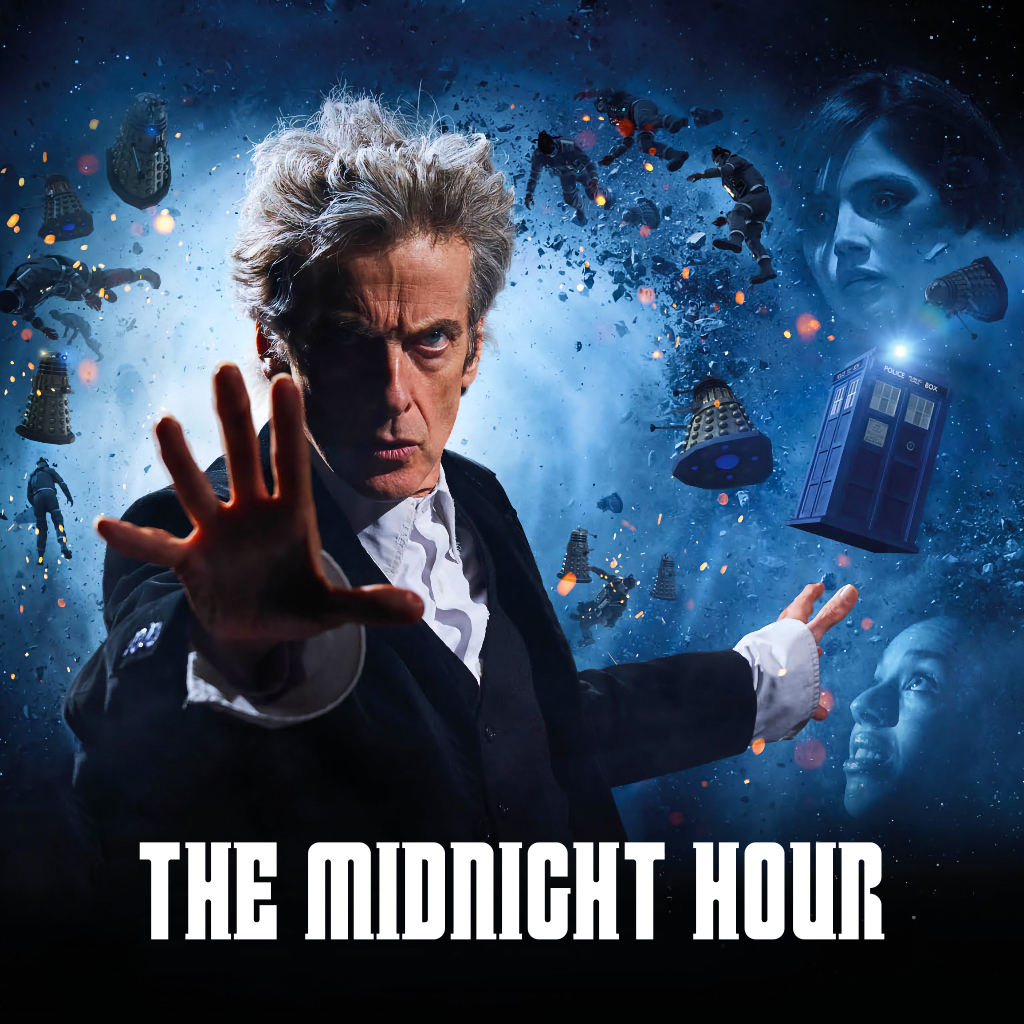
I’ve been talking a lot over the last few posts about the Wheel of the Year and how different stories within series 8 map loosely on to various Wiccan sabbats: Kill the Moon, as I’ve said, is a Yule story with the trappings of a Samhain one. In the Forest of the Night is a Beltane story, dealing as it does with life, fertility, and springtime, heading into summer.
Permit me, if you will, to dip into this swimming pool once again. Because what we have here, with Dark Water/Death in Heaven, is an honest-to-Goddess Samhain story. Moon and Forest were both, ultimately about life winning out over death, whereas this is just about death, straight up. No chaser, no masquerade. Just death, plain and simple.
Let me set the scene. Dark Water aired on November 1st, 2014 – the day after Halloween, or All Hallows Eve. In Celtic tradition, the day began and ended at sunset, so the holiday of Samhain begins on the night of October 31st, and concludes at nightfall on November 1st.
And we neopagans not the only ones with remembrance holidays around this time: There’s the Mexican El Día de los Muertos, for example, and the Christian observances of All Saints Day (Nov. 1st) and All Souls Day (Nov. 2). So, remembering the deceased definitely seems to be a popular activity during the transition from autumn to winter.
As a meditation on death, the afterlife, and what happens to us when we die, Dark Water/Death in Heaven was always fascinating, but when I watched in for the first time in 2014, I was doing it from the perspective of an atheist. I didn’t believe in any sort of divine being, or indeed an afterlife – once we’re dead, that’s it.
Obviously, that’s no longer the case.
Most of the mechanics of Dark Water/Death in Heaven come from Christianity: the necro-cloud that everyone gets uploaded to has been specifically described as being Heaven, while the famous volcano sequence may as well be taking place in Hell, given all the fire and volcanic rock. Despite all the Christian overtones though, there is still something of Britain’s pagan roots bubbling under the surface of Missy’s cauldron here. Specifically, the idea of reincarnation.
Most Wiccans believe that when our earthly bodies die, our souls go on to a place called the Summerlands, often described as a paradise with a meadow-like area that is pleasant and warm with the wind gently whistling through the grass. How long we’re there depends on who you ask, but most of us believe that we’re only there for a little while, because we then go on to be reincarnated into another body. An entirely new life begins, completely separate from who, or what, we were before.
Whenever I picture the Summerlands, the garden from the end of Deep Breath is what I think of, with the Goddess shepherding the souls of her creations into their next incarnations. There’s no element of judgement here – reincarnation happens to everyone, no matter what kind of person they were in their previous life. It’s part of the cycle of life, and that cycle is constant.
What Missy is doing with Earth’s corpses and the Cybermen, and this is only something that I realized since becoming Wiccan, is a dark and twisted inversion of the Summerlands and reincarnation. Like the Mother Goddess I pray to, she’s shepherding the dead of humankind into their next lives… it’s just that their next lives are more cybernetic than organic. So basically, she’s the Goddess’s evil twin sister, and she’s having a tantrum. (As my fiancee put it when I told her what I was writing.)
Of course, reincarnation isn’t the only thing going on here. There’s more: running through the story’s second half is the theme of sacrifice and redemption. Death in Heaven aired on November 8th, 2014, one day before Remembrance Sunday: a day of commemoration of British soldiers (like our Danny Pink) who died during various global conflicts, in particular the two world wars. (If you’re American and you ever wondered why you see so many red poppies around in the first couple weeks of November, this is the reason.)
In Dark Water, we learn that Danny accidentally killed a young boy during his service in Afghanistan. When I was trying to be Catholic back in the late 00s, this would’ve been defined as a mortal sin: a sinful act which could lead to eternal damnation if a person does not repent before they die. (The other category of sin is venial sins, sins that injure but do not permanently sever one’s relationship to God in the way that un-repented mortal sins do.)
Of course, Christians are not a monolith. How different sects view what Danny did varies a lot, depending on who you ask. For example: My Episcopalian fiancee told me that in all likelihood, Danny still sinned, but his pastor, if he had one, would’ve made allowances for the fact that he shot the boy unintentionally. So, in the Anglican church, Danny would probably have been fine.
Wiccans, meanwhile, do not really have a concept of sin, nor do we have a conception of Hell. The core of our ethical system is neatly summed up in eight words: “An Ye Harm None, Do What Ye Will,” AKA the Wiccan Rede. (There’s a longer version out there, but most people, when they talk about the Rede, focus on this particular couplet.)
What this essentially means is that Wiccans are free to engage in any behavior they choose, as long as their actions do not harm themselves or others, though what exactly does and does not do harm is therefore open to personal interpretation. Mine is not a religion that specifies what is Good and what is Evil, in the fashion of Christianity’s Ten Commandments. We believe that the paths of our lives are ours to chart, and we’re not exactly big on having a central authority telling us what to do.
The other big piece of our morality system is the Three-Fold Law, first mentioned by Raymond Buckland in 1968. It states that whatever energy a person puts out into the world, be it positive or negative, will be returned to that person three times. Again, personal responsibility is a big thing here – if you’re going to hex someone, be ready to have that energy reflected back at you later on.
In the case of Danny Pink, he did do harm, but we wouldn’t call that a sin per se, because that implies Danny will be judged and found wanting – judgement isn’t really a thing Wiccans do. But he does get an opportunity to restore the balance later on, in the form of resurrecting the boy he killed. Balance is a big thing for us – we believe in a Goddess and a God, after all. And balances, once upset, can always be restored.
Which, incidentally, puts the Brigadier’s murder of Missy at the end of the story in an interesting light. As Sophie pointed out when I discussed this post with her, even hexing someone with baneful magic isn’t inherently harmful – you just have to have good ethical reasoning for doing so. Missy murdered Osgood, but the Brigadier shooting Missy means that, once again, balance is restored to the universe.
And if you ask me, nothing crystallizes the meaning of Samhain quite like having Kate Stewart’s deceased father do his duty one more time, for both his country and for his offspring. And someday, we will be the ancestors. It is therefore incumbent upon us to make this world a better place than how we found it, any way that we can.
Blessed Samhain to all, and to all a good night.


Leave a Reply