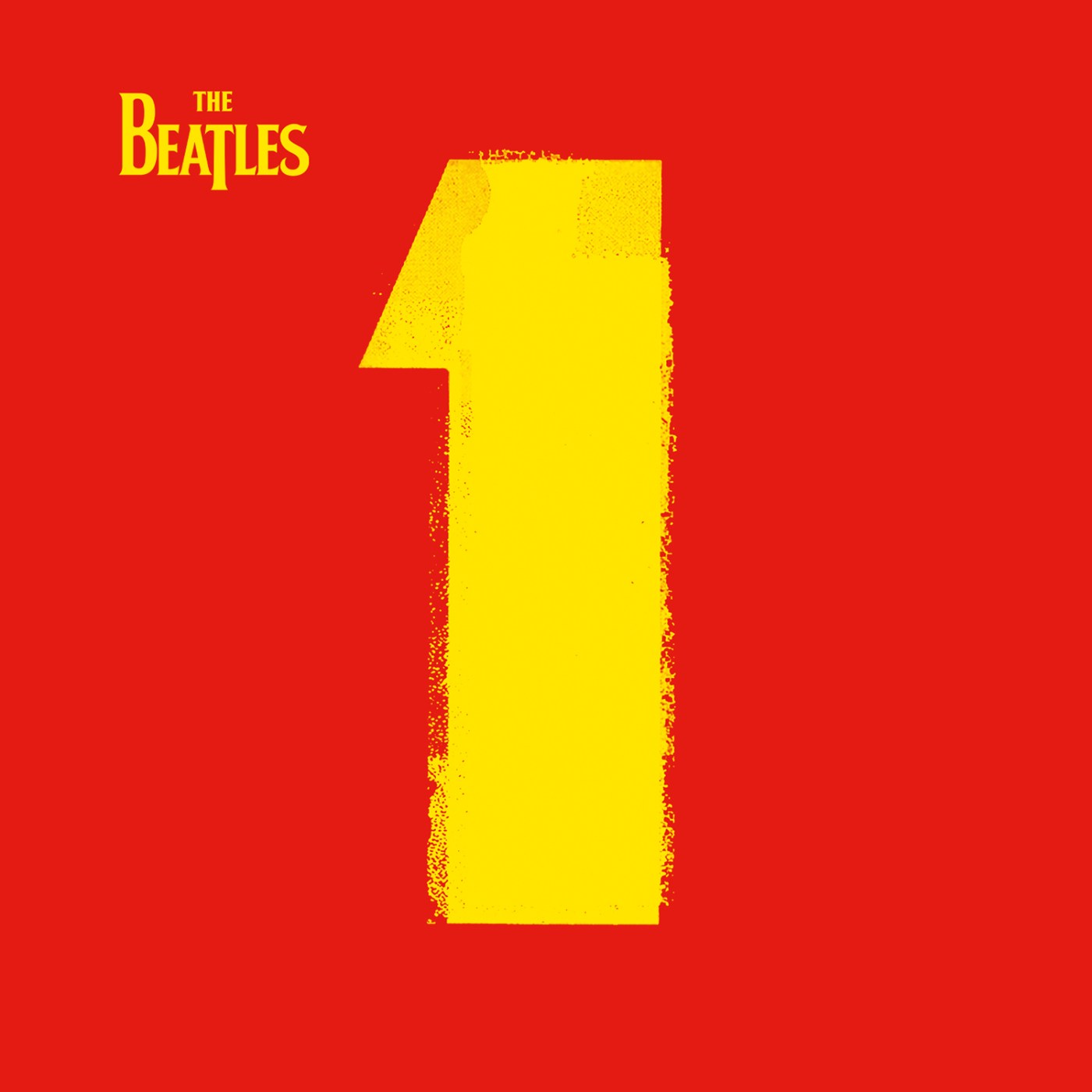
This is it: the big one. If you’re a Beatles fan from the ‘90s like I am, chances are you remember this commercial when it started airing on TV in 2000. It feels quaint now, considering this album has been out for 24 years (…the fuck?!!) but at the time, 1 was a huge deal. The Beatles’ singles were the songs everyone knew, but listening to them meant buying at least the Red and Blue albums, plus Past Masters. That’s a lot of music!
The 1 album changed all that. Now, you could have all 27 (before “Now and Then” became #28) of their number 1 singles, all on 1 CD. That was the pitch. For a lot of people, 1 was their first album – I know for sure it was mine. And it sold like crazy: 31 million copies as of 2009, and it quickly became the best selling album of the entire 2000s decade.
The only problem with 1, at least to my ears, is that the sound is really harsh. According to the album liner notes, “These original analogue masters have been digitally remastered at 24 bits resolution, processed using Sonic Solutions NoNoise technology and mastered to 16 bit for CD using Prism SNS Noise Shaping.” So it’s been compressed to hell and back. Listening to it now, it’s a deeply uncomfortable listening experience on headphones – it probably sounded better coming out of the speakers on my dad’s Nissan Altima.
Enter Giles Martin.
In 2015, 9 years after he remixed portions of the catalogue for the Love show, the son of the Beatles’ producer returned for another extensive remix project, with the goal of improving the sound beyond even what the 2011 remaster had done. He told Entertainment Weekly, “It’s vastly different. The remasters went back to these final mix tapes and remastered them. They cleaned them up and then they EQ-ed them and released them. What we’re doing is remixing. We’re going not to the final mix, we’re creating our own mixes.”
Appropriately enough, I was studying abroad in London when this remix came out, and to this day it remains the only Beatles CD that I bought in their home country. I remember listening to a preview of “Paperback Writer,” and hearing the return of the delay effect on Paul’s voice when he sings the title phrase. My exact words were, “Holy shit!” I was blown away, and I still am.
So: let’s take a deep dive into, as the commercial said, the 79 minutes and 12 seconds that changed the sound of music forever.
‘Love Me Do’: The version of the song released on Please Please Me in early 1963 – presented in mono, since that’s the only version of the song that exists… for now
‘From Me To You’: Again, the regular mono mix of the song.
‘She Loves You’: Still mono, because in 2015, the technology didn’t yet exist to create the stereo mix from the expanded Red album.
‘I Want To Hold Your Hand’: At last, we enter the stereo mixes! This version, in terms of where everything is placed in the stereo field, is relatively unchanged from the original, except the handclaps are now off to the right, and there’s a lot more punch, particularly where Ringo’s drums are concerned.
‘Can’t Buy Me Love’: The standard stereo mix of the song has most of the sound coming from the left speaker, making for a somewhat lopsided listening experience. The 2015 version evens things out significantly, evening things out – it sounds kind of like a 3D version of the mono.
‘A Hard Day’s Night’: The biggest difference here is you can hear more instruments during the opening chord, particularly the piano. John and Paul’s vocals are also spread across the left and right channels, rather than being dead center.
‘I Feel Fine’: As before, John’s vocal appears in both channels now, and you can hear way more of Ringo’s fantastic drumming – the influence of “What I’d Say” on this song is much more evident. I also can hear a bit more reverb on John’s vocal in places, and where before the lead guitar was mono, now you can hear it dance around from left to right and back again, it’s pretty cool!
‘Eight Days A Week’: No immediately evident changes here, just general tweaking to make it sound less harsh than the version from 2000. Sometimes the simplest changes are the most effective!
‘Ticket To Ride’: There’s more bass here, particularly on the left channel.
‘Help!’: As well as having more punch, Paul and George’s backing vocals during the intro have been separated, so you can make them out more clearly. Curiously though, they’re back to being centered for the rest of the song. George’s lead guitar is now centered too, rather than being shoved off to right.
‘Yesterday’: With this mix, Giles was somehow able to pan Paul’s guitar off to the right, and the strings off to the left. It’s an interesting effect, but I’m not entirely sure it works. I think I like his 2023 version better, where the guitar is centered and the strings are everywhere.
‘Day Tripper’: While I will always love this song to death, one of my recurring annoyances with it is the fact that the vocals are panned hard right. The 2015 mix fixes that issue by putting John and Paul right in the middle where they belong, and the other instruments are spread around them. (That said, I question the decision to put the lead guitar all the way on the left instead.)
‘We Can Work It Out’: As with “Day Tripper,” the standard mix of this song has the vocals panned hard right – only now, with this 2015 version, do we have a fix. It sounds wonderful, and I would say it and the previous track have probably aged the best.
‘Paperback Writer’: As I mentioned before, this is the song that most impressed me when the album first came out. The panning on the instruments is better balanced, you can hear the echo on Paul’s voice between verses better, the guitar is centered… it’s fantastic, and honestly, far superior to the 2022 remix from the Revolver set.
‘Yellow Submarine’: I like the amount of low end in this mix of the song, but I wish I knew why the sound effects (save for the ones during the instrumental break) are buried so low – it kind of takes away from the fun of the song.
‘Eleanor Rigby’: The strings sound great, and we get centered vocals for the verses this time, plus genuine double tracking during the opening. The “all the lonely people” lyric is single-tracked this time – no evidence of ADT to be had.
‘Penny Lane’: The original mix sounded really busy, this version lets everything spread out a little bit more.
‘All You Need Is Love’: This 2015 mix is nice and crisp, providing just a bit of extra low end to an already immaculate recording. The brief quotation of “She Loves You” by John toward the end is a startling reminder of how far they’ve come since then, fame-wise and as musicians, and how fast it all happened – only four years separate the two songs. Trippy, isn’t it?
‘Hello, Goodbye’: Difficult to know what to write about this one, from a mixing standpoint. It’s… fine. Not bad, but not exactly a sonic revelation either. Maybe it works better in concert with the video.
Lady Madonna: With this song, we go from a drug-fueled dreamscape to good ol’ rock and roll, Beatles style. As noted, Martin’s mixes on this album were made using the original tapes, somewhat limiting his mixing decisions here. Even so, nice to hear John and George’s harmonies in stereo at last, and I always have time for a good brass solo.
‘Hey Jude’: The crowd song. I’ve heard Paul play this live, and believe me, once you do that, you never quite look at the studio version in the same way. It’s still a wonderful song though, and Martin’s mix makes you feel like you’re right there with the band. It’s fantastic.
‘Get Back’: With this song we reach the last two albums the band’s recording career, featuring Billy Preston on keyboard duties. Giles Martin gives him plenty of time to shine on this mix, which I appreciate. (Also, I’m pretty sure “Sweet” Loretta Martin is nonbinary with any/all pronouns. Yes, I have thought about this.)
‘The Ballad Of John And Yoko’: In which John recounts the story of his marriage to Yoko in song form. It only has John and Paul on it, in one of their last collaborations before the band’s split just a year later. The remix lends an additional sense of immediacy to the proceedings.
‘Something’: This is Giles Martin’s first go at “Something,” he’ll do it again in 2019 for the Abbey Road box set. As it goes, I like this mix well enough, but I think the later version is the best one.
‘Come Together’: It’s a sign of just how well made Abbey Road was that I struggle to find any noticeable differences between this and the mix from 2019. It’s a good mix of the original song, and everything has plenty of room to breathe.
‘Let It Be’: Based on a dream he had about his mother, “Let It Be” is one of Paul’s defining works. For my part, the single version (which this is a remix of) is the best one, since it contains zero Spectorian bullshit. Every time I listen to it, I remember watching a sea of phone flashlights swaying in time at Busch Stadium in 2016.
‘The Long And Winding Road’: Written by Paul in 1968 and recorded during the Get Back album sessions, this became the Beatles’ final single, issued in May 1970 alongside Let It Be. It’s a yearning piano ballad by Paul, though you’d never know it from the Spectorian gloss that covers up everything but his vocal and piano. At least Giles Martin’s remix makes it listenable.
Giles Martin’s Beatles remixes have gained something of a controversial reputation in Beatles circles, mainly because they don’t like the way he bows to contemporary musical production realities while trying to maintain the sound of the music we all know and love. To hear these people talk, you’d think anything that wasn’t the original vinyl mixes from the ‘60s were worth listening to, and those who prefer other versions are little more than easily amused sheep.
Personally, I’m game for anything that can strike a balance between presenting this band’s music in the best light possible, and frankly, if it’s good enough for Paul and Ringo, it should be good enough for the rest of us.
As an album, 1 remains the best possible introduction to the band’s music out there, it has simply never been bettered. This 2015 remix helps it shine even brighter, freed from the harsh, overly sharp mess that was the original 2000 version. If you’re looking to start out with the Beatles, you really can’t pick a better place to begin.


Leave a Reply