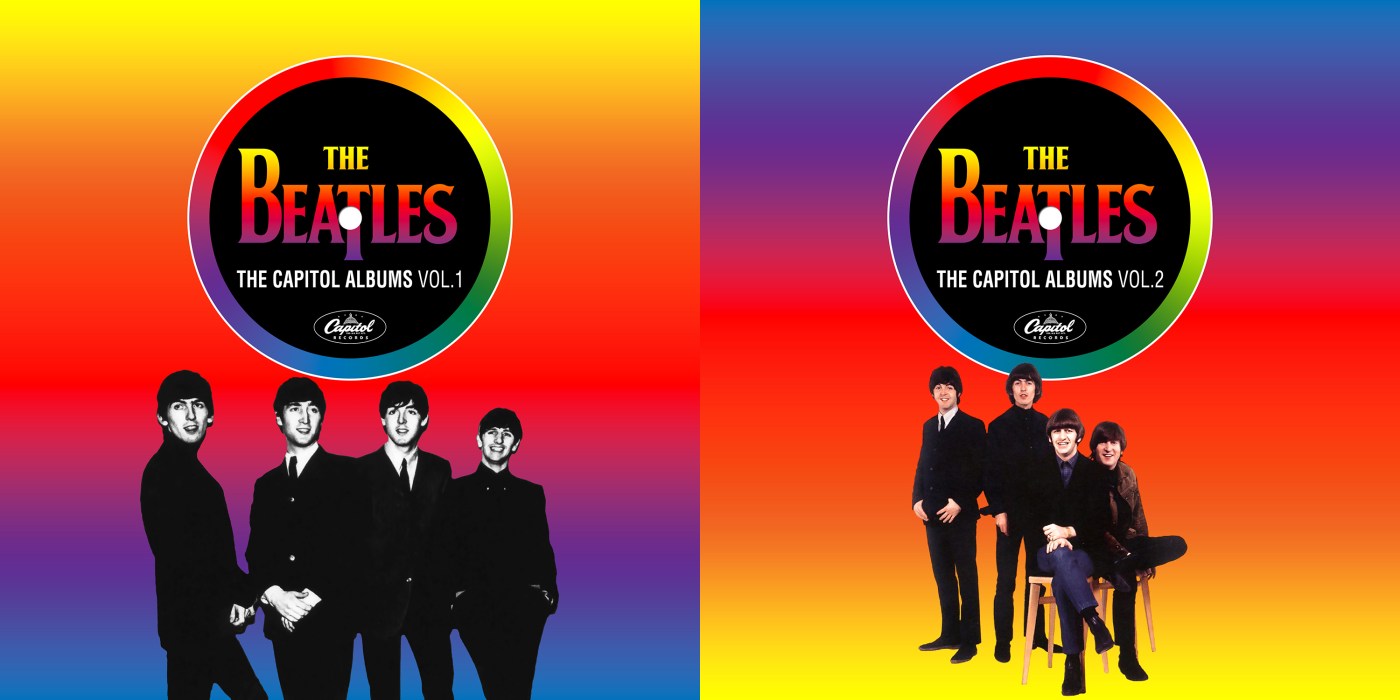
When the Beatles’ catalogue was released on CD in 1987, only the British albums made the cut, aside from the American Magical Mystery Tour album and the Past Masters collection. The various unique American albums were left in the dust, a mere curiosity. Once the hot sellers of 1964 and 1965, they now lay forgotten, upstaged by their British counterparts.
That was, until 2004.
40 years since the Beatles arrived in the US, eight Capitol albums from 1964 and 1965 in two four-disc box sets: The Capitol Albums: Volume 1 contained the 1964 releases, while Volume 2 from 2006 contained the 1965 albums, presented in both stereo and mono. The albums were mastered from the original Capitol tapes, with all of Dave Dexter’s mixes in place. Since they were released worldwide, that meant fans from outside the US had a chance to experience American Beatlemania, exactly as it sounded in the 1960s.
Let’s dive in, shall we? We’ll be discussing the stereo tracks only, since the changes are more obvious with those.
The first thing to note about these songs is that they sound big. This is mainly due to the exceptional amounts of compression and limiting going on with each track, so everything has more impact.
Some of the stereo mixes that were released in the 1960s weren’t genuine stereo mixes, but fake ones, created from the mono masters sent over from the UK. The way these fake stereo mixes worked is they take the song, remove the high frequencies from one copy, and the low ones from another, then add a very slight delay so as to fool the listener into thinking that it’s real stereo. It’s an interesting production trick, and you should notice it right away.
On to the music:
Volume 1
Disc 1: Meet the Beatles!
I Want to Hold Your Hand: This track, recorded 17 October 1963, was the song that broke open the floodgates for the band’s invasion of America. The band’s previous singles up until now had been released on some smaller record labels, where they proceeded to flop. It was not until “I Want to Hold Your Hand,” released on the big-time Capitol Records label, that the group’s fortunes in the US changed. This mix of the song is one of the faux-stereo versions I mentioned earlier.
I Saw Her Standing There: Truly an amazing up-tempo rock number, fizzing with energy and confidence, and a great start to a career that would go on to redefine popular music forever.
This Boy: “This Boy” has always been a favorite of mine, showcasing the gorgeous three-part harmonies of John, Paul, and George. You don’t get to hear it often, so when you do, it’s a real privilege. This mix of the song is another fake stereo, and it’s really obvious, since Paul’s bass guitar suddenly sounds really loud on the left channel. Still, I’d take this over having vocals on the right!
It Won’t Be Long: Though the Beatles were on record as being big fans of Elvis Presley, Buddy Holly, Chuck Berry, and lots of other heavyweights of ‘50s rock and roll, they really liked girl groups too. This track is an original and it sounds a lot like a girl group number from the same period, but where anyone else would do it from the woman’s perspective about the guy, the Beatles flip the script, and what results is a song from the guy’s perspective about the woman he’s with. This is radical stuff for the early sixties, and one of our earliest indications as to how awesome women are in Beatles songs.
All I’ve Got to Do: John’s take on a Smokey Robinson pastiche, it’s a great early ballad number from him, and I love the way he sings on it. While his vocal stylings could be described as tart, (probably from all the cigarettes he smoked) he really makes it work for him – that tartness gives his vocal some raw passion, and it really shines in this song. And then he does it again, six years later, on Don’t Let Me Down.
All My Loving: Paul really seemed to like epistle songs, given the sheer number of them that he writes during the Beatles years, from P.S. I Love You to Paperback Writer. This is a fantastic one, though whenever I listen to it I can’t help but think like the narrator is practically begging to end up cheating on his girlfriend later on. While researching this song, I found someone in The Independent had hypothesized that it was inspired by “Kathy’s Waltz” by Dave Brubeck, and I wouldn’t be surprised if it was, given all the jazz that played in the McCartney house when Paul was growing up.
Don’t Bother Me: For a band whose catalog could be described as, largely, being about the power of love in all its many varieties, they could also write some really good break-up songs. This one, by George, was his very first song ever, and while he didn’t really like it, I think it’s fantastic. It really reflects the sheer devastation and downtrodden-ness that accompanies a break-up, be it romance or friendship, and I love that about it.
Little Child: One of the last Beatles songs to prominently feature harmonica, it’s a song that definitely exists. In fact, according to Paul it was almost Ringo’s vocal spot on the album, until saner heads prevailed and we got “I Wanna Be Your Man” instead. As a song, it comes off as uncomfortable – I really hate the early sixties’ penchant for infantilizing women, and this one is particularly bad.
Till There Was You: A beautiful acoustic guitar-driven cover of a song from the musical The Music Man, this features Paul attempting to sing in an American accent, for whatever reason. He does an okay job, though the way he sings “at all” and “saw” kind of break the illusion. For a real trip, go track down the version of the song they played at Decca Records in January 1962 – everyone sounds super nervous, though I do like Paul’s vocal, even if he is a bit shaky. (Pete Best… well… thank god they hired Ringo.)
Hold Me Tight: The one song from this album that John and Paul don’t think much of, and I kind of get why they don’t like it. There’s no bass to speak of, Paul sounds like he has a cold, it’s just kind of… there. What I didn’t know was that they sped this one up from E to F, to give it a bit more energy. Having slowed it back down to get an idea for what it might’ve sounded like otherwise, I think they made the right choice. In E, it sounds a bit plodding. (And despite the title, this has nothing to do with the song from Red Rose Speedway.)
I Wanna Be Your Man: Now this is more like it! I don’t care what anyone says, Ringo is really good at rock and roll as long as it’s in his range, like this one is. It’s more remembered these days for being the song that gave the Rolling Stones their first hit single, which kind of says everything you need to know about the Stones. As John put it, “We weren’t going to give them anything great, right?” (Ringo’s version is way better.)
Not A Second Time: One of my favorite Beatles songs, this, and a great early break-up song. George Martin’s piano gives the song some wonderful depth, I especially like the solo. I also highly recommend Robert Palmer’s cover, decked out in 1980s synths and an entirely original second verse that I wish John had sung.
Disc 2: The Beatles’ Second Album
Roll Over Beethoven: As a native St. Louisan, I’m contractually obligated to like George’s version of this classic Chuck Berry number, but even if I wasn’t, I’d still enjoy it because George does such a fabulous job with it. He can do straight rock songs just as well as John and Paul, and this one proves it. This mix of the song contains additional reverb, especially notable during the opening lead guitar.
Thank You Girl: A love song written by John and Paul to their fans, it’s hard not to like it. This mix of the song has even more harmonica, and as an admitted fan of John’s harmonica playing, that’s never a bad thing in my book.
You Really Got A Hold On Me: Another Smokey Robinson song, this one is another great showcase for John’s ability to do ballad songs, along with some gorgeous harmonies between him and George in places.
Devil In Her Heart: Once again, here comes George! This time around he’s singing about the naiveté that results when you start dating a girl who is legitimate bad news, and holy shit, they could’ve been singing about either of my ex-girlfriends. More extra reverb here, so we can at least pretend they recorded this song at the studios in California/
Money: Another Motown cover from the boys, the idea was for it to be an energetic album closer in the tradition of Twist and Shout, though I’m not entirely sure it works as one. Then again, it’s a little hard to top the exuberant performance of the latter. It works better here on Second as a mid-album track, I think. The extra reverb makes it sound even better, I really like it.
You Can’t Do That: If you read my review of the expanded Red album from last year, you already know what I think of this song: two minutes of sexist trash that, sadly, are of a piece with ‘60s expectations between men and women in relationships, and given John’s history of domestic violence… good fucking grief, Lennon.
Long Tall Sally: In which Paul McCartney displays his amazing Little Richard impression. Always a highlight of the band’s early ‘60s work, the way he can turn on a dime from the sweet-voiced crooner of “And I Love Her” and “Til There Was You” to this is absolutely something else. This song in particular was a staple of their live shows going all the way back to the Quarry Men era of the late ‘50s, and was, in fact, the last song they played as a live act – Candlestick Park, San Francisco, 1966. This version? All done in one take.
I Call Your Name: One of John’s earliest songs, “I Call Your Name” is another early Beatles song to include cowbell, and was in fact considered for inclusion on the A Hard Day’s Night album before eventually getting released on the Long Tall Sally EP instead. It’s a much better song than “You Can’t Do That” in my opinion, and I think the AHDN album would be much improved if you put this there instead.
Please Mister Postman: In which the Beatles do a credible Motown cover, complete with the requisite gender-swap in the lyrics that, in their hands, turns the song into something a bit more feminist than would’ve flown in the early ‘60s. You can really hear the desperation in John’s voice, especially when he starts screaming his vocal toward the end. (He always was great at rock and roll screams.)
I’ll Get You: If I’m being honest with myself, this is a song that probably worked better when I first heard it as a kid. I was around eight or nine years old. And for whatever reason, I absolutely adored this particular number, along with “Thank You Girl,” perhaps because the first two lines reminded me so much of John’s later song, “Imagine.” As well as the Capitol reverb that’s been covering this album, this is another faux stereo mix, since the mono version is the only one that currently exists.
She Loves You: This song, more than any song they ever did, is the one that defines early ‘60s Beatlemania, particularly in Britain. This is the song that made them international superstars, and made everything that followed possible. As well as their falsetto vocal harmonies and their knack for catchy hooks, to say nothing of the sheer power behind Ringo’s drumming, this is a song that defies all convention with regard to how love songs are “supposed” to be, since it comes from a third party. Another fake stereo mix, for the same reasons as “I’ll Get You.”
Disc 3: Something New
‘I’ll Cry Instead’: The aforementioned almost-film song, in which John sings about his inability to be emotionally honest with himself in the aftermath of a nasty break-up, coupled with a promise for revenge. Sheesh. The song did eventually get used in 1982, when it appeared underscoring a Lennon tribute montage appended to the beginning of the film. Minor audio note: the American mono version of this song contains an extra verse that doesn’t appear on either the stereo version or the British mono mix.
‘Things We Said Today’: Another Paul love ballad, featuring him harmonizing with himself. (It’s especially noticeable in stereo, you can hear him pushed off to the right.) They’d sometimes play this song during their concerts, including on the Hollywood Bowl album. God knows why, but it makes for an interesting effect, at least.
‘Any Time At All’: This is a nice collab between John and Paul, as the narrator promises their partner that they’ll always be with them. We can all use little reminders like that, I think. In a way this is kind of like a sequel to “All I’ve Got to Do” from With The Beatles.
‘When I Get Home’: This song is our first entry in what will become a distinct genre of Beatle song: The one where the narrator (read: John) writes about, and then sings, about having an affair. Given his marriage troubles throughout the ‘60s, it really says something that he tends to focus on the messier side of love until he begins dating Yoko around 1968.
‘Slow Down’: A cover of a song by Larry Williams, this contains two amazing things: my favorite Beatle vocal flub of all time (John can’t decide whether he’s singing about a girl or a boy and so does both at once, courtesy of double-tracking) and one of his best rock and roll screams, right up until “Revolution” in 1968.
‘Matchbox’: Ringo’s vocal spot, in one of the earliest entries in a Beatles sub-genre we might call Forlorn Ringo songs, in that his protagonists all seem to be men who are down on their luck, in the fashion of Ringo himself from his big scene in A Hard Day’s Night. Songs of this kind will appear on the next three UK Beatles albums: Beatles For Sale, Help!, and Rubber Soul, before resurfacing on the White Album – “Don’t Pass Me By,” Ringo’s own composition, was written around 1964. In between, of course, he’ll become the go-to guy for kid-friendly songs, like “Yellow Submarine,” “With A Little Help From My Friends,” and “Octopus’s Garden.”
‘Tell Me Why’: The happiest song ever recorded about confronting your partner for some kind of failure, right here. As an aside, those falsetto vocals are, “Is there anything I can do?” (It took me an embarrassingly long time to realize this.) I
‘And I Love Her’: One of the prettiest love songs the Beatles ever wrote, this. The opening riff was apparently George’s creation, right on the spot – an earlier version on Anthology 1 lets us hear it on electric instruments, minus the riff, and I have to say, something really is lost without it. This song belongs on acoustic guitars. The single tracked vocals are here again, but at the right speed this time.
‘I’m Happy Just To Dance With You’: George’s vocal spot on the album, I occasionally forget that he didn’t actually write this. I like it anyway, and I like the way he sings it.
‘If I Fell’: One of my favorite John ballads, this song gets played early in the movie to cheer up Ringo, but nowadays I associate it with all the times I’ve listened to it with my girlfriend, since it’s part of one of our couples mixes. Sonically, it’s a wonderful display of John and Paul’s talent for harmonizing. That’s a sound you’ll never forget, even sixty years later.
‘Komm, Gib Mir Deine Hand’: This version of “I Want to Hold Your Hand” (In English, the German title means, “Come, Give Me Your Hand.”) came about because executives at Odeon (EMI’s German subsidiary) thought that the Beatles would only sell in Germany if they sang their songs in German. And so, we got this.The Beatles, understandably, thought this was an idiotic idea, and dropped the practice after this and “Sie Liebt Dich” were made. I like them anyway, and these songs are pretty much entirely responsible for why I took German in high school. I even still remember some of it!
Disc 4: Beatles ‘65
No Reply: Based on the song “Silhouettes” from 1957, this is a song in which the narrator tries to contact his unfaithful girlfriend, failing repeatedly. Despite the bossa-nova rhythm of the backing track, it’s a grim opening to the album, but given how exhausted they are after a whirlwind of a year, it makes perfect sense. (I dare you, however, to listen to this song the same way again after hearing one of the early takes from Anthology, where they forget the words and sing “your face” at the end of every verse.)
I’m A Loser: A straight break-up song in which the narrator reflects on his mistakes when dating this particular girl, whom he thought the world of, and still does. And I’ll tell you what, nothing hits you quite so hard as listening to this after… well, a break-up.
Baby’s In Black: This might sound weird considering the dark lyrics, but this is genuinely one of my favorite Beatles songs, entirely because of the vocals: John and Paul singing into the same microphone, harmonizing together in a way that only they were able to do, and it really comes alive in stereo. It’s fucking gorgeous.
Rock And Roll Music: John does a Chuck Berry cover, and he does a really great job with it! Kind of reminds me of “Twist and Shout,” though his vocal performance here is a bit more restrained here than in that earlier song. (For a given definition of “restrained” anyway.) Also note the way in which the piano drops out at 1:45.
I’ll Follow the Sun: Another great Beatles ballad, but even here, it presents a somewhat more negative view of love than we’ve come to expect from the boys so far. In other words, this is the gentlest break-up song you could hope to have, though I’ll always associate it with footage of the band in Miami during their first American tour.
Mr. Moonlight: Yeah, no, I’m sorry, the critics are right. This one just sucks. They almost used “Leave My Kitten Alone” (available on Anthology 1) and if you slipped that into place, “Kitten” is obviously a better song. This is just cheesy and awful.
Honey Don’t: Ringo’s song on the album, and it’s a cover of Carl Perkins. I don’t rate it especially highly, but that might just be because I’ve never been the biggest fan of country music. They do a pretty credible job, and it’s certainly better than “Mr. Moonlight.”
I’ll Be Back: John and Paul share lead vocal duties on this acoustic-guitar driven track – it fits like a glove on the somewhat more downbeat mood of this album, compared to its British placement on their Hard Day’s Night album. It’s a surprisingly downbeat ending to what has otherwise been their most energetic record yet, something that speaks to their rapidly increasing maturity as musicians.
She’s A Woman: Another great Paul song where he gets to do his rock and roll voice again, I love any song where he gets to sing about how awesome his woman is. He’s head-over-heels for this chick, and you can tell! This mix of the song, along with “I Feel Fine,” contains additional compression and reverb, added by Dave Dexter Jr. when he remixed the song for its release here. This gives the song a more crisp vibe than the original UK masters.
I Feel Fine: Another song with a particularly notable beginning, the start of “I Feel Fine” happened when Paul McCartney plucked an A note on his bass while it was pointed in the vicinity of John’s guitar amp, causing feedback. Doing this technically violated EMI’s recording rules, but as so often happens in the story of this band, sometimes you have to break the rules to get the sound you want.
Everybody’s Trying to Be My Baby: Poor George, getting no vocal time until the last track on the album. It’s another Carl Perkins cover, and this one is pretty successful. George always really liked Carl Perkins, and you can hear that love in his performance on the track. I have to admit I really like the echo on his voice here – a good slap-back echo never hurt anyone.
Volume 2
Disc 1: The Early Beatles
‘Love Me Do’: The very first Beatles song, and a logical place to begin. This version is probably the more well-known, since it’s a much stronger performance by everyone involved than the original single version… except, infamously, this is one of two songs without Ringo on drums! That’s Andy White pounding away in the background, poor Ringo was reduced to tambourine. Even so, it’s a solid first song, and the harmonica throughout gives it a nice blues-y vibe that contrasts with the sweetness of the words. This mix of the song is another faux-stereo creation, since the master no longer exists.
‘Twist And Shout’: Once a closing track, on this album it becomes track two, to its detriment. Even so, John Lennon gives the performance of his life, absolutely shredding his vocal part – recorded after sucking down cough drops and milk for an entire day. It is amazing, and he only needed one take to nail it. Also of note: the backing vocals from Paul and George, especially those rising “ahhs” that take us into the last third of the song. (And that scream! Yes!)
Anna (Go to Him): Following the original running order now, “Anna” has John on lead vocals, and on this track you can really hear how his cold affected his singing. It’s an interesting effect though, since it gives his voice a raw, haunting quality. I also quite like the reverb-heavy backing vocals from Paul and George.
Chains: The first of two lead vocal performances from George on this album, I’d say this one is easily the strongest. Interestingly, this is their earliest song to have originally been performed by a girl group – the Beatles loved American rock ’n’ roll, and not just the male heavy hitters!
Boys: Ringo’s sole song on the album, he nonetheless gives a vocal performance worthy of John and Paul. While he may not have a ton of range, he uses the range he does have to great effect, so it’s no surprise that this song became a staple of his solo concerts in later decades. And because we have boys singing about boys, it’s unintentionally queer. Works for me! (Brian must’ve loved this one, being gay and all.)
Ask Me Why: A more straightforward love song in which the narrator describes all the reasons he loves his partner, it’s got an interesting rhythm, and I really kind of like the way John’s voice cracks on the word “cry.” Wouldn’t have that in today’s recording world, that’s for sure!
Please Please Me: Their first British hit single, Please Please Me was John’s attempt to write a Roy Orbison song, with a little bit of Bing Crosby in the title. Early versions were slower and closer to a blues song than a rock number, but George Martin persuaded them to bring up the tempo and add harmonica, establishing it as an early Beatles trademark.
P.S. I Love You: One of Paul’s first epistolatory songs, (he seems to really like this format) P.S. I Love You is the other Andy White song on the album. A tender ballad song that shows off how well he can sing those, I still really like the brief flash of his rock ’n’ roll voice on the phrase “You KNOW I want you to remember,” just before George’s delightful “Yeeeaaah” a second later. As an aside, this is one of four Beatles songs for which no true stereo mix exists: the album version of “Love Me Do” and the singles “She Loves You” and “I’ll Get You” are the others. But if Giles Martin has his way, that won’t be the case for long…
Baby It’s You: I really love this song – the singer tells his girlfriend that she’s the only one for him, regardless of what other people say about her. That devotion is everything for a girl, and I speak from personal experience.
A Taste of Honey: Here’s an interesting technical detail: this song contains the first instance we have of a Beatle double-tracking a vocal part. In this case, it’s used in the choruses. It’s subtle, but if you know what to listen for, it stands out. This will go on to become a standard feature of Beatles recordings, long into the mid-60s.
Do You Want to Know A Secret: George’s second vocal spot, and probably my least favorite. Not because of his accent (his particular brand of Liverpudlian drawl is amazing) he just sounds slightly off-key in places. The “do-da-do” backing vocals are nice though.
Disc 2: Beatles VI
‘Kansas City/Hey-Hey-Hey-Hey!’: Another fabulous example of Paul doing his Little Richard impression! As I mentioned the last time, it is genuinely incredible, and as a native Missourian, I am happy that both sides of my old home state are represented.
‘Eight Days A Week’: The boys may not have thought much of this one, but it’s one of my favorite love songs of theirs, and intensely relatable now that I’m in a relationship. I really would love my girlfriend eight days a week!
‘You Like Me Too Much’: George’s third-ever song is not quite as good as his second one, which appears on the album after this, but there’s something to be said for the electric piano and the way the solo section alternates between guitar and regular piano.
‘Bad Boy’: Our first Larry Williams cover on this album, and while I prefer the earlier “Slow Down” from Something New, this is still pretty good! It’s got John doing a single-tracked vocal this time, a real rarity for him – most of his Beatles-era songs, at least in the moptop era, were double-tracked, though he moves away from it as the ‘60s progress.
‘I Don’t Want To Spoil The Party’: I’ve never been quite sure what to make of this song. Maybe it’s the admission that the narrator has had a couple drinks and isn’t entirely in his right mind, but I kind of get the impression that the girl in this song ditched her boyfriend for a reason, whether he loves her or not. Dude, just give her some space, and respect the boundary she set.
‘Words Of Love’: A touching Buddy Holly cover, this song will now forever be connected to the day my girlfriend sent me this song, completely out of the blue, when we first got together. I love you to the moon and back, Lykos. ❤
‘What You’re Doing’: Paul’s turn to write a more straightforward breakup song, this one for me foreshadows “You Won’t See Me” from Rubber Soul. At this point the guy still has hope even as he is steadily losing his patience, whereas two albums later, he’s given up and is cutting her off entirely.
‘Yes It Is’: George breaks out his volume pedal for this song, the mournful B-side of “Ticket to Ride.” According to John, this was him trying to rewrite “This Boy” (down to the 3-part harmonies and a solo John section) but if you ask me, I think it’s more like the dismal sequel: the guy trying to warn the object of his affections away from That Boy has found a new love, but he’s failing to move on, to the point that he doesn’t want his new beau to wear red because it reminds him of his ex. Poor guy.
‘Dizzy Miss Lizzy’: John gets to do another hard rock and roll song, with the shout-y vocal style he always pulls out for songs of this sort, stretching as far forward in time as “Yer Blues” and “Cold Turkey,” to name a track from his solo era. It’s a spirited performance, though I admit I think it works better on Help! as the closing track.
‘Tell Me What You See’: I really like this one. After spending most of the last few songs listening to stories where relationships are crumbling, it’s nice to have a song that’s about a relationship beginning instead. In this one, our narrator attempts to convince his would-be partner to start dating him. One imagines, given the running order, that the woman accepted, and the song immediately after this is the narrator’s exuberant joy at being in a relationship.
‘Every Little Thing’: Another Beatles song that hits very differently in the throes of a relationship: when I think of the things my girlfriend does for me, my heart gets full. She writes me love poetry, she comforts me when I need comforting, she makes me laugh, she makes *amazing* quesadillas, she’s always happy to see me… and no matter what happens between us, I know our relationship is strong enough to withstand anything.
Disc 3: Help!
‘Help!’: The title song, written by John Lennon. He described it as essentially being him calling out for help amidst the hurricane that was Beatlemania in the early sixties, and that really does lend the track a more anxious vibe than “A Hard Day’s Night” had. Audio nerd note: the lead vocal heard on the stereo version is completely different to the lead vocal on the mono – listen to the verses and choruses, not the intro. This version of the song opens with a James Bond-style introduction, fitting the vibe of the period.
‘The Night Before’: Paul’s first song, about a relationship that is rapidly heading toward a nasty split, the narrator’s wishes to be treated “like he was the night before” notwithstanding. One could imagine (since they’re both film songs) that the later track, “Another Girl,” is the song that comes after this, if the two narrators are the same person. Interestingly, the reverb that’s on Paul’s lead vocal on the stereo mix isn’t on the mono mix. How about that!
From Me To You Fantasy (instrumental): Somehow, Ken Thorne works in the lead vocal line of this classic Beatles single from 1963 and turns it into a tense, menacing piece of orchestral backing music that plays during the movie scene where the two competing villain groups (the scientists and Easterners) converge on the Beatles’ house to try and kill them. I particularly like the use of military-style snare beats mixed with tambura drones here. symbolizing our antagonists.
‘You’ve Got To Hide Your Love Away’: John doing another Dylan pastiche, only this time with flute rather than harmonica. No one is entirely sure what inspired the writing – John never spoke about it before he died, though some have claimed it may be about Brian Epstein, given that Brian was gay and that was illegal in 1965.
‘I Need You’: George’s first composition in two years, it’s another uneasy song about love gone sour, as our protagonist (George himself) tries to get his girlfriend (Pattie Boyd) to cone back after a separation, explaining that he can’t make it through life without her. This is one of the last pure rock songs we’ll get from George before he starts getting really into Indian music – funnily enough, while the Help! film was being made.
In The Tyrol (instrumental): An original from Thorne this time: the first part appears during the Swiss Alp scenes where Klang accidentally wins a skiing competition, while the next part appears during the big fight scene at the house.
‘Another Girl’: In which our protagonist from “The Night Before” tells his ex-girlfriend to, basically, go fuck herself for two minutes, along with extolling the virtues of his new main squeeze. Its rough equivalent on A Hard Day’s Night is probably “Can’t Buy Me Love,” given the up-tempo rhythm and the similar introduction (one line sung a cappella before the rest of the band crashes in behind him) but this is a much angrier song than “Buy” ever was.
Another Hard Day’s Night (instrumental): This is pretty clever! A short medley of A Hard Day’s Night songs played on Indian instruments, used during the restaurant sequences in the first third of the movie. The songs are “A Hard Day’s Night,” “Can’t Buy Me Love.” and “I Should Have Known Better.” It was while this scene was being shot that George Harrison got his first exposure to Indian classical music, changing his life (and the sound of the band) forever.
‘Ticket To Ride’: One of the Beatles songs of 1965, “Ticket to Ride” has been described by John Lennon as the first heavy metal song, I can kind of get why he thought that – this is a heavy song, thanks to a combination of overdubs and the drone-like, sustained A chord that runs through the main body of the track. Also, that riff is fucking great, and I really love Ringo’s drumming here.
The Bitter End/You Can’t Do That (instrumental): This track plays at the very beginning of the movie, where Eleanor Bron’s character first attempts to steal the sacrificial ring worn by a sleeping Ringo. And while I hate the original version of You Can’t Do That, I have to admit, it works pretty well when it’s used here.
‘You’re Going To Lose That Girl’: I’ve always really liked this song, mainly because of how it’s used in the movie: we join the Beatles pretending to record this song in a studio, in a haze of blue and purple light and cigarette smoke. (Because it’s the ‘60s.) It’s one of my favorite scenes in the whole movie, and the song is pretty great as well. The solo remains one of my favorite Beatles moments.
The Chase (instrumental): I’ve seen this movie pretty recently, and for the life of me I couldn’t tell you where this song appears in it. Nice sound though, Indian classical music has really neat sonic textures. I think I get why George got so hooked into it.
Disc 4: Rubber Soul
I’ve Just Seen A Face: Nothing indicates the fact that this Rubber Soul is going to be different from the British one than the opening track. While both versions start with a Paul song, this one originated from the British version of Help!, and given the acoustic guitar that runs throughout, it suits the folk rock vibe of this record perfectly.
Norwegian Wood (This Bird Has Flown): John’s acoustic ballad about an affair he was having, it’s still a lovely song, with lots of acoustic guitar and some great vocal parts from John and Paul. But of course, what ties it all together is George’s sitar part, the first recorded instance of his growing interest in Indian music. Just try and imagine it without it. You can’t, can you?
You Won’t See Me: A song of Paul’s about Jane Asher, this is one of my all-time favorite Beatles break-up songs, just because of how 200% done Paul is with Jane’s bullshit. It’s aggressively petty, and very cathartic to listen to after a nasty break-up. I should also direct you to a version by Dar Williams – no lyric changes, so in her hands it becomes a lesbian break-up song as well.
Think For Yourself: Another great break-up song on an album full of them, the fuzz bass on this song is kind of amazing. One of my favorite George songs, paws down – emotionally speaking, the exact opposite of “I Need You.” (George seems to have a thing for break-up songs, doesn’t he? They dominate most of his Beatles work, other than the Indian-inspired pieces of the mid-late sixties.)
The Word: The first Beatles anthem about love as a concept, this song is a forerunner of “All You Need is Love,” and as a theme, it stays with John throughout his life, all the way to “Mind Games” in 1974. It’s one of my favorites of his, and I particularly like the American stereo mix, where you have double-tracked vocals by him during the verses, something not heard on the regular UK version.
Michelle: When I first came out as trans around nine years ago (holy fuck nine years?!) I chose Michelle for my replacement middle name, entirely because of this song. I had hoped Paul might perform it when I saw him live in 2016, but he didn’t – maybe I’d’ve stuck with it if he had. (As it is, Fenrira Dukane fits me better anyway, middle name wise.)
It’s Only Love: One of only a few traditional “love” songs on this album, even here the feelings are more complex than pure puppy love. Our narrator sings about a turbulent relationship, even as he admits that he’s still head-over-heels for her. It’s far from John’s best love song, but it’s got a good melody to it. On the British Help! album, I thought it was kind of weak, but it suits this album pretty nicely.
Girl: I’ve never been overly fond of this song, mainly because of the hissing noises that come between repetitions of the title – they’re really loud on the stereo mix, so Young Lena would always get freaked out by them. Thankfully, the mono mix (which I’m listening to as I write this) has them much much quieter, almost to the point of inaudibility.
I’m Looking Through You: The best break-up song Paul McCartney ever wrote, I’ve listened to it a lot over the years, in a variety of contexts. Fun fact: my girlfriend and I talked about this song quite a bit on the day we got together. In fact, it was part of our first conversation as a couple!
In My Life: One of John’s prettiest ballads, my personal favorite aspect of this song is the piano solo – it sounds like a harpsichord, but it isn’t! It’s a regular piano played at half speed, then sped up, a technique called varispeed. I used the exact technique once in an AUDI 2000 assignment in college, and my professor was really impressed! Thanks, George Martin!
Wait: A leftover from the Help! sessions, it’s really not much to write home about. I like the lyrics well enough, and any moment when John and Paul get to swap lead vocal parts is always fun, it’s one of the few standard love songs on this album, which really accentuates the extent to which love songs are an increasingly rare breed on Beatles records.
Run For Your Life: I absolutely fucking hate this song. I understand it’s John trying to do a sarcastic Elvis song, but I don’t care, because it just fucking sucks. While this doesn’t drag my opinion of the whole album down in much the same way “You Can’t Do That” did, it’s still a bad note on an otherwise perfect album. Leave this off, and you have perfection. (Or put “Day Tripper” on instead. That would also work.)
After writing so extensively about the Capitol Albums in earlier weeks of this series, I have to admit – they’ve really grown on me. There is much, much more to these albums than just being quick cash-grabs assembled by record executives to meet market demand, there are some genuinely good song choices here, and these two sets collect the highlights.
Doubly interesting is being able to listen to the actual mixes of the songs as prepared for release in 1964 and 1965, something that the US Albums box set (the comprehensive collection of American albums) didn’t have, since that set used the 2009 remastered tracks.
There’s nothing wrong with that, of course – Beatles product will sell regardless of what mix you put on the record, and with the Capitol Albums sets getting increasingly hard to find, (the first one is 20 years old for fuck’s sake!) I am glad that those albums are available in some form.
Still, there’s something charming about the Dave Dexter mixes. In their own way, they’re a historical artifact from an era when the music world is very different than it is now. I can’t imagine Taylor Swift putting out different mixes of her albums to suit international marketplaces in the way Capitol execs did for the Beatles. The Capitol Albums sets are something of a musical time machine, coming to us live from 60 years in the past, and making this beloved band sound shiny and new, all over again.


Leave a Reply