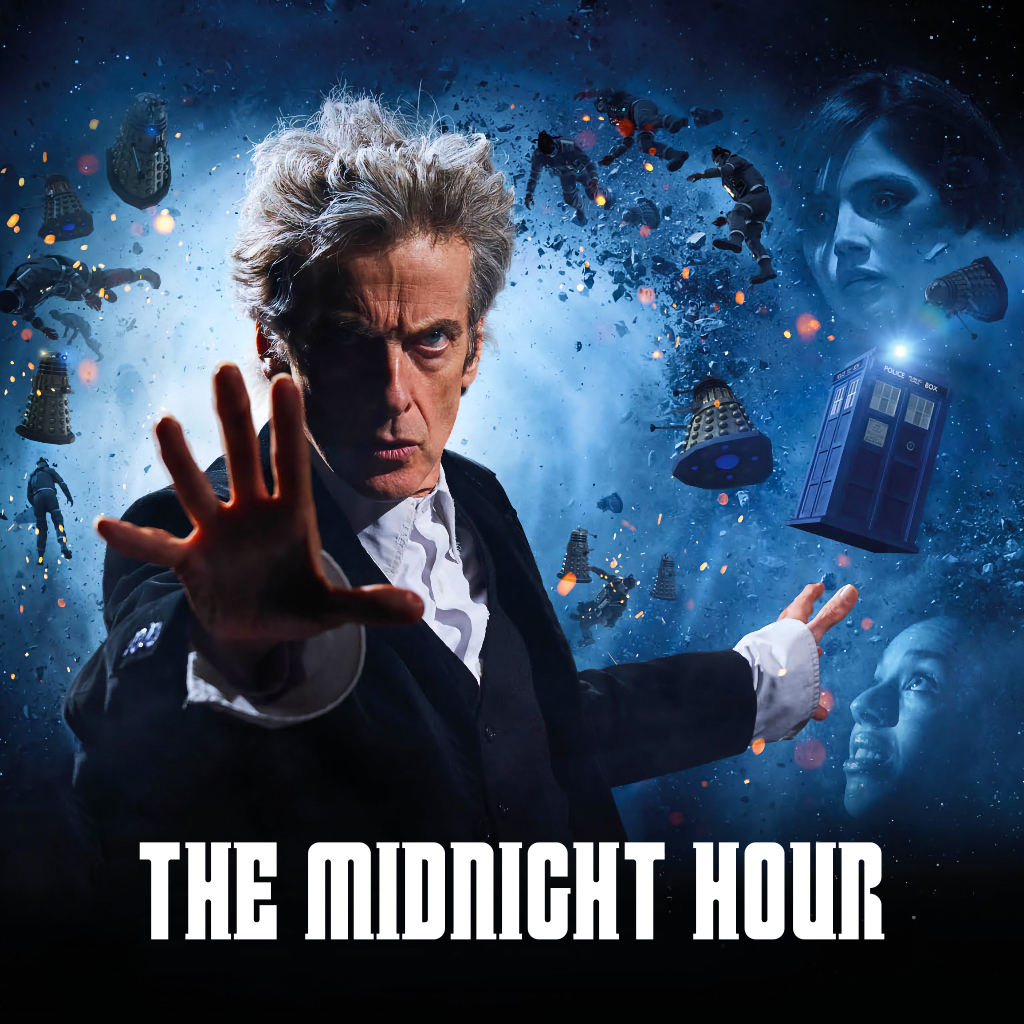
It’s October 17th, 2015, my twenty first birthday.
I am still in Britain, and have just spent the day visiting Brownsea Island with my dear friend Alice. At that time she was still a furry, and her fursona was a squirrel. Brownsea Island has a lot of squirrels! (Red ones, I think.) It was a fabulous way to spend the afternoon, a proper girl’s day out. (Despite the fact that I was still pre-everything back then and so boy mode was all I had.)
After our little escapade on the island, we took a boat back to the mainland and had lunch somewhere (I think at a gift shop or something) and I bought a book on the ghosts of Dorset. (I’m pretty sure I still have it, it might be buried somewhere in my room in Missouri.)
Later that night, while Alice was off attending a concert, I decided to watch Doctor Who in the company of Anna, her mother. Anna is a wonderful woman, and I loved her from the moment I met her. To this day, I call her Mum.
After she got me some tea (I don’t think it was earl grey, but I liked it) we sat together in her living room, turned on the TV in the corner, and… Doctor Who came on. For the first and only time in my life so far, I got to watch Doctor Who live, on its home network, in its home country, in the company of a good friend.
And what a marvelous episode it was.
I love The Girl Who Died. Honestly, I would go so far as to call it my favorite episode of the Capaldi years, just because so much of it is entwined with pleasant memories of my UK trip and the people I met while I was there. But the other reason is, of course, what this episode is about.
Vikings. Norse mythology, and the importance of storytelling. Gods, mortals, and wanna-be gods. This is an extremely pagan episode of Doctor Who, and it’s only now, as a proud Wiccan myself, that I realize it. While I don’t worship the Norse gods, (I’m a Celtic witch, after all) I know that there are people out there who do, and I recognize their importance, so much so that I took one of my middle names from the Norse pantheon: Fenrira, after the wolf god Fenrir.
But there’s more to this than just extreme paganism. There’s a gender element at play here as well, making this the perfect episode of Doctor Who to watch for a newly-hatched transfemme, like I was at the time. Basically, this is a Doctor Who story that manages to invoke everything I’m about as a person… and it aired on my freaking birthday.
Let’s get started then.
Our villains are the Mire, a race of alien lifeforms who feed on testosterone and adrenaline. (During the scene in which Odin is expositing how great testosterone is, I remember riffing, “I’d rather have estrogen.” So too, apparently, does the episode.) To facilitate their deception of our Viking heroes, their leader pretends to be Odin, the supreme god and creator, complete with the requisite shout-out to Monty Python and the Holy Grail.
Since I am, again, not a Norse person, I will instead bring in my old pal from the Eruditorum Discord, Tom Marshall. In April 2023, he published a Black Archive on this story, touching on all aspects of it – from the mythology side to the comedy and the gender transgressiveness. It’s a fabulous read, and I will be quoting from it extensively.
Let’s start, then, with what he says about Vikings, and the form of toxic masculinity that the common depiction of them represents: “Stereotypical hyper-masculine Viking traits include a propensity for bloody violence, a love of adventure and conquest, coarse and brash behaviour, and an almost unquenchable appetite for food, drink, and women. […]
This exaggerated hyper-masculinity, with its hardiness, ferocity, and a determination to die with honor, is no doubt at the heart of the Vikings’ extraordinarily persistent popularity.”
Of all things, I am suddenly reminded of the Klingons, particularly as they are depicted in the era of Star Trek: The Next Generation. In that series, the Klingons are represented by Lieutenant Worf, who works mainly as the Enterprise D’s tactical officer. Because he’s the only Klingon within Starfleet at that point, he is the lens through which we view his species, we are led to believe that they are a noble warrior race who value honor above all things.
But of course, Worf was raised by humans, and formed his impression of what his species is like from books and second-hand accounts. So when Worf briefly joins the crew of a Klingon ship in the Redemption two-parter from seasons 4 and 5, and the poor guy is completely out of his depth. Real Klingons, he discovers, are hard-drinking partiers who love excessive violence.
In other words, they’re stereotypical Vikings, except instead of worshiping Odin, they worship Kahless – effectively the Klingon equivalent of Jesus of Nazareth. (For more on Klingon religion, check out season 6’s “Rightful Heir,” where we get to see some of a Klingon worship ritual, and meet Kahless himself.)
The Girl Who Died, though, goes to great lengths not to valorize this hyper-masculinity. The Vikings, tricked into thinking that they’re being taken to Valhalla, are instead murdered en masse so the Mire can get their testosterone fix… after freaking out and panicking about not being where they expected to be.
As Marshall writes, “The critique the story is making of toxic masculinity targets both groups, juxtaposing the Vikings with an even more exaggerated version of their own behaviour. In this way, this kind of macho posturing is inflated to ludicrous proportions in order to highlight just how laughable it fundamentally is – taking the classic satirical approach of ‘exaggerated lunacy.”
Exactly right. Masculinity doesn’t have to be poisonous and toxic, like so many people (including the entire fucking American right) seem to believe. For every “macho alpha” out there, and boy do I hate that concept, there’s someone like Tim Walz, showing that it’s possible to exist as a man and not be a raging piece of shit.
Let’s move on, then, to the more difficult subject of religious faith. As the remaining villagers are freaking out about having lost their best warriors, the Doctor coldly brushes off their belief system:
DOCTOR: Oh, stop it! All of you, stop it right now. Homo sapiens, you’re an intelligent species. Stop lying to yourselves.
EINARR: Choose your words carefully, False Odin.
DOCTOR: Yes, I am a false Odin. That’s exactly right, I lied. The big fella in the sky, he lied too. You all know it. Because what’s the one thing that gods never do? Gods never actually show up!
2015-era Lena was an atheist, and so she probably would have agreed with that statement in private, though she wouldn’t have put it in those words. This was because, though I was raised an Irish Catholic, I never felt a strong connection to the Christian God, or indeed, to Jesus. They were distant figures who had no bearing on my day-to-day life. So, as I entered high school and college, I drifted away from Catholicism and became a nonbeliever.
But now, things are different. Very different. In May 2023, after binge-reading Drawing Down the Moon by Margot Adler, I performed a self-initiation ritual to formally place myself on the Wiccan path. In keeping with my witchy namesake, I called this ritual the Claiming: In the Beautiful Creatures series, this is the night where a Caster, like Lena Duchannes, is claimed for either light or dark. Lena, though, chose to Claim herself instead, just as I was doing, and became both light and dark.
To prep myself for this, I researched various deities: the Wiccan Goddess and God, (sometimes referred to as Aradia and Cernunnos) Cerridwen, the Welsh goddess of creativity, and the Morrigan, the Irish goddess of warfare, death, and prophecy. (About whom I plan to talk about in greater detail when we get to Face the Raven.)
On the night of my Claiming, I cast a circle to create a sacred space, asked these deities to join me, and began reading my ritual speech. I introduced myself, explained who I was and why I was there, and what I planned to do as a practicing witch. The pivotal line was, “From this moment on, I choose to walk the Wiccan path. I dedicate myself to you, Mother Goddess, Father God, and Cerridwen.” (I hadn’t yet formally introduced myself to the Morrigan, but I’m pretty sure She was there too.)
And they replied, “As we do to you.”
And ever since that night, my connection to my gods has been as strong as anything. I know that not only are my gods real, they have spoken to me. I honestly believe they’ve been around my whole life, watching over me, and sometimes even nudging me in the direction I needed to take in order to find them.
And when I did, they welcomed me home with open arms. The love I felt in the circle that night was unlike anything I’d ever experienced – quite literally life-changing. I left the Claiming circle a fundamentally different person than who I had been the day before, fully aware of my own power as a practitioner of magic, and of the love my gods have for me.
So, no, Doctor. The gods do show up. They may not take physical form, but they do appear. I’ve felt them, and no power on this earth will ever separate me from them.
Now, I know perfectly well why the Doctor generally distrusts faith. (Or at least, until RTD2 happened.) He’s a science fiction character, and science fiction has always had a weird-ass relationship with religion.
Returning to the Star Trek franchise for a bit, Gene Roddenberry (who grew up Southern Baptist… sorta) described himself a secular humanist, and yet Christianity pops up with surprising regularity in the original series. It’s not until we get to the TNG era that humans are explicitly secular, and the only religious people are the aliens. (And, eventually, Ben Sisko… by dint of being the Emissary to the Bajoran Prophets. And even he started out by calling them the “wormhole aliens.”)
Bluntly, this irritates the fuck out of me. I didn’t like it as an atheist, and I really don’t like it now as a Wiccan. But fortunately, it seems that some corners of major science fiction franchises are able to explore the topic with actual nuance.
In 2019, Star Trek: Discovery gave us the episode “New Eden,” an episode of about a small colony of humans who, after being mysteriously rescued from nuclear annihilation in the church they were hiding in, founded for themselves a syncretic faith based on various Earth religions.
In one scene, depicting a stained glass window, you can see symbols from these seven faiths incorporated into the design: Christianity, Judaism, Islam, Hinduism, Buddhism, Shinto and Wicca. Captain Pike, being the son of a comparative religions professor, treats these people with respect, even if he doesn’t believe a god himself.
And yet, Doctor Who can’t be bothered to do the same. Now, in fairness, I expect this kind of behavior from Twelve – he’s skeptical about everything. He didn’t even believe in Robin Hood until the last third of Robot of Sherwood, after all. But his treatment of the old Norse faith in this story, at least to me, smacks of the exact kind of New Atheism Will Shaw accused the Eleventh Doctor as having in his Black Archive on The Rings of Akhaten.
Shaw writes:
“The Doctor displays a more specifically New Atheist attitude in his patronizing approach to the religion of Akhaten. In an early scene, he recounts one of the religion’s core beliefs, ‘that life in the universe originated here, on that planet.’ When Clara asks if this is true, he replies, ‘It’s what they believe. It’s a nice story.’ This kind of dismissal is common in New Atheist discourse – Sam Harris asserts that conflicts between India and Pakistan occur because ‘they disagree about “facts” that are every bit as fanciful as the names of Santa’s reindeer’ – and, coming from the Doctor, it is troubling for a number of reasons.”
“The Doctor’s dismissal of the Akhaten religion as merely ‘a nice story’ clashes noticeably with his famous assertion that ‘we’re all stories in the end’. In an era so deeply concerned with metafiction, the Doctor’s attitude here ought to unsettle us slightly, and smacks of prejudice on his part. The religion of Akhaten is dismissed not because it is a story, but because it is a story from a culture different to the Doctor’s own, and therefore implicitly of lesser value.”
I do not agree with this. While I feel like the Doctor is an atheist, which is somewhat ironic given that he’s been described in godly terms before, I don’t think he belongs to the politically noxious brand of atheism peddled by Richard Dawkins. It is possible for someone to be an atheist without being a New Atheist, and I think it’s a mistake to define the Doctor with that terminology.
Similarly, I don’t read the ‘It’s what they believe. It’s a nice story’ line as being dismissive or patronizing at all. It’s the exact kind of statement I would’ve made in conversation with my Episcopalian fiancee during my atheist era, though I would probably have softened it up a bit. The Doctor clearly respects the Akhaten religion, even if he doesn’t believe it. He’s a committed atheist, and his actions later in the episode (like when he quotes Lewis Carroll while talking to Merry) reflect that.
In some regard, it brings to mind a conversation Picard has with Worf in the start of “Rightful Heir.” He’s clearly concerned about Worf and disturbed by his behavior during the worship ritual, but only in terms of how it intersects with the Enterprise and her crew. When it comes to Worf’s spiritual journey, he’s nothing but respectful.
While I can see how Shaw gets to his reading of Eleven’s alleged patronizing tone with regard to the beliefs of the Akhatenites, a lot of which probably comes from the way Smith reads the dialogue, Twelve’s insistence that “the gods never show up” blows right past being patronizing and slap-bang into outright contempt. The episode never calls him out on this, (and that’s fine, there’s plenty of other things going on) but it still rankles me, and probably always will. Even as an atheist, I would’ve thought the line was a bit much.
Anyway, back to comedy and masculinity. There’s a lot of both in this episode, with the former allowing for satirical commentary on the latter. As well as the aforementioned Holy Grail reference, the episode’s climax runs with the idea of taking a scary thing, and instead of being scared by it, laughing at it instead. Marshall describes it with the term ‘apotropaic laughter’, but I know it best as, quite literally, the underlying premise behind the very first musical number ever heard on My Little Pony: Friendship is Magic, ‘Giggle at the Ghostly.’
In the second part of the pilot episode, also called “Friendship is Magic,” Twilight Sparkle and company are traversing the spooky Everfree Forest to look for Nightmare Moon, a vengeful demigoddess of the night who has managed to shroud Equestria, where our heroines live, in an ‘eternal lullaby.’ (To quote a lyric from one of my favorite fandom songs.)
As they are faced with various frightening trees, Pinkie Pie immediately provides a helpful lesson in how to deal with them:
[Pinkie Pie]
When I was a little filly and the sun was going down…
Twilight Sparkle: Tell me she’s not…
[Pinkie Pie]
The darkness and the shadows, they would always make me frown…
Rarity: She is.
[Pinkie Pie]
I’d hide under my pillow
From what I thought I saw
But Granny Pie said that wasn’t the way
To deal with fears at all
Rainbow Dash: Then what is?
[Pinkie Pie]
She said, “Pinkie, you gotta stand up tall
Learn to face your fears
You’ll see that they can’t hurt you
Just laugh to make them disappear.”
Pinkie’s advice, five years later, winds up forming the core of the Doctor’s plan to defeat the Mire. Using some eels, Ashildr’s power as a storyteller, and a smartphone, the Doctor is able to puncture the Mire by scaring them and making them out to be what they’ve always been: cowards who loudly compensate for that by being Macho Men. (Yes, that’s a Village People joke. You’re welcome.)
Obviously, there are some limitations to how well this kind of approach can work, as Marshall discusses when he looks at how Nordic paganism has been co-opted by right-wing fascist movements for decades. It’s hard to laugh at something that is actively attempting to destroy everything you love, just because you are different from them, and they don’t like that.
So, of course the Doctor’s plan works too well, resulting in the death of Ashildr. A comedy romp through Scandinavia during the time of the Vikings turns deadly serious, and so too must this essay. Because much as I am loath to admit it, I am entirely too familiar with people like the Mire, and the way that comedy can turn on a dime into tragedy.
As I write this, (two days before my 30th birthday, incidentally) we’re in the closing stages of a presidential election that has had more twists and turns in it than a Stephen King novel. For half the year I really thought that Trump would win, and then Biden dropped out, Harris dropped in, and then everything changed.
Next thing you knew, Tim Walz was calling Republicans weird, and everyone was making jokes about JD Vance having sex with a couch. During those hot summer days, I really felt like we were cruising for a Harris landslide.
Now though, I’m not so sure. The campaign has taken a turn for the serious. Trump is getting even more Hitler-ian than he was already, Harris is touting endorsements from Republicans, including Dick freaking Cheney.
And at least for those of us who enjoy having an approximation of democratic governance, we’re looking at the race (which polls show is basically tied, and has been since September) with an increasing sense of dread, uncertainty, and fear. Fear that Harris will lose, and that we’ll end up not only with a second Trump administration, but with a one-party fascist state bent on white cisgender heterosexual conservative Christian supremacy. Like The Handmaid’s Tale but in real life.
By the time you all read this on WordPress, of course, the question (tyranny or freedom?) will have been answered. And I will probably do some rewrites on this section for that version of the essay. But you Patreon types are stuck in the same miasma I am.
November 5th is coming. May the Goddess keep us safe.


Leave a Reply