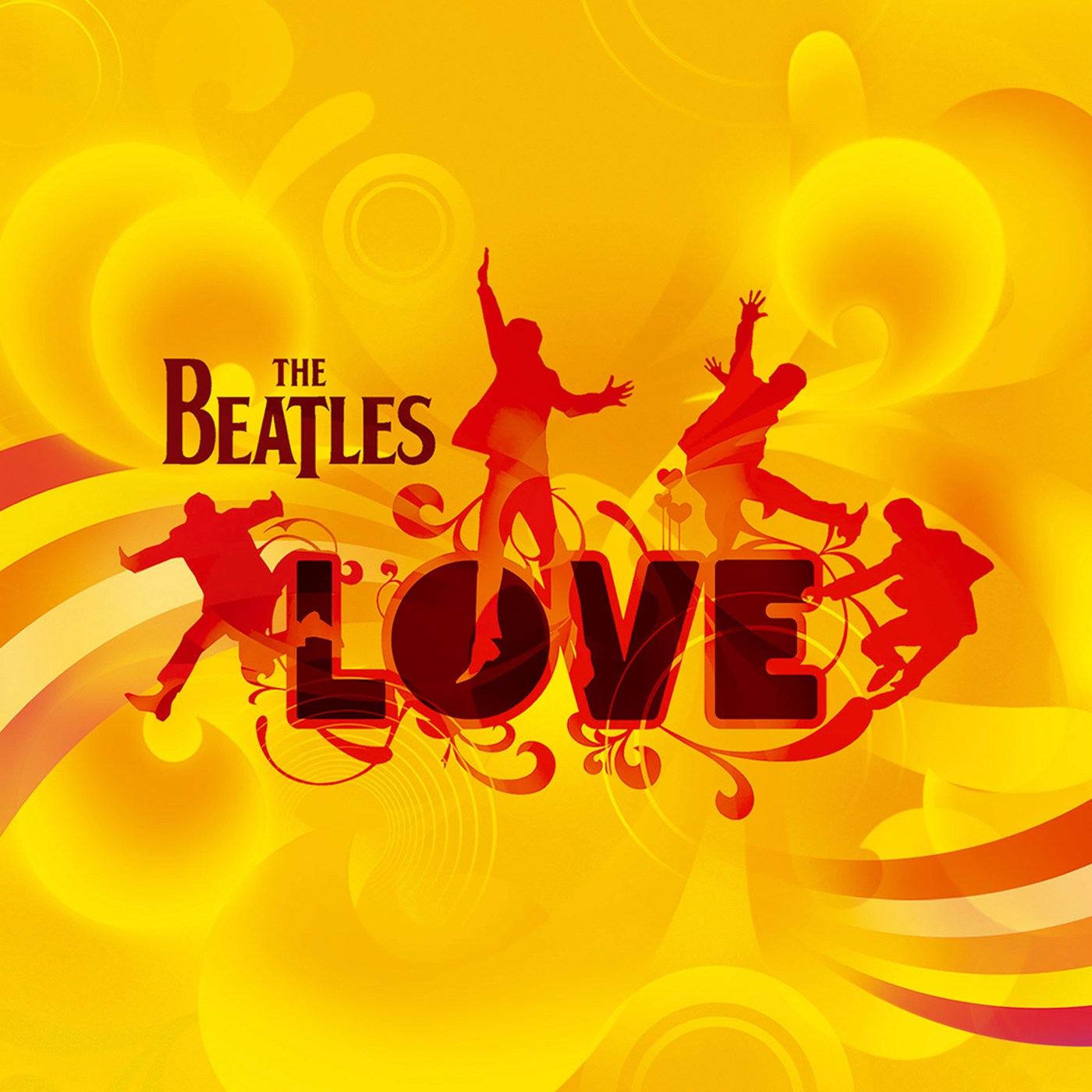
While I technically cheated by talking about his version of 1 from 2015, this is the point at which, temporally speaking, Giles Martin enters the ever-evolving story of The Beatles. Love is both a remix album (in fact the very first one he did) and a soundtrack album, accompanying the Cirque du Soleil show of the same name. It is also the very last Beatles project to involve George Martin before his death in 2016.
What sets Love apart from other Beatles remix albums is that, for the most part, all 37 of the named songs on the album appear in drastically different form compared to the standard album mixes we all know and remember. It’s an utterly unique production, taking the music of the Beatles (particularly the studio-bound stuff of the late 1960s) and throwing them together in a brand new way. It’s absolutely incredible, and a highly enjoyable listen.
It’s also a true collaboration between the Martins. As George said in a 2007 interview with Sound on Sound, “”It’s a funny word, ‘retirement’,” he says. “Because it suggests you’re giving up everything, and I certainly haven’t done that. But I’ve given up recording, because my ears aren’t good enough. This, however, was an offer I couldn’t refuse, when they asked me to produce the music for the show. It was such a challenge. But I couldn’t have done it without Giles. He’s my ears.”
Like all of Giles’ remix projects, Love is a salute to Ringo Starr. His drum parts loom large on this album in particular, the highlight being the mashup of “Within You Without You” and “Tomorrow Never Knows,” where you hear him doing his TNK drum part over George’s vocal and the Indian background score. It is genuinely tantalizing stuff. As George put it: “The brief on this show was that I should use all previous recordings in any form I wanted. It gave us carte blanche to muck about.”
One thing that doesn’t appear much on the album is any music from before 1966. There are some tracks from the moptop era here, but not a lot, as Giles explained: “The earlier stuff is sonically similar. It lacks the imagery the later stuff has. […] There’s not much stuff from Let It Be, because it’s all live with no separation.” Obviously now, thanks to Peter Jackson’s MAL process, that’s no longer an issue!
But what are we waiting for?! Let’s jump right into that mucking about!
‘Because’: The album begins quietly – sounds of birds and wildlife lead into an a cappella version of this track from Abbey Road, which ends with the famous chord from “A Day in the Life,” but played in reverse, leading directly into “Get Back.”
‘Get Back’: BANG! The opening chord from “A Hard Day’s Night” gets mixed with drum and guitar parts from “The End,” including Ringo’s solo and some of the guitar parts before heading into the first verse and chorus of “Get Back.” The main body of the song sounds nice and crisp, with only very low-mixed screams and other elements hinting that this isn’t the standard version of the song.
‘Glass Onion’: Paul’s closing “ooh” from the previous song leads us into “Glass Onion,” albeit only the last third, starting with the instrumental break. It sounds incredible with all this other stuff in it!
‘Eleanor Rigby’/‘Julia’ (Transition): This version of the Revolver track begins not with Paul’s vocal, but instrumental strings. When Paul’s vocal does come in, there’s genuine double-tracking during the choruses, just like on the Songtrack mix of the song. Paw on heart, this version of “Rigby” is probably my favorite just for that.
‘I Am The Walrus’: Ignoring the count-in and some of the leftover bits from “Rigby,” this is the first song on the album to sound largely identical to the album mix. This version was the first full stereo version to ever exist, since the entire second half was only ever presented in faux-stereo. It sounds great, and I really wish a stand-alone version was on the expanded Blue album, rather than the actual mix from 2023.
‘I Want To Hold Your Hand’: This version of the song is a hybrid of the studio version and a live version from the Hollywood Bowl tapes, painstakingly beat-matched. It sounds absolutely fantastic, though the left channel sounds a bit heavy, since the bass and drums are right there.
‘Drive My Car’/‘The Word’/‘What You’re Doing’: The only medley on the album, and probably one of my favorite tracks on the entire thing – a great big salute to the Beatles’ early days, built out of two songs from Rubber Soul and one from Beatles For Sale. It sounds fucking amazing, and I really wish it was longer than two minutes.
‘Gnik Nus’: The vocals from “Sun King” but in reverse, with a tambura drone underneath. According to Giles, like many great Beatles moments, it came about by total accident.
‘Something’/‘Blue Jay Way’ (Transition): Another song that sounds identical to usual, this is one of the loveliest mixes of the song out there – you really notice the strings in this version, and Ringo’s drums sound fucking great. And of course, George’s vocal is nice and clear, it sounds like he’s in the room! The “Blue Jay Way” portion, meanwhile, acts as a fantastically spooky lead into the next track.
‘Being For The Benefit Of Mr Kite!’/‘I Want You (She’s So Heavy)’/‘Helter Skelter’: At first, you think this is just the album mix with the opening notes removed to make way for the drum roll, and by and large, that’s exactly what it is… until we get to the very end of the song, where it transforms into a terrifying circus from Hell, what with the Guitars of Doom and Paul’s screaming from “Helter Skelter” echoing around. It’s absolutely incredible.
‘Help!’: No changes to note here, just a really crisp sounding mix of the title song from their second movie.
‘Blackbird’/‘Yesterday’: Otherwise pretty identical to the album version, save for the inclusion of guitar from “Blackbird,” which sounds just lovely as a lead-in.
‘Strawberry Fields Forever’: This was already my favorite Beatles song ever, but this particular mix of it is by far and away the one I like best. It’s a quick montage of the song’s evolution, from John’s first demo recording to the very first EMI take, which then transitions into the psychedelic version we all know today, but pitched upwards to match the demos, making for a much brighter performance. If the regular version is cloudy, this is pure sunshine.
‘Within You Without You’/‘Tomorrow Never Knows’: By far and away the stand-out track on the album that proves why this thing was worth making, and it was in fact the very first track completed. It’s fucking brilliant stuff, and I know Ringo fucking loved it. It even got a music video on the expanded 1 album!
‘Lucy In The Sky With Diamonds’: After a fucking brilliant intro where the organ notes are scattered around like speckles of starlight, they gradually resolve into one of the best mixes this song’s ever had – you can hear Paul’s bass come in before John’s vocal does, and it’s really great. And when the choruses hit?! Absolute bliss.
‘Octopus’s Garden’: Our Ringo vocal spot on the album is basically a salute to the man himself, by combining bits and pieces from all three of his children’s songs. Strings from “Good Night,” sound effects and vocals from “Yellow Submarine,” and of course, “Octopus’s Garden” now begins with Ringo on drums. It sounds absolutely brilliant.
‘Lady Madonna’: After a little bit from the instrumental of “Sun King,” we dive headlong into “Lady Madonna,” which also gets a brilliant new intro – John and George playing the combs, some harmonies, and that’s what leads us into the rest of the track. Somewhat lopsided sound mix here, but I love the groove!
‘Here Comes The Sun’/‘The Inner Light’ (Transition): Another George tribute number, as the happiest song he ever wrote as a Beatle gets some Indian instrumentation added on, and it sounds really great. And when HCTS actually starts, his vocals are centered!
‘Come Together’/‘Dear Prudence’/‘Cry Baby Cry’ (Transition): For the bulk of the song, this is just the regular version of “Come Together,” but presented with more clarity – among other things, you can hear Paul’s backing vocals a little better… at least until we get to the point where the album version gradually fades out. That’s when the “Dear Prudence” stuff comes in, and John’s repetition of the title phrase is presented in stereo for the first time. It sounds really fucking cool, and I love it. Then Paul doing his bit from “Cry Baby Cry” leads us into Revolution, with Ringo’s kick drum serving as the lead-in.
‘Revolution’: Nothing much to say here, just the best version of the single ever, at least until the 2023 version came out. The CD take is actually shorter, it’s longer on the digital version. (Which is the one I’m listening to as I write.)
‘Back In The USSR’: Another song that’s virtually unchanged from the original, but the introduction sounds really cool. If the Beatles ever did this song live, I like to imagine they would’ve put the two songs together just like this. It sounds incredible, and when paired together, the two tracks really highlight how great the Beatles were when they decided to do straight rock and roll.
‘While My Guitar Gently Weeps’: Rather than augment the version from the White Album, this version of the track is George’s acoustic demo from Anthology 3, augmented with a string quartet – George Martin’s last contribution to a Beatles recording. It sounds beautiful, like George’s equivalent of “Yesterday,” and I can understand why it moved Olivia Harrison to tears. It’s utterly breathtaking. (And for my money, a better version of the song than the White Album one.)
‘A Day In The Life’: After some studio chatter (including the “Sugarplum Fairy” count-in) we get what was the first mix of this song with centered lead vocals all the way through. It’s otherwise identical to the album version, but the crescendo and the ending chord sound bigger than ever.
‘Hey Jude’: While the single is 7 minutes, this version is much shorter – verse 3 is what leads us into the second half, where all the na-na-nas come in. What I love about this mix is the way the piano drops out at 2:54, so it’s just vocals, drums, and that sexy bassline. It kind of reminds me of how Paul performs it at his concerts. (Which I’ve heard him do, and it’s incredible.)
‘Sgt Pepper’s Lonely Hearts Club Band (Reprise)’: Nothing much to say here, except that “Hey Jude” really works as a transition track. And it’s even clean, which is new and different! No crowd noise at all!
‘All You Need Is Love’: Because what else would you end this show (and album) with? This mix is probably the best, you really notice Paul’s bass more than you do on most versions. I also like the fade out, where they mix in bits and pieces from “Rain,” “Ticket to Ride,” “Good Night,” and the 1965 Beatles Christmas record. What a fantastic finale to a brilliant album!
The digital version of the album includes two bonus tracks, released in 2011 when Love came out on iTunes:
‘The Fool On The Hill’: Here we have cellos from ‘I Am The Walrus’, drums from ‘Octopus’s Garden’, brass and vocals from ‘Mother Nature’s Son’, piano from ‘Dear Prudence’, and a tambura drone. The new intro is really pretty, it does a wonderful job of setting up the rest of the song. The new additions really enhance the track, it sounds better than ever!
‘Girl’: I will never be too fond of “Girl,” entirely because of the tape hisses, but this mix sounds pretty awesome. We have drums from ‘Being For The Benefit Of Mr Kite!’, a tambura drone from ‘Within You Without You’, and some acoustic guitar from ‘And I Love Her’, including all but the last note of that famous riff. It shouldn’t work, but it kind of does!
There really is no other album out there quite like Love. Honestly, it’s probably one of my all-time favorite Beatles albums – it’s the music we all know, but presented in a unique way that never fails to make me happy when I listen to it. I’ll never get to see the show (thanks to money and the fact that the show was closed in July) but the album is a more than adequate substitute.
It’s a psychedelic summary of everything the Beatles were, and it makes their music sound more timeless than ever before. Some purists out there might hate on this record, but I don’t know why. It’s fucking great. It takes balls of steel to dramatically change the way this music sounds, and Giles Martin, both in 2006 and now, is just the man to do it.
With the exception of the next two blog posts, every post from here on out relating to the Beatles’ music releases will involve Giles Martin and his approach to Beatles mixes. And I’m a huge fan, so expect me to be about as objective as I’ve been this entire series. (Not at all.)
Next time though, the Beatles get back to mono with Mono Masters – a collection you may have heard before, but not quite like this.


Leave a Reply