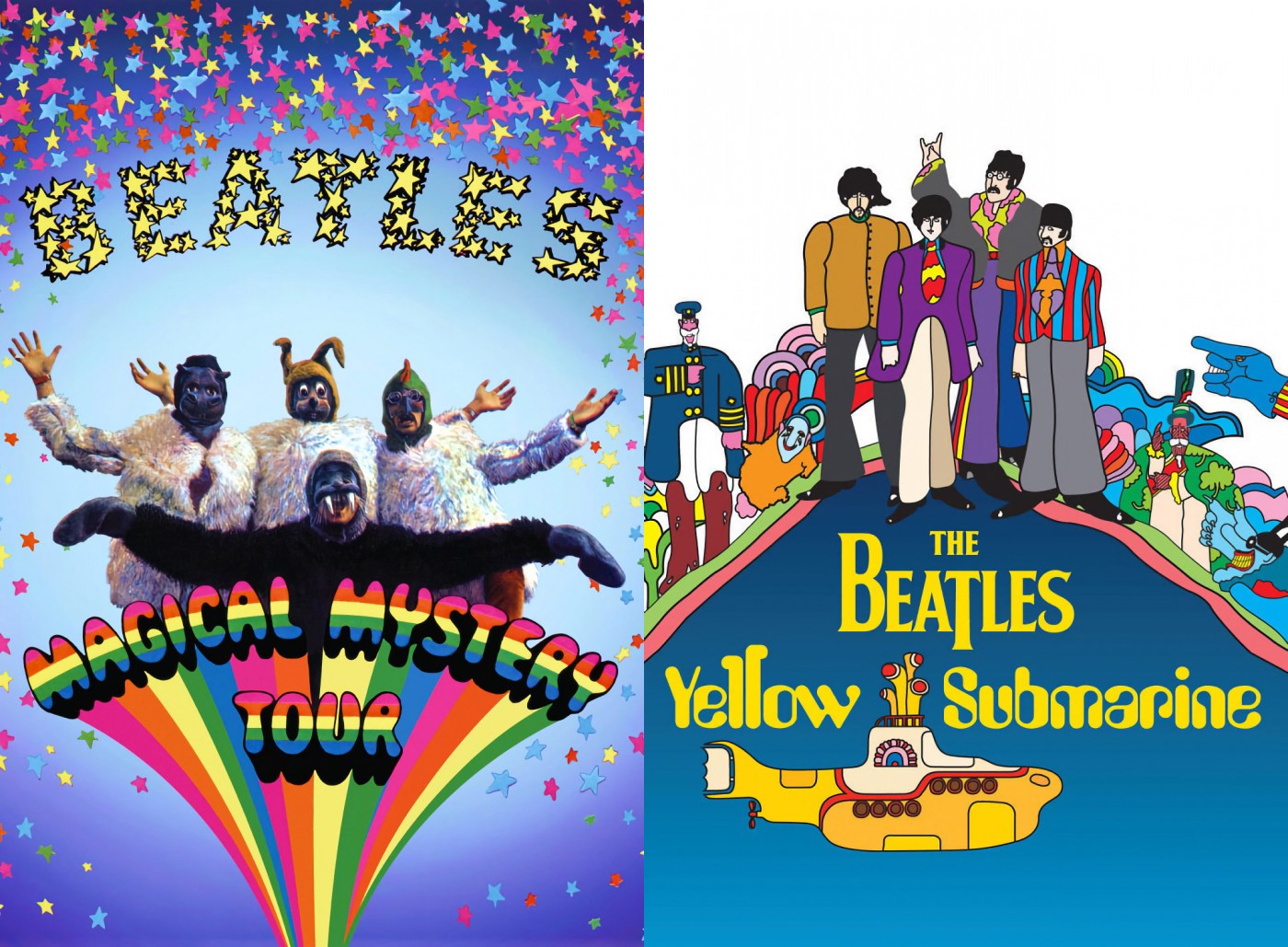
As movies go, Magical Mystery Tour is extremely strange. Made in the immediate aftermath of Brian Epstein’s death, the film is an entire world away from the two movies made during the Lester era, though it does include Victor Spinetti – this time as a gibberish-spouting sergeant. Also, Ringo is the next Beatle to suddenly have an imaginary relative, in this case, Aunt Jessie. (Though unlike John McCartney in AHDN, she’s mainly just there for the spaghetti scene.)
The plot, to the extent it exists, is this: the Beatles (primarily Ringo) get on a bus and travel to who knows where. The best parts of the movie are all the ones where they play their songs, particularly “I Am the Walrus” and “Blue Jay Way.”
Connecting the music scenes are a series of incredibly odd sketches, from a marathon scene where Ringo hijacks the bus and drives it around a race track, to the aforementioned spaghetti scene, based on a dream John had, where he endlessly shoves spaghetti onto Jessie’s plate.
Also there’s a strip tease, and the movie ends with the boys lip-syncing to “Your Mother Should Know” while dressed in white suits.
So far as I can figure out, MMT really does feel like an acid trip committed to celluloid. When it aired on the BBC in December 1967, it was shown in black and white, completely ruining the presentation… though if we’re being honest with ourselves, a color showing would not have helped much either.
If there is anything good to be said about the movie, it’s that in some ways, it pre-sages the surrealist comedy of Monty Python – Monty Python’s Flying Circus will begin on October 5th, 1969, exactly seven years since “Love Me Do,” carrying on the Beatles’ comedic spirit through the show and then four feature films.
Python has often been compared to the Beatles, in fact. George Harrison in particular was a big fan of theirs, and financed Life of Brian, because he wanted to see the movie. He also appears as a news reporter in Eric Idle’s solo project, All You Need is Cash, which satirized the Beatles’ career.
So, while Magical Mystery Tour itself may not work very well as a piece of entertainment, you can start to see where things are going in terms of wider British pop culture. As always, the Beatles are ahead of their time.
Let’s move on to their other psychedelic era project: Yellow Submarine from 1968. An animated film intended to conclude their three-picture deal with United Artists, the Beatles themselves don’t appear until the very last scene of the movie – instead, their voices are provided by other actors, aside from the musical numbers.
While I’ve always been a fan of this movie, going back to when I owned a copy on DVD sometime in the early 2000s, it was not until very recently that I really started to appreciate just how good it is.
See, a few months ago I read Up Periscope Yellow by Al Brodax, one of the movie’s producers and screenwriters. Brodax gives a very thorough (and hilarious) account of how the movie was made, from many troubles with the script to how they decided on the movie’s look – as far away from Disney as possible:
“That morning there is an ad in the New York Times for an exhibition at the Metropolian Museum of Art featuring the work of Paul Signac, a master neoimpressionist. There’s a picture in the ad of his “Portrait of Felix Fenon Opus 217,” a work clearly influenced by Seurat and Monet. A swirl of colors, a Carnaby Street image, magnificent psychedelia. […] Signac had died in 1935, so his availability is questionable. But Milton Glaser’s name comes to mind. Glaser’s magnificent Bob Dylan poster-Dylan’s silhouetted head crowned by Signac-like swirls of brilliant color-could easily be taken for a Signac.”
As it turned out, they couldn’t get Glaser either, but they did get Heinz Edelmann. According to Brodax, Edelmann was “steeped in the techniques of Beardsley, and Bosch, with a touch of the Dada movement, but with it all, he creates a unified effect that is all his own.” The end result of that was, of course, an animation style that became as unique as the movie it was made for: the Eleanor Rigby scene in particular is basically the Beatles inventing Terry Gilliam’s Monty Python animations.
As for the Beatles themselves, Brodax tells of a band that was initially very reluctant to involve themselves with the production – the four new songs featured in the movie were dubbed by John as “the four humiliations.” It was not until the Beatles paid a few visits to the studio that the tide began to turn, and they became quite enthusiastic about the project.
It’s a wonderful film, Yellow Submarine. Brodax’s book is absolutely spellbinding, and I highly recommend it to anyone who wants to know all the inside detail into how this movie was made. It’s available on Amazon in hardcover, paperback, and an acceptable Kindle version – my copy is paperback, purchased from Autumn Leaves Used Books here in Ithaca.
The power of Beatles music against the forces of tyranny and evil would end up recurring, albeit in a roundabout way, in the Doctor Who episode The Devil’s Chord, when John and Paul are the ones to defeat the villainous Maestro, simply by playing a chord on the piano.
Yellow Submarine, as a movie, makes literal something I’ve been saying since this project began: the power of their music to bring people together through joy, love, and harmony. It’s something that I think a lot jukebox musical films that use their music often miss – it’s not just the lyrics and the tunes, but those four specific individuals, coming together to create something wonderful.
This is why I love this band so much, and it’s why they’ve lasted for 60 years and counting. Why they’ll last forever.
Next time: the end of the line for our four lads from Liverpool, as we watch the (in)famous 1970 documentary Let It Be, now newly restored, and released to the public for the very first time since it came out.


Leave a Reply