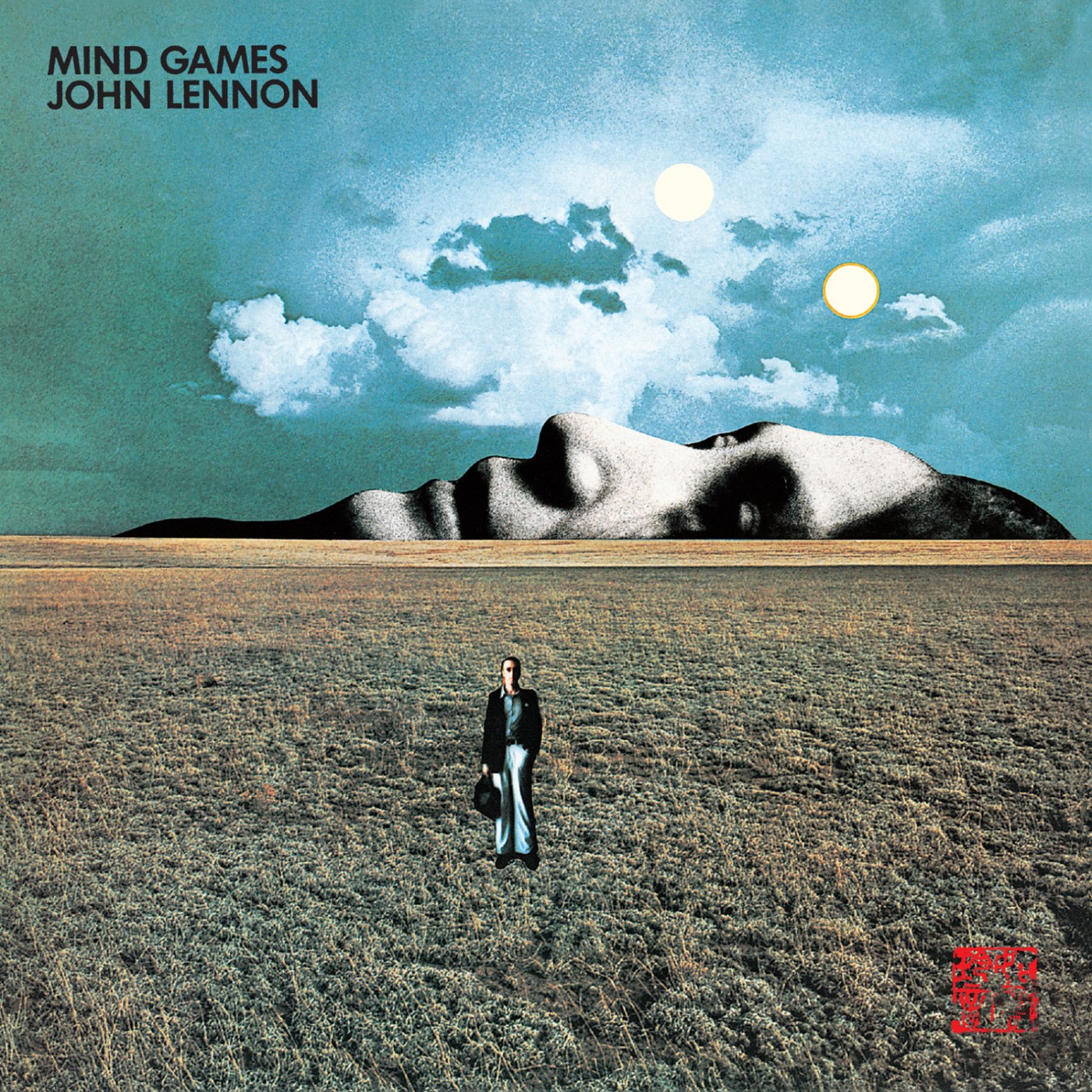
Mind Games finds John Lennon getting his music back on track after the unqualified disaster that was Some Time in New York City… which is somewhat ironic, considering everything that was happening to him beyond the confines of the recording studio seemed to be falling apart.
His marriage with Yoko was on the rocks, launching the beginning of what came to be known as his Lost Weekend: he was seeing May Pang (on Yoko’s orders) and, consumed by his love for his wife and the heartbreak he felt at being forced apart from her, music was his only solace from the pain… but being who he was, he channeled that pain into his work.
Unfortunately, the music critics of 1973 did not think Mind Games was up to their already-high standards of John and his music. The general impression seemed to be that John’s writing was anemic at best, and insipid at worst, unless he was writing about Yoko. They said he felt aimless, unsure of where to go next now that his artistic muse had left him behind.
Cut to 2024. Sean Lennon, son of John and Yoko, has become the point man for all things related to his father’s solo career over the last several years, and 2024 was the year in which he decided to celebrate Mind Games by remixing it himself. As he told Variety, “Well, for me personally, “Mind Games” was always one of my favorite albums, and certainly one of my favorite John Lennon albums. So I just felt like it was an amazing opportunity to be able to work on music that I really love from my father.”
It’s always endlessly fascinating to hear Sean talk about his dad. Years ago he was on BBC Radio for a special program to celebrate John’s 80th birthday, and you can hear the love he has for the man, both as a father and as one of the architects of, to use Derek Taylor’s phrase, “the twentieth century’s greatest romance.” Sean’s perspective on John and his work is entirely unique, and I am very excited to hear how he translates that love into the difficult task of mixing music.
Let’s hear how he did, shall we?
‘Mind Games’: The title track is just the latest in an entire sequence of “Power of love” songs of his that go all the way back to “The Word” from Rubber Soul, filtered through the mysticism that runs through the early 1970s. John specifically mentions druidry and magic here, nodding toward neo-paganism and other non-Abrahamic religious traditions.
For all that John said in 1970 that he didn’t believe in magic or tarot, I kinda think that by now, he must have done. Among other things, Yoko was known to keep astrologers and tarot card readers on her payroll, and made her business decisions based on what the cards told her. All of that is real-world magic. (And for crying out loud, she released an album called Yes, I’m A Witch.) So in that kind of environment, of course John would end up slipping some pagan references into his work. He was surrounded by it!
But there’s a larger piece at work here: the rise of neopaganism, and Wicca in particular, in the United States. While the religion was founded by Gerald Gardner in the 1950s, it was in the early 1960s that Raymond Buckland was initiated into the Craft. He moved to America in 1962, was initiated in 1963, and in 1964, Buckland founded his first coven in Bay Shore, New York, working in the Gardnerian tradition.
(And at the same time as this, the Beatles were conquering the US as well.)
Over the next few years, witchcraft absolutely exploded in popularity across the United States, as traced in Margot Adler’s Drawing Down the Moon. Different witches founded their own traditions across the mid to late 1960s, just as the Beatles stopped touring, entered the recording studio, and began making magic of their own with albums like Revolver and Sgt. Pepper’s Lonely Hearts Club Band.
By 1972, as John and Yoko were getting settled in New York City, the Church and School of Wicca (established by Gavin and Yvonne Frost in 1968, had become the first federally-recognized Wiccan church. In 1973 itself, Raymond Buckland left the Gardnerian tradition behind and founded one of his own, called Seax-Wica.
I don’t know how plugged into neopaganism John was in late ‘60s and ‘70s, but I have to believe that Yoko was. The rise of non-Abrahamic belief systems was definitely on the rise at that time, thanks not only to the various British ex-pats that brought Wicca to the US, but also to George Harrison and his particular take on Hindu spirituality. Take all that together, and all of a sudden John’s pagan-inflected lyrics start to make a lot more sense.
‘Tight A$’: Not much to write here, just John getting back to his rock and roll roots, with a bit of wordplay for old time’s place. He said at the time, “Just a throwaway track. I felt like doing that kind of a song. It’s a Tex-Mexsound which actually you could play now and it would be au courant, but I don’t think many people were doing it then.”
Surprisingly, I don’t think I’ve heard this song before, so it’s entirely new to me. What a wonderful experience! I really like it, it’s a nice rock and roll number that sounds a bit like something you’d’ve heard in the 1950s. Shades of his later Rock ’n’ Roll album, perhaps.
‘Aisumasen (I’m Sorry)’: The Mind Games equivalent of “Jealous Guy,” as both songs feature John apologizing for earlier harm toward a woman. But where “Jealous Guy” was directed toward the women he hurt in his youth, “Aisumasen” is an apology song to Yoko, by name. The repeated line “All I had to do was call your name” evokes the early Beatles tracks “All I’ve Got to Do” and “I Call Your Name,” though of course, rendered in the past tense rather than the present.
‘One Day (At A Time)’: A straight love song meditating on the theme of two parts creating a whole, with John singing falsetto for the first time. (Yoko’s idea, apparently.) He said in 1980, “Well, that’s just a concept of life, you know. How to live life. It was Yoko’s idea for me to sing it all falsetto.” Also listen for that most early ‘70s of instruments, the keyboard, played by Ken Archer.
‘Bring On The Lucie (Freeda Peeple)’: John returns to the political sphere on this song with an anti-Vietnam track, but I only figured that out when I looked it up. This is a protest song that’s closer to something from the Imagine era – not tied to any specific cause, just a general protest against war. Honestly, it’d work just as well now if directed toward Benjamin Netanyahu in reference to the Gazan genocide, or toward Vladimir Putin and the war in Ukraine.
‘Nutopian International Anthem’: Just three seconds of silence, representing the conceptual country invented by John and Yoko in April 1973. In 2024 the concept was revived to promote Sean Lennon’s Mind Games remix, and I am happy to say I now have an official Nutopia identity card.
‘Intuition’: A rare note of McCartney-esque optimism in John’s work, both as Beatle and as a solo artist. While the maintainers of Beatles Bible seem quite down on Mind Games as a whole, and this song in particular, I couldn’t disagree more if I tried. It’s a happy song that rambles along, and given everything that was happening to John at this point in his life, it’s wonderful that he was able to conjure up something like this.
My favorite line? “The magic of the music seems to light the way.” I’ve loved music since I was a kid, and in particular the Beatles. It was because I spent my childhood listening to them that I majored in audio production, and I have always believed in the power of music to enhance, and even change, our emotional states.
I’m a firm believer in what the Welsh call “Awen,” a word that means ‘inspiration.’ It is a force that is said to flow through you, and in a neopagan context, it is often looked upon as a gift from Cerridwen: the Welsh goddess of creativity and inspiration.
In the famous myth of Cerridwen and Gwion Bach, Cerridwen was brewing a magic potion of inspiration in her cauldron for her son, Morfan. In this work, she recruited a young man named Gwion Bach to stir the cauldron for a year and a day, while she went to go look for more ingredients.
But Gwion Bach accidentally took three drops of this potion while Cerridwen was away looking for herbs, and when she came back, she discovered her cauldron had broken, and the potion she made had become poisonous. Enraged, Cerridwen chased Gwion Bach down, intending to kill him… but then she changed her mind, and for nine months, carried him in her womb. Gwion Bach was then reborn as the legendary bard Taliesin, and began a new life.
Among neopagans today, Cerridwen is worshipped as the Goddess of Creativity, and her cauldron is believed to be the source from which our inspiration to create arises. She is one of my deities, and it is because of Her influence on my life, even before I came to know Her, that I felt called to become a writer. Every morning, I pray to her, asking her to bless me with the light of Awen – it is a precious gift, after all, and one that I am honored to receive.
To quote Kristoff Hughes’ eponymous book on Cerridwen, “The Welsh word for bard—bardd—derives from the proto-Celtic word bardos, meaning “in praise.” In the Welsh language it specifically means a bard, a poet, a literary person, an author; figuratively, a prophet, philosopher, or priest.”
John Lennon, then, and the rest of the Beatles, were and are the bards of our modern era. “Intuition” seems to be gesturing toward the concept of Awen, at least in vibe if not in specific terminology. That’s why I like the “magic of the music” line so much – John recognizes that musicians, being descendants of the ancient bards, have magical powers all their own.
Awen is an incredibly powerful creative force, and I think that’s part of why the music of the Beatles, together or apart, have outlasted so many of their contemporaries, and inspired so many people. In 2023, “Now and Then” became the band’s 28th Number One single, to generally positive reception by music critics. And if you listen to it, along with “Free As a Bird” and “Real Love,” you realize that not even death itself can stop the magic of Awen, and the Beatles, from manifesting.
‘Out The Blue’: Here we have another song written specifically for, and about, Yoko. It’s the most powerful love song John Lennon ever wrote, but as Rob Sheffield said in Rolling Stone, “it’s a song he couldn’t write until she finally left him.” It feels like his version of Paul’s “Maybe I’m Amazed,” down to the sense of sheer astonishment that he gets to share his life with such a magnificent individual.
But what’s this? John Lennon, avowed atheist, credits his meeting Yoko to divine intervention… but two very specific deities, at that. Here’s how the first verse begins: “Every day, I thank the Lord and Lady/For the way that you came to me.” When I first heard this song, I think in my teens, I didn’t think much of that line, but it hits entirely differently now that I’m a practicing Wiccan.
Most forms of Wicca are duotheistic in nature, going back to our roots in the Gardnerian tradition. Gerald Gardner, inspired by the writing of Dr. Margaret Murray, believed that worship of a Horned God and a Mother Goddess originated during the Stone Age, and was passed down through the millennia, and that their names were so sacred that they were to be kept secret from all non-initiates. Most of us, then, simply refer to them as the Lord and the Lady, just like in the song.
Again: I don’t know if John was clued into the neopagan scene in the 1970s, and it’s not like we can ask him, but I wouldn’t be a bit surprised if he at least read Gerald Gardner at some point. Why else would he directly invoke two of my deities by name?
(For the record, my personal theology is that the Goddess is the creator of all things, as She is for Dianic Wiccans, and the God is her eternal consort. I usually refer to them as the Mother Goddess and the Father God, but when I do give them names, they are Aradia and Cernunnos, the same ones used by the early Gardnerians. Though most Wiccans describe them as archetypes, I choose to worship them as separate deities, alongside my other two goddesses, Cerridwen and the Morrígan.)
‘Only People’: Per Beatles Bible, “‘Only People’ was intended as an inspirational call for people to take charge, but its non-specific nature and plodding rhythm meant it lacked the anthemic qualities of songs like ‘Give Peace A Chance’ and ‘Power To The People’.” John himself dismissed the song in a 1980 interview with Playboy, and I have to admit, while the lyrics are kind of weak, I do enjoy the melody they’re sung to.
‘I Know (I Know)’: While John later dismissed this song as “just a piece of nothing,” I don’t see it that way. This is another Yoko song, where he says he can see more clearly now than he has before, as on the Imagine track “Oh My Love.” But of all things, the guitar riff that opens the song sounds like a straight lift from “I’ve Got A Feeling,” one of the last songs that he collaborated on with Paul McCartney. Maybe he’s thinking of both of them?
‘You Are Here’: A touching ballad from John reflecting on his relationship with Yoko, with its title taken from an art exhibition he held in 1968, as a tribute to her. It’s a song about two separate individuals coming together, whether as cities or as countries, to form a whole. It’s quite beautiful, I think.
‘Meat City’: A straight rock and roll song, in case you forgot John could do those. For me it has shades of “Rock and Roll Music,” his Chuck Berry cover from Beatles For Sale. I kind of love it, even though the words don’t make a ton of sense.
I really, really like Mind Games. It’s a much stronger album than the music critics of the ‘70s were prepared to admit – in their minds, Some Time in New York City had been an irredeemable mess, and nothing John could do would ever make up for it. Given that, it’s hard not to see why he decided to ditch the music business in 1975.
Sean Lennon’s remix gives the album some much needed depth, making everything sound bigger while not sonically reinventing the wheel, as Giles Martin’s Beatles remixes do. The title song in particular sounds fucking incredible in this new mix, but the whole album is well worth your time.
And as noted, it’s as close to pagan as John’s music ever gets. This is an era where Doctor Who is doing stories rooted in Barry Letts’s Buddhism, Hindu spiritualism is taking off, and witchcraft is sweeping the US as widely as the Beatles did a decade before. Mind Games is a magical ritual in musical form, and John is our spell caster.
So mote it be.


Leave a Reply