Stop me if you’ve heard this one before: an attempt by a Beatle to return to the music of his youth is derailed by legal travails, disillusionment, recriminations, and Phil Spector being himself. Another studio album is released during the long gap, and the Beatle’s recording career ends not with a bang, but with a thud. Am I describing Let It Be and Abbey Road, or Walls and Bridges and Rock ’n’ Roll?
As a friend of mine in high school used to say, “Neither, it’s both.”
The story of John’s Rock ’n’ Roll album begins with a lawsuit. In 1969, John wrote the Beatles song “Come Together” around an old Chuck Berry track, “You Can’t Catch Me.” By 1973, the publisher of that song, Morris Levey, sued John for copyright infringement, but they reached a settlement in which John agreed to record three songs owned by Levey for his next album, intended to be Rock ’n’ Roll.
Unfortunately, things very quickly went off the rails. Sessions for the album, begun in Los Angeles, very quickly fell apart into drunken chaos as Phil Spector seemed to go even more haywire than he had been previously. He would show up to sessions dressed in a costume, and one night, even fired a gun in the studio.
In the end, John returned to New York to record Walls and Bridges, and returned to Rock ’n’ Roll in October 1974, where he chose to produce himself. Re-recording the LA tracks entirely, he sent work-in-progress mixes of the songs to Morris Levey for his approval… and Levey then turned around and released the tracks anyway, on the album Roots: John Lennon Sings the Great Rock & Roll Hits.
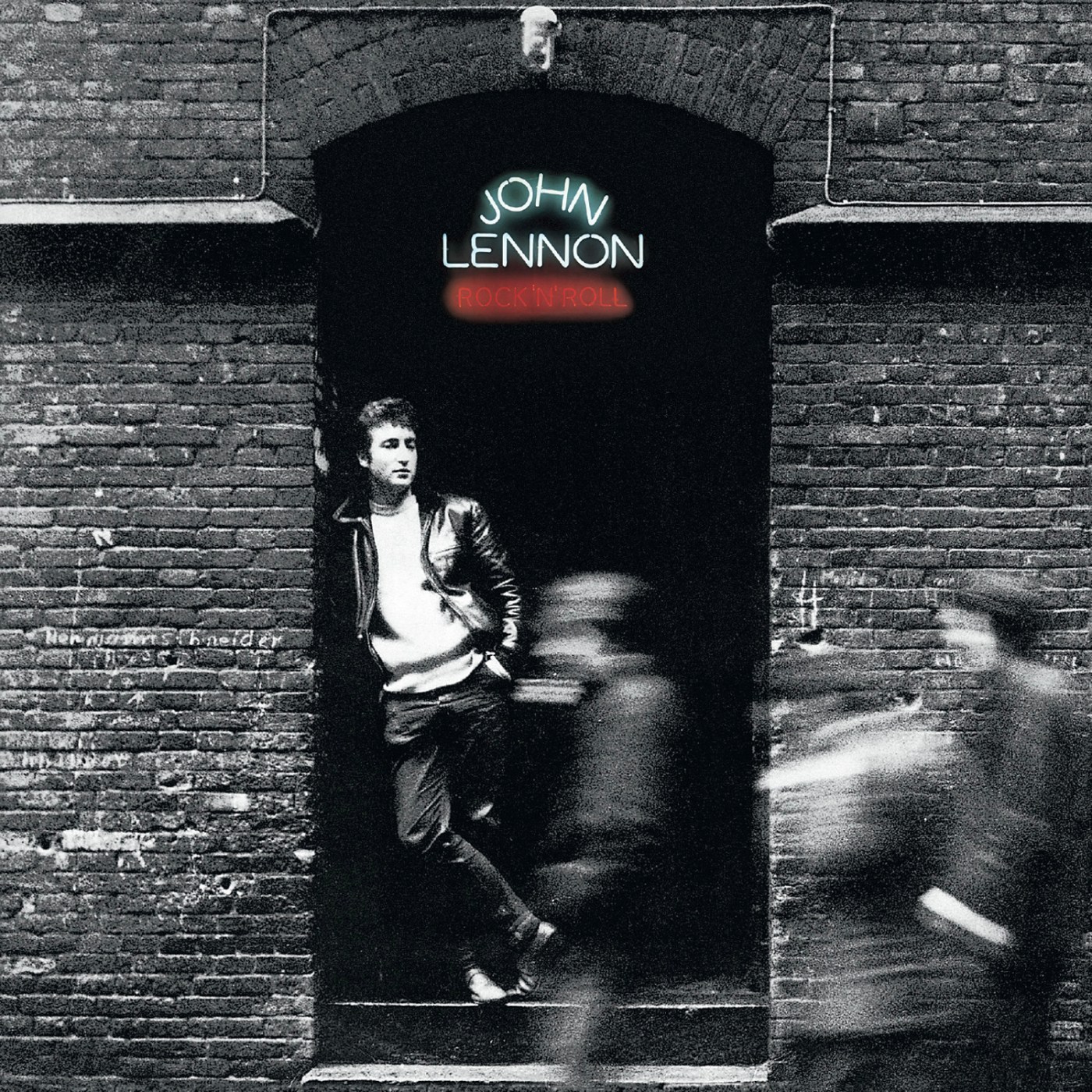
John sued, and Rock ’n’ Roll was released February 1975, with a famous cover photo: John standing in a Hamburg doorway in 1960. The picture was taken by Jürgen Vollmer, one of the German trio who befriended the young Beatles during their Hamburg residency. (The other two being Klaus Voormann and Astrid Kirchherr.)
Fittingly, the photo in question featured the blurred forms of Paul, George, and Stu Sutcliffe racing past the camera, neatly book-ending John’s musical career. He chose not to renew his recording contract, which expired in 1975, and instead spent five years as a househusband, raising his newborn son Sean.
Let’s jump into John’s intended swan-song:
‘Be-Bop-A-Lula’: A Gene Vincent track, John had been performing this song at the famous Woolton church fete in 1957, during which he was introduced to Paul McCartney by his friend, Ivan Vaughn. Reflecting on the moment in an interview with Rolling Stone, John said: “There’s a photo in all the Beatles books – a picture of me with a checked shirt on, holding a little acoustic guitar – and I am singing ‘Be-Bop-A-Lula’, just as I did on that album.”
‘Stand By Me’: This was John’s last hit single before he retired from music in 1975 to raise Sean Lennon. The original album version has slapback echo on his vocal – the Ultimate Mix from 2020 presents it unadorned. Whichever you way you slice it, the sheer emotion in his singing is always exhilarating.
‘Medley: Rip It Up/Ready Teddy’: A medley of two Little Richard songs, these picks might sound familiar to the especially dedicated Beatles fan, as The Beatles had performed a medley similar to this during their January 1969 sessions for Get Back. It was released on Anthology 3. John’s version here clearly shows that he can do Little Richard songs just as well as Paul McCartney.
‘You Can’t Catch Me’: The song that launched a thousand lawsuits, or so it must’ve felt to John. The arrangement performed here sound absolutely nothing like “Come Together,” though John sings his vocal in a similar fashion, with his voice soaked in slapback echo.
‘Ain’t That A Shame’: A Fats Domino number, this song was also the first one John learned to play, taught to him on banjo by his mother Julia, and it became a favorite song of his and Paul’s to jam to. Paul himself later recorded his own version in the late 1980s, where it was released on his album Снова в СССР – the first and only album to be released on purpose by a Beatle in the Soviet Union.
‘Do You Wanna Dance?’: While most of the songs of this album attempt to replicate the original arrangements, John decided to do something different with this track. He explained, “’Do You Wanna Dance?’ is the only one that I messed around with a bit more. I tried to make it reggae… This one makes you feel happy, but I don’t know if it makes you want to dance, and that’s the problem. It’s definitely different from the original.”
‘Sweet Little Sixteen’: Another Chuck Berry number, this song has been performed by the Beatles: they recorded a version for BBC radio in 1963, which was then released in the 1990s on the Live at the BBC collection. The solo version is slower than that 1963 recording, but John turns in one of his best vocal performances ever. Even Phil Spector’s production sounds good!
‘Slippin’ And Slidin”: This song was the b-side of a more well known Little Richard song, “Long Tall Sally,” which quickly became a standard part of Beatles shows when they were still a live band. John’s version would’ve been the b-side on a single with “Ain’t That A Shame,” but the single was canceled just before release, except in Mexico.
‘Peggy Sue’: Buddy Holly looms large in Beatle legend. His “That’ll Be the Day” was recorded by the Quarrymen in 1958, and included on Anthology 1. Several years later the Beatles recorded his song “Words of Love” for Beatles For Sale, and now, at last, John recorded this for Rock ’n’ Roll. Across the sea at Abbey Road, his former collaborator Paul McCartney recorded a version too, on the last day of sessions for his One Hand Clapping project.
‘Medley: Bring It On Home To Me/Send Me Some Lovin”: A medley of Sam Cooke and Little Richard songs, featuring Klaus Voormann on backing vocals. John said in 1975: “‘Bring It On Home To Me’ is one of my all-time favourite songs and, in fact, I have been quoted as saying I wish I had written it. I love it that much, and I was glad to be able to do it. ‘Send Me Some Lovin” is a similar kind of song and it was done originally by Little Richard – again, one of my favourites – and also by Buddy Holly.”
‘Bony Moronie’: For those who are deep into Beatle lore, you’ll recognize Larry Williams. The Beatles recorded three of his songs in 1964 and ’65: “Bad Boy”, “Slow Down”, and “Dizzy, Miss Lizzy”. “Bad Boy” and “Lizzy” both appeared on the American album Beatles VI, while “Bad Boy” debut on 1964’s Something New. John sang lead vocals on all three, and his performance here on “Bony Moronie” is just as good as those earlier songs.
‘Ya Ya’: A proper version of the infamous Morris Levey track, heard previously on Walls and Bridges. John gives it his all, despite the fact that he was reluctant to record it in the first place: “‘Ya Ya’ was a contractual obligation to Morris Levy as a result of the court case. It was a humiliation, and I regret having to be in that position, but I did it.”
‘Just Because’: Whereas the lion’s share of Rock ’n’ Roll featured songs John knew well, this one was recorded entirely because Phil Spector talked him into it. Even so, it serves as John’s goodbye to the music industry, as the track ends with him saying farewell: “This is Dr Winston O’Boogie saying goodnight from Record Plant East, New York. We hope you had a swell time. Everybody here says hi. Goodbye.”
Given the unfortunate circumstances that surround Double Fantasy, I want to wrap up this portion of our look at John’s discography on a good note. After all, this was his intended finale to his music career, and it’s a wonderful one. You can hear in his performance the love and passion he feels for the songs that made him a musician, and you get the sense that he’s proud of all that he’s achieved.
His professional recording career, as of this album, lasted from those tentative first sessions with George Martin and the rest of the Beatles at EMI in 1962, to 1975 at Record Plant East, a full 13 years in between. During that time, he completely rewrote the book on popular music, and contributed some of the most-beloved songs known to humans. (And wolves, of course.)
So, given all that, an album where he looks back at where he began from the perspective of where he is now makes complete sense. He’s John freaking Lennon, he doesn’t need to prove himself anymore. He sounds the happiest he ever has on this record, as if he knows that this is the end of the line. His next goal is simply to live life, and who can blame him? With everything he gave the world, he’s more than earned some time to himself.


Leave a Reply