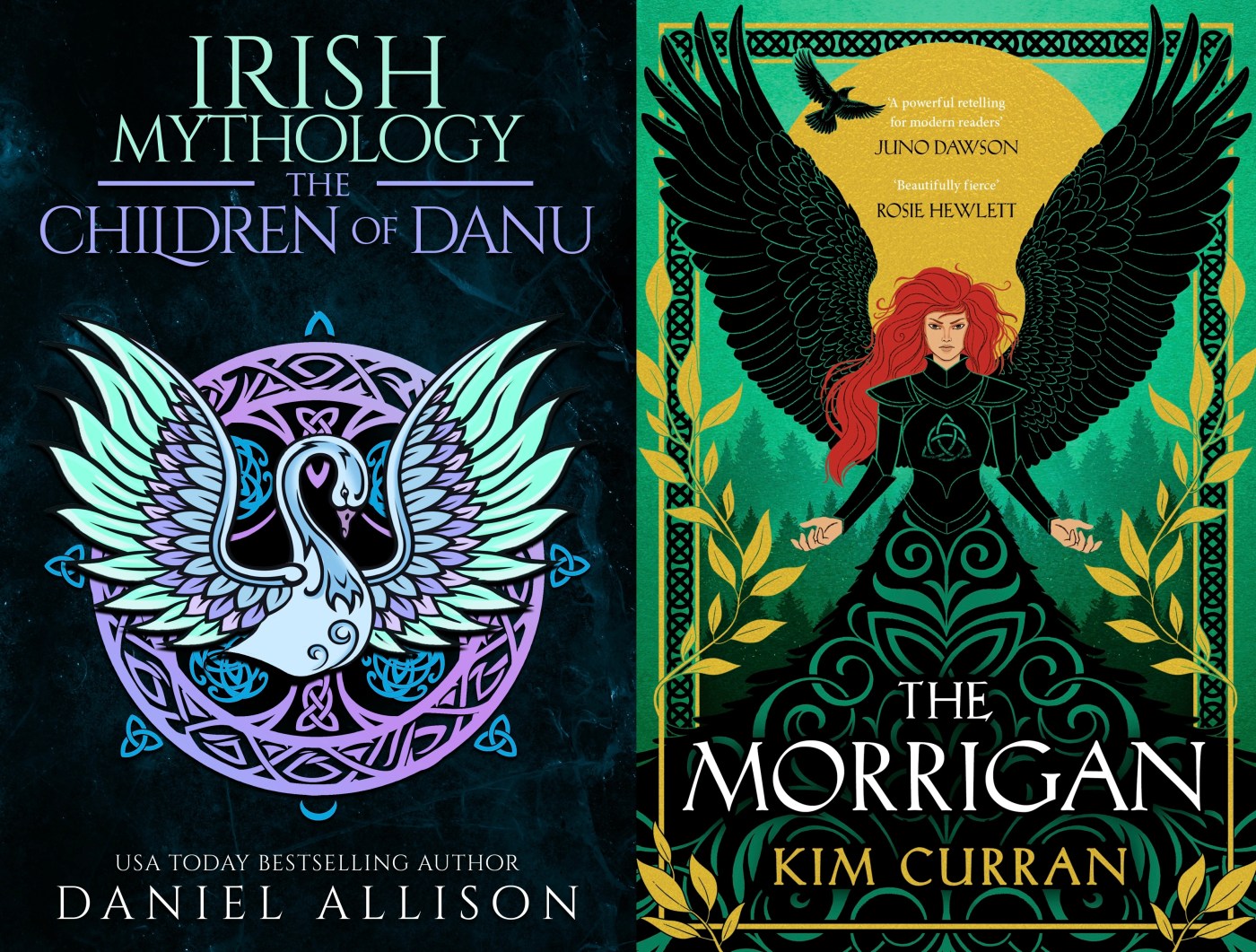
The witch is back! I know it’s been a long time since I last wrote one of these – I ended up taking a long break from Craft studies for a few months, after going so hard at it for much of 2024. But now I am back, and this time, I’m reading something a little different: the stories of Irish mythology.
I found both these books somewhat unexpectedly while browsing Witchsky sometime in March, and utterly devoured them both. They are both retellings of the ancient Irish myths, but they take slightly different approaches on exactly how they get there. While not a replacement for reading the true original stories, they are at least a useful stepping stone, since these are books meant for the readers of today.
We’ll start with Daniel Allison’s The Children of Danu, published in 2023. By his own admission, Allison is Scottish, not Irish, but he took great care in listening to the tales told by those who know them best. He stays true to the intent behind the original myths, while doing his best to root out any Christian imagery inserted into the original stories, presenting us with a picture of what ancient Ireland was really like, in the time of the Tuatha De Danann.
I read this book first, and I’m very glad I did. While the Morrígan doesn’t appear very often in the stories featured here, when she does show up, Allison writes her as the exceptionally powerful magical powerhouse that she is. In the second chapter, which serves as a prelude to the first battle of Moytura, she’s described as turning the skies of Ireland red with blood, in order to frighten the Fir Bolgs, whom the Tuatha are due to fight.
The battle itself is richly told, focusing on all the different spheres of combat, and all of the gods get a moment or two to shine. Of particular focus is Bres, the half-Fomorian who, after distinguishing himself in the fighting, is made the new king of the Tuatha, since Nuada had lost his arm and was thus unable to continue ruling.
Bres serves as the antagonist for much of the first two thirds of the book, serving first as a horrible, oppressive king who forces gods like the Dagda to work as servants in his court. He’s eventually deposed and flees to the safety of the Fomorians, (portrayed here as reptilian creatures not unlike the Silurians of Doctor Who fame) where he leads them into the second battle of Moytura.
The account of that second battle is the last one in the period where the Tuatha De ruled Ireland – they win, but but at great cost: the Dagda, Nuatha, and Ogma are all slaughtered before Lugh can slay Balor with his spear. The Morrígan’s last appearance is at the very end of that chapter, when she predicts peace and prosperity to come.
The final third of the book is something like an extended epilogue: the Gaels come to Ireland and displace the Tuatha De, driving them underground and, it is implied, to be gradually forgotten and turned into the Fae of today. The final story of the book, “The Children of Lir,” is a tragedy – it tells the story of three children cursed into being swans. In time they meet a Christian priest, and though their faiths are radically different from one another, they become friends.
Finola, the eldest of them, asks to be baptized, suggesting that she doesn’t think Danu (the mother of all the Tuatha De) would mind if they were. The priest, Malachi, consents, and the book ends with the swans passing on into the afterlife… though which one they went to is entirely up to the reader’s imagination.
As sometimes happens with books, The Children of Danu grabbed me and would not let me go until I’d finished it, and it was a marvelous read. I read it first, since I wanted to have a better understanding of the myths, and the people the Morrígan comes from before I tackled Kim Curran’s book about her.
The Morrigan is a very different book. While The Children of Danu aimed to retell the stories of the Irish Mythological Cycle in a more accessible way, The Morrigan is exactly what it sounds like – an account of the Great Queen’s life, beginning with her birth and arrival in Ireland, and ending with the death of Cú Chulainn.
The best way to look at this book, since it’s told over a period of several hundred years, is in terms of arcs. Her early life during the rule of the Tuatha De takes up about a third of the book, and the descriptions of some battles differ from what was in Children of Danu. Bres, for example, dies in this book, while in Children, Lugh spares his life.
One of the most heart-rending sections of the book is the arc in which the Morrígan gives birth to a child, Méche. Though she loves him dearly, none of the other Tuatha do, and he is eventually slaughtered by Dian Cecht, the healer. This proves to be the Morrigan’s break with her fellow Tuatha, and while the rest of them go on to Tír na nÓg, the Land of the Young, she chooses to stay behind.
This gets at a recurring theme that runs through the entire book: This isn’t just a retelling of the life and adventures of the Great Queen, but a retelling through the lens of feminism, and what it means to be a woman in a paternalistic society. Even within the Tuatha she is sidelined and marginalized, all for the “crime” of wanting more for herself.
The Tuatha lurk in the background for the rest of the book, with Lugh and the Dagda popping up every now and then to check on her. Meanwhile, the Morrígan has various adventures in trying to understand what it’s like to be a mortal woman – she allows herself to reincarnate in a human body and becomes Queen Macha.
Later still she becomes the wife of an ordinary mortal man, and is forced to race against a local king’s horses, which kills her earthly body. She curses the men of Ulster in revenge, setting the stage for the final arc of the book: her trials with Cú Chulainn, the great hero of Ireland. (But to hear her tell it, he’s kind of a shithead.)
The Morrígan doesn’t die, of course. She’s with us still, collecting followers and giving the marginalized a bit of her unquenchable fire, helping us to reclaim our sovereignty. Knowing her, and being one of her ravens, has changed me, and in reading this book I feel I know her better than I ever have before.
The Morrígan is not just a goddess of battle, war, and prophecy. She is a goddess of sovereignty, and that above all is what runs through this book. She can see the pain and suffering we today are living through at the hands of men, and just as she does with Medb, or the warriors of the Tuatha in the second battle of Moytura, she demands that we stand, and fight for ourselves. To reclaim our sovereignty.
She can see what a corruptive influence shame has on us. To take the wrongs committed against us by men, and make them our responsibility. She challenges us to say no, to dare to change fear into bravery. And in the world we live in now, as virulently anti-woman as it’s possible to be, we need the Great Queen’s spirit more than ever.
This is a book of rebellion. The fire of anger, when used right, can move mountains. And in this book, I found hope.
Who can ask for a better legacy than that?


Leave a Reply