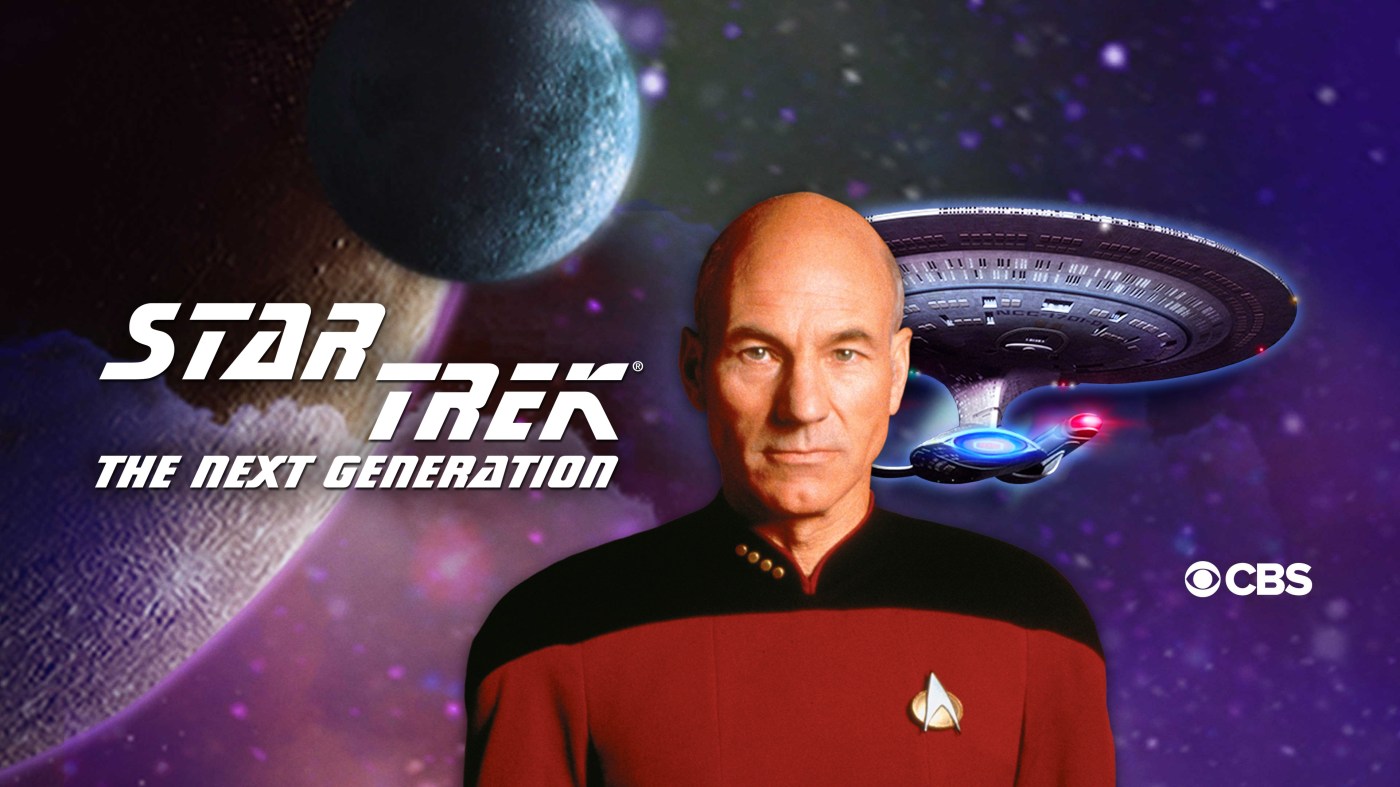
Captain’s log, stardate 80311.1: The Enterprise crew welcomes an Antedian delegation to a peace summit and Troi’s mother, now in a phase of increased sexual activity, has come to the Enterprise to visit Picard, which meets with disapproval from Counselor Troi and amusement from Riker.
The Enterprise becomes the temporary home of a special emissary who has been sent to deal with an emergency – a crew of 23rd century Klingons in suspended animation is about to be awakened to wage war against the former enemies of the Klingons – the Federation.
While I generally try to consider a given episode on its own merits, sometimes I can’t, and so I am obliged, rather than attempt to get a thousand words out of something that really does feel like the kind of “filler” episode everyone yelled at Alex Kurtzman for dismissing, I can at least talk about two episodes at once and see if I can find anything in common.
Fortunately, TNG makes this very easy. Season 1’s post on “Symbiosis” and “Skin of Evil” allowed me to spend some time memorializing Tasha and complaining, at great length, about the rampant sexism inherent in Star Trek and Gene Roddenberry’s stewardship of TNG in particular. And it’s that second theme that I want to focus on today.
Let me begin by saying that I have no particular love for Gene Roddenberry. I respect him, certainly: Star Trek would literally not exist without him coming up with the idea, and the goals of the original series, presenting positive representation of various minority groups at a time when such depictions were very rare indeed, pointed the way to the greater focus on representation that we saw on TV during the 2010s.
His creation of TNG, bringing Star Trek back to life and forcing it to comment on and survive for itself at the very beginning of the conservative counter-revolution, showed that not only did Star Trek have staying power, you could change all the characters and still come up with an optimistic, forward-thinking show that in many respects is actually superior to the original series.
But I also believe that much of Star Trek’s success, then and now, was also largely despite Gene Roddenberry rather than because of him. He may have created the character of Captain Jean-Luc Picard, but it was Patrick Stewart who molded him into becoming a man who, going by Stewart’s testimony in his announcement of his return to Trek in 2018, literally saved the lives of some people in the audience.
Roddenberry himself, as I’ve noted before, was a spectacularly sexist piece of shit. Yes he gave the world Nyota Uhura, a character solely responsible for bringing Whoopi Goldberg into the Trek fold 20 years later, but she was also the glorified secretary. (At least until the movies.)
Then there’s TNG itself. Last season you had Tasha Yar and Roddenberry’s absolute refusal to allow the writing staff to do any story on her other than the one she dies in, and in this season you have shit like “The Child,” where a discussion on what Troi should do with the magic baby in her womb is carried out by her MALE colleagues in the senior staff. Because you know, having men make decisions about women’s bodies has never led to utter disaster.
Which brings us, at last, to this week’s pair of episodes: for my money, the nadir of TNG and its treatment of women during the Roddenberry era of the show. Both “Manhunt” and “The Emissary” (not to be confused with DS9’s premiere) feature Strong Female Characters, Lwaxana and K’Ehleyr, showing up to throw TNG’s two big Manly Man characters, Picard and Worf, off their game. And both of them suck, because both Lwaxana and K’Ehleyr are written completely one-dimensionally.
It’s possible for male writers to write good female characters – I am a ride-or-die Violet Baudelaire fan, for example, since she’s a woman in STEM and doesn’t let someone like Mr. Poe, who has a more “traditional” view on female behavior, slow her down in any way whatsoever, and Daniel Handler wrote her marvelously.
But you also have to take the time and really try to write characters like Violet, and while I accept that writing a character in a novel is a very different thing from writing a character in a TV series, that’s also not an excuse. Roddenberry’s views on sex and gender did not age well, and IMO, by and large TNG is much better with its female characters after he’s sidelined than with him around.
That said, Troi remains a big exception, and it’s telling that most of the episodes where Marina Sirtis gets more to do are the ones where she isn’t playing Troi, but a different character entirely. I get that writing characters like Troi is hard – Star Trek is just not built for something like a ship’s counselor, and goddess knows I ran into a lot of problems trying to make Sunset Shimmer, Troi’s equivalent in New Endeavours, work.
But that’s the thing: even when you screw up, you still have to try. And a lot of the time, TNG’s writers don’t.
Which is frustrating. It’s not that TNG itself is a bad show – it’s a very good one most of the time, but it’s hampered somewhat by being part of the extremely masculine world of Star Trek. Women just do not get a lot of love in this franchise – sure, we had our first female captain in Kathryn Janeway, but she was written incredibly inconsistently from episode to episode, and when we got to Michael Burnham, you had large segments of the fanbase attacking her for being “overly emotional” and other such nonsense.
What I want, someday, is a Star Trek show that purposefully inverts the gender dynamic. Instead of having, say, a main cast that consists of five men and two women, or three in season 1’s trifecta of Crusher, Yar, and Troi, give us a show with a majority female cast, while the guys take up the roles of ship’s counselor and chief medical officer. Like, imagine an alternate version of TNG where most of the main cast are women. Judi Dench as Captain Jeanette Picard, or something like that. It can be done, it’s just that it hasn’t been. Ever.
And I wonder, why is that? Is it just down to the built-in sexism of the society we live in? And if so, that’s all the more reason to do it rather than less. Star Trek is nearly sixty years old now, and isn’t it still supposed to be about charting a path forward? Imagining a world where we’ve moved on from the considerable number of social ills currently plaguing us?
I mean, look at the current political situation in the US. The second Trump administration is extremely misogynistic, but it’s of a piece with an America that has already decided that women don’t have the right to an abortion, and may soon decide that we don’t have the right to vote either. If America circa 2025 is intent upon dragging us backwards to 1825, then in my opinion, it’s imperative that Star Trek go in the opposite direction and put women first.
We are people too. And don’t you forget it.


Leave a Reply