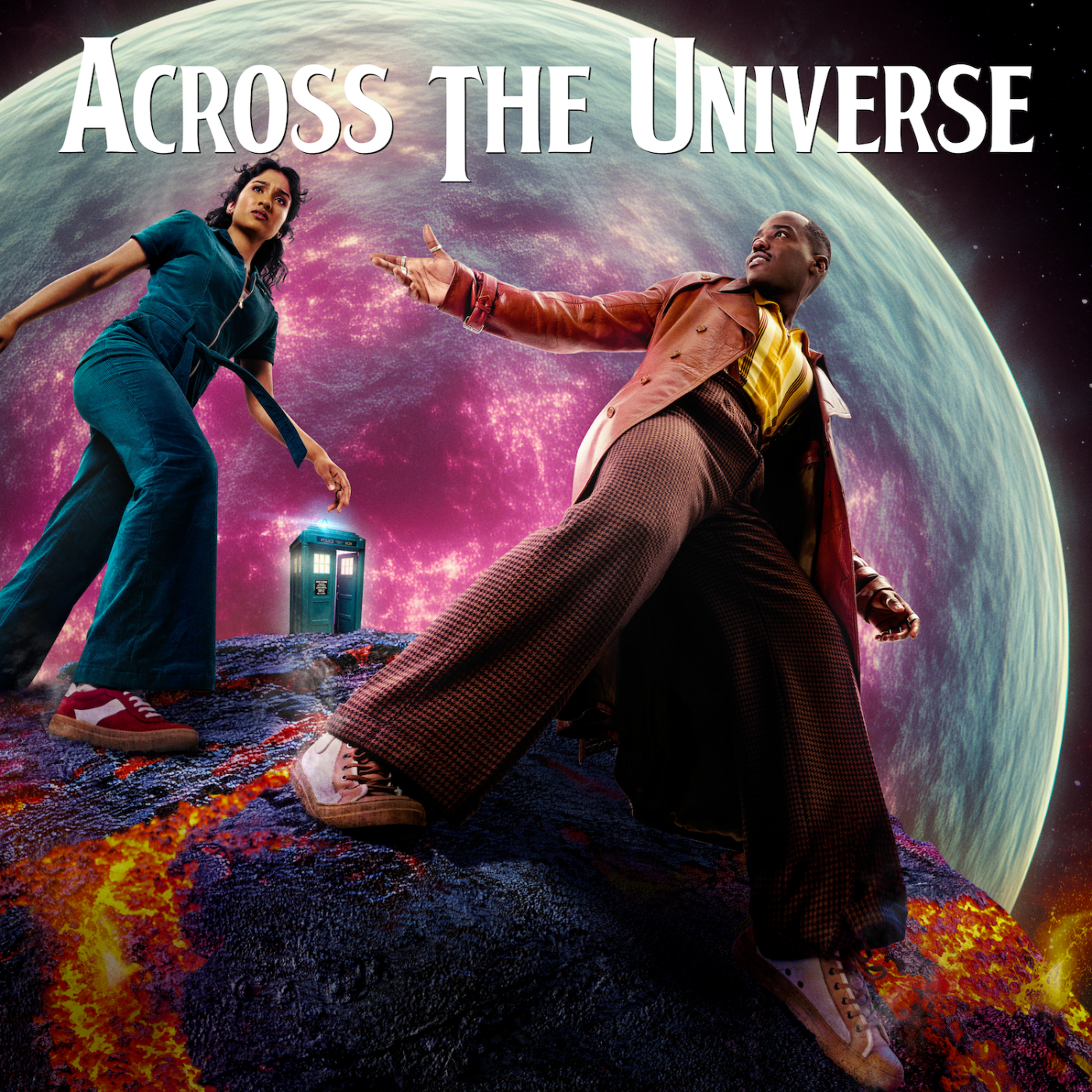
1968’s Yellow Submarine was not the first Beatles-related cartoon in existence, but it is the one most people have seen, since Apple Corps likes to pretend the mid-1960s series from ABC doesn’t exist. It is a film in which the Beatles (voiced by other actors this time) find themselves undertaking a journey to a place called Pepperland.
At the start of the movie, Pepperland is menaced by creatures called the Blue Meanies – music hating individuals who freeze all of Pepperland’s musicians into silent stone. A motive not unlike that of Maestro’s, now that I think about it. Old Fred runs off to the town’s sacred Yellow Submarine and flies it to Liverpool, looking for the first quartet of musicians he can find. (No prizes for guessing who he meets there.)
It’s very appropriate, then, that Lux should refer back to last season’s The Devil’s Chord, since both episodes feature a god of the Pantheon returning to menace the Doctor and his companion during an adventure set in the mid-20th century, and both episodes play with the fourth wall in ways not seen since… well, The Giggle.
But what does any of this have to do with the Beatles? I’m glad you asked. “All Together Now” is the last song featured in Yellow Submarine, and is the only scene in the whole film to contain actual Beatles. They speak directly to the viewer, and there’s a giddy cheekiness to the way they introduce themselves, calling back to the rest of the movie and even interacting with the medium in a way that one can only do when you shatter the Fourth Wall to pieces.
Even in the universe of the show, the Beatles have totemic power – it was John and Paul who actually defeated Maestro, the Doctor was otherwise engaged. And so, this week, it makes complete sense that the Doctor should call upon that magic in order to defeat Lux, a blue meanie in every sense of the word. (And just like the ones from Yellow Submarine, he even gets redeemed at the end.)
At the mid-point of the episode, he breaks through into what is supposed to be our world, and goes even further than the Beatles did, interacting and talking to his own fans. And that conversation is what paves the way to the final defeat of Lux at the end. (Some people will probably bitch and moan about how the fans are written in this episode, but they’ve been doing that since Love & Monsters. Self-reflection is not their strong suit.)
Which brings me to my next point: this is an extremely magickal episode. That’s Crowley’s spelling of the word, referring to forms of magic that are more ceremonial in nature, such as what his own Thelemites do, or what Wiccans like me do. The lighting of candles, casting of circles, arranging of various herbs and crystals, calling upon the forces of nature in order to achieve our set intention… these are the forces Davies taps into in writing this story, and that affects the narrative in very surprising ways.
Let’s start with the cold open. Lux shows up when moonlight shines down on Mr. Pye’s teaspoon, and that bounces off the metal of the spoon and into the film projector, imbuing Mr. Ring with form and sentience. Those of you who read my Kill the Moon post can probably see where I’m going with this – time to call in my gods.
In witchcraft, we are able to tap into the creative energies the universe. If I place a jar of water on a windowsill and ask for the Goddess (aka the moon) to bless it, She imbues the jar of water with lunar energy. And that’s powerful stuff – coffee made with moon water, according to my fiancee, is like drinking electricity. Lux is tapping into that same power source, only he’s using it for evil.
This begs the question: who is Lux? Is he really Mr. Ring A Ling, or was Mr. Ring A Ling’s image merely a shape he happened to be borrowing in order to interact with the mortal world? Personally, I’m leaning toward the second one. Lux could’ve looked like anyone, it just became Mr. Ring A Ling because he happened to be onscreen at the time.
There is actual solid theological evidence for this. See, the gods can’t incarnate, but they can briefly possess the bodies of mortals in order to speak directly with their devotees. This is done by having the oracle go into a trance, and touch the border between the material and spiritual worlds. This allows the god to step into the body of the person, and speak through them. Iron Age cults who worshipped the Morrígan did this before Ireland was Christianized, and modern pagans have continued that tradition into today.
The thing is though, mortal bodies have limits. We age, we die, we fall apart. If interacting directly with the mortals is what a god wants to do, a fictional character actually makes more sense to possess than a mortal does, because fictional characters are inherently limitless. They can’t age or die unless we, the people, make them, and even then, they can always come back. They don’t have the same limitations we do.
It’s a shame, then, that the gods of the Pantheon are universally depicted as being evil.
Now, admittedly, some of this is RTD just doing what he did all the time in his first era – we all remember how the Doctor was framed as the Lonely God for much of the Tennant years. He was effectively divine, and the show stated over and over again that to approximate him in any way, and approach godliness, was to risk crossing into monstrousness. Just look what happened to Rose in Doomsday, or to Donna in Journey’s End.
And to be fair, that last one got fixed in RTD’s very first episode back in charge, suggesting that his views on divinity and morality have evolved somewhat since the late 2000s… and then we get to The Giggle and its retconning of the Toymaker into being of the same pantheon that produced the Trickster from The Sarah Jane Adventures.
I don’t have a problem with them being identified as gods per se – they’re not based on any real pantheon after all, and if you’re going to talk about cosmic entities who are indescribably strong, “god” is pretty much the only place to go, because everyone knows what a god is. Even Star Trek does it with the Prophets of Bajor. And anyway, this is a kid’s show with villains in, and the villains have to come from somewhere.
But speaking as a devout polytheist, having the gods be evil kind of rankles me a bit, theologically speaking. My hope is that, one of these days, we can meet a god of the Pantheon who does the laugh and the Harbinger bit… and then it turns out the god is actually perfectly nice and not baneful in the least.
The god of light is actually a useful step forward in that regard, since he’s “defeated” when, after being given a physical body via the Doctor’s regeneration energy, he is exposed to sunlight and is not only returned to cartoon form, but he seems to be purified, becoming simply part of the creative energies of the universe, with no malice in it whatsoever.
I have to admit, I like this resolution. It goes back to what I said earlier regarding the moon, because it calls to mind (at least for me) the Goddess and the God, the two primary deities of Wicca. As Scott Cunningham writes in The Standing Stones Book of Shadows:
Before time was, there was The One; The One was all, and all was The One. And the vast expanse known as the universe was The One, all wise, all-pervading, all-powerful, eternally changing.
And space moved. The One molded energy into twin forms, equal but opposite, fashioning the Goddess and God from The One and of The One.
The Goddess and God stretched and gave thanks to The One, but darkness surrounded them. They were alone, solitary save for The One.
So they formed energy into gases and gases into suns and planets and moons; they sprinkled the universe with whirling globes and so all was given shape by the hands of the Goddess and God.
Light arose and the sky was illuminated by a billion suns. And the Goddess and God, satisfied by their works, rejoiced and loved, and were one.
From their union sprang the seeds of all life, and of the human race, so that we might achieve incarnation upon the earth.
The Goddess chose the moon as her symbol, and the God the sun as his symbol, to remind the inhabitants of earth of their fashioners.
All are born, live, die, and are reborn beneath the sun and moon; all things come to pass there under, and all occurs with the blessings of The One, as has been the way of existence before time was.
Once again, Davies taps into those same creative energies in returning Lux to the cosmos from which he came. Light itself isn’t inherently evil, it just exists, and the sun and moon are both focal points that witches use in our magic. We can create not just moon water, but sun water as well.
But I also like this resolution because, as pagan blogger John Beckett notes, we’re living in an era of high magic. Various forms of neopaganism are becoming increasingly accepted in our world, and it is now the easiest it has ever been to explore those older forms of religious belief. Monotheists, after all, do not own the copyright on religion. And it’s wonderful to have an episode of Doctor Who that, in a roundabout way, evokes pagan beliefs.
More of this please, Russell!


Leave a Reply