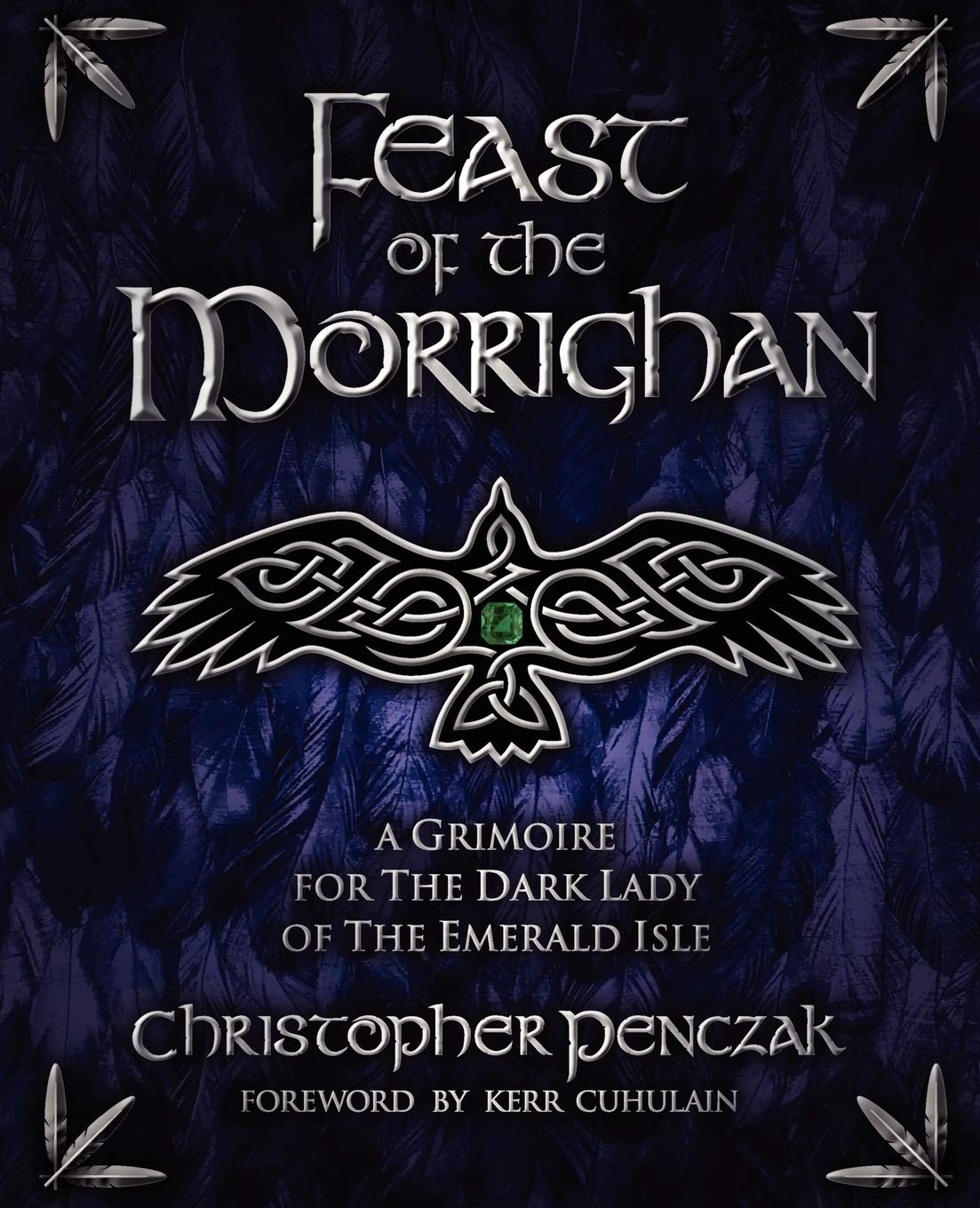
With this book we reach the end of my available list of books surrounding the Great Queen, though that is by no means the end of my studies of her. She’s made clear to me in recent days that I am hers, no matter what, and I take that dedication very seriously. With that in mind, this final book is an important step on the journey, since it is rooted not only in neopaganism, but in the specific teachings of Wicca and the various forms of witchcraft it helped spawn.
This is actually pretty huge, since this is the first time I’ve read a Morrigan book written from a Wiccan-adjacent perspective. While all the previous books we’ve looked at have each tried to place the Morrigan in her original context as a goddess of ancient Ireland, Penczak widens the view considerably, in the grand tradition of syncretism that Wicca came out of.
I’ve been feeling for a while that the Great Queen has wanted me to read these books, in the specific order that I’ve done so: I began with Morgan Daimler’s Meeting the Great Queens and Raven Goddess, then Morpheus Ravenna’s The Book of the Great Queen. Those three books, paired with the six we’ve been looking at, all add up to nine – three times three. A sacred number for the Morrigan, which does not seem coincidental. For crying out loud, this book has nine chapters in it. She knows what she’s doing.
Like any good book on our favorite goddess, Penczak establishes things by discussing the Morrigan in the context of her native culture, including various vision rituals along the way in order to help establish a relationship. (They won’t help me much because I’m crap at visualizing, but they might help you!)
Where Penczak’s approach differs from the others we’ve looked at is how he discusses not just Irish culture, but Welsh mythology as well. Courtney Weber largely left the Morgan Le Fe question to the side in her book, and understandably so – Irish and Welsh culture are not the same, but there are still some links, perhaps from the Indo-European sources that the Celts came out of.
So, Penczak goes all in on Welsh lore and mythology, in a move that would probably send Lora O’Brien through the roof. He never equates that Morgan Le Fey is the Morrigan, but by pointing out that as regards his own religious practice, the sometimes-adversarial figure of Arthurian legend isn’t as far apart from the Morrigan as we might think. Comparisons are drawn, for example, between the Irish belief in kingship as a divine contract between the royal and the gods, with Morgan Le Fey’s role in the death of King Arthur, and his passage to Avalon – what we Irish witches would call the Otherworld.
One surprising guest appearance comes at the start of chapter 8. He writes, “In my own personal gnosis and understanding of the Goddess as the creative force and body of the universe, portrayed in the wide variety of Celtic myths inspiring Neopagans today, I find a connection between the Morrighan and Morgan Le Fey, not just in name, but in my own visions. The connecting link, strangely, is through the figure of Ceridwen. The one thing they all have in common is that these figures are all Ladies of the Isle, if not all Ladies of the Lake.”
Until I read this book, it had literally never occurred to me to find any sort of connection between the Morrigan and Cerridwen, beyond the fact that I worship and honor both of them. But when I think about it, the connection makes sense. While Cerridwen only has the one story to her name, it’s still an important one – like the Morrigan she’s a shapeshifter, and a bit tempestuous at times, but she’s still a mother goddess, just like the Morrigan. (As in a goddess who has had children, not in the modern neopagan sense where she’s used to represent the moon.)
And both of them, each in their own ways, had a role in welcoming me to witchcraft and helping me begin my journey in my new faith. Cerridwen was the first goddess I introduced myself to, and she appeared to me briefly via Sophie to reassure me, and claim me as her daughter, just days before my formal initiation ritual. It was a deeply powerful experience, and one I still hold close in my heart.
But the Cerridwen connection is evident in another way as well. Here I am now, nearly a year after I became a witch, and she’s appeared in a book about another of my goddesses, as if to remind me of how far I’ve come… and to let me know that whatever happens, she’ll never leave me. And if I’m honest with myself, it’s a reminder I needed.
I wouldn’t say I’ve been having a crisis of faith since reading Irish Witchcraft – my connection to my gods and to my faith has never felt stronger. But the blatant and vehement disgust with which O’Brien holds us Wiccans was still deeply disquieting to me. To hear her tell it, we’re all a bunch of cultural appropriators.
But that’s not how I’ve seen it, at least in relation to Celtic witchcraft. As Penczak writes in the introduction, “It is said that the Celtic Gods, beyond all other pantheons, choose their own. […] While the Celtic gods will hear and sometimes even answer for a time, they will choose you as their own only if they recognize you. You can’t always choose them. You need to be called. And from the past experiences that have led me here, I have to agree.”
And honestly, so would I. I’ve felt a connection to the Celtic pantheon that simply doesn’t exist for the gods of other pantheons, like the Egyptian one or the Greek and Roman ones. Being of Irish descent is only half the story – there’s more to that connection than I know. When I was born, the gods claimed me as theirs, and it took until the year I turned 30 (yet another recurrence of the power of three) for me to find them.
My practice, syncretic though it is, is still valid. And that, more than anything else, I think is the thing the Morrigan wants me to know: she doesn’t much care where I come from, it’s who I am that’s important, to paraphrase something Cerridwen told me. As the Great Queen herself has said, “Always a blessing. Forever mine.”
Penczak’s book isn’t just another Morrigan book, but a celebration of religious syncretism as filtered through a goddess who has worn many different faces in the course of her existence. It’s a book that says to those of us who aren’t reconstructionists, “You are valid and your beliefs matter.”
The gods call whom they call, no matter their background. And I can’t think of a better sentiment to wrap things up on than that.


Leave a Reply