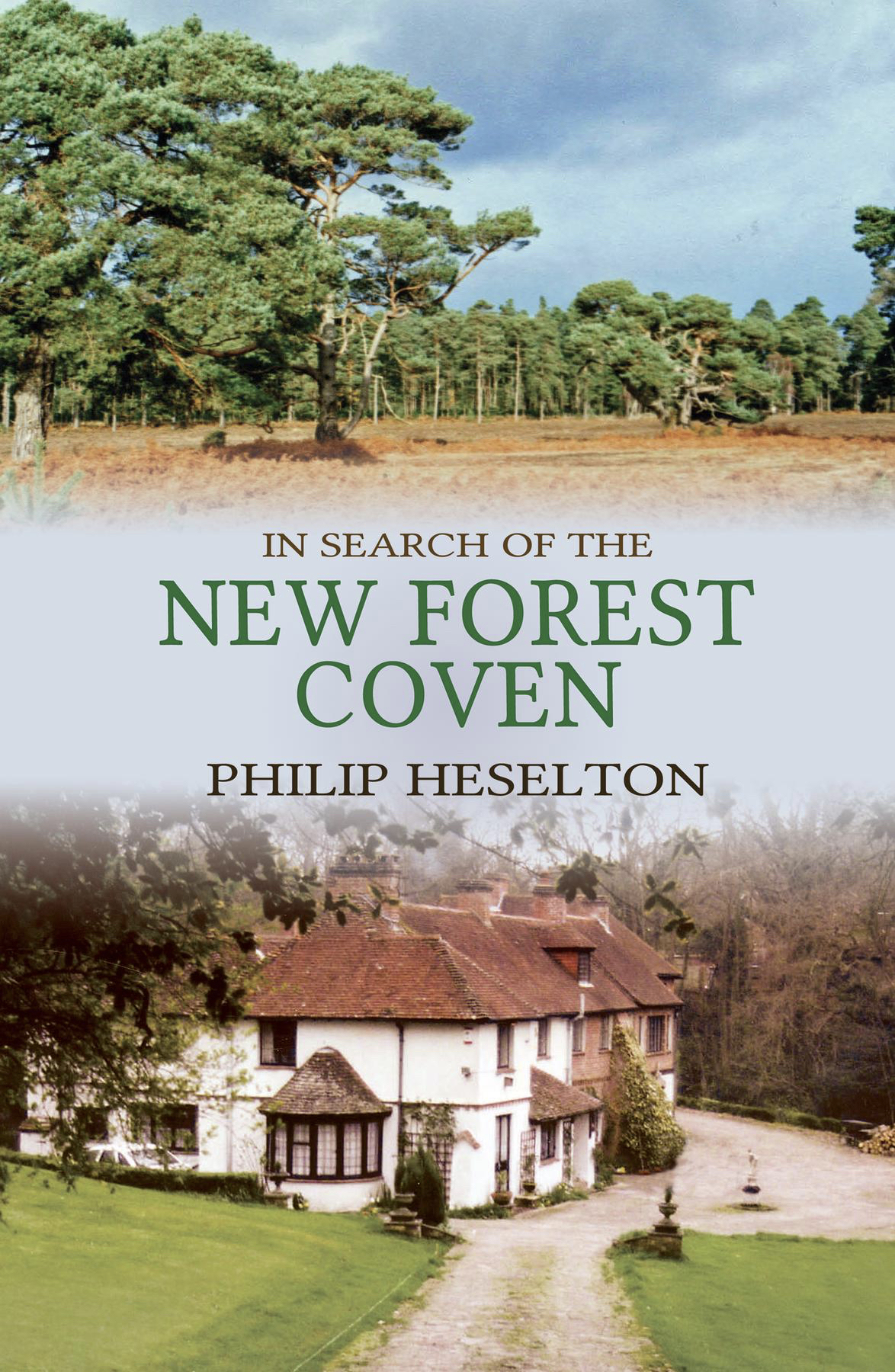
Our dive into the early years of Wicca continues this week with another book by Philip Heselton: In Search of the New Forest Coven. While we all know about Gardner’s initiation into the Craft and how this group was responsible for it, not much is known about the group itself, and Heselton’s aim is to correct this.
The NFC made something of a relatively brief appearance in Witchfather, appearing only when Gerald Gardner had moved to the Highcliffe region of Britain, where that group was based.
In Witchfather, Heselton names who he thinks was likely a member of the NFC, with quick biographical sketches of each person, in order to provide context for the initiation itself: “The individuals concerned were likely to have been Rosamund and George Sabine; Catherine Chalk; Dorothy Fordham; Katherine Oldmeadow; Edith Woodford-Grimes; Ernie, Susie and Rosetta Mason; and possibly other characters like Elsie Begg and Irene Lyon-Clark.”
In this book, Heselton has far more space to devote to the coven specifically, prior to Gardner’s initiation. All of the people listed above get at least a chapter of their own, during which Heselton names not only their ancestors, but shares what information he has on their lives prior to the Craft. Edith Woodford-Grimes, for instance, used to work as a lady’s maid before she moved south to Highcliffe.
My favorite section of the book relates to Katherine Oldmeadow. She was a children’s book author, and though she may not have been what we would classify as pagan herself, pagan themes cropped up all the time in her books. Characters go out dressed as Pan, initiation rituals into secret clubs are performed, and there’s discussions of tools used for scrying, like crystal balls and darkened mirrors, in such a way that one suspects Oldmeadow was slipping in her magical knowledge via fiction, in the same way Gardner did in his novel High Magic’s Aid.
Just check out this bit, from a book called Princess Charming:
“It’s lucky we had classical dancing this term”, said Nancy, “it will be jolly to have the nymphs barefoot, and those green Greek dresses will just do”. … “We must have twelve nymphs,” said Barbara.
… in the middle of the door there swung an old copper knocker – the head of Pan, the woodland god, holding a round copper ring between his grinning lips.
“Let us have Greek statuary in the woods. There won’t be a thing to learn, and we’ll only have to get the dresses and practise the posing.” … “I thought we would make a little setting for the most well-known Grecian deities in the gardens and woods.”
“I’ll be Pan,” announced Jill with determination. “I don’t care if he is a boy. I simply love him, and I’m like him, too, because I adore wandering over mountains and rocks and woods and having people dance round me and teasing them.” … There in a little fern-grove, on the grassy knoll before a tall beech-tree, sat Jill, or rather Pan, for her small mischievous face against the background of greenery, her dark silky hair wreathed with leaves, and her expression of almost fiendish merriment was the very Pan of one’s imagination. She was half-draped in a goat-skin, and in her brown, slender fingers she held a flute of reeds.”
Incredible, isn’t it? In today’s world we’d probably think Oldmeadow was pagan, though to my great surprise she wasn’t! Heselton quotes an interview with someone named Gurth Brooke, who says that she actually belonged to the Church of England before converting to Catholicism. Brooke says, “I don’t know whether there was some pressure or incentive, but Kit was such a very individual character, with her own beliefs and outlooks, and perhaps she didn’t find that Roman Catholicism was a very comfortable frame for her point of view. It didn’t allow enough, shall we say, mental freedom.”
Speaking as an ex-Catholic myself, I know exactly what he means. My mother’s family was strongly Irish Catholic, and at the church I went to in my early years, there was One Way To Do Everything. You went to church on Sundays, you said certain prayers at certain times, if you sinned you went to confession, and you looked at the Bible a certain way. Catholics, like witches, are big on ritual… but don’t tell the Catholics that!
Moving along, another interesting tidbit I learned from this book came in the last chapter. Heselton believes that there may have been a sexual component to Gardner’s imitation ritual, based on something Gardner wrote in Witchcraft Today: “It was, I think, the most wonderful night of my life. In true witch fashion we had a dance afterwards, and kept it up until dawn.”
In Heselton’s telling, it was Edith (aka Dafo) who led the group ritual in early September 1939. The group then adjourned, allowing Edith and Gerald to “dance” until morning. And “dance,” of course, does not mean gyrating to music. Heselton believes that Gardner was using the word “dance” in the exact same way Steven Moffat used the word in the 2005 Doctor Who episode “The Doctor Dances” – as a euphemism for sex.
One thing that Heselton stresses, both at the beginning and end of the book, is that this group was not a formal coven in the way we understand the term now. These were people who simply shared a few common esoteric interests, with witchcraft being only one of them. He writes, “It is a matter of what we might call ‘continuous evolution’ where all of the participants contributed something towards the whole, according to their particular knowledge, background, skills and insights.”
Heselton also stipulates that for most of the NFC, witchcraft was an activity, not a religion: “Most of them remained Christian all their lives, or at any rate put things in such wider context as the Theosophical Society promulgated. Witchcraft was merely one thread in the rich tapestry of occult and esoteric endeavour, though for Gardner, and I think for some of the others, it later became more.”
And as we know from Witchfather, it wasn’t until the mid-late 1950s, through Gerald Gardner’s sheer determination and the explosion of people who came to him seeking invitation following the release of Witchcraft Today, that “the witch cult” grew and eventually became Wicca.
What, then, can we make of this informal coven of quasi-witches? I think it’d be fair enough to say that they are just as responsible for helping to bring the Craft to life as Gardner himself is. Heselton uses the metaphor of a cauldron, with each person gradually adding more insights and skills until, like a potion brewing to completion, Gardner had something he could base a religion off of.
The members of the NFC (with the exception of Gardner) may not have ever been Wiccan themselves, but much like Margaret Murray, the Craft as we know it today would not exist without them, and for that, they have my everlasting thanks.


Leave a Reply