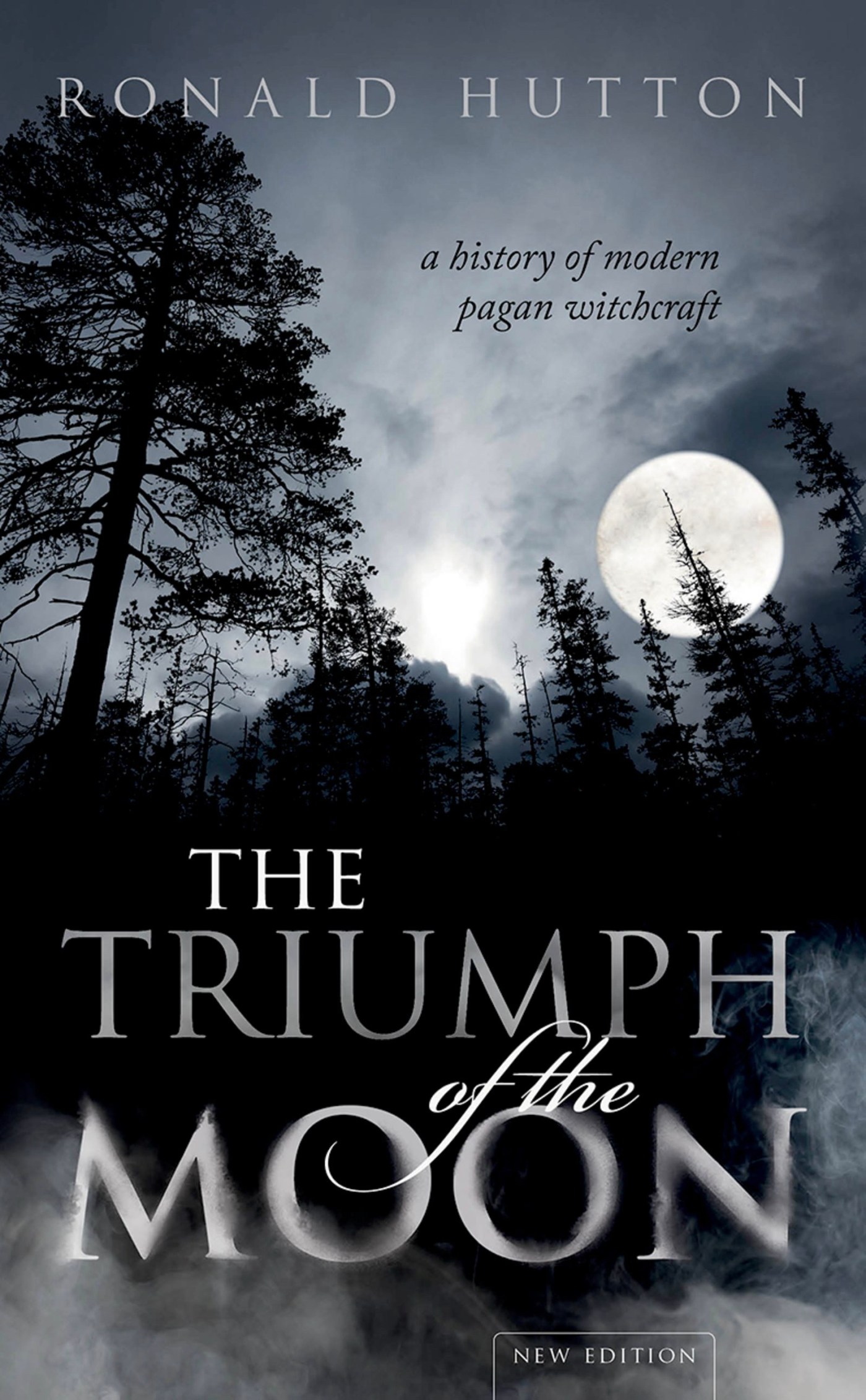
More history, witches! Having explored the very early years of Wicca vis a vis the lives of Gerald Gardner and the New Forest Coven, I think it makes sense now for us to widen the field a bit and examine the history of the Craft both before Gardner’s time, and after it. Here to assist in that endeavour is Ronald Hutton, with his book The Triumph of the Moon. I’ve heard very good things about this book, and from what I understand, it does for the British Craft what Drawing Down the Moon did for American Craft. So, let’s get right into it.
Triumph is not exactly an easy beach read, if you catch my drift – the hardback version I checked out from the library last year, roughly, was about the size of any of the last four Harry Potter novels. For the sake of my own sanity I decided to read the ebook version this year, both for easier reference and because digital files weigh nothing.
The book is structured into two parts. The first half, “Macrocosm,” explores assorted aspects of the Craft and traces their development over time, as they relate to British history. The chapters “Finding a Goddess” and “Finding a God” deal with specific deity obsessions that various Romantic writers had, and how those obsessions mutated and shifted into the development of the Mother/Triple Goddess and Horned God archetypes.
Interestingly, “Finding A Structure” reveals that much of how Wiccan rituals work were derived from Masonic traditions as much as ceremonial magic. It’s from the Masons that we got the phrase “So mote it be!”
And in the penultimate chapter of that section, “Matrix,” we learn that quite a few authors (like WB Yeats and DH Lawrence) were ready for a pagan revival. As Hutton tells it:
“Most wanted such a revival to act as a supplement to Christianity or even to refresh the latter. On the other hand, there were some, like Dion Byngham, who wanted paganism to be restored in its own right. It was out of this second impulse that modern pagan witchcraft was to arise.”
And lo! As if it had all been planned out by the Goddess herself, that’s exactly what happened next. The stories of Crowley, Dion Fortune, and Robert Graves all lead up to Margaret Murray and the publication of The Witch Cult in Western Europe. That book, especially when it came out in paperback, proved to be a big hit, clearing the way for the next section, and the arrival of Gerald Gardner.
The Gardner chapter will be quite familiar to anyone who’s read Witchfather – a quick overview of his life prior to the Craft, a long section where he debunks the rumor that Dorothy Clutterbuck initiated Gardner into the NFC (which, of course, Heselton took care of as well) before stipulating that it must’ve been Edith Woodford-Grimes, aka Dafo.
There’s another section discussing Gardner’s brief intersection with Crowley, and of course, a very deep dive into Gardner’s Book of Shadows, and I must admit, it’s a better one than the brief glance I gave it a couple of weeks ago. Near the end of the chapter, Hutton breaks down exactly what was so radical about Gardner’s work:
“By uniting paganism with the figure of the witch, in the Leland and Murray tradition, it automatically pre-empted any easy reconciliation of the result with Christianity or with conventional social mores; it was full-blown counter-cultural religion of the sort after which people such as Dion Byngham had hankered. This was supercharged by the fact that it paid no reverence to any Great Spirit, Prime Mover, or World Soul, who might be equated with Jehovah, but to the nature-goddess and the horned god who had arisen in the nineteenth century as the favourite deities of the positive, life-affirming, language of paganism.”
At long last, someone finally puts into words exactly what it was that attracted me to Wicca in the first place. Coming out of a Christian/culturally Catholic atheist background, I was used to that faith’s particular method of “doing religion” – worship, to me, meant making myself small in the presence of God. He was all encompassing, and I am a dust mote with ideas.
But not in Wicca. In Wicca, we work with specific gods in order to achieve specific goals, and our worship of them, if we choose to do so, comes from that same place. Yes, the Morrígan, Cerridwen, Danu, and Cernunnos are all bigger than I am, but they’re not so big that I can’t relate to them. They are far more approachable, to me, than the Christian God ever was.
Anyway. For my money, the book really starts to get interesting when we move beyond the Gardnerian period, and focus on how the Craft evolved following his death in early 1964. Hutton devotes several chapters to discussing non-Wiccan forms of the Craft that claimed to exist, with varying degrees of truth behind them. Sybil Leek’s various adventures get discussed, and Ruth Wynn Owen also merits a namedrop.
I mention her because this is the very same woman who taught Patrick Stewart how to speak with that received pronunciation accent he’s used ever since – particularly as Captain Picard. His autobiography, Making It So, is dedicated to her, and if you read the sections of it that discuss his visits to her house, the fact that she’s a witch will become obvious. Whether Sir Patrick himself knew of her engagement with the Craft, I can’t say.
Brief intersection with Star Trek aside, an entire chapter gets devoted to Robert Cochrane, who founded his own Craft tradition that was entirely separate from Wicca, which he treated with vehement disgust and hatred. Though he soon crossed paths with Doreen Valiente, Cochrane’s hatred of Wicca got so strong that she ended up leaving his coven over it.
Then there’s the entire series of disasters surrounding Alex Sanders: he meets Patricia and Arnold Crowther, meets with them a few times, and tries to get news of a ritual publicized. He at least succeeds in that part, but the article framed what he was doing as “black magic,” and his use of some of Arnold Crowther’s paintings (without permission) made them his enemies. And that’s just the start of it! It does get better though – by 1965 Sanders seems to have gotten on stronger footing, and his own tradition began in earnest.
Another interesting moment in development of the Craft comes late in the chapter called “Royalty From the North.” In the mid-1970s, writers like Marian Green, Lois Bourne, and of course Doreen Valiente, each began to propagate the idea that one could practice witchcraft alone, without a coven. Here we see the very beginnings of modern solitary Wicca, popularized and developed for American audiences in the late ‘80s by Scott Cunningham.
And speaking of the American Craft, you can’t really talk about the history of the British one without discussing the cultural export of Wicca to the US in the early Sixties. Hutton doesn’t avoid the subject either – instead, he focuses himself on those figures of the American Craft who have impacted the British scene, and affected its development. (And yes, he refers to Drawing Down the Moon extensively.)
He begins by discussing the intersection of witchcraft with second-wave feminism, including a long discussion of Z Budapest and her exclusionary, female separatist form of Dianic Wicca, before spinning off into a wonderful profile of Starhawk and the three books she wrote.
Of The Spiral Dance in particular, he notes that it displaced Witchcraft Today as the most popular introductory text for anyone interested in witchcraft. Also of particular fascination to me was his breakdown of how Wicca, once confined to the British right-wing, came back from the US radically transformed into something decidedly leftist, thanks to the work done by people like Starhawk.
Past that, the book concludes with a long discussion of how the Craft has matured, starting from the 1980s as belief in Margaret Murray’s witch cult theory fell apart, and Alex Sanders passed away. British witchcraft grew and shifted with the times, becoming more diffuse and professionalized, along with the growth of solitary witches and internet communities.
The end result? Triumph of the Moon is an exhaustively researched book – or more accurately, a tome. Hutton’s prose is decidedly academic, and and borderline impenetrable at times. (I have to admit I largely skimmed much of the first half of the book.) But it is a good book, and a necessary one, I think – not just for British witches, but for all of us. We Wiccans have to know and remember our history, and this book, as well as Drawing Down the Moon, is an important first step in that remembrance.
And speaking of remembrance, our next three books are all biographies of Wiccans who have passed on, but did so much to shape the modern Craft along the way. Join me next time for the return of Philip Heselton, and his 2016 biography of Wicca’s founding mother, Doreen Valiente.


Leave a Reply