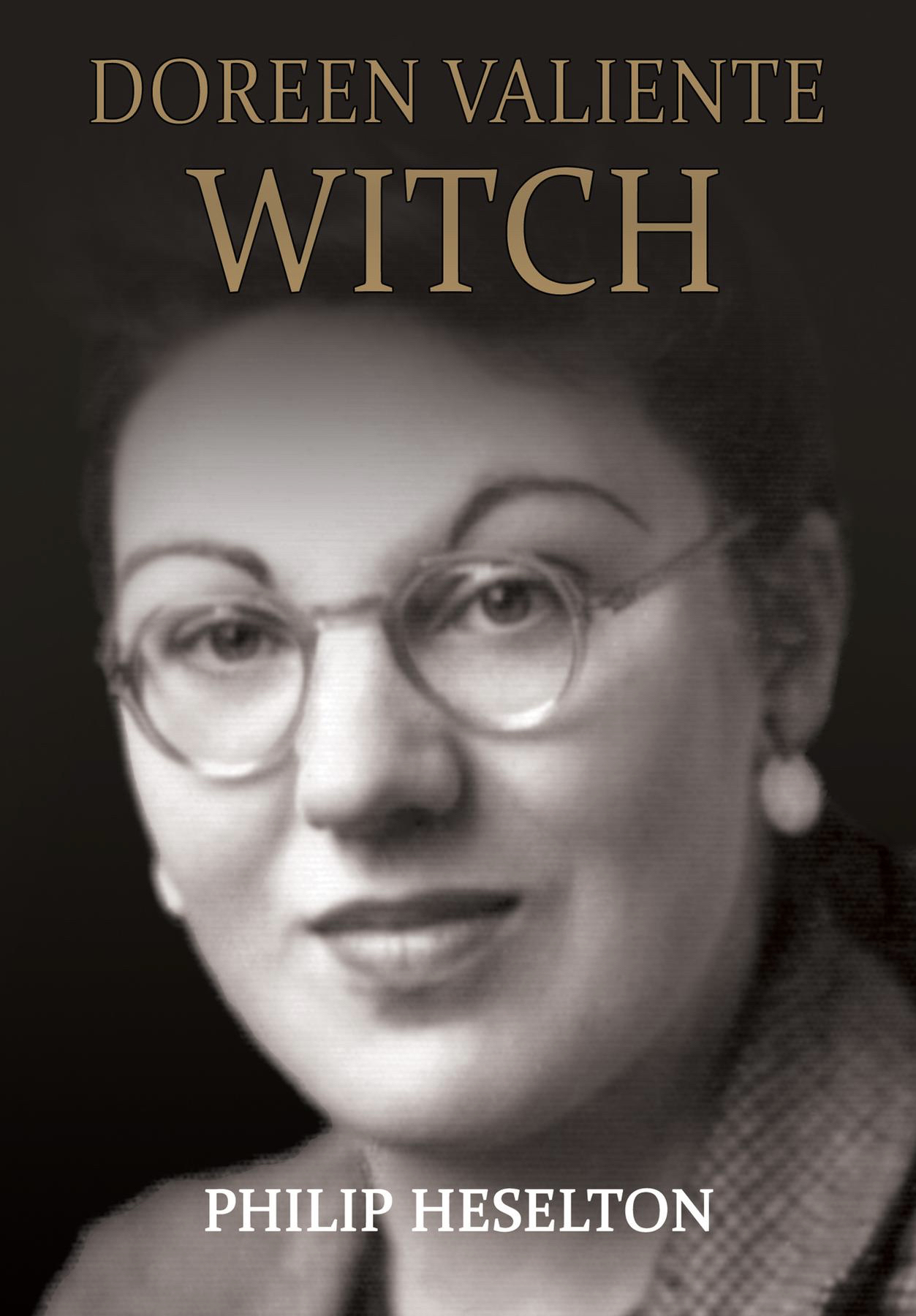
After spending so long with Wicca’s founding father, now seems like a good time to turn to its founding mother – Doreen Valiente. Though she was only in Gerald’s coven for four years, what she did during those years played a part in making her, as Ronald Hutton says, “… the greatest single female figure in the modern British history of witchcraft.”
But until Heselton’s 2016 biography of her, (published at the behest of the foundation that bears her name) not many people knew who Doreen Valiente really was. Heselton aims to correct the record, and give Gerald Gardner’s partner in magic her long-deserved moment in the spotlight.
This is a much shorter book than Witchfather, but in many regards, the two books complement each other perfectly. What I loved about that book was learning all about the adventures Gardner had prior to the Craft, and similarly, Doreen’s adventures following her time with “old Gerald” make for fascinating reading, the same with what information we have of her early life.
Like Gerald, Doreen taught herself to read, and unlike him she had a formal education… not that she liked it very much. She was mocked and bullied by fellow students, and when she was 15, she couldn’t take it anymore and left school altogether, much to her mother’s disapproval.
One thing that does become clear about Doreen is that, if anyone could be said to have been a witch from birth, it’s her. Chapter 2 reveals an incident where she cast a protection spell to keep her mother safe from someone who’d been bothering her:
“She confided in her daughter that a particular unpleasant woman had been picking on her. In response Doreen asked her mother to obtain a lock of hair belonging to the bullying colleague and intimated that she would work a charm to solve the problem once and for all. Whether Mrs Dominy went along with this out of amusement, desperation or simple curiosity is not actually known but she did bring back a few strands of hair belonging to her persecutor.
Using black-ended pins and a few traditional herbs, Doreen made a figurine of the woman in question and wound the strands of hair around the doll. She then cast a spell to protect her mother from further interference.”
And it worked! Between that early bit of magic, and the accounts we have of her considerable psychic ability, (such as when she saved a collection of Craft books from being burned, as recounted in chapter 4) I think it’s fair to say that Doreen really was the real-life equivalent of famous fictional good witches, like an English Prue Halliwell.
One thing Heselton talks about early in the book is how close Doreen was to Gerald Gardner following her initiation. As he puts it, to some degree or other she acted like his secretary, as much his partner in business as in magic… which just makes their acrimonious split all the more heartbreaking. (Thankfully, they reconciled in 1959, just a few years before he died.)
After Gerald’s passing, Doreen had a front row seat to the evolution of the British Craft. She was strongly disapproving of people like Alex and Maxine Sanders, and instead wound up in a few different post-Gardner covens, the most notable being one helmed by Robert Cochrane… but that relationship didn’t last too long, thanks to Cochrane’s increasing hatred of Gardnerian witchcraft. (Ironically, it’s thanks to him that we even have the term ‘Gardnerian.’)
In the 1970s, as she began to write books, she began to posit whether a coven was truly necessary in order to do witchcraft. Much of the book talks about how some of Doreen’s favorite rituals weren’t with a coven at all, but performed on her own, in the woods of southern England. She’d ask, “Who initiated the first witch?” suggesting that solitary practice had to come from somewhere.
And so, in 1978’s Witchcraft For Tomorrow, she became one of the first people (another being Marian Green) to write a guide to solitary witchcraft, complete with a full Book of Shadows. In that way, she fills a similar role for British witches as Scott Cunningham would go on to do for American ones – demonstrate that solitary Wicca is just as valid as the coven-based version.
At around the same time, she worked intensely with the Farrars (Janet and Stewart) in publishing the OG Book of Shadows, which they did in their book The Witches’ Way in 1984, just in time for what would’ve been Gerald Gardner’s 100th birthday. (That book was later republished, along with Eight Sabbats for Witches, as A Witch’s Bible.)
It’s worth pointing out (as Heselton does) that the wider British Craft viewed the Farrars as oath breakers, since Stewart’s 1971 book What Witches Do exposed the inner workings of an Alexandrian coven beyond anything ever published previously. But Doreen helped them anyway, because she realized that the Craft needed to change if it was to survive.
My favorite chapter in the book, and part of the reason I love Doreen as much as I do, is the one about her poetry. We all know about “The Charge of the Goddess” – the essential piece of Wiccan liturgy, but there were plenty of others too, lots of which have been published in a book. He provides several examples, and as you’d expect from someone as talented as her, they are all beautiful. Writing has always been a big part of my own magical practice, and I am so, so happy that Doreen saw it that way too.
There are so many little tidbits I learned from reading this book. Doreen’s apartment in Brighton was so cramped because she had a fierce love of books, she had over two thousand of them! There’s a story Heselton relates about a coconut man named Hob, whom Doreen used to leave in charge whenever she went out, or the story about the time she bought a pair of cloven hoof-shaped candlesticks and freaked out the guy behind the counter.
But what I love most about Doreen is that she lived and breathed the Craft, right to the end. In 1997 she started attending coven meetings again, and even gave a couple of talks. She lived for so long that she got to see the Craft at almost every stage of its evolution, from the small, scattered covens of the Sixties to the interconnected world of the 1990s.
In one of her last speeches, she said:
“As witches, Pagans, or whatever we choose to call ourselves, the things which unite us are more important than the things which divide us. I was saying this back in the 1960s, in the days of the old Witchcraft Research Association, and I repeat it today.”
“However, since those days we have, I believe, made great progress. We have literally spread world-wide. We are a creative and fertile movement. We have inspired art, literature, television, music and historical research. We have lived down calumny and abuse. We have survived treachery. So it seems to me that the Powers That Be must have a purpose for us, in the Aquarian Age that is coming into being. “So Mote It Be”.”
And two thousand people, most of them younger, proceeded to give her a standing ovation.
In reading this book, I find myself filled with yearning. I was not yet five years old when she died, and I dearly wish I could’ve met her… but in some ways, I have. I read her book Witchcraft For Tomorrow last November, around the election, and it proved to be a balm in ways I’ll discuss when we eventually get to it.
For now, I’ll end things with this. She made such an impression on me, just in my first year as a witch, that when I married my wife I asked that one of her poems be read at the end of the ceremony. It’s called “Love Song,” and it goes like this:
“In the deep midnight
Move to my side
Love’s a true thing love
Why should it hide
Hearing the footsteps
Pass in the street
Kiss me and hold me
Feel my heart beat
Give me your sweet love
Love’s a true thing
Fair as the moonrise
Warm as the spring
Run like the river
Fall like the rain
Love’s a true thing love
Pleasure and pain
Grow like a flower
Under the snow
Love’s a true thing love
Let it be so
We ended up using another poem of hers, but I don’t think that negates my overall point. What better way to begin my life as a married woman than with the words of my religion’s founding mother?
Thanks for all you did for us, Doreen. Blesséd be.


Leave a Reply