We’ve talked a lot in the past several weeks about the beginnings of Wicca – the New Forest Coven, Gerald Gardner’s initiation and the subsequent birth of the Bricket Wood coven, crossing paths with Doreen Valiente, and the long period of growth and change that followed in British witchcraft after Gardner’s death in 1964.
But as regards the American branch of the Craft, we haven’t focused on it as much. Drawing Down the Moon was and is an excellent starting point in terms of how witchcraft grew here, from Z Budapest to Starhawk, Morgan McFarland and Isaac Bonewits, to the Church of All Worlds, Feri, and a whole galaxy of other forms of neopaganism.
But there’s a missing link here: what happens between Gardner’s death in 1964, and the birth of, say, feminist witchcraft just a decade later in 1974? Ronald Hutton simply offers this in Triumph of the Moon, as part of a longer paragraph about post-Gardner covens: “Monique Wilson had set up two in Scotland by 1961, and an initiate of hers founded the first securely recorded Wiccan group in the United States during 1963.”
Hutton never names this person, but we know from Witchfather exactly who that initiate was: Raymond Buckland. His intersection with Gardner was very brief, occurring just before the latter’s last trip abroad, but it would prove to be pivotal for future development of the Craft. Gardner and Valiente got the ball rolling, but it’s thanks to Raymond Buckland that Wicca really took off, and became one of the fastest growing religions in the world.
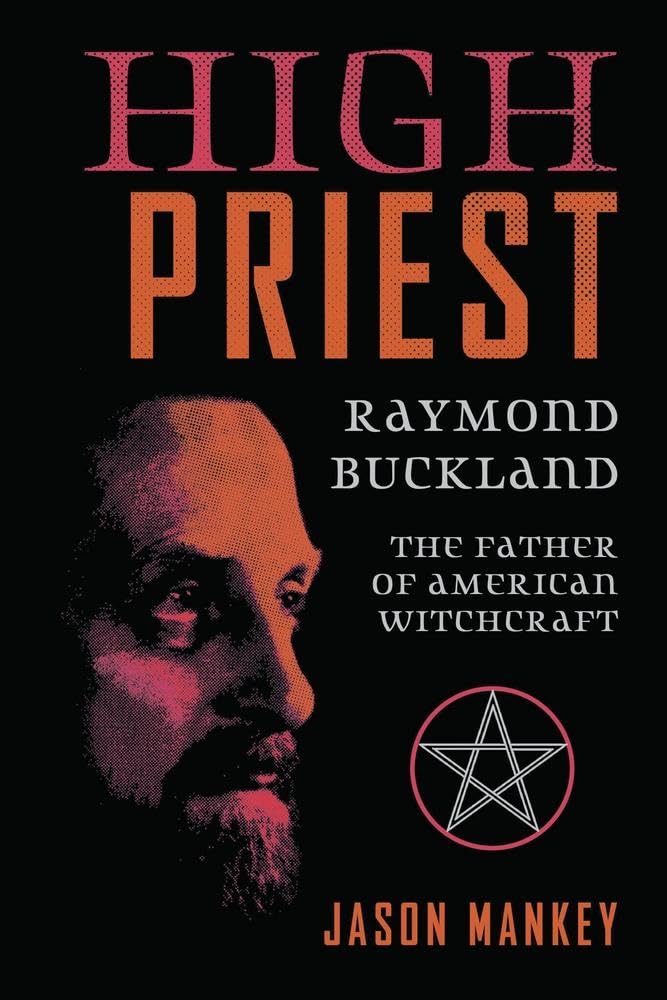
And now, here comes Jason Mankey with a new biography of the man, published in May 2025. We’ll be talking about Buckland a lot later on, but before we do, I thought it best to start with the story of the man himself, and the part he played in forming the American Craft.
Let’s jump in.
The first two chapters of the book chronicle Buckland’s childhood and early adulthood in England, littered with extracts from Buckland’s unpublished memoir. We see his wartime reminiscences, his earliest brushes with the occult, and later on, two years spent in the RAF, where he fostered a love of planes and flying in general.
One of the most surprising things from these first two chapters was that, at first, he wasn’t terribly interested in religion. Mankey notes that “[d]uring his time at trade school for the Royal Air Force, all recruits were required to attend a religious service on Sunday mornings. Buckland opted for the Roman Catholic services because the Catholics had the best collection of tea and pastries after services.”
This is genuinely fascinating stuff, given how devout a Wiccan he would grow to be in less than a decade from his conscripted military service. (Fun fact: Buckland was one of the last Brits forced into the military, as that policy was rescinded in 1960. Without it, there would be no Beatles, either.)
Instead, Buckland fills his pre-America life with a wide assortment of other interests. The most prominent is his brief career as a jazz musician, but he was also a stage actor, playwright, stand-up comedian, and even a writer for television – he wrote occasional episodes for the British sitcom The Army Game, best known to Doctor Who fans as an early TV role for William Hartnell. (Also in the cast: Norman Rossington from A Hard Day’s Night.)
Given all these varied projects, one can very easily imagine alternate universes where Buckland became, say, a famous jazz bandleader like Miles Davis or Dave Brubeck, or a stage actor in the tradition of David Warner and Patrick Stewart. But the Goddess had other things in mind for him, as we know – a visit from his Uncle Charles set him on the path to emigrating to America, and once he got there, he found two books that changed his life forever: Witchcraft Today and The Meaning of Witchcraft by Gerald Gardner.
In some ways, the portions of High Priest that focus on Buckland’s life in the US, and his obvious excitement and enthusiasm at becoming Wiccan, mirror my own just over a year ago. But I had the advantage of entering the Craft at a time when solitary practice wasn’t just normal, I’d even estimate that the majority of Wiccans out there are solitaries. Though with the internet making connections so much easier, the line between “solitary witch” and “coven witch” has blurred a lot.
But that kind of infrastructure simply didn’t exist in the early 1960s. Back then, if you wanted into Wicca, you had to Know People, and that was a lot harder in the days where long-distance communication between countries could only be done by mail. Mankey shares many extracts from Buckland’s letters with Monique Wilson (GG’s High Priestess at the time) and the sheer amount of demands she’s making are worth quoting in full:
“Will you be able to form a Coven? Do you have a Priestess in view? I am afraid you will not have much chance to be initiated on your own as we do not care for free-lancers. Anyway you couldn’t do a thing by yourself as the Priestess rules the Circle, and you be highly frustrated knowing you were a witch and not being able to even form the Circle. So possess your soul in patience. … The most important is that you should have a Priestess. Write and let me know.”
I have to admire Buckland’s determination here. Dealing with that sort of condescension and strict rules about initiatory procedure, if I’d been in his shoes, would’ve turned me off the Craft like a shot. It gives me uncomfortable flashbacks to when I had to go through the “membership process” at the village where I live now, just so I could be granted the privilege of living with the woman who is now my wife.
But somehow, it all paid off. Buckland was initiated on November 23rd, 1963 – the same day as the premiere of Doctor Who. No data exists as to whether or not he caught the broadcast that night, but I think he could probably identify with Ian and Barbara becoming part of something much bigger than themselves. Initiations are powerful things, after all.
But I digress. Mankey spends the few chapters taking us through the beginnings of American witchcraft, from the formation of Buckland’s first coven to introducing us to Buckland’s own chain of initiated witches, in everywhere from Canada to Kentucky, and of course, New York itself.
This part of the book makes for a fascinating compliment to Margot Adler’s Drawing Down the Moon, which Mankey refers to several times, naturally enough. DDTM gave us a bird’s eye view at the beginning of American witchcraft, while Mankey gives us a worm’s eye view, so to speak. Not only does the Craft spread, it spreads fast. By the mid-1970s, dozens of new covens and Craft traditions were popping up everywhere, too fast for the country’s Gardnerian population to keep up with.
This quickly becomes a Problem. As Mankey observes, “Initiation as a way to spread a religious movement might work in a country like the United Kingdom, an area less than the size of California, but it was always going to be a tough sell in the United States and Canada, where large cities are separated by hundreds and even thousands of miles.” For modern witchcraft to survive, there would have to be a move away from initiatory coven systems and toward solitary practice. But Wicca, as of the early 1970s, didn’t have that kind of infrastructure yet.
Enter Ed Fitch. Ed Fitch was one of Buckland’s initiates, and in 1967, after diplomatic relations with another initiate went south, (it involved sharing oathbound material with the general public) Fitch began to realize that there were issues with Wicca as it was presently constituted. In response, he came up with the Outer Court system, using a phrase coined by Dion Fortune.
If “Inner Court” material is oath-bound stuff you only learn about in the coven circle, like deity names, Outer Court stuff is more general-purpose material that anyone can use. As Mankey says, “An Outer Court serves as a training ground for individuals interested in an initiatory path, but one that doesn’t reveal any secrets or require an initiation.” It’s Open Source Wicca, basically – all the basics you need to understand the religion, without rigorous evaluations and waiting and worrying whether the High Priestess will deign to let you in or not.
There are other advantages too, as Mankey explains. “The development of the Outer Court provided a door into the world of Witchcraft and, better yet, kept people interested in it! With an Outer Court, a prospective initiate can start doing things that look and feel like Wicca right away.” So as far as the initiate-to-be is concerned, they are Doing Wicca, they’re just going about it slightly differently compared to an initiated coven witch.
Ed Fitch went on to publish the Outer Court material he developed into two books, with the Bucklands (Raymond and Rosemary) acting as consultants, giving him advice on what to include and what to leave out. And while I’m sure no one realized it at the time, those books, A Grimoire of Shadows and A Book of Pagan Rituals, would go on to transform Wicca forever.
I have no doubt, after all the hoops he had to jump through with Monique Wilson, that Raymond Buckland was not happy with the Gardnerian tradition was practiced. He went through a lot of hard shit with witches who sucked, and by the early 1970s, he was ready for a change. So, he came up with his own tradition, Seax-Wica, and wrote about it in 1974’s The Tree. (Nowadays it’s called Buckland’s Book of Saxon Witchcraft.)
Reading through the development of Seax-Wica, there’s a lot in it that feels like a reaction against the, shall we say, exclusivity of Gardnerian Craft: There isn’t a formal degree system. There are no high priests or priestesses, instead everyone takes turns. There’s no requirement that a high priestess must always cast the circle. If someone is missing from the circle, a different person can take their spot in the performance of a ritual.
But what really stuck out to me is this little detail: “The Tree also offers the reader the opportunity to participate in a dedication ritual that confers all the benefits of initiation.”For the first time, it was now possible to initiate oneself into Wicca, without needing to be blessed by a high priestess. In Buckland’s system, “If a solitary Saxon Witch joins a coven, they are accepted as a full member right away.”
Self-dedication and initiation may be commonplace now, but in 1974 this was an absolutely momentous shift in how Wicca operated. Prior to 1974, covens were the be-all end-all, you could not be considered Wiccan if you weren’t in one. But Raymond Buckland was the first one to not only allow someone to initiate themselves, but stipulate that, at least within his system, they are concerned a true Wiccan, just as much as a traditionally initiated coven witch.
Buckland’s hand in developing the Outer Court system of Wiccan practice, paired with making Seax-Wicca easier to join than Gardnerian Wicca had been, all played a huge part in making Wicca accessible to more people. And he wasn’t the only one thinking like this – as we discussed last week, Doreen Valiente went even further than Buckland did in 1979, when she published Witchcraft for Tomorrow and put forward the idea of solitary practice as a valid means of practicing Wicca.
But that wasn’t all Buckland did: he was also among the first people to state, point blank, that gay people were allowed, and even welcomed, into the Craft. Gerald Gardner had been a homophobe, and quite a nasty one at that, but Buckland made a point of going in the opposite direction as he built up Seax-Wica in the early ‘70s. While modern witchcraft still has problems dealing with LGBTQ people, the days of baked-in, widespread homophobia are long gone, and Buckland helped make that possible.
And that, for me, is Buckland’s legacy: I became a witch in the world he helped build, a world where an American trans woman can initiate herself into a religion, and be welcomed not only by her fellow witches, but by the gods themselves. None of that would’ve been possible had he not been there to take the first step, and boldly go where no witch had gone before.
Thanks for everything, Ray. We love you, and we miss you. Blessed be. ❤


Leave a Reply